
Laurel Sabino (Magnolia splendens)
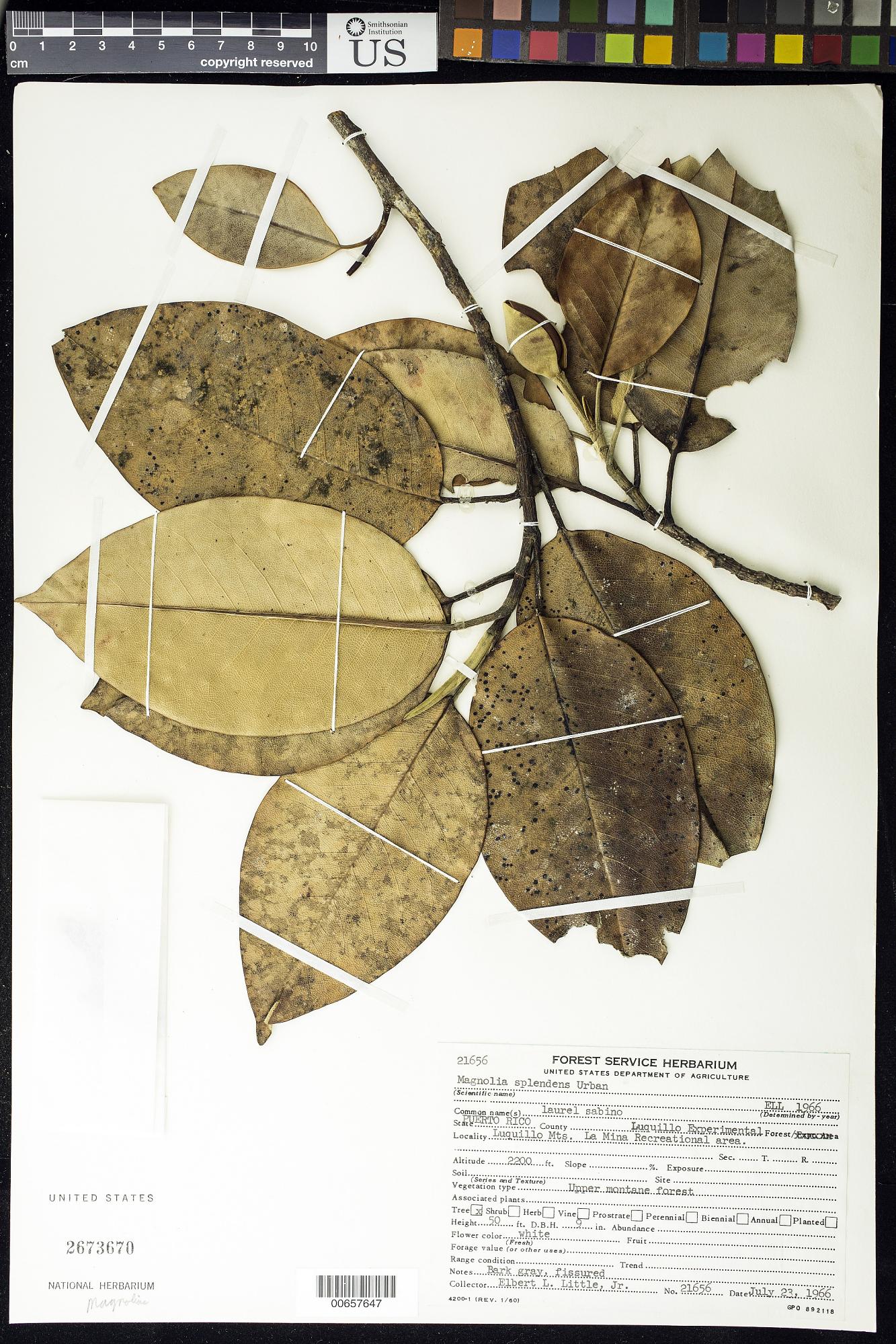
Magnolia splendens, known in Puerto Rico as laurel sabino or simply sabino, and listed by USDA PLANTS under the English name laurel magnolia, is a tall evergreen magnolia found nowhere on earth but the mountains of northeastern Puerto Rico. Gardeners who know the big white magnolias of the southeastern United States will recognize the family at once: glossy leathery leaves, fat pointed terminal buds, and large fragrant cream-white flowers with a cone-like center.
The tree is a true island endemic. Virtually the whole wild population grows inside the Luquillo Experimental Forest — the mountains most Puerto Ricans know as El Yunque — on roughly 10,000 hectares of montane forest between about 200 and 1,075 m (650 to 3,500 ft) elevation. It is most frequent in the cool, cloud-wrapped forests between 600 and 900 m, where it grows alongside tabonuco, sierra palm and West Indian tree fern.
Laurel sabino is a slow, long-lived tree with a hard, beautifully figured wood that made it a favorite of Puerto Rican furniture makers until logging in the forest ended in the early 1950s. It is assessed as Endangered on the IUCN Red List and is not a common nursery plant, but for anyone gardening in the wet uplands of Puerto Rico it is one of the island’s most distinguished native trees. This guide covers how to recognize it, where it grows, and what is realistically involved in growing it.
Identification
Laurel sabino is the largest-leaved magnolia in Puerto Rico and is unmistakable once you know what to look for: a ring scar circling the twig at every node, long tapered terminal buds, and leaves that taste spicy when a fragment is chewed.
Form & Size
A medium to large evergreen tree with a narrow, dark green crown. Mature trees commonly reach 50 to 80 ft (15 to 25 m) and occasionally much more; the Puerto Rico champion measures 21.0 m tall and 1.53 m in trunk diameter with a crown spread of 10.3 m. Most trees in the forest today are far smaller, because the biggest ones were cut long ago. Trunks characteristically throw up numerous basal shoots and suckers, especially after hurricanes.
Bark & Twigs
The bark is gray and fissured on older trunks. The most useful field character is on the twigs: each leaf is enclosed in bud by a terminal stipule that falls away and leaves a complete ring scar encircling the branch, a classic magnolia trait. Terminal buds are long and sharply pointed.
Leaves
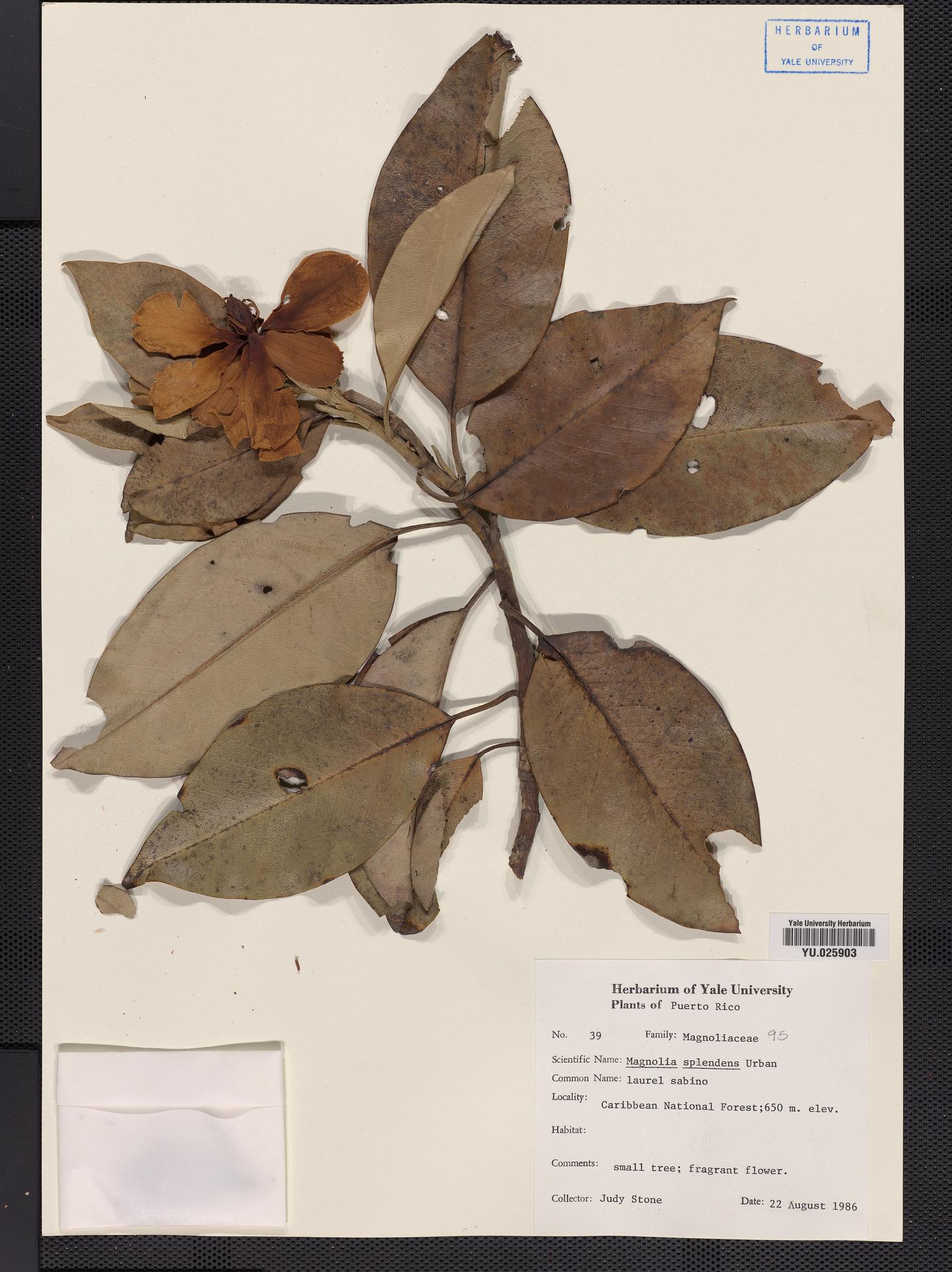
Leaves are alternate, simple, evergreen, leathery and large, with smooth margins and a broadly oval to elliptic outline. The undersides are covered with fine silky gray hairs, giving the foliage a two-toned look when wind turns the leaves. Crushed or bitten leaves have a distinctly spicy taste and aroma, and they have been used locally as a condiment — this spicy, laurel-like quality is the source of the name “laurel.”
Flowers
The flowers are large, white and fragrant. Each has three whitish-green sepals about 1¼ in (3.2 cm) long and six or more spreading white petals about 1½ in (3.8 cm) long, broad and rounded at the tip. Numerous stamens about ½ in (1.3 cm) long surround a cone-like center roughly ⅝ in (1.6 cm) long made of many spirally arranged pistils. The fragrance has been compared with that of the Asian magnolias M. hypoleuca and M. sieboldii. Flowering runs mainly from April to September.
Fruit & Seeds
The fruit is a greenish, cone-like aggregate about 1¼ in (3.2 cm) long and ⅞ in (2.2 cm) wide, made up of many follicles that split open at maturity. Each follicle usually holds two triangular, red, fleshy seeds a little over ¼ in (0.6 cm) long, which dangle from the open pod on slender threads — the standard magnolia display that attracts birds. Fruits ripen from spring into winter.
Similar Species
Puerto Rico has a second endemic magnolia, Magnolia portoricensis (jagüilla), which grows in the Cordillera Central rather than the Luquillo Mountains. Laurel sabino is the Luquillo species, has larger leaves, and is restricted to the northeast. Outside flowering season the ring-scarred twigs and spicy leaves separate both magnolias from every other large-leaved tree in the mountain forest.
Quick Facts
| Scientific Name | Magnolia splendens Urb. |
| Family | Magnoliaceae (magnolia family) |
| Plant Type | Evergreen tree |
| Mature Height | 50–80 ft (15–25 m); champion 21 m |
| Mature Spread | 20–35 ft (6–10 m); champion crown spread 10.3 m |
| Growth Rate | Very slow (about 0.07–0.21 cm trunk diameter per year) |
| Sun Exposure | Full sun to part shade; regenerates in forest gaps |
| Water Needs | High; needs consistently wet, humid conditions |
| Soil Type | Deep acid clay (Ultisols and Inceptisols); well drained |
| Soil pH | Acid |
| Bloom Time | Mainly April to September |
| Flower Color | White with whitish-green sepals |
| Fall Color | None; evergreen |
| Fruit | Green cone-like aggregate about 1¼ in long with red fleshy seeds |
| Deer Resistant | Not applicable in Puerto Rico |
| USDA Hardiness Zones | 12–13 (frost-free montane Puerto Rico) |
Native Range
Laurel sabino is endemic to northeastern Puerto Rico and native nowhere else in the world. USDA PLANTS lists it as native in Puerto Rico only, under the common name laurel magnolia, and it is absent from the U.S. Virgin Islands and from every U.S. state. Essentially the entire population lies within the Luquillo Experimental Forest in the Luquillo Mountains, on about 10,000 hectares of montane forest between roughly 200 and 1,075 m (650–3,500 ft) elevation.
Within that range it is uncommon rather than abundant. In the 1940s it made up about 1.0 percent of stems over 10 cm in diameter in virgin tabonuco forest and 1.3 percent in virgin Colorado forest, ranking 33rd among the 80 tree species tallied. It is most frequent in the cool, wet forests between 600 and 900 m, more common on windward slopes at 600–700 m, and it also appears in the palm forest of steep ravines and in the stunted dwarf forest near the summits. Surveys in the Baño de Oro Research Natural Area found it from about 350 m up to 750 m and none above 850 m.
The species grows in four of the five Holdridge life zones represented in the Luquillo Mountains — subtropical wet forest, subtropical rain forest, lower montane wet forest and lower montane rain forest. Rainfall over that gradient runs from about 2,500 to more than 4,500 mm per year (roughly 100 to 180 inches), mean annual temperature falls from about 23 to 19 °C, and the upper slopes are frequently wrapped in cloud. Every site where laurel sabino grows is frost free.
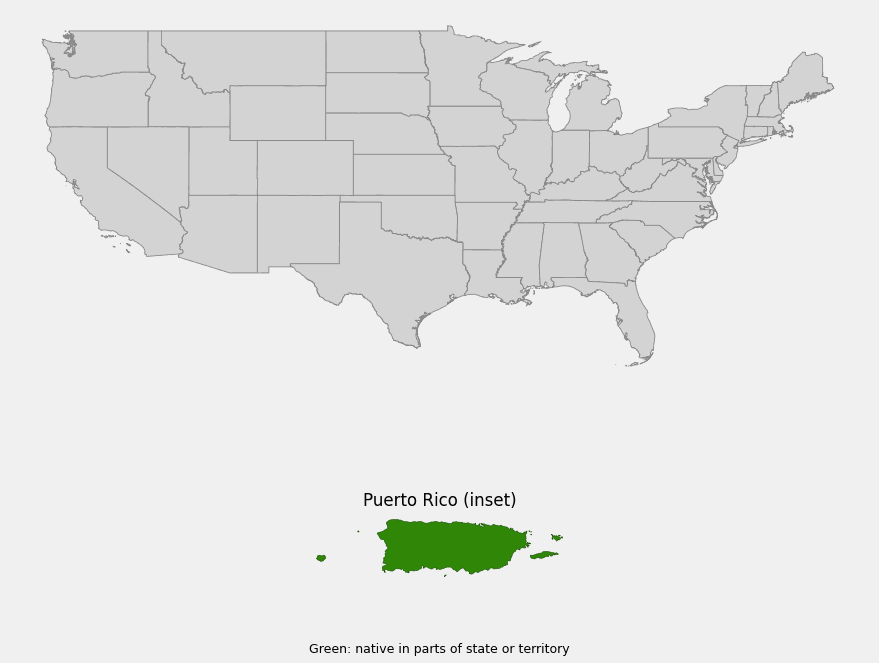
📋 Regional plant lists featuring Laurel Sabino: Puerto Rico
Growing & Care Guide
Laurel sabino is a forest tree of cool, soaking-wet mountain country, not a general-purpose landscape tree. Where those conditions exist — the uplands of eastern Puerto Rico and similar wet, frost-free montane sites — it can be grown, but it is slow and demanding, and its performance outside the Luquillo Mountains has never really been tested. Obtain plants from nurseries and conservation programs; the wild population is small and protected inside El Yunque National Forest, where collecting is not permitted.
Light
Seedlings and saplings behave like gap species: they establish in openings created by treefalls or hurricanes rather than under a closed canopy. Give young plants good overhead light or high filtered light, and expect growth to stall in deep shade. Once a tree reaches the canopy it holds its own, but studies in the Luquillo Mountains showed that in closed forest the smallest stems are progressively shaded out by faster competitors.
Soil & Water
Plant in deep, acid, well-drained clay or clay loam with abundant organic matter — the Ultisols and Inceptisols of the Luquillo uplands are highly weathered and strongly acid. Moisture is the limiting factor: in the wild the tree lives under 100 to 180 inches of rain a year with high humidity and frequent cloud cover. It will not tolerate dry, alkaline or coastal sites, and it should never be allowed to dry out.
Planting Tips
Choose a sheltered upland site with cool nights, high humidity and no frost. Plant small, since the root system establishes slowly, and mulch heavily to keep the soil cool and damp. Allow plenty of room: the tree is narrow-crowned but eventually very tall. Roots form associations with endotrophic mycorrhizae, so avoid sterilized soil mixes and heavy fungicide use around the root zone.
Pruning & Maintenance
Very little pruning is needed or wanted. Trunks naturally produce clusters of basal sprouts, particularly after storm damage, and these can be left as insurance or thinned to a single leader for a shapely tree. Growth is extremely slow — about 0.07 to 0.10 cm of diameter per year in undisturbed forest, rising to roughly 0.15 to 0.21 cm per year for dominant trees in thinned stands — so patience matters more than technique. Note that the wood is very susceptible to decay in ground contact and to attack by the dry-wood termite Cryptotermes brevis, so prunings are not useful as stakes or posts.
Propagation
Seed is the usual route and it is not easy. Collect the cone-like fruits as the follicles begin to split and sow the red fleshy seeds immediately; magnolia seed coats are hard, lignified and impermeable, and only a fraction of seeds are fully developed. A trial of seed from two trees in the Colorado forest gave 32 percent germination from 41 seeds sown straight away and zero germination from 31 seeds given a 3.5-month cold treatment, so do not chill the seed. Seedlings are slow and need steady shade, moisture and several years in the nursery. Trunks sucker freely, which suggests vegetative propagation is worth trying for anyone with access to legitimately sourced material.
Landscape Uses
- Montane native gardens: a signature endemic canopy tree for wet upland Puerto Rico
- Forest restoration: a slow-growing canopy species for gap and hurricane-opening plantings in the Luquillo uplands
- Botanical and conservation collections: an IUCN-Endangered island endemic worth keeping in cultivation
- Large shade tree: narrow dark-green crown and fragrant white flowers where space and rainfall allow
- Fine woodworking (historic): hard, figured furniture and cabinet timber, now no longer harvested
Wildlife & Ecological Value
Laurel sabino is a structural member of Puerto Rico’s montane forests, and a few of the island’s most famous animals use it directly.
For Pollinators
Like other magnolias, laurel sabino offers large, strongly fragrant, white flowers with numerous stamens — the classic arrangement of a beetle-pollinated magnolia. Flowers open mainly between April and September, and the fragrance has been compared with the Asian magnolias M. hypoleuca and M. sieboldii.
For Birds
Birds appear to be the main seed dispersers: the aromatic, red, fleshy seeds hang from the opened follicles in a way that advertises them to fruit-eating birds. The endangered Puerto Rican parrot usually nests in cavities of swamp cyrilla, Cyrilla racemiflora, but cavities in laurel sabino have also been used, and parrots have been seen eating the tree’s new, still-unfurled foliage. Both the tree and the parrot were more numerous in the past, so that association may once have been more important.
For Mammals
No significant mammal food plant. Puerto Rico’s native land mammals are bats, and the tree’s main contribution to them is forest structure and roost sites rather than fruit.
Ecosystem Role
Laurel sabino behaves as a gap opportunist. Its regeneration is tied to openings from isolated treefalls or from hurricane damage, and in the long record from permanent plots its numbers rose after Hurricane San Cipriano in 1932 and fell again as the canopy closed. Between 1946 and 1981 its share of stems in Colorado-forest plots dropped from 2.6 to 1.7 percent, while on a thinned plot stems increased by a third. Mature trees are centuries old — growth data from undisturbed Colorado forest put a 40 cm trunk at roughly 300 years and a 65 cm trunk at about 500 years — so each one represents a very long-term carbon and habitat investment in the watershed above the Luquillo rivers.
Cultural & Historical Uses
The German botanist Ignatz Urban described Magnolia splendens in 1899. The epithet splendens means shining, for the glossy foliage. The tree has been shuffled between genera more than once and appears in older literature as Talauma splendens, Talauma mutabilis var. splendens and Dugandiodendron splendens; all refer to the same Puerto Rican endemic. The Spanish name laurel sabino combines “laurel,” from the spicy aromatic leaves, with “sabino,” a name Spanish speakers have applied to several valuable timber trees.
Laurel sabino wood is hard and moderately strong, with a specific gravity around 0.59. The heartwood seasons from olive green to brown against whitish sapwood, and growth rings and frequent dark streaks give it a strikingly figured appearance. It air-dries easily with little degrade, saws and machines well, and turns, bores and holds screws well. Those qualities made it a prime furniture and cabinet timber in Puerto Rico and a candidate for decorative veneer, plywood, millwork, boat planking and durable construction.
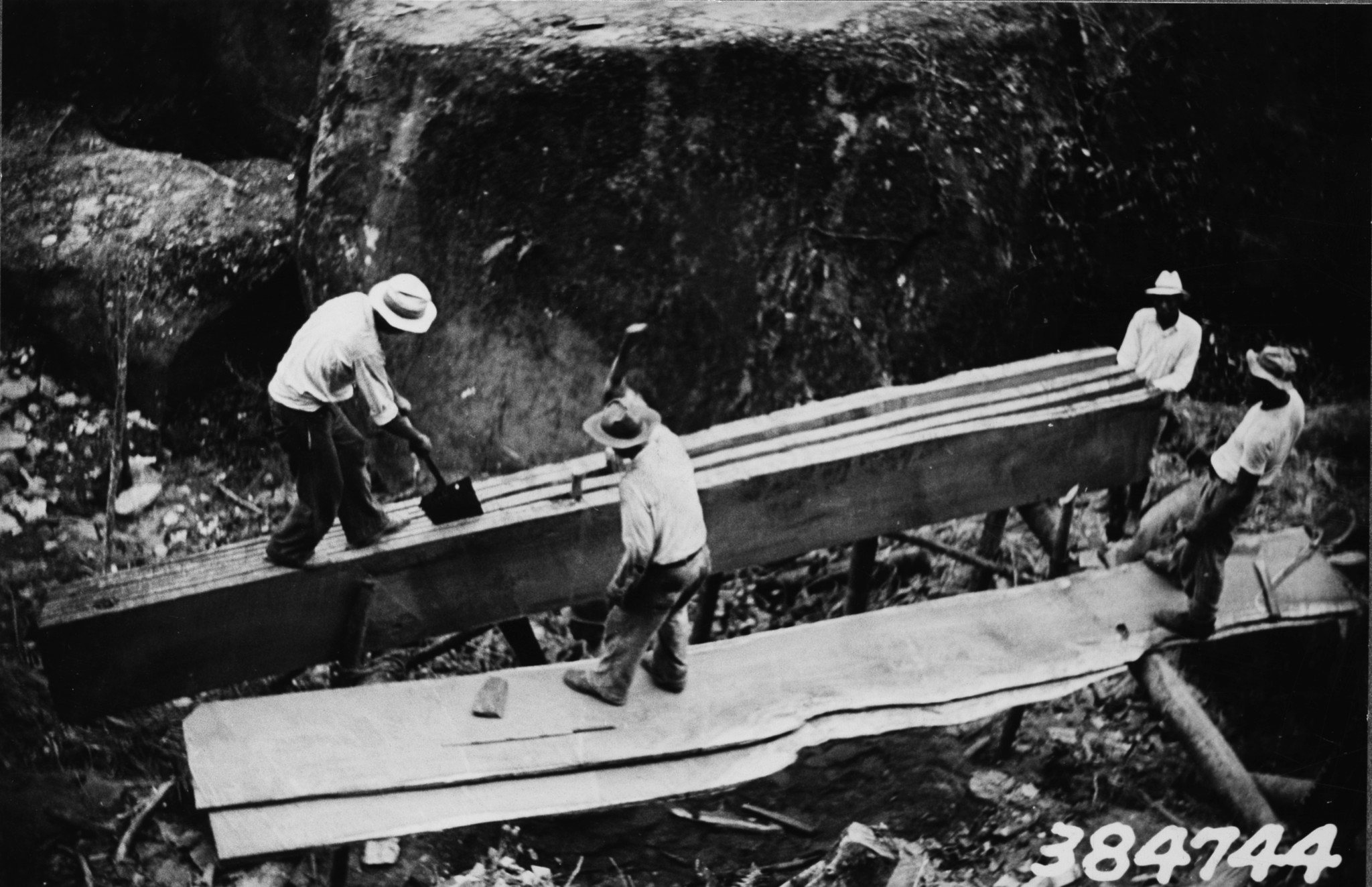
That reputation came at a cost. Laurel sabino was cut in the Luquillo Mountains from about 1930 into the early 1950s, and the 1938 Forest Service photographs of crews whipsawing boards by hand show the scale of the effort — single boards 30 inches wide and 25 feet long were described at the time as very valuable. Removing the largest trees also removed most of the seed source, compounding the species’ naturally poor seed production. By the mid-1970s it was tentatively placed on Puerto Rico’s list of endangered endemic plants, and the IUCN Red List assessed it as Endangered in 2014. Harvesting has long since stopped, and the population now sits inside El Yunque National Forest.
Frequently Asked Questions
Is laurel sabino found anywhere outside Puerto Rico?
No. It is endemic to northeastern Puerto Rico, essentially confined to the Luquillo Experimental Forest in the mountains of El Yunque. USDA PLANTS lists it as native in Puerto Rico and in no U.S. state or other territory.
Is Magnolia splendens a protected species?
It is assessed as Endangered on the IUCN Red List (2014) and was tentatively listed on Puerto Rico’s roster of endangered endemic plants in the 1970s, but it is not listed under the U.S. Endangered Species Act. Almost all wild trees stand within El Yunque National Forest, where collecting plants, cuttings or seed is not allowed. Buy nursery-propagated plants.
How fast does laurel sabino grow?
Very slowly. Trunk diameter growth in undisturbed Luquillo forest averages only about 0.07 to 0.10 cm per year, and even dominant trees in thinned stands manage roughly 0.15 to 0.21 cm per year. Growth estimates from permanent plots put a 10 cm trunk at about 85 years old, a 40 cm trunk at about 300 years, and a 65 cm trunk at about 500 years.
Can I grow laurel sabino in Florida or the mainland United States?
It is not a realistic mainland plant. The tree is adapted to frost-free montane sites with 100 to 180 inches of annual rain, constant humidity and cool nights, and its hardiness outside the Luquillo Mountains has never been tested. Southeastern gardeners who want a large evergreen magnolia should grow southern magnolia (Magnolia grandiflora) or sweetbay (Magnolia virginiana) instead.
What grows with laurel sabino in the wild?
In the tabonuco forest it grows with tabonuco (Dacryodes excelsa), sierra palm, Sloanea berteriana and West Indian tree fern. Higher up in the Colorado and palm forests its associates include Micropholis garciniifolia, Croton poecilanthus and Calycogonium squamulosum, and in the dwarf forest, Ocotea spathulata, Tabebuia rigida and Clusia grisebachiana.

Looking for a nursery that carries Laurel Sabino?
Our nursery directory does not yet include Puerto Rico. Browse the native plant nursery directory by state: Alabama–Arkansas · California · Colorado–Hawaii · Idaho–Kansas · Kentucky–Montana · Nebraska–Oklahoma · Oregon · Pennsylvania–Virginia · Washington · West Virginia–Wyoming