
Milkmaids (Cardamine californica)
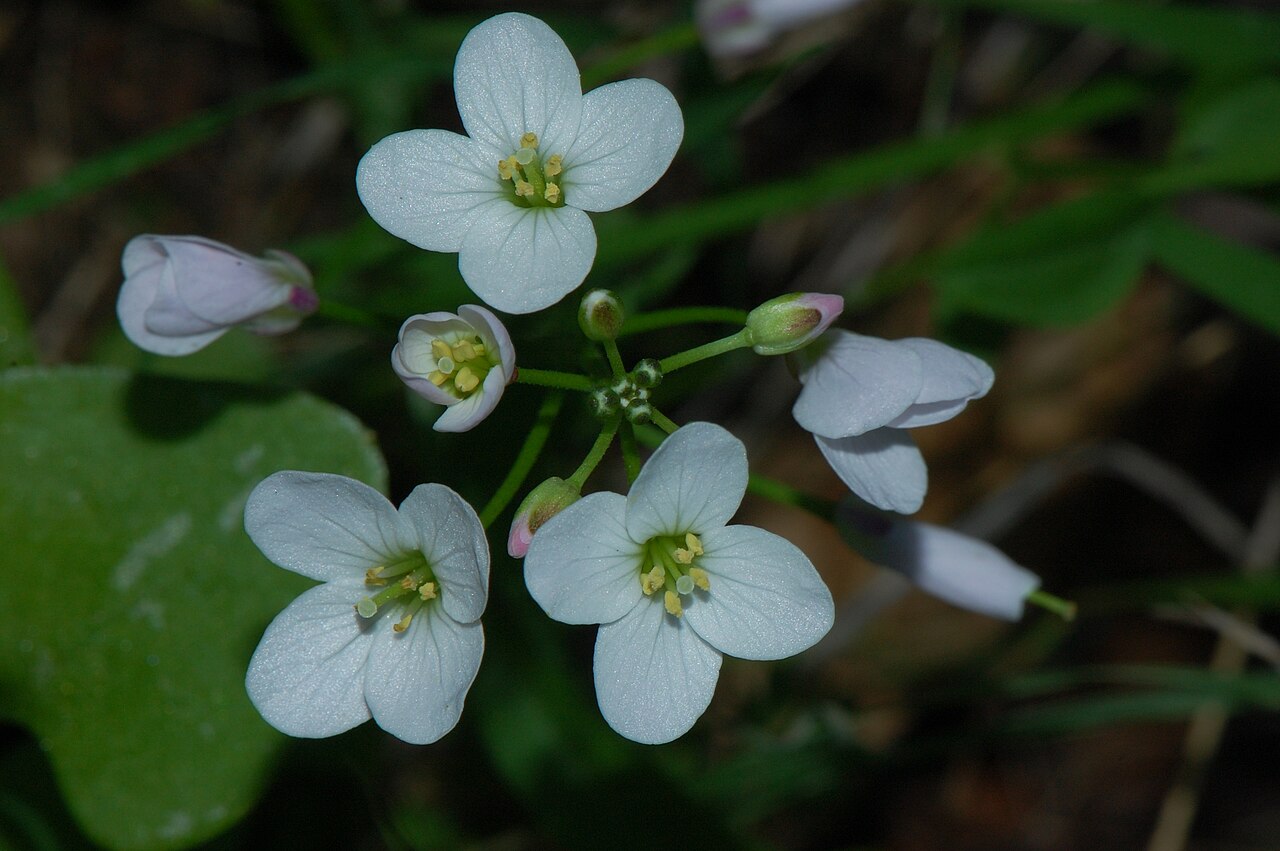
Cardamine californica, known as Milkmaids (also milk maids or California toothwort), is one of the first wildflowers to bloom each year in California’s woodlands. As early as January, after the winter rains begin, slender stems rise from the leaf litter carrying loose clusters of white to pale pink, four-petaled flowers. By late spring, the plant has withered and gone dormant, surviving the dry summer as a small underground rhizome.
Milkmaids belongs to the mustard family (Brassicaceae), and its four petals arranged in a cross and its narrow, pod-like fruits are typical of the family. It was long placed in the genus Dentaria, the toothworts, named for the tooth-like knobs on the rhizomes of some species, and older books call it Dentaria californica.
For California gardeners, milkmaids is a charming, low-maintenance addition to shady native gardens under oaks, bays and redwoods. It comes up with the rains, blooms in late winter when little else is in flower, feeds early pollinators and orangetip butterfly caterpillars, and then disappears for summer without needing irrigation. This guide covers its identification, range, care and ecology.
Identification
Milkmaids is easy to recognize in late winter and early spring by its combination of four-petaled white or pinkish flowers, separate round basal leaves, and narrow, divided stem leaves. It is quite variable, and botanists have named several varieties based on leaf shape.
Rhizome & Stems
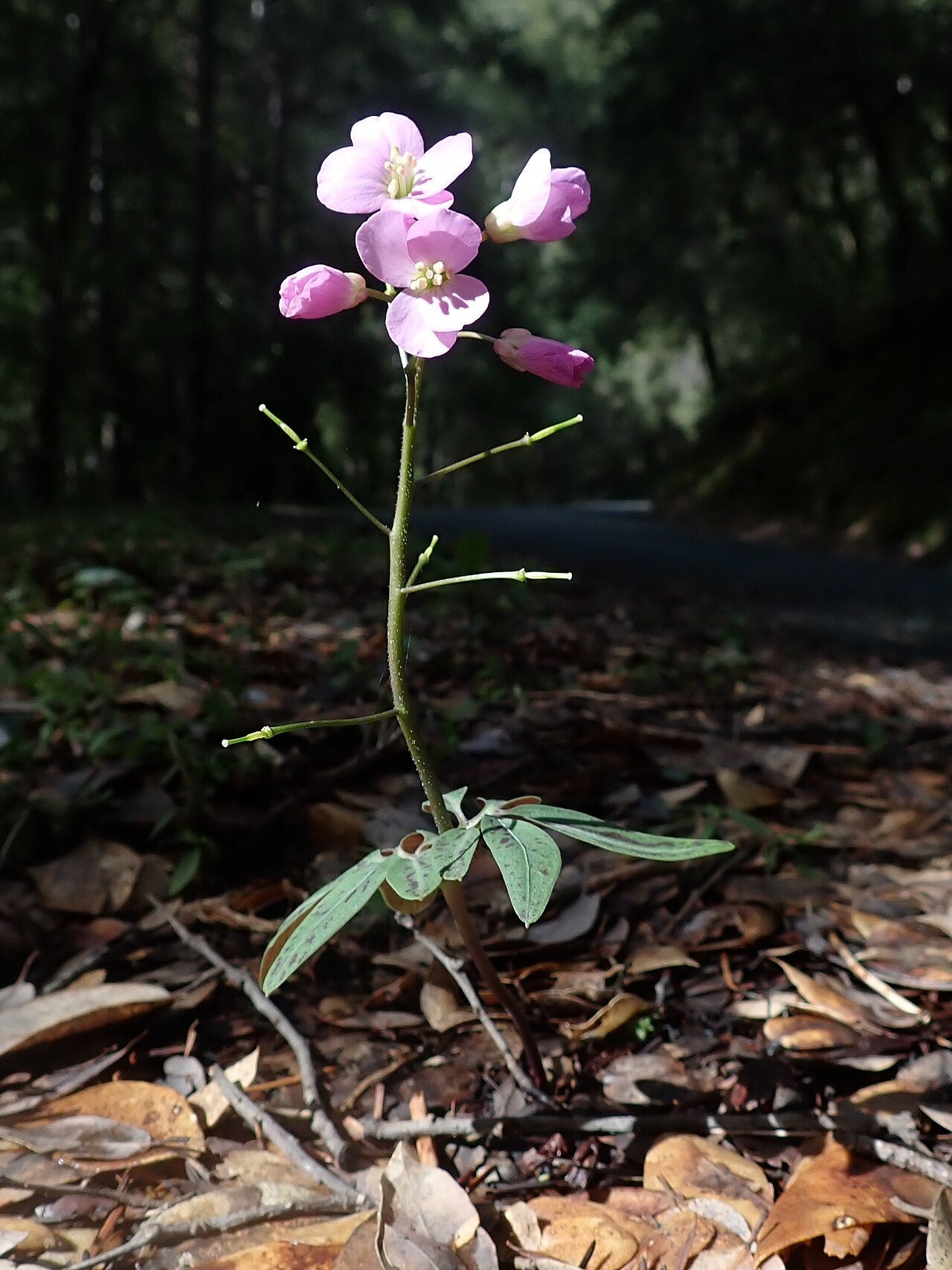
Milkmaids grows from a slender, often branched rhizome a few inches below the surface, with small tuber-like swellings. Each year it sends up one or more slender, unbranched flowering stems, usually 8 to 20 inches tall, occasionally to about 28 inches. The stems are smooth or slightly hairy.
Leaves
Milkmaids has two kinds of leaves. Basal leaves arise directly from the rhizome on long stalks, separate from the flowering stem. They are usually simple and round to heart- or kidney-shaped, sometimes with three leaflets, and they often appear in fall or early winter before the flowers. The stem leaves are quite different: two or three leaves along the stem, each divided into three to five narrow, lance-shaped to oblong leaflets, sometimes with a few teeth.
Flowers
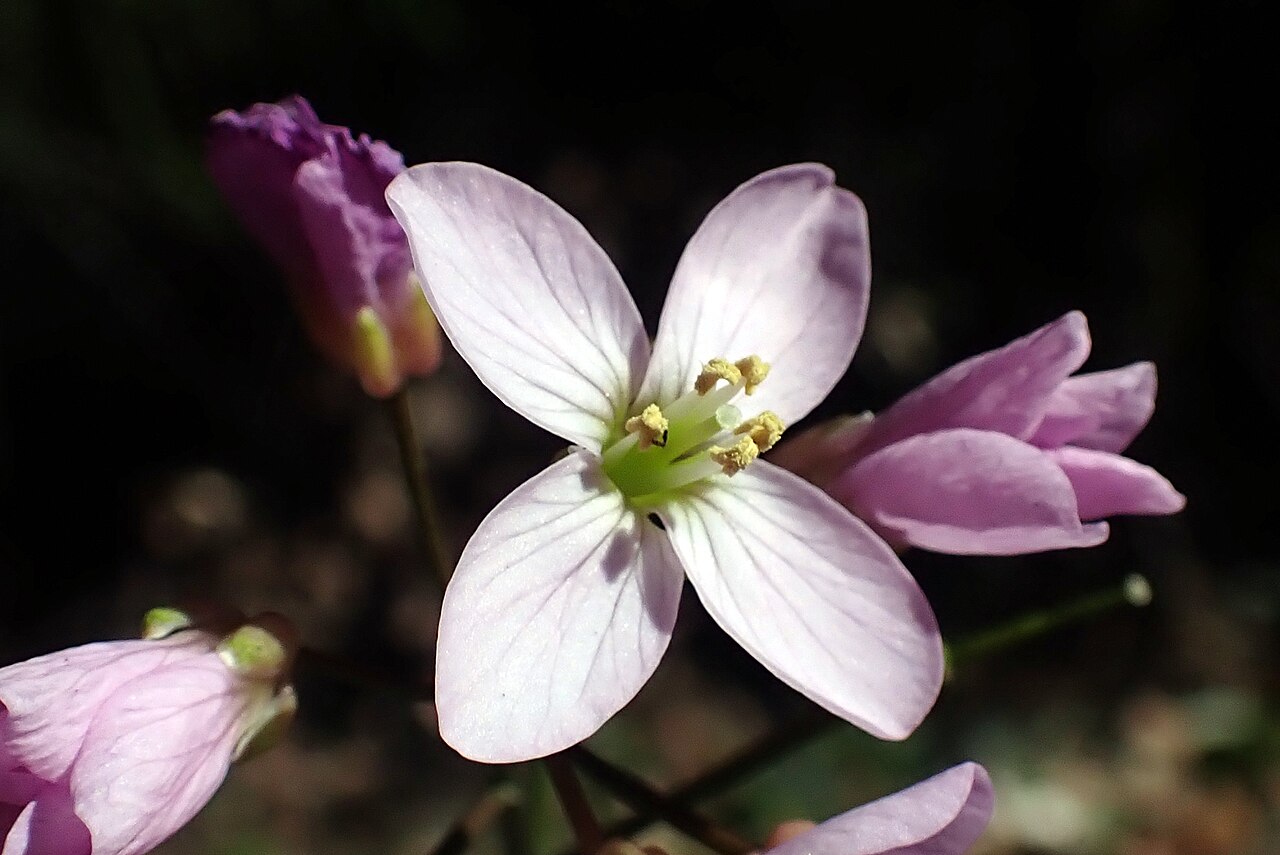
From about January to May, depending on location, a loose cluster (raceme) of flowers opens at the top of the stem. Each flower is about ½ to ¾ inch across, with four rounded petals that are white to pale pink, often aging pinker, around six yellow-tipped stamens. Unopened buds are often pink to lavender.
Fruit & Seeds
The fruits are slender, upright pods (siliques) 1 to 2 inches long. When ripe, the two halves of the pod coil back suddenly and fling the seeds a short distance from the parent plant. Soon after the seeds are shed, the stems and leaves wither and the plant goes dormant until the next rainy season.
Quick Facts
| Scientific Name | Cardamine californica (Nutt.) Greene (syn. Dentaria californica) |
| Family | Brassicaceae (mustard family) |
| Plant Type | Herbaceous perennial (forb) from a rhizome; summer dormant |
| Mature Height | 8–20 in (occasionally to about 28 in) |
| Mature Spread | 6–12 in; slowly forms small patches |
| Growth Rate | Moderate |
| Sun Exposure | Part shade to full shade |
| Water Needs | Moist in winter and spring; dry summer dormancy |
| Soil Type | Loam, clay or rocky soil rich in leaf litter; well drained |
| Soil pH | About 5.5–7.5 |
| Bloom Time | January–May (earliest in the south and at low elevations) |
| Flower Color | White to pale pink |
| Fall Color | None; dormant from late spring to fall |
| Fruit | Slender pod (silique) 1–2 in long that coils open to fling seeds |
| Deer Resistant | Moderately; deer occasionally graze it |
| USDA Hardiness Zones | 7–10 |
Native Range
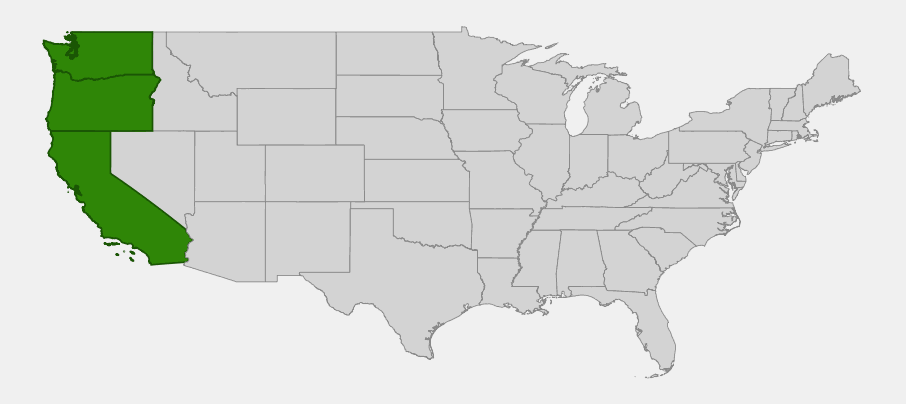
Milkmaids is a plant of the Pacific Coast. USDA PLANTS records it as native in California, Oregon and Washington, and its range extends south into northern Baja California. It does not grow in Canada.
Its stronghold is California, where it is widespread west of the Sierra Nevada crest: along the coast and through the Coast Ranges from the Oregon border to San Diego County, in the foothills of the Sierra Nevada and Cascades, and in the Transverse and Peninsular ranges of southern California. In Oregon it is mainly found in the southwest, in the Klamath Mountains and nearby valleys, and USDA also records it in Washington at the northern edge of its range.
It grows in shady or partly shady places that are moist in winter and spring: oak woodlands, mixed evergreen and redwood forests, the edges of chaparral, shaded canyon slopes and stream banks. It is mostly found below about 3,000 feet, occasionally higher. Several varieties have been named based on leaf shape, including var. californica, var. integrifolia, var. cardiophylla, var. cuneata and var. sinuata, though not all botanists recognize them.
Growing & Care Guide
Milkmaids is a delightful plant for shady native gardens in its home range. Like many California wildflowers, it follows a winter-wet, summer-dry rhythm. It grows and flowers during the rainy season and disappears in late spring. Plan for that cycle, and it will return reliably year after year.
Light
Part shade to full shade suits it best, as under oaks, bays or redwoods, or on the north side of a building. It tolerates morning sun in cooler coastal gardens.
Soil & Water
It grows in a wide range of soils, including clay, as long as they are not waterlogged. A layer of natural leaf litter helps keep the soil cool and moist in spring. Water is only needed if winter rains fail. Keep summer watering light or absent, because a dry dormant season helps prevent rot and suits the companions it naturally grows with.
Planting Tips
Plant nursery-grown plants or dormant rhizomes in fall, ideally just before the rains. Set rhizomes about 1 to 2 inches deep. Plant in drifts among ferns, bulbs and other woodland natives, and mark the spot so you do not dig into it during summer dormancy.
Pruning & Maintenance
Little care is needed. Let the plants die back naturally in late spring, and leave the seed pods to ripen if you want it to spread. Leaf litter is beneficial, so do not rake it away from the plants. Snails and slugs may chew the leaves in wet weather.
Propagation
Divide rhizomes in summer or fall while plants are dormant. Seed can be collected from pods just before they split and sown outdoors in fall; seedlings need a few years to reach flowering size.
Landscape Uses
- Woodland and shade gardens: early bloom under oaks, bays and redwoods
- Butterfly gardens: a larval host for Sara orangetip and other early-spring butterflies
- Naturalizing: spreads gently by rhizome and seed in leaf litter
- Low-water gardens: needs no summer irrigation once established
- Habitat restoration: an understory wildflower for California oak woodland and forest restoration
Wildlife & Ecological Value
Because it blooms so early, milkmaids is an important resource for insects that are active in late winter, when few other flowers are available.
For Pollinators
The flowers are visited by early native bees, including small mining bees and sweat bees, as well as flies and early butterflies. Milkmaids is a larval host plant for the Sara orangetip (Anthocharis sara), whose caterpillars feed on the flowers and developing seed pods, and it is used by other butterflies in the white family that feed on mustards.
For Birds
Its direct value to birds is small, but the early insects that visit and feed on it are food for insect-eating birds in late winter and early spring.
For Mammals
Deer and rodents occasionally eat the leaves, and small mammals may eat the seeds. The plant goes dormant early, so it is little browsed after spring.
Ecosystem Role
Milkmaids is part of the spring wildflower community of California’s woodlands and forests. It uses winter moisture and light under deciduous and evergreen trees, then retreats underground during the dry season. Its early bloom helps sustain pollinator populations before the main flush of spring flowers.
Cultural & Historical Uses
Like other Cardamine and toothworts, milkmaids has a peppery, mustard-like flavor. Several California Indigenous peoples are reported to have eaten the leaves and rhizomes, raw or cooked, as a spring green or seasoning. As with any wild food, accurate identification and responsible harvesting are essential.
The plant was first described by Thomas Nuttall as Dentaria californica, and Edward Lee Greene moved it to Cardamine. Today most botanists include the toothworts in Cardamine, a large genus that also includes bittercresses and cuckooflower.
For many Californians, milkmaids is the first sign of spring. The name likely refers to the milk-white color of the flowers. Hikers and naturalists eagerly look for it on shady trails in January and February, and it is a favorite subject of local wildflower walks and native plant society guides.
Frequently Asked Questions
When do milkmaids bloom?
Milkmaids is one of the earliest California wildflowers, typically blooming from January to April at low elevations and into May in the north and at higher elevations. Flowering begins once winter rains have soaked the soil.
Why do my milkmaids disappear in summer?
Milkmaids is summer dormant. After it flowers and sets seed in spring, the leaves and stems wither and the plant survives underground as a rhizome until the rains return in fall. This is normal, not a sign the plant has died.
Are milkmaids edible?
The leaves and rhizomes have a peppery, mustard-like flavor and have been eaten as a spring green or seasoning. Only eat plants you have identified with certainty, and harvest sparingly from abundant populations, never from parks or preserves.
Do milkmaids attract butterflies?
Yes. The early flowers are visited by small bees, flies and butterflies, and milkmaids is a caterpillar host plant for the Sara orangetip, a white butterfly with bright orange wing tips that flies in early spring.
Can I grow milkmaids outside California?
It is native only to California, Oregon, Washington and northern Baja California, and it is adapted to mild, wet winters and dry summers. Gardeners elsewhere should choose a native Cardamine or spring woodland wildflower from their own region instead.

Looking for a nursery that carries Milkmaids?
Browse our native plant nursery directory: California · Oregon · Washington