
Purple Mountain-Heath (Phyllodoce breweri)
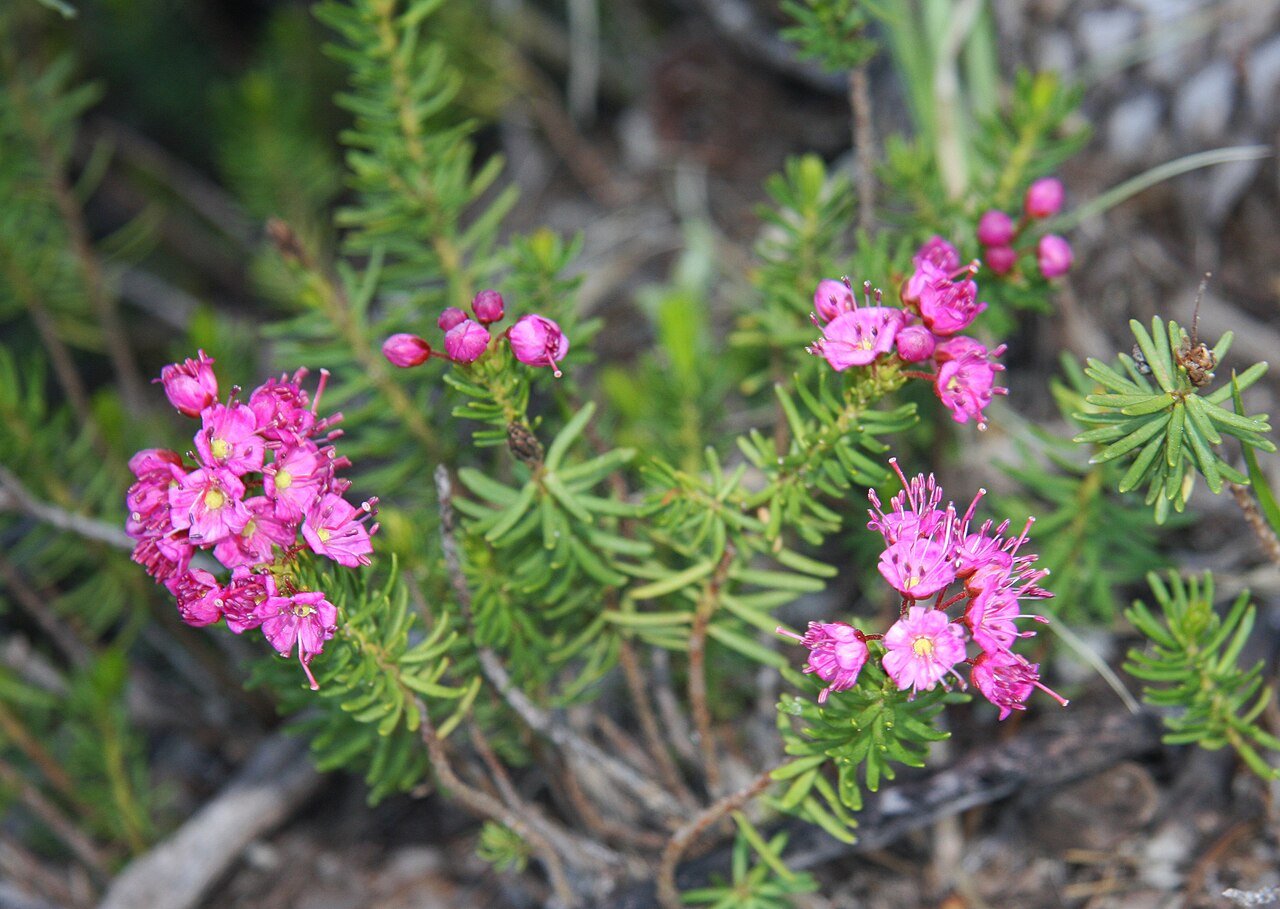
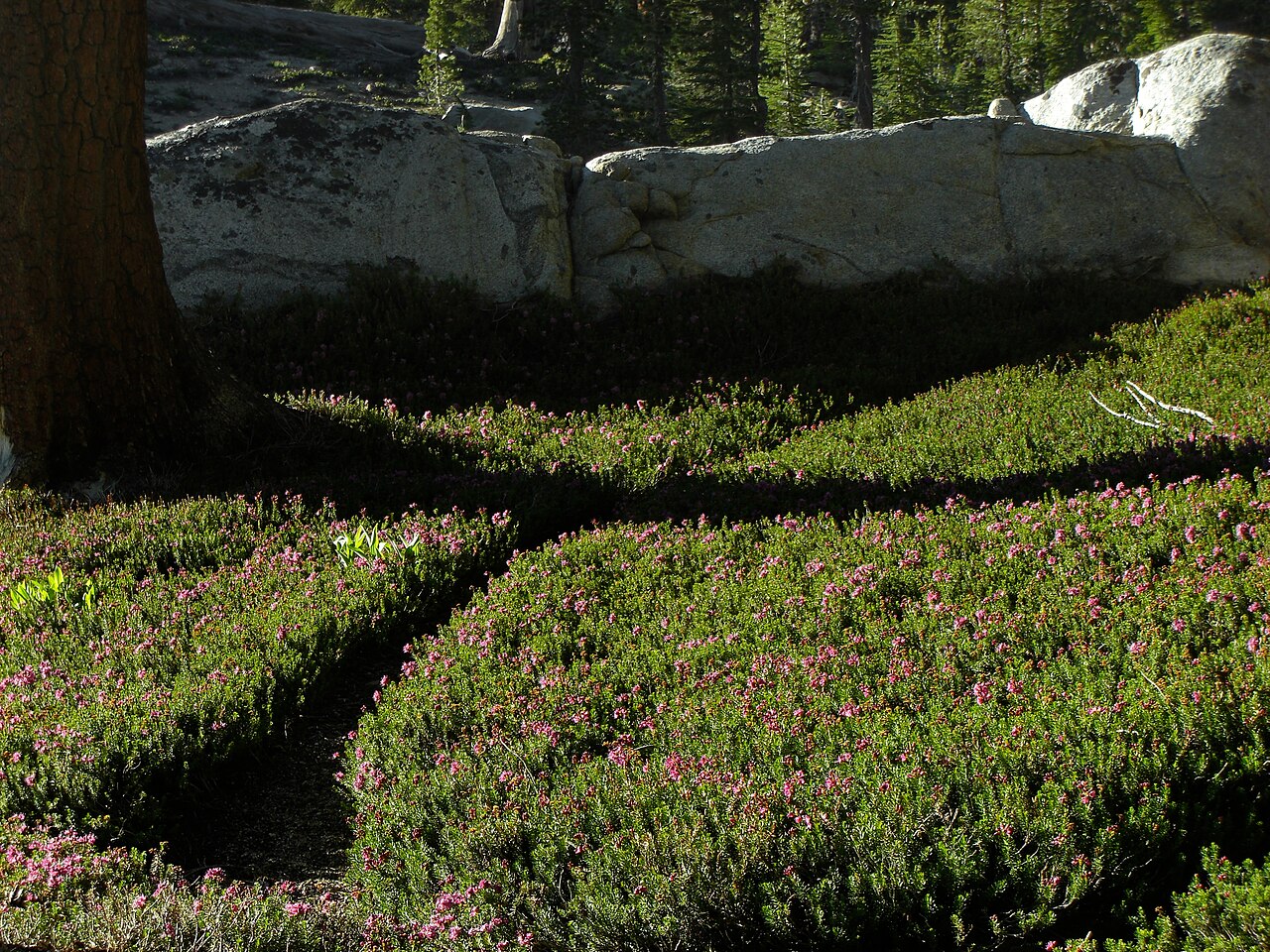
Phyllodoce breweri, known as Purple Mountain-Heath (USDA: purple mountainheath), is a low, mat-forming evergreen shrub of the high mountains of California and adjacent Nevada. It is also called Brewer’s mountain heather and, in the Sierra Nevada, simply red heather. It belongs to the heath family (Ericaceae), alongside blueberries, manzanitas and rhododendrons. The plant is only a few inches to about a foot tall, but it spreads into dense carpets that cover rocky slopes, meadow edges and lake shores near and above timberline.
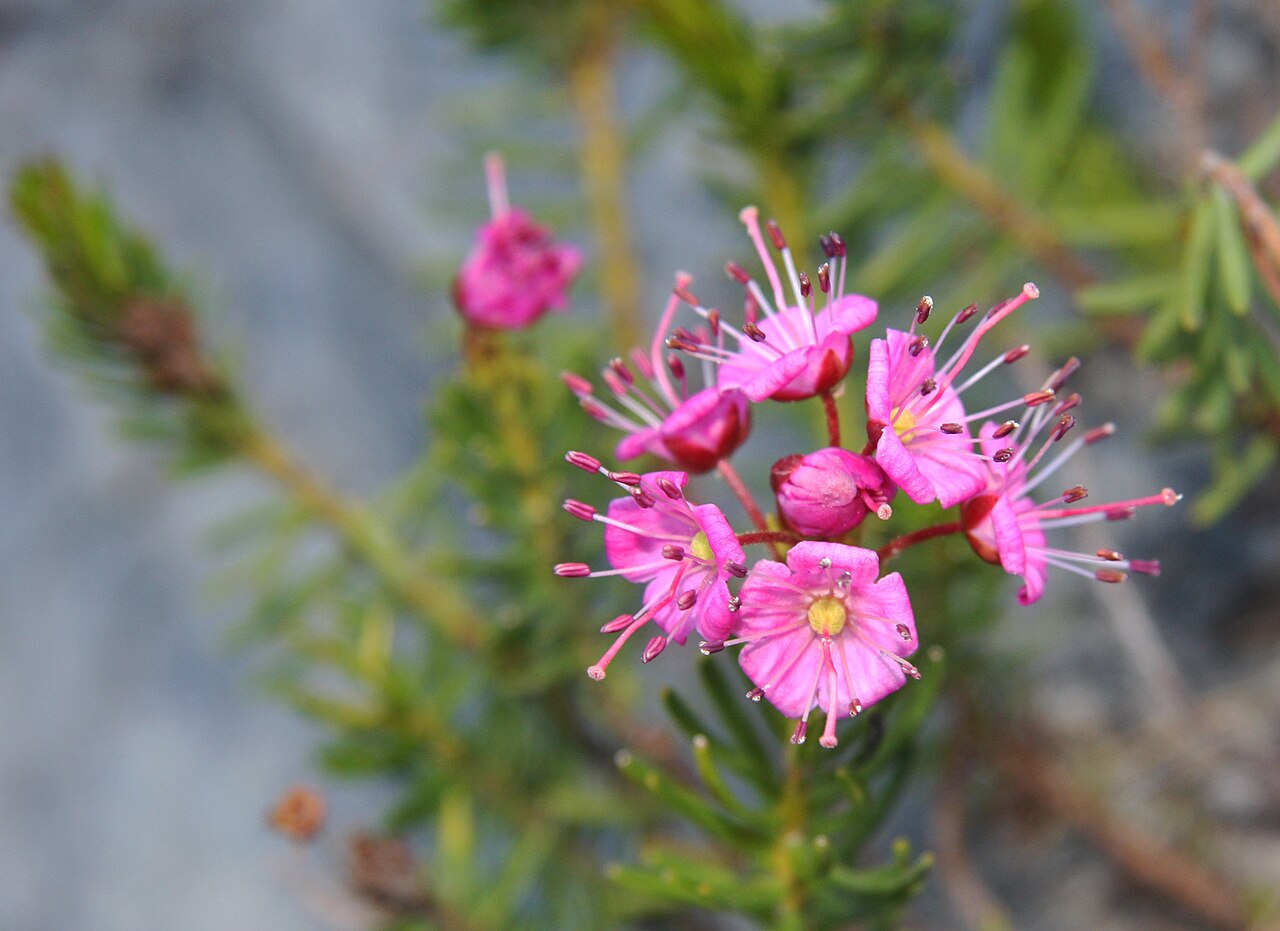
In early to midsummer, soon after the snow melts, the dark green, needle-leaved mats are covered with clusters of bright rose-purple to pink flowers. Each flower is an open, shallow cup with long stamens projecting from the center, giving the clusters a fuzzy, starry look. The bloom is one of the signature sights of the High Sierra in July, when whole granite basins turn pink.
Purple mountain-heath is a plant of cold, snowy, high-elevation places, and it is difficult to grow at low elevations. It is best appreciated in the wild, along trails in the Sierra Nevada, the southern Cascades and the San Bernardino Mountains. Its slow-growing mats are easily damaged by trampling, so stay on trails and never dig plants from the wild. Gardeners in cool mountain climates can sometimes grow it from nursery-propagated stock in a rock or alpine garden.
Identification
Purple mountain-heath looks like a miniature conifer seedling or a heather. Look for a low, spreading mat of stiff stems densely covered in short, needle-like leaves, with clusters of rose-pink, open, cup-shaped flowers at the tips of the stems in summer.
Growth Form
A low evergreen shrub, usually 4 to 12 inches tall, with many branched, partly sprawling stems that root as they spread. Over time a single plant forms a mat several feet across, and neighboring plants merge into continuous carpets on moist, rocky ground. The older stems are woody and covered with the bases of old leaves.
Leaves
The leaves are crowded all along the stems, linear and needle-like, about 1/4 to 3/4 inch long, leathery and dark glossy green. Their edges are rolled under, leaving a narrow groove on the underside. They stay on the plant for several years and give the mats a soft, bristly texture that is often mistaken for a young fir or spruce.
Flowers
The flowers appear from June to August, depending on elevation and snowmelt, in loose clusters at the ends of the stems on slender, glandular-hairy stalks. Each flower is about 1/2 inch across, an open, shallow cup or saucer with five spreading lobes, in shades of rose-purple, magenta or pink. Seven to ten long stamens with dark anthers project well beyond the petals, around a single style. Fresh flowers have a light, sweet fragrance.
Fruit & Seeds
After flowering, each flower develops into a small, round, dry capsule about 1/8 inch across that splits open in late summer and fall to release many tiny seeds. The persistent flower stalks with their capsules often turn reddish brown and stay on the plant into winter.
Look-alikes
Pink mountainheath (Phyllodoce empetriformis), found farther north and in the Rocky Mountains, has nodding, bell- or urn-shaped flowers with the stamens hidden inside, not open saucers with protruding stamens. Cream mountainheath (P. glanduliflora) has yellowish urn-shaped flowers. White heather (Cassiope mertensiana) has small white bells and scale-like leaves pressed tightly to the stems. Alpine laurel (Kalmia microphylla) has flat, oval leaves and pink, saucer-shaped flowers with stamens tucked into small pockets in the petals.
Quick Facts
| Scientific Name | Phyllodoce breweri |
| Family | Ericaceae (heath family) |
| Plant Type | Low, mat-forming evergreen shrub |
| Mature Height | 4–12 in (occasionally to 16 in) |
| Mature Spread | 1–4 ft; forms spreading mats |
| Growth Rate | Slow |
| Sun Exposure | Full sun to partial shade |
| Water Needs | Moderate to high; moist, well-drained soil |
| Soil Type | Rocky, gravelly or peaty acidic soil |
| Soil pH | About 4.5–6.0 (acidic) |
| Bloom Time | June–August |
| Flower Color | Rose-purple to pink |
| Fall Color | Evergreen; dark green year-round |
| Fruit | Small round capsule with many tiny seeds |
| Deer Resistant | Generally yes; rarely browsed |
| USDA Hardiness Zones | 3–7 |
Native Range
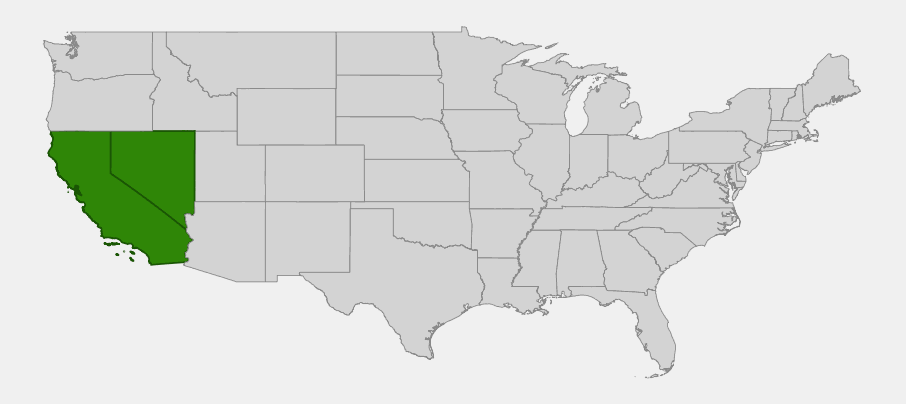
Purple mountain-heath is a plant of the California mountains, with its range spilling just over the state line into Nevada. USDA PLANTS lists it as native to the lower 48 states and records it only from California and Nevada. It grows throughout the high Sierra Nevada, north into the southern Cascade Range around Lassen Peak, and in the high peaks of the San Bernardino Mountains of southern California. In Nevada it occurs on the eastern side of the Sierra crest, in the Carson Range around Lake Tahoe.
It is a plant of the subalpine and alpine zones, typically from about 6,000 to 12,000 feet. Most populations lie between roughly 8,000 and 11,000 feet in the central and southern Sierra Nevada, where it is one of the most common low shrubs in moist granite basins. Plants are covered by deep snow for much of the year, which protects them from winter wind and cold, and they bloom soon after the snow melts.
Habitats include moist rocky slopes, granite ledges and cracks, the edges of subalpine meadows, lake and stream margins, seeps, and openings in lodgepole pine, mountain hemlock and whitebark pine forest. It favors acidic, gravelly or peaty soils that stay moist through early summer but are well drained.
📋 Regional plant lists featuring Purple Mountain-Heath: California & Nevada
Growing & Care Guide
Purple mountain-heath is a challenging plant outside its mountain home. It needs cool summers, reliable moisture, acidic soil and a cold winter, ideally under snow. It is grown mainly by alpine and rock-garden enthusiasts in cool, high-elevation or northern coastal climates. Buy nursery-propagated plants only; plants dug from the wild almost never survive, and digging damages fragile subalpine habitat.
Light
In cool mountain gardens it does best in full sun. At lower elevations or where summers are warm, give it morning sun and afternoon shade, or bright dappled light, to keep the roots and foliage from overheating.
Soil & Water
Plant it in acidic, humus-rich but gritty soil, such as a mix of peat or leaf mold, coarse sand and fine gravel. The soil must stay evenly moist, especially in spring and summer, but must never be waterlogged. Water with rainwater or soft water if your tap water is hard and alkaline, since lime causes yellowing. Avoid fertilizers; heaths are adapted to poor soils and have fine roots that are easily burned.
Planting Tips
Plant it in spring in a raised rock garden, a scree bed or among stones that keep the roots cool, or in a trough for alpine plants. A mulch of fine gravel or pine needles conserves moisture. Combine it with other small acid-loving plants such as dwarf blueberries, alpine laurel and mountain heathers. It is not suited to hot, dry lowland gardens such as most of coastal southern California or the Central Valley.
Pruning & Maintenance
It needs very little pruning. Lightly trim off the spent flower clusters after blooming if you want a tidier mat, and cut out any dead stems in spring. Keep weeds and aggressive groundcovers from overrunning it, and do not walk on the mats. Winter snow cover or a light mulch of evergreen boughs helps protect it from drying winter winds where snow is unreliable.
Propagation
It is usually propagated from semi-hardwood cuttings taken in late summer and rooted in a moist mix of peat and sand, or by layering, since the spreading stems root where they touch the soil. Seed is tiny; sow it on the surface of moist, acidic seed mix and keep it cool and humid. Seedlings grow slowly and take several years to reach flowering size.
Landscape Uses
- Alpine and rock gardens: a classic small evergreen heath for cool, high-elevation gardens
- Troughs and containers: for alpine plant enthusiasts who can give it cool, moist, acidic conditions
- Mountain cabin landscapes: a natural groundcover around rocks in subalpine settings
- Restoration: stabilizing gravelly soil on disturbed subalpine sites with locally sourced plants
- Wildflower viewing: a highlight of Sierra Nevada trails and lake basins in July
Wildlife & Ecological Value
Purple mountain-heath is a key part of the short growing season in the High Sierra, providing nectar when few other shrubs are blooming and shelter close to the ground.
For Pollinators
The bright, fragrant flowers are visited by bumblebees, which are the main pollinators at high elevations, as well as by butterflies, flies and other insects. Its open flowers with exposed stamens give insects easy access to pollen and nectar during the brief subalpine summer.
For Birds
The dense mats provide low cover for ground-nesting and ground-foraging birds of subalpine meadows and slopes, such as dark-eyed juncos and white-crowned sparrows.
For Mammals
The tough, leathery foliage is not a major food plant, but the mats give cover to small mammals such as voles and pikas living among the rocks. Deer browse it only lightly.
Ecosystem Role
Its long-lived, spreading mats hold gravelly soil in place on slopes and around lakes, trap snow and organic matter, and help build soil in harsh, rocky places. Like other heaths, it forms close partnerships with root fungi (ericoid mycorrhizae) that help it take up nutrients from poor, acidic soils.
Cultural & Historical Uses
The species is named for William Henry Brewer, a botanist and leader of the California Geological Survey in the 1860s, who collected plants throughout the Sierra Nevada. Asa Gray first described it as Bryanthus breweri, and it was later moved to Phyllodoce. Older California wildflower books, such as Mary Elizabeth Parsons’ The Wild Flowers of California, list it as alpine heather under the name Bryanthus.
The genus name Phyllodoce comes from a sea nymph in Greek mythology. John Muir, who explored the High Sierra in the same era, wrote admiringly of the heathers he called Bryanthus and Cassiope in the lake basins, and red heather remains one of the plants most associated with the Sierra high country.
Today purple mountain-heath is a favorite of hikers and wildflower photographers along trails such as those around Tioga Pass, Desolation Wilderness, the Mokelumne Wilderness and Lassen Volcanic National Park. Because the slow-growing mats can take decades to recover from trampling, land managers ask visitors to camp and walk on durable surfaces away from heather carpets.
Frequently Asked Questions
How do I tell purple mountain-heath from pink mountainheath?
Look at the flowers. Purple mountain-heath has open, saucer-shaped flowers with long stamens sticking out. Pink mountainheath (Phyllodoce empetriformis) has nodding, bell-shaped flowers with the stamens hidden inside.
Where can I see purple mountain-heath in bloom?
Look in moist granite basins, lake shores and meadow edges of the Sierra Nevada from about 8,000 to 11,000 feet in July, around Lassen Peak, and in the high San Bernardino Mountains. Bloom time follows snowmelt.
Can I grow purple mountain-heath in my garden?
Only in cool climates with moist, acidic, well-drained soil and cold winters, such as mountain or northern gardens. It usually fails in hot lowland gardens. Buy nursery-propagated plants from an alpine plant specialist.
Can I dig up a plant from the mountains?
No. Wild plants rarely survive transplanting, collecting on public lands is generally prohibited without a permit, and digging damages fragile subalpine habitat that takes decades to recover.
Is purple mountain-heath toxic?
It is not known as a significant poisonous plant, but many members of the heath family contain compounds that can upset the stomach. Do not eat any part of it, and keep pets and children from chewing on it.

Looking for a nursery that carries Purple Mountain-Heath?
Browse our native plant nursery directory: California · Nevada