Whitebark Pine (Pinus albicaulis)
Pinus albicaulis, the Whitebark Pine, is a slow-growing five-needle pine of the highest, harshest country in the western mountains — the last tree standing at timberline, where it often grows not as a tall trunk but as a low, twisted mat (krummholz) sculpted flat by wind and ice. Its pale, smooth young bark gives the species its name, and its large, nutritious seeds make it one of the most ecologically important trees in the subalpine West, feeding grizzly and black bears, red squirrels, and especially Clark’s nutcracker, a bird so tightly bound to this tree that neither species does well without the other.
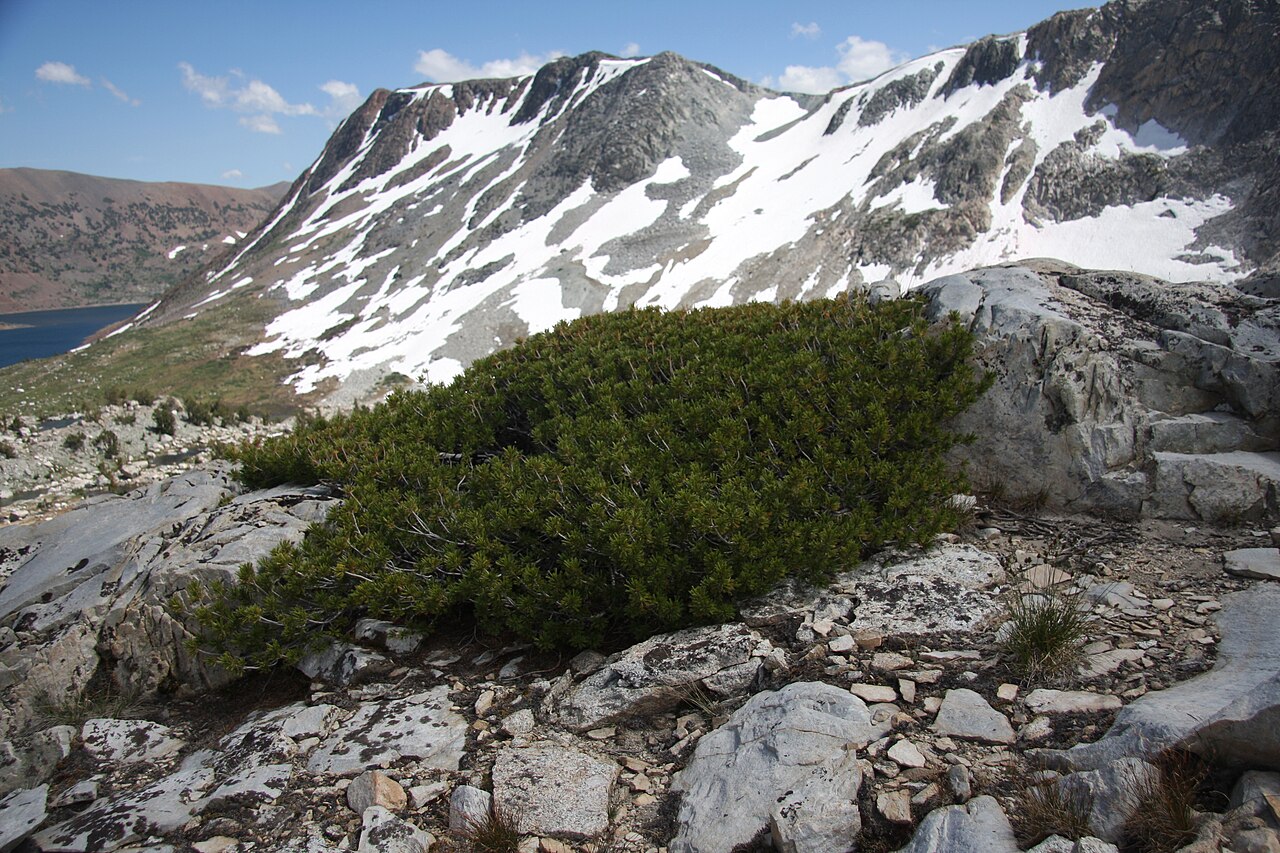
Where conditions allow, whitebark pine grows as an upright tree 20 to 60 feet tall with an open, irregular crown; at its upper elevation limit it shrinks to a sprawling, multi-stemmed shrub a few feet high, pressed against rock to survive hurricane-force winter winds and a growing season that may last only six to eight weeks. It is a true pioneer of poor, rocky, thin soils where almost nothing else can root, and it often marks the literal edge of the forest — the line above which trees give way to alpine tundra.
Whitebark pine is not a conventional garden plant; it belongs to high, cold, exposed ground above 7,000 to 10,000 feet and is essentially never offered in the nursery trade. Its importance here is ecological and conservation-related rather than ornamental: the species is in serious decline across its range from an introduced disease, native beetles, and a changing climate, and it was listed as threatened under the U.S. Endangered Species Act in 2022. Anyone who hikes or lives near its range will benefit from knowing it on sight and understanding why it matters.
Identification
Whitebark pine is a five-needle pine (subgenus Strobus) that ranges from a single-trunked tree with an open, rounded or flat-topped crown to a dense, ground-hugging krummholz mat at the harshest sites, often with several trunks fused together from branches that rooted where they touched the ground.
Bark & Form
Young bark is thin, smooth and whitish to light gray, giving the tree its common name; with age it breaks into small, grayish-brown scaly plates, though it never develops the thick, deeply furrowed bark of lower-elevation pines. Trees at exposed, wind-scoured sites are often strikingly asymmetrical, with branches and foliage pushed entirely to the lee side, or reduced to a flattened mat only a few feet tall that can be centuries old despite its small size.
Needles
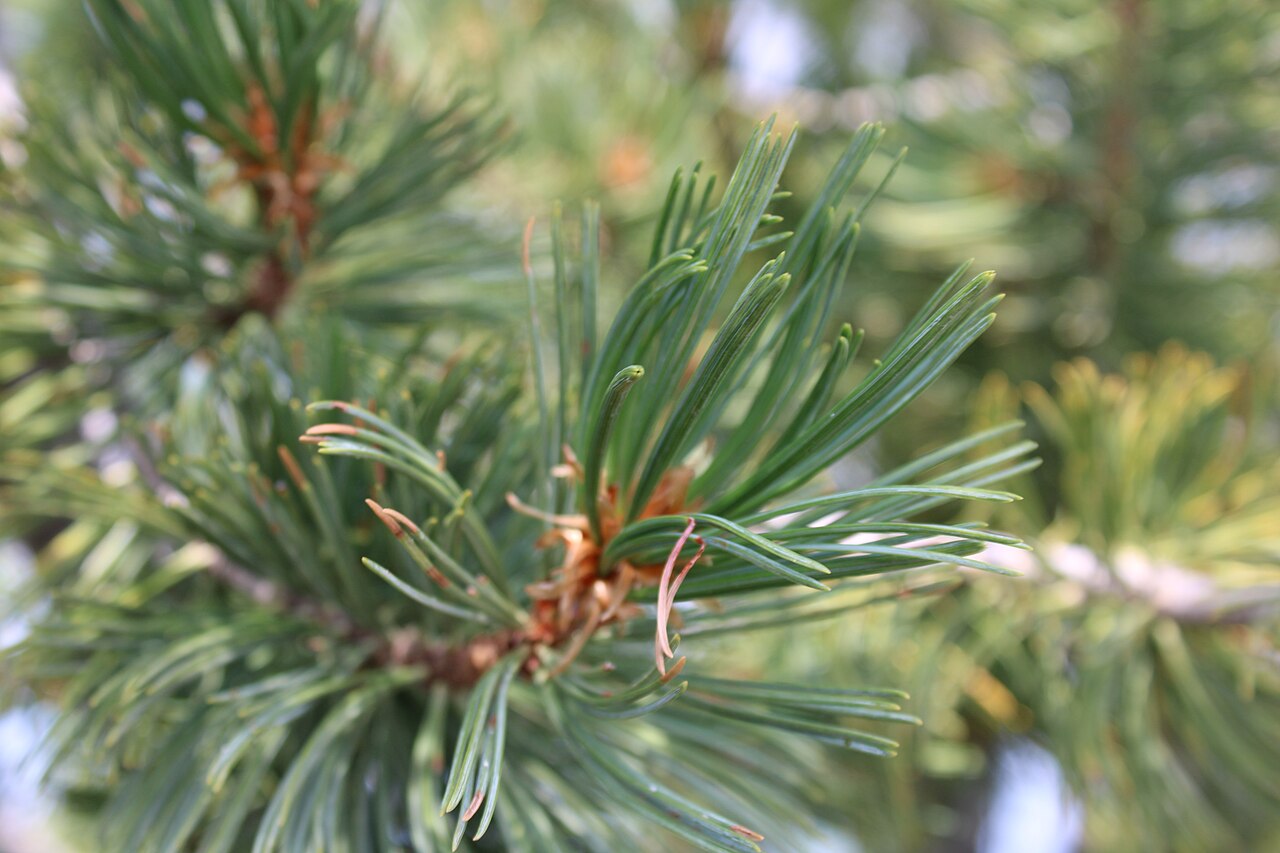
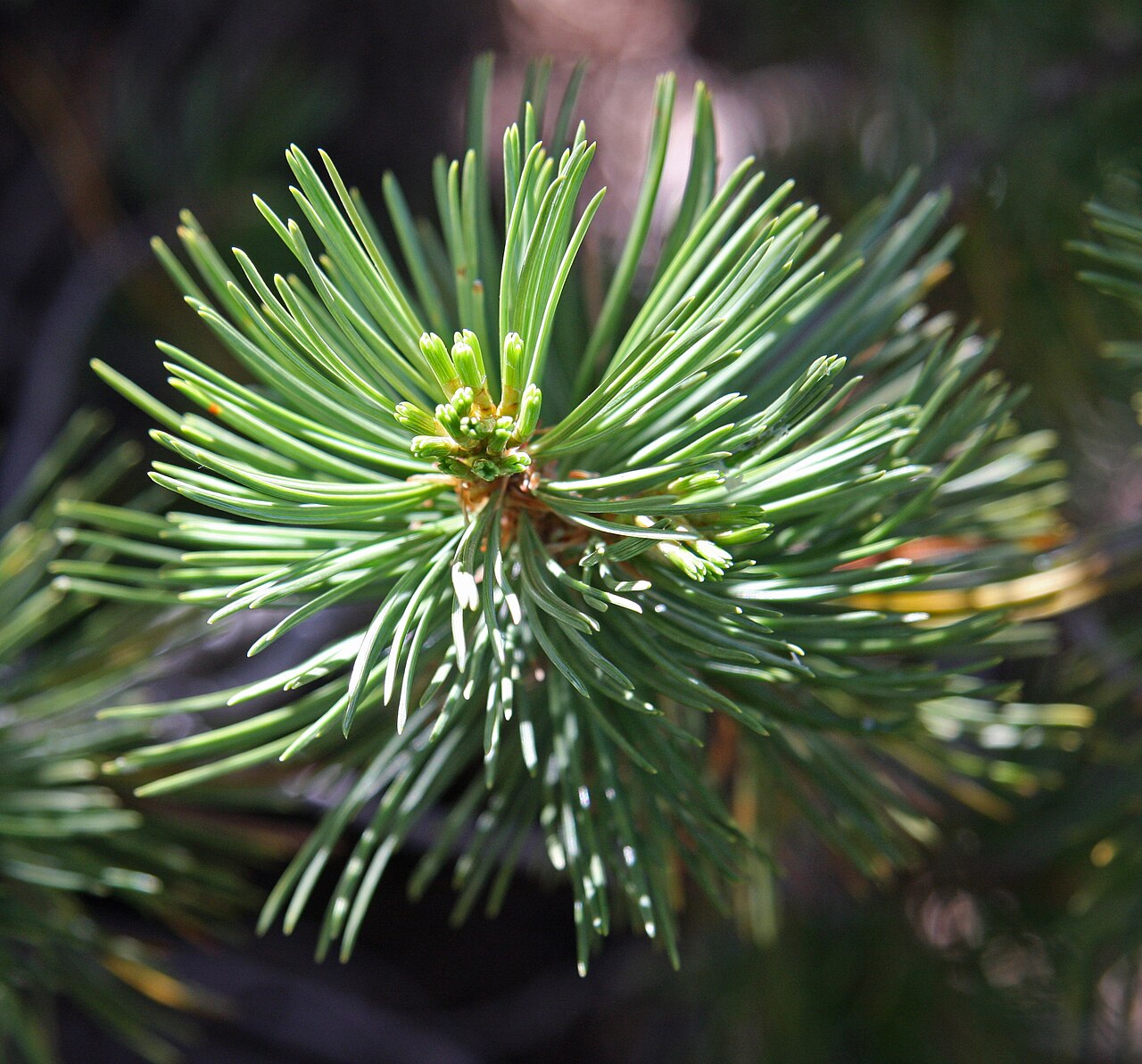
Needles are borne in bundles (fascicles) of five, 1.5 to 3 inches long, stiff, slightly curved, and clustered densely toward the ends of the branches, giving the foliage a tufted, bottlebrush look. They are yellow-green to blue-green and are retained for 5 to 8 years, among the longest needle retention of any North American pine, an adaptation to the short, cool growing season at high elevation.
Cones & Seeds
Cones are egg-shaped, 1.5 to 3 inches long, dark purple when young and ripening to brown over two growing seasons. Unlike most pines, whitebark pine cones do not open on their own at maturity; the scales stay sealed shut around large, wingless, nutritious seeds, and the tree depends almost entirely on Clark’s nutcracker to pry the cones apart, extract the seeds, and cache them in soil for later retrieval. Uneaten caches are the main way whitebark pine regenerates, which makes the fate of this one bird species central to the tree’s future.
Quick Facts
| Scientific Name | Pinus albicaulis |
| Family | Pinaceae (Pine) |
| Plant Type | Evergreen coniferous tree (krummholz shrub at treeline) |
| Mature Height | 20–60 ft upright; 3–10 ft as wind-formed mats at treeline |
| Growth Rate | Very slow |
| Sun Exposure | Full Sun |
| Water Needs | Low to moderate; relies on snowmelt, needs sharp drainage |
| Soil Type | Rocky, thin, infertile; often bare granite or talus |
| Soil pH | Slightly acidic to neutral |
| Bloom Time | Cones pollinated June–July; not a flowering plant |
| Fall Color | None (evergreen) |
| Fruit | Indehiscent cones with large wingless seeds, ripen over 2 years |
| Deer Resistant | Yes |
| USDA Hardiness Zones | 3–7 |
Native Range
Whitebark pine grows along the high mountain spine of the western United States and adjacent Canada: the Cascade Range of Washington and Oregon, the Sierra Nevada and Klamath ranges of California, scattered high ranges of the Great Basin in Nevada and a small disjunct population in the Uinta Mountains of Utah, and the Rocky Mountains of Idaho, Montana and Wyoming, with its range continuing north into British Columbia and Alberta. Everywhere it grows, it occupies the subalpine zone and timberline, typically between about 7,000 and 10,000 feet in the south of its range and considerably lower, down to around 4,000 feet, toward the northern Cascades and Canadian Rockies.
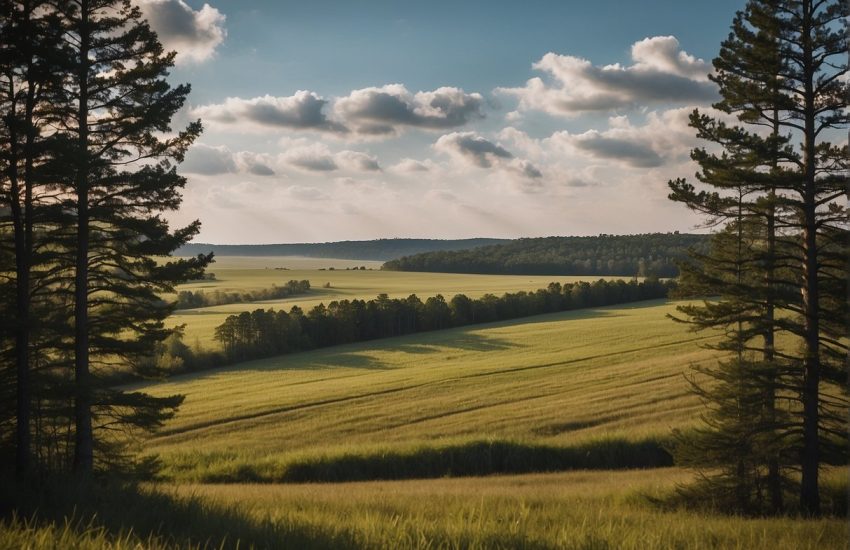
Typical habitat is harsh by design: exposed ridgelines, rocky slopes and plateaus just below and at treeline, where wind, cold, heavy snowpack and short growing seasons exclude most other trees. Common companions at these elevations include subalpine fir, Engelmann spruce, lodgepole pine and mountain hemlock at slightly lower, more sheltered sites, giving way to pure whitebark pine or whitebark–subalpine fir stands right at the treeline edge.
Whitebark pine populations have declined sharply across most of this range over the past several decades, driven primarily by white pine blister rust (an introduced fungal disease), periodic mountain pine beetle outbreaks, fire exclusion that has allowed shade-tolerant competitors to encroach, and a warming climate that is shifting suitable habitat upslope faster than the slow-growing tree can follow. The species was listed as threatened under the U.S. Endangered Species Act in 2022, and collecting, transplanting or disturbing wild whitebark pine should be avoided; restoration relies on disease-resistant seed sources managed by land agencies, not casual collection.
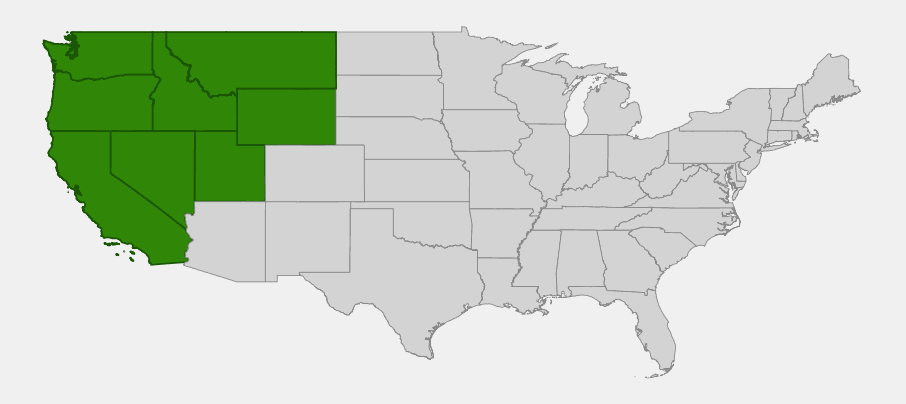
📋 Regional plant lists featuring Whitebark Pine: Idaho, Eastern Oregon & Eastern Washington · Western Oregon & Western Washington · Montana & Wyoming · Utah & Western Colorado
Growing & Care Guide
Whitebark pine is not a practical choice for ordinary home landscapes — it is almost never sold commercially, grows extraordinarily slowly, and genuinely needs the cold, high-elevation conditions of its native range to thrive. The notes below are offered for context and for land managers, high-elevation property owners, or restoration projects rather than typical home gardeners.
Light
Full sun is essential; the species evolved in open, wind-exposed, treeless-adjacent terrain and does not tolerate shade or competition from faster-growing trees, which is part of why it struggles where fire suppression lets shade-tolerant conifers like subalpine fir crowd in beneath and around it.
Soil & Water
Whitebark pine thrives in thin, rocky, nutrient-poor soils with excellent drainage, often rooting directly into granite cracks and talus. It depends on winter snowpack for most of its moisture and is intolerant of wet, poorly drained or fertile soils at lower elevations, where it is quickly outcompeted. It is not a tree that can be relocated successfully to typical garden conditions.
Planting Tips
Because whitebark pine is listed as threatened, restoration plantings use seed collected from rust-resistant parent trees through coordinated agency and university programs rather than commercially purchased stock. Anyone interested in supporting the species is better served by contacting a regional whitebark pine restoration partnership than by attempting to grow or transplant wild material.
Conservation Status
Whitebark pine was listed as a threatened species under the U.S. Endangered Species Act in December 2022, the result of decades-long decline from white pine blister rust, mountain pine beetle outbreaks, altered fire regimes and climate change. In many areas more than half of mature trees have died. Recovery work focuses on identifying and propagating rust-resistant trees, protecting Clark’s nutcracker habitat, and reintroducing low-severity fire where appropriate to reduce competition from shade-tolerant conifers.
Landscape Uses
- High-elevation restoration plantings using agency-sourced, disease-screened seedlings
- Alpine and subalpine demonstration gardens at botanical gardens equipped to replicate its climate
- Wildlife and watershed conservation projects protecting existing stands and nutcracker habitat
- Not recommended for typical home landscaping outside its native high-elevation range
Wildlife & Ecological Value
Few North American trees are as central to the animals around them as whitebark pine, which is considered a keystone species of the subalpine zone.
For Birds
Clark’s nutcracker and whitebark pine have one of the most specialized partnerships in North American ecology: the bird’s long, sharp bill is adapted to pry open the tree’s sealed cones, and a single nutcracker can cache tens of thousands of seeds each fall across many square miles, remembering a large share of the sites months later. Uneaten caches are the species’ primary means of regeneration, since the cones do not open or disperse seed on their own.
For Mammals
Grizzly and black bears dig up squirrel middens to feed heavily on whitebark pine seeds in late summer and fall in parts of the Rocky Mountains, where the fat- and calorie-rich seeds are an important pre-hibernation food source; declining whitebark pine has been linked to changes in grizzly bear foraging behavior in places like the Greater Yellowstone Ecosystem. Red squirrels cache cones in large middens that both they and foraging bears exploit.
For Pollinators
As a wind-pollinated conifer, whitebark pine does not rely on insect pollinators, though its foliage and bark support various bark beetles and other insects that are, in turn, prey for woodpeckers and other birds working the high-elevation forest.
Ecosystem Role
Whitebark pine stabilizes soil on steep, rocky, avalanche-prone slopes, shades and slows snowmelt to regulate downstream water flow through the summer, and provides the only woody structure at many treeline sites, sheltering tree seedlings of other species and small wildlife from wind and sun. Its decline is considered a serious concern for the broader health of subalpine watersheds and wildlife communities across the western mountains.
Cultural & Historical Uses
Several Indigenous peoples of the Rocky Mountain and Great Basin regions, including groups within the Shoshone, Blackfeet and other mountain-dwelling nations, historically gathered whitebark pine seeds as a nutritious food source, harvesting cones in late summer and fall much as they harvested the seeds of other high-elevation pines, and competing with bears and nutcrackers for the same limited, high-value resource.
Because of its slow growth, remote high-elevation habitat and difficult-to-access, resin-sealed cones, whitebark pine was never an important timber or commercial resource, and its wood has seen little use beyond occasional local firewood near treeline cabins and camps. Its primary modern significance is ecological and symbolic — a visible indicator species for the health of high mountain ecosystems and a focal point for climate change research and conservation.
Today, whitebark pine is most often encountered by hikers, backpackers and mountaineers as the gnarled, often dead or dying trees that mark the edge of the alpine zone, and increasingly as the subject of agency restoration signage explaining blister rust, beetle damage and ongoing recovery efforts across the western national forests and parks where it grows.
Frequently Asked Questions
Can I plant a whitebark pine in my yard?
Almost certainly not successfully unless you live at high elevation within or near its native range. It is not sold through typical nurseries, grows extremely slowly, and needs the cold, exposed, high-elevation conditions it evolved in. It is also a federally threatened species, so wild collection is not appropriate.
Why is whitebark pine threatened?
The U.S. Fish and Wildlife Service listed it as threatened in 2022 because of combined pressure from white pine blister rust (an introduced fungal disease), mountain pine beetle outbreaks, fire exclusion that lets competing trees crowd it out, and climate change shrinking its high-elevation habitat.
How can you tell whitebark pine from other high-elevation pines?
Look for needles in bundles of five clustered toward branch tips, smooth whitish young bark, and cones that stay sealed shut at maturity rather than opening on the tree — a trait shared with only a few other “stone pines” and distinct from the open, winged-seed cones of lodgepole or ponderosa pine.
Why do Clark’s nutcrackers matter so much to this tree?
Whitebark pine cones do not open on their own, so the tree depends almost entirely on Clark’s nutcracker to extract and cache its seeds. Buried, uneaten caches are how most new whitebark pines get started, making the bird essential to the tree’s regeneration.
How old can whitebark pine get?
Very old. Individual trees, especially the stunted krummholz forms at treeline, commonly live 500 years or more, with some documented trees exceeding 1,000 years, reflecting the species’ extremely slow growth in harsh conditions.

Looking for a nursery that carries native plants for a western mountain property?
Browse our native plant nursery directory: Washington · Oregon · California · Nevada · Idaho · Montana · Wyoming · Utah