Jeffrey Pine (Pinus jeffreyi)
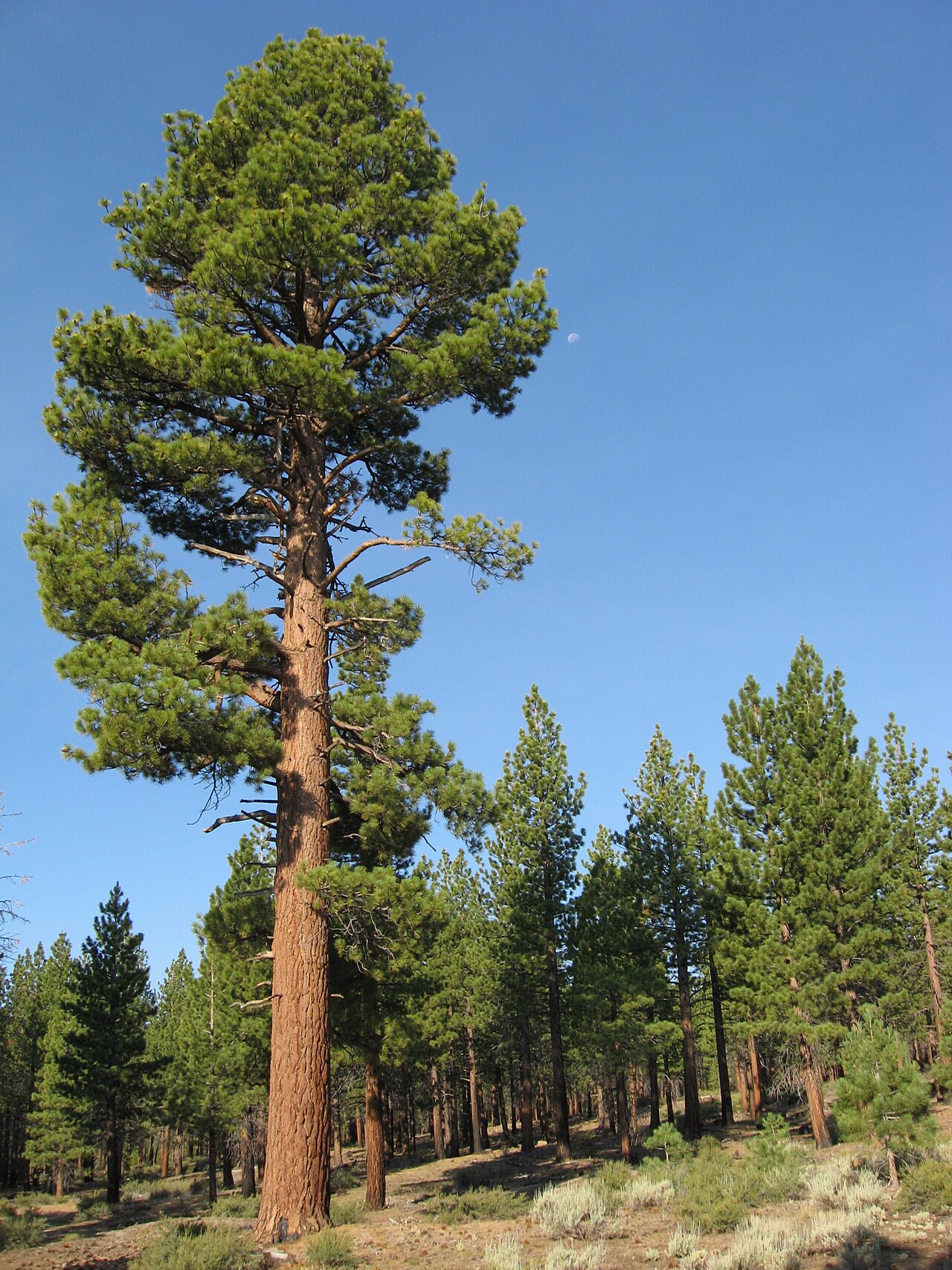
Pinus jeffreyi, the Jeffrey Pine, is a large, long-lived, three-needle pine of California’s dry mountains and the adjacent fringes of Oregon and Nevada, closely related to — and often confused with — ponderosa pine. Jeffrey pine is the pine famous for bark that smells distinctly of vanilla, butterscotch or pineapple when warmed by the sun, a trait that gives the species its memorable field test: lean in, sniff a sun-warmed furrow of bark, and you will know within seconds which pine you are looking at.
Mature Jeffrey pine is an imposing tree, commonly 80 to 130 feet tall with a long, straight, cinnamon-to-pinkish-barked trunk and a relatively open, rounded crown of long blue-green needles. It specializes in dry, well-drained mountain soils, including the thin, mineral-poor serpentine and pumice soils that many other conifers cannot tolerate, which lets it dominate certain high, dry sites in the southern Cascades, Sierra Nevada, and California’s coastal and desert-fringe mountain ranges almost to the exclusion of other trees.
For gardeners and land managers within its native elevation band, Jeffrey pine is an excellent large shade and specimen tree: drought tolerant once established, tolerant of poor and even toxic serpentine soils, long-lived, and a valuable wildlife tree. It is not a fast grower and needs significant room, so it suits large properties, parks, and restoration plantings more than small residential lots.
Identification
Jeffrey pine grows as a single-trunked tree with a straight, often branch-free lower trunk and a comparatively open, irregular, rounded crown in maturity, commonly reaching 80 to 130 feet, with exceptional trees exceeding 170 feet.
Bark
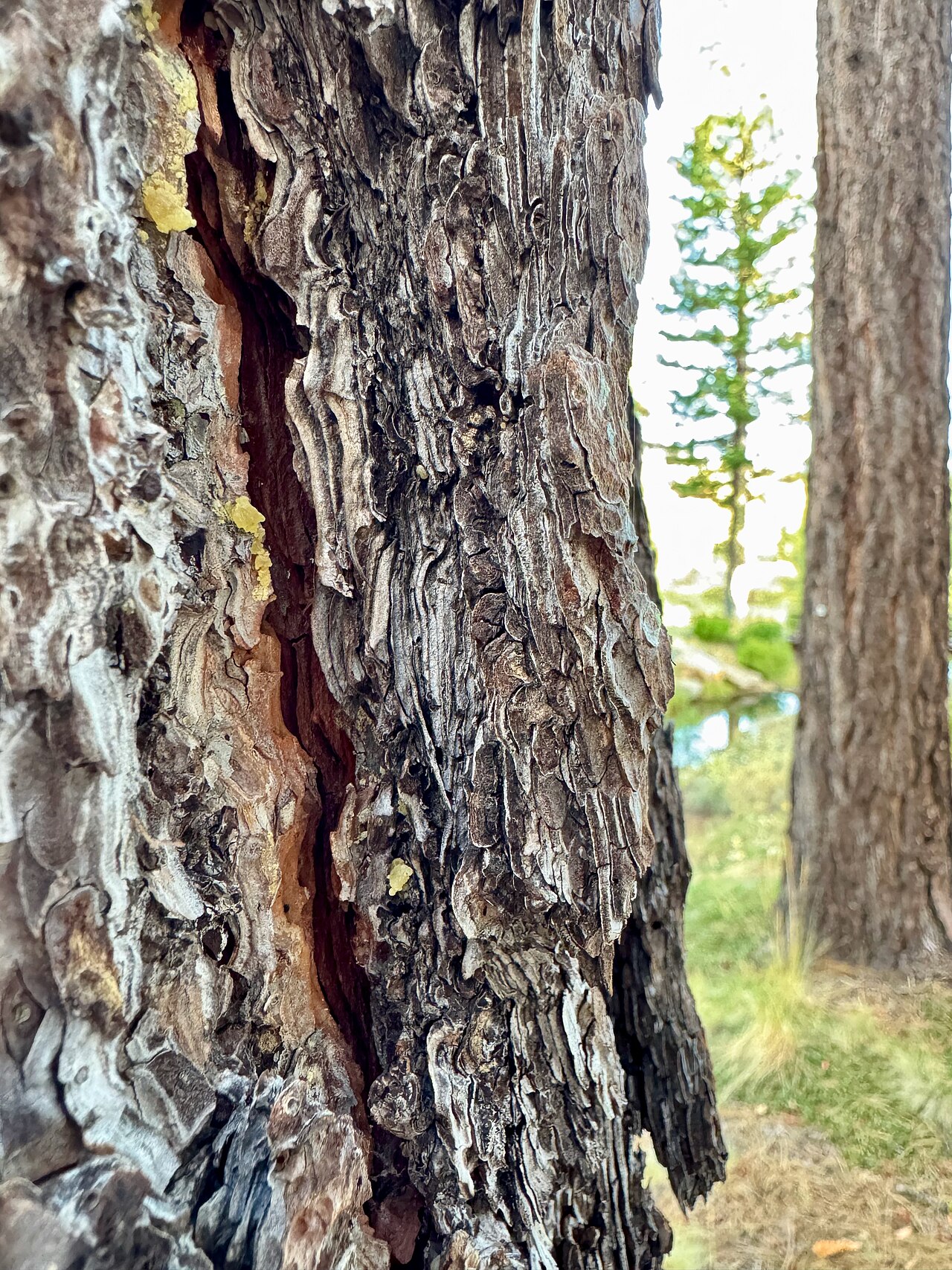
Mature bark is thick, deeply furrowed into broad, flat, puzzle-piece plates, and colored cinnamon-red to pinkish-orange to gray-brown, closely resembling ponderosa pine bark. The most reliable identification trick is scent: press your nose into a warm bark furrow on a sunny day, and Jeffrey pine typically smells sweetly of vanilla, butterscotch or pineapple, while ponderosa pine smells more like turpentine or has little scent at all.
Needles
Needles grow in bundles of three, 5 to 10 inches long, stiff, and a distinctive blue-green to gray-green color that stands out against the surrounding forest, especially compared with the brighter yellow-green of ponderosa pine. Needles are retained for 5 to 9 years, giving the crown a fuller, denser look than many other western pines.
Cones & Seeds
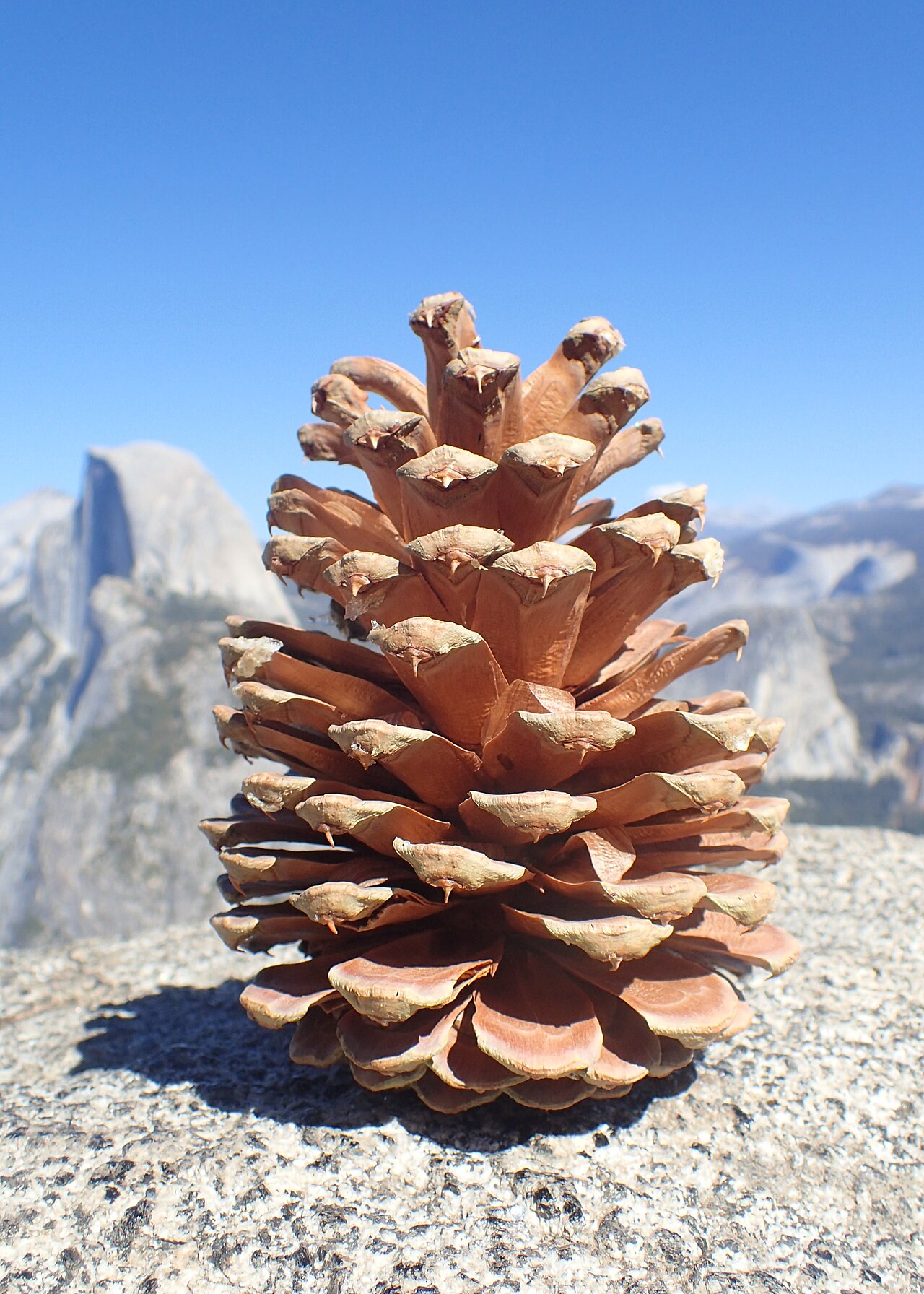
Cones are large, 5 to 10 inches long, egg-shaped, and reddish-brown at maturity, ripening over two growing seasons. The key identification feature is the prickles on the cone scales: Jeffrey pine’s prickles curve inward toward the cone, so the cone feels smooth and “gentle” when handled, while ponderosa pine’s prickles point outward and feel sharp — the classic field mnemonic is “gentle Jeffrey, prickly ponderosa.” Seeds are winged and wind-dispersed once the cone dries and opens.
Quick Facts
| Scientific Name | Pinus jeffreyi |
| Family | Pinaceae (Pine) |
| Plant Type | Evergreen coniferous tree |
| Mature Height | 80–130 ft (exceptional trees to 170+ ft) |
| Mature Spread | 25–40 ft |
| Growth Rate | Slow to moderate |
| Sun Exposure | Full Sun |
| Water Needs | Low; drought tolerant once established |
| Soil Type | Dry, rocky, well-drained; tolerates poor and serpentine soils |
| Soil pH | Wide tolerance, acidic to alkaline |
| Bloom Time | Cones pollinated May–June; not a flowering plant |
| Fall Color | None (evergreen) |
| Fruit | Large cones, 5–10 in, with inward-curved prickles; ripen over 2 years |
| Deer Resistant | Yes |
| USDA Hardiness Zones | 6–8 |
Native Range
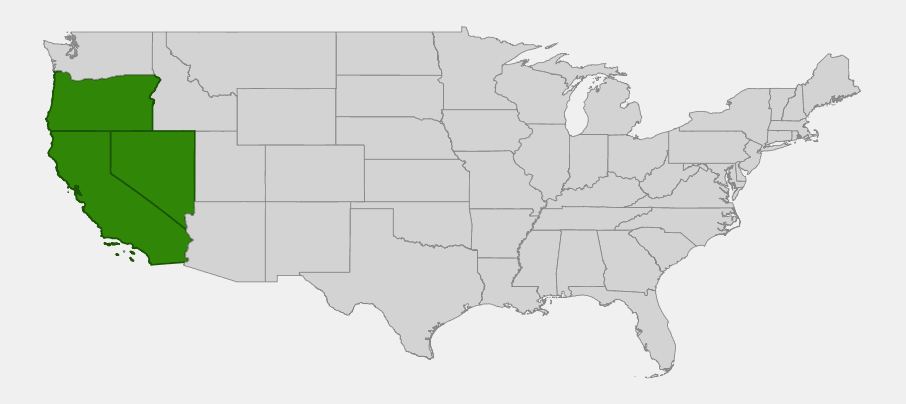
Jeffrey pine is centered in California, where it grows through the Sierra Nevada, Klamath and Siskiyou mountains, the Transverse and Peninsular ranges of southern California, and scattered desert-edge mountains, extending north into the southern Cascades and Siskiyous of Oregon and east onto a few high, dry ranges in Nevada near the California line. Its range continues south into the mountains of northern Baja California, Mexico, though that area falls outside this guide’s regional lists.
Jeffrey pine typically grows between about 6,000 and 9,500 feet in the southern Sierra Nevada and southern California mountains, descending to lower elevations, sometimes under 3,000 feet, toward the northern edge of its range in the Klamath-Siskiyou region and southern Oregon. It is especially associated with dry, cold-air-pooling basins, pumice flats, and serpentine or other nutrient-poor soils where it often forms nearly pure, open stands because few competing conifers can tolerate the same harsh ground; red fir, lodgepole pine and white fir are common neighbors on adjacent, less extreme sites.
Jeffrey pine is not considered rare or threatened rangewide, though individual stands have been affected by drought stress, bark beetle outbreaks and high-severity wildfire in recent decades, consistent with broader stress on California’s dry conifer forests. It is not native to, and should not be confused with, the much more widely distributed ponderosa pine, which overlaps with Jeffrey pine at many sites but generally occupies somewhat lower, less extreme ground.
📋 Regional plant lists featuring Jeffrey Pine: Idaho, Eastern Oregon & Eastern Washington · Western Oregon & Western Washington
Growing & Care Guide
Jeffrey pine makes an outstanding large specimen or reforestation tree where it has room to reach full size and the dry, well-drained conditions it is built for. It is a poor choice for small lots, irrigated lawns or heavy, wet soils.
Light
Plant Jeffrey pine in full sun. It is intolerant of shade at every life stage and naturally establishes only in open, sun-exposed ground, often on sites so dry and harsh that few shade-casting competitors survive alongside it.
Soil & Water
This is a tree built for poor, rocky, fast-draining soils, including pumice, decomposed granite and serpentine, and it is notably more tolerant of nutrient-poor and even mildly toxic serpentine ground than most other conifers. Established trees are strongly drought tolerant and should not be irrigated on a regular landscape schedule; wet feet, heavy clay or frequent watering are the most common causes of root rot and decline. Young trees benefit from deep, infrequent watering through their first two or three summers to encourage a deep root system.
Planting Tips
Plant container-grown seedlings in fall or early spring at higher elevations, giving the tree decades of room: mature Jeffrey pines need 25 to 40 feet of spread and should be sited well away from structures, septic systems and power lines. Avoid amending the planting hole with rich compost, which can encourage shallow roots poorly suited to the tree’s naturally lean, dry-soil habit.
Pruning & Maintenance
Mature Jeffrey pines need little pruning beyond removing dead, broken or diseased branches; avoid heavy pruning or “lion-tailing,” which stresses the tree and can increase vulnerability to wind damage and bark beetles. In drought-stressed years, monitor for bark beetle activity (pitch tubes, boring dust) since stressed, overcrowded or injured trees are more susceptible to attack.
Fire Ecology
Jeffrey pine is adapted to a historical regime of frequent, low- to moderate-severity surface fire, which thick bark on mature trees helps them survive while it thins out competing understory vegetation and seedlings of less fire-adapted species. Decades of fire suppression in many Jeffrey pine forests have allowed denser understory fuels to build up, increasing the risk of uncharacteristically severe, tree-killing fire; prescribed burning and mechanical thinning are widely used restoration tools in these forests today.
Landscape Uses
- Large specimen or shade tree on dry, well-drained properties with ample room
- Reforestation and fire-resilience plantings in appropriate montane settings
- Serpentine and poor-soil restoration where few other conifers will establish
- Wildlife habitat plantings supporting birds and small mammals
- Not suited to small residential lots, lawns, or irrigated landscapes
Wildlife & Ecological Value
Jeffrey pine forests, though often sparse and open compared with wetter conifer forests, support a distinct community of wildlife adapted to dry montane California.
For Birds
White-headed woodpeckers, mountain chickadees, pygmy nuthatches and Clark’s nutcrackers forage for seeds in Jeffrey pine cones and bark crevices, while larger cavity nesters, including northern flickers and various owls, use snags and older trees for nesting. Open-crowned mature trees also provide prominent perches for raptors hunting the surrounding dry forest and meadow edges.
For Mammals
Douglas squirrels and chipmunks cache Jeffrey pine seeds extensively, and black bears will feed on squirrel caches and on the cambium of stressed or damaged trees. Mule deer browse young seedlings and use open Jeffrey pine stands as travel corridors and bedding areas, particularly where a shrub understory of manzanita or ceanothus provides cover nearby.
For Pollinators
As a wind-pollinated conifer, Jeffrey pine does not depend on insect pollinators, but its bark and foliage host various native bark beetles, scale insects and other invertebrates that in turn support insectivorous birds working the trunk and canopy.
Ecosystem Role
Jeffrey pine is often a foundation species on the driest, poorest soils in its range, including serpentine barrens where it may be one of very few trees able to establish at all, shaping entire plant communities around it. Its deep roots stabilize steep, erosion-prone volcanic and granitic slopes, and its historically open, fire-maintained stand structure supports a diverse understory of drought-adapted shrubs, grasses and wildflowers that denser forest types cannot sustain.
Cultural & Historical Uses
Indigenous peoples of the Sierra Nevada and southern California mountains, including groups within the Washoe, Miwok and Cahuilla, historically gathered the large, nutritious seeds of Jeffrey pine (along with those of other regional pines) as a food source, and used pitch for waterproofing, adhesive and medicinal purposes.
The species is named for John Jeffrey, a 19th-century Scottish botanical collector sent to the Pacific Coast in the 1850s to gather conifer seed for European estates and forestry trials; Jeffrey pine was one of several western pines introduced to Britain and continental Europe through this and similar expeditions and is still occasionally planted ornamentally there. For many years Jeffrey pine was not distinguished from ponderosa pine in timber records, and the two species were — and sometimes still are — harvested and sold together as a mixed “yellow pine” product, though Jeffrey pine’s resin has a notably different chemical composition and was investigated in the 20th century as a possible source of heptane for industrial use.
Today Jeffrey pine’s main cultural significance is as an iconic tree of the Sierra Nevada and southern California high country, closely tied to recreation, forestry and, increasingly, the challenges of fire management and drought resilience in a changing climate.
Frequently Asked Questions
How do you tell Jeffrey pine from ponderosa pine?
Smell the bark: Jeffrey pine typically smells like vanilla, butterscotch or pineapple when warmed, while ponderosa smells faintly of turpentine or has little scent. Cone prickles are also diagnostic — Jeffrey pine’s curve inward and feel smooth, ponderosa’s point outward and feel sharp. Jeffrey pine also tends to have slightly longer needles and grows at higher, drier sites on average.
Does Jeffrey pine really smell like vanilla?
Many people describe it that way, though others report butterscotch or pineapple notes; the scent comes from aromatic compounds in the resin and is strongest on a warm, sunny bark furrow, especially in the afternoon heat.
Can Jeffrey pine grow on serpentine soil?
Yes, notably well. Jeffrey pine is one of the more serpentine-tolerant conifers in California and often dominates serpentine barrens where soil chemistry (low calcium, high magnesium and heavy metals) excludes many other trees.
How fast does Jeffrey pine grow?
Growth is slow to moderate, generally slower than lower-elevation pines, reflecting its harsh, dry, high-elevation habitat. Expect gradual, steady growth over decades rather than rapid early height gain.
Is Jeffrey pine good for a home landscape?
Only on large properties within or near its native elevation range with dry, well-drained soil. It ultimately becomes a very large tree and performs poorly with regular irrigation, rich soil, or confinement near structures, so it suits spacious, naturalistic or restoration plantings better than typical suburban yards.

Looking for a nursery that carries Jeffrey Pine?
Browse our native plant nursery directory: California · Oregon · Nevada