Eastern Prickly-pear (Opuntia humifusa)
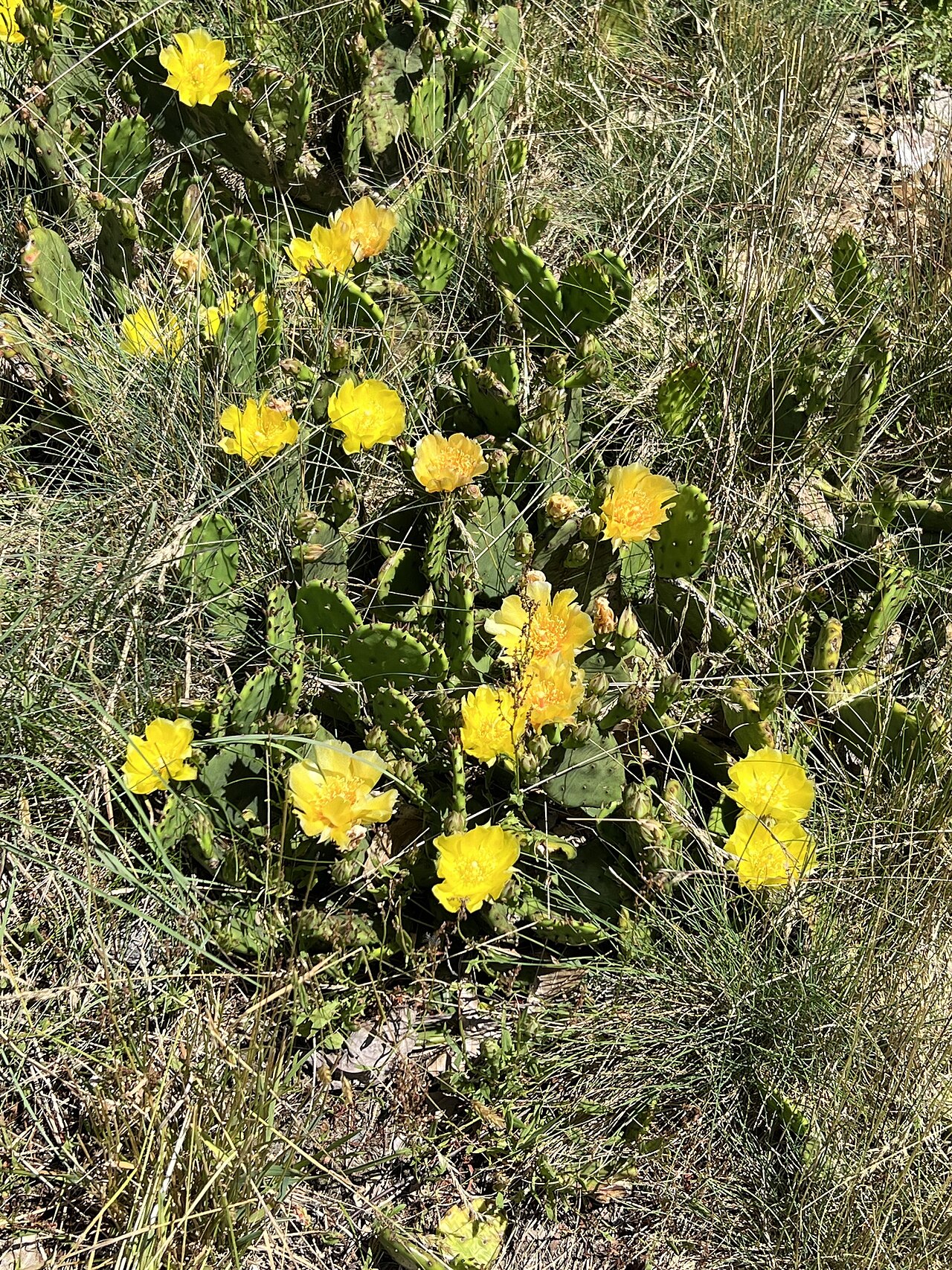
Opuntia humifusa, commonly called Eastern Prickly-pear (also devil’s-tongue or low prickly-pear), is a low, sprawling cactus and the most widely distributed native cactus in the eastern United States. It is easy to overlook most of the year as a mat of flattened green pads hugging sandy or rocky ground, then impossible to miss for a few weeks in early summer when it opens large, silky, lemon-yellow flowers that glow against the dry soil it favors. Few people expect to find a cactus growing wild in Ohio sandhills, Cape Cod dunes, or Appalachian glades, which makes this plant one of the more surprising native species in its range.
Eastern prickly-pear is a true survivor of poor, droughty soils where little else thrives: sand barrens, rock outcrops, dry prairie, old dune fields and thin-soiled glades. It stores water in its jointed pads, tolerates long dry spells and hard freezes alike, and spreads slowly outward or hitchhikes to new ground when a pad breaks off and roots where it lands. The trade-off for that toughness is a covering of fine, barbed bristles called glochids, hidden in little tufts (areoles) across the pad surface, that detach at the lightest touch and work into skin far more readily than the showier long spines some plants also carry.
In the garden, Eastern prickly-pear rewards a hot, dry, well-drained spot with reliable summer flowers, reddish-purple fruit that birds and small mammals readily eat, and almost no maintenance once established. It is one of the few native plants equally at home in a coastal sand garden in Rhode Island, a limestone glade in Missouri, or a rock garden in the upper Midwest, and it is the only cactus most gardeners in the eastern half of the country will ever grow outdoors year-round.
Identification
Eastern prickly-pear grows as a low, spreading, mat-forming cactus, typically 4 to 12 inches tall but spreading 2 to 6 feet wide as pads layer outward and root where they touch soil. There is no true trunk or woody stem; the whole plant is built from flattened, jointed pads (technically modified stems called cladodes) stacked end to end.
Pads & Spines
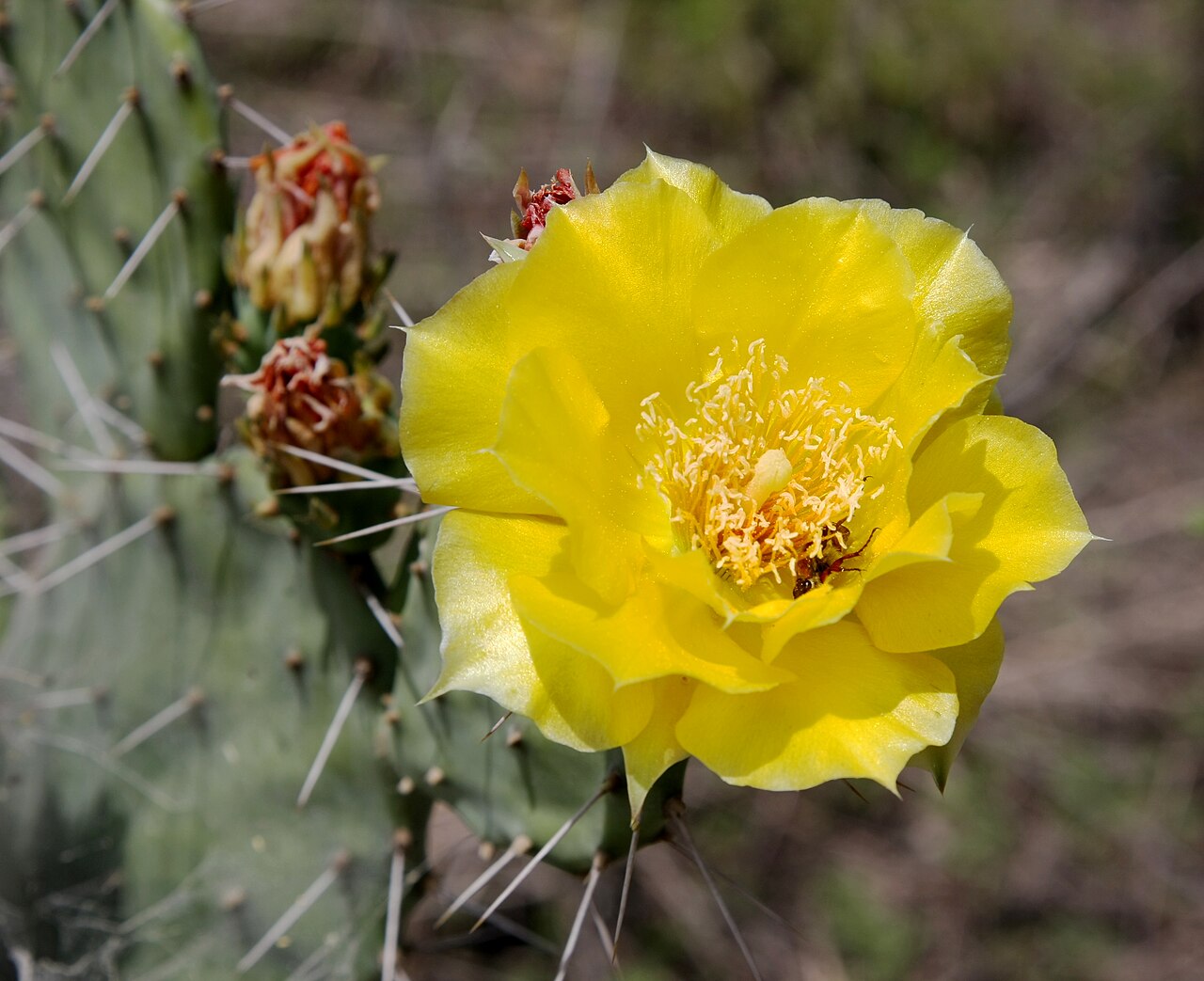
The pads are bright to blue-green, broadly oval to obovate, usually 2 to 6 inches long, and noticeably flattened and fleshy. Scattered across each pad are small cushion-like areoles, each bearing a tuft of tiny, barbed, hair-fine glochids that detach into skin on contact and a variable number of true spines. Many populations of Eastern prickly-pear have few or no long spines at all, which is part of why it gets mistaken for a harmless succulent until someone brushes against the glochids. Older, lower pads often shrivel and wrinkle in late summer drought or go limp and purplish after hard frost, then plump back up with the next rain or warm spell.
Flowers
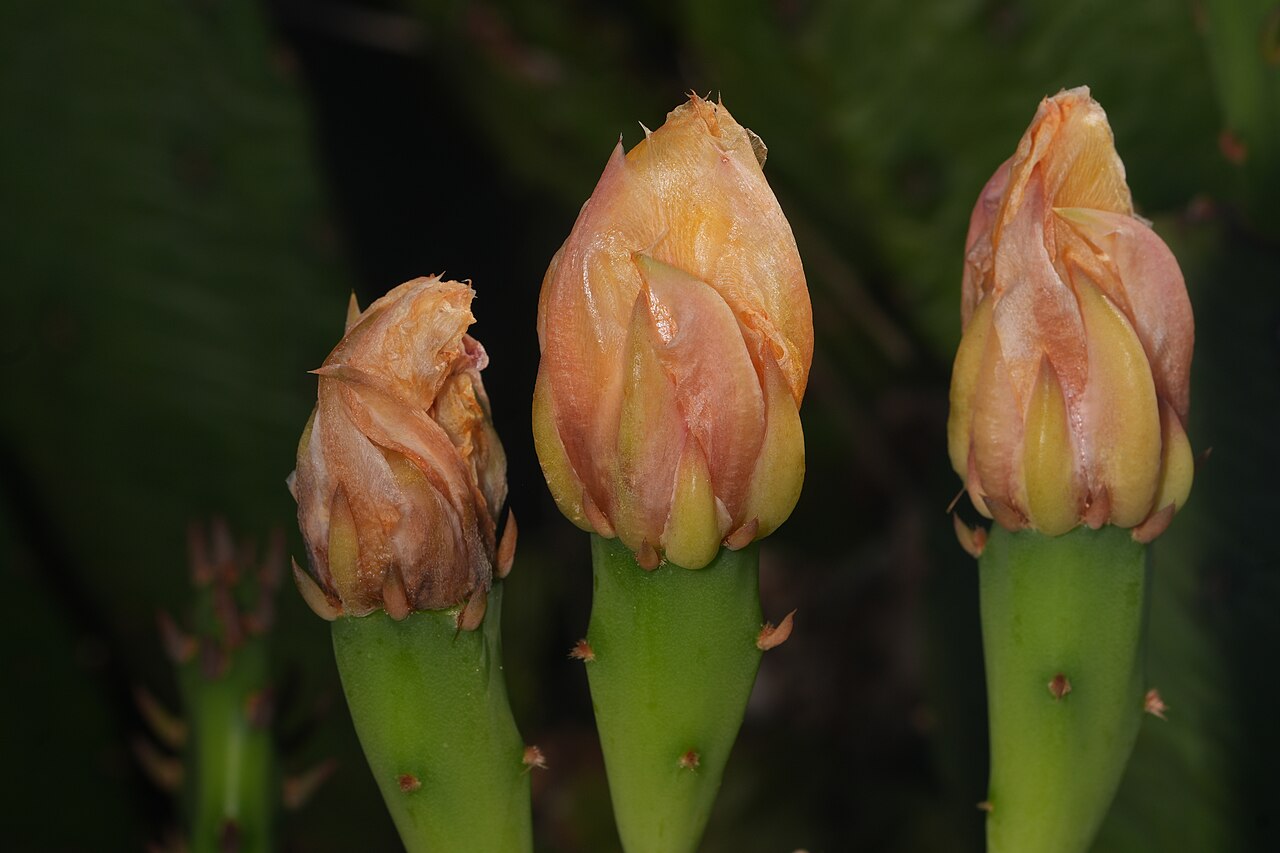
Flowers open from late spring into midsummer, each lasting only a day or two, in a rapid, showy succession along the upper edges of the previous year’s pads. They are 2 to 3 inches across, with many waxy, overlapping petals in clear lemon-yellow, occasionally with a reddish-orange throat, surrounding a dense cluster of yellow stamens that visibly curl inward when touched by a visiting bee — a built-in pollination trigger that dusts the insect with pollen.
Fruit & Seeds
Pollinated flowers swell into fleshy, barrel-shaped fruits (“tunas”) 1 to 1.5 inches long, green at first and ripening to reddish-purple by late summer and fall. The fruit pulp is edible and sweet once the glochids are carefully removed or burned off, and it is a reliable late-season food source for birds, raccoons, foxes and other wildlife, which disperse the many small, flattened, pale seeds embedded in the pulp.
Quick Facts
| Scientific Name | Opuntia humifusa |
| Family | Cactaceae (Cactus) |
| Plant Type | Mat-forming perennial cactus |
| Mature Height | 4–12 in |
| Mature Spread | 2–6 ft, slowly widening |
| Growth Rate | Slow to moderate |
| Sun Exposure | Full Sun |
| Water Needs | Low; drought tolerant |
| Soil Type | Sandy or rocky, sharply drained, low fertility |
| Soil pH | 6.0–8.0 (tolerates alkaline/limestone soils) |
| Bloom Time | Late May – July |
| Flower Color | Yellow, sometimes with an orange-red throat |
| Fall Color | None; pads may blush purple-red in cold weather |
| Fruit | Reddish-purple fleshy fruit, ripens late summer–fall |
| Deer Resistant | Yes |
| USDA Hardiness Zones | 4–9 |
Native Range
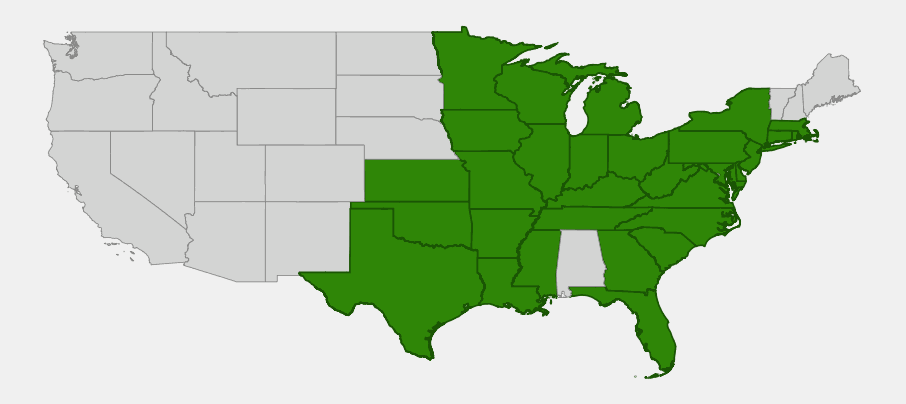
Eastern prickly-pear has the broadest native range of any cactus in North America, stretching from the Gulf Coast and Florida north through the Mississippi and Ohio valleys to the Great Lakes, and east to the Atlantic seaboard. It reaches its northeastern native limit in a scattering of coastal sites in Connecticut, Massachusetts and Rhode Island — New England’s only native cactus — but it is not native farther north or east in New England; plants grown in Vermont, New Hampshire or Maine gardens are cultivated well outside the species’ wild range, not naturalized populations. On the western edge of its range it native populations thin out around the Kansas–Nebraska border and the eastern edge of the Great Plains, well short of the Rocky Mountains.
Within that broad range, Eastern prickly-pear is a plant of specific, demanding microsites rather than a generalist: coastal and inland sand dunes, sandhills and sand prairie, exposed rock outcrops and glades, dry bluffs, and the thin, gravelly soils of old fields and barrens. It is usually found in full sun on soils too dry and infertile for most competing plants, often alongside little bluestem, prairie dropseed, sand jointweed and various lichens and mosses that share the same tough ground.
The species is not considered rare rangewide, but because it depends on open, undisturbed sandy or rocky ground, local populations can be lost quickly to development, fire suppression that allows woody encroachment, or off-road vehicle damage, and some northeastern coastal colonies are now small and closely watched. Eastern prickly-pear is not invasive or weedy outside its native range in North America; where it shows up well beyond the mapped states it is almost always a deliberately planted cold-hardy cactus rather than an escape.
📋 Regional plant lists featuring Eastern Prickly-pear: Connecticut, Massachusetts & Rhode Island · New York, Pennsylvania & Northern New Jersey · Delaware, Southern New Jersey & Long Island · Maryland, Virginia & West Virginia · North Carolina & South Carolina · Georgia, Alabama & Mississippi · Arkansas, Louisiana, Eastern Oklahoma & Eastern Texas · Kentucky & Tennessee · Ohio & Indiana · Illinois, Iowa & Missouri · Michigan, Wisconsin & Eastern Minnesota · Nebraska, Kansas & Eastern Colorado
Growing & Care Guide
Eastern prickly-pear is about as low-maintenance as a native plant gets, provided it has the one thing it cannot do without: sharp drainage. Give it a hot, dry, sunny spot and it will ask almost nothing of you for decades.
Light
Plant Eastern prickly-pear in full sun. It flowers best and stays compact and healthy with at least 6 hours of direct sun a day. In partial shade it survives but blooms sparsely and pads stretch and etiolate toward the light, becoming weaker and more prone to rot.
Soil & Water
Sharp drainage matters more than any other factor. Sandy, gravelly or rocky soils that would starve most garden plants are exactly what this cactus wants; heavy clay that holds winter moisture around the pads is the most common cause of failure, especially in colder zones where wet, cold roots rot. Once established, it needs no supplemental water beyond normal rainfall in most of its range and should not be irrigated on a regular garden schedule. New plantings benefit from an occasional deep watering during their first summer, then should be left alone.
Planting Tips
Plant in spring after the last hard frost, in a raised bed, slope, rock garden or sandy berm that sheds water quickly. Handle pads with tongs, thick leather gloves or several layers of newspaper — the glochids are nearly invisible and far more irritating than the obvious spines. A broken-off pad will root readily if set cut-side-down in sandy soil and kept dry for the first week or two to let the wound callus over before any watering.
Pruning & Maintenance
Little maintenance is needed beyond removing damaged, rotten or overcrowded pads with tongs, cutting cleanly at a joint. Winter cold often leaves pads looking limp, wrinkled or purplish; resist the urge to cut these back, since most recover fully as temperatures rise in spring. Established plants almost never need fertilizer and can be damaged by rich soil or excess nitrogen, which encourages soft, rot-prone growth.
Landscape Uses
- Rock gardens and dry slopes where few other natives tolerate the drainage
- Coastal and dune gardens in its native Atlantic and Gulf range
- Xeriscaping for hot, low-water landscapes
- Erosion control on sandy banks and barren fill
- Wildlife gardens, where the fruit feeds birds and small mammals
- Container and rooftop gardens with sharply draining mix
Wildlife & Ecological Value
For a plant that looks spare and sparse, Eastern prickly-pear supports a surprising amount of life, especially on the open, sandy sites where little else grows.
For Pollinators
The large yellow flowers are a magnet for native bees, including several specialist cactus bees in the genera Diadasia and Lithurgus that collect pollen almost exclusively from Opuntia flowers. Honeybees, bumblebees and beetles also visit freely, and the stamens’ touch-sensitive curling response helps ensure visiting insects pick up and deposit pollen efficiently.
For Birds
Ground-nesting and brush-dwelling birds use dense prickly-pear patches as protected nesting and loafing cover, since the spines and glochids deter most predators. Several songbirds and game birds eat the ripe fruit in late summer and fall, and the seeds pass through unharmed to sprout elsewhere.
For Mammals
Raccoons, opossums, foxes and white-tailed deer all browse the fruit, and some small mammals will eat pads in hard winters when little else is available, despite the glochids. In the driest, sandiest sites, prickly-pear patches can be an important late-season water and food source for wildlife when other plants have dried up.
Ecosystem Role
Eastern prickly-pear is one of relatively few succulent, drought-adapted plants native to the eastern United States, and it plays an outsized role in stabilizing the loose sand and thin soils where it grows. Its mats help anchor dune and barren soils against wind and water erosion, and the microhabitat beneath and around a mature clump — shaded, slightly cooler, and sheltered from browsing — often hosts smaller plants and insects that could not establish in open sand on their own.
Cultural & Historical Uses
Indigenous peoples across the plant’s range used Eastern prickly-pear in both food and practical ways for centuries before European contact. The ripe fruit was eaten fresh, dried for storage, or boiled into syrup, and the pads, with spines and glochids carefully scraped or burned away, were split and used as an emergency source of moisture and as a poultice for minor wounds and insect stings.
Early European settlers in the eastern colonies and later prairie homesteads adopted similar uses, candying the fruit, brewing it into jellies, and occasionally cooking the cleaned pads (nopales) as a vegetable, a practice more strongly associated with the plant’s southwestern relatives but documented in parts of the eastern range as well. Farmers also noted — sometimes with frustration — that cattle and horses would graze pads down to the spines in hard winters when other forage was scarce.
Today Eastern prickly-pear’s main cultural role is as a horticultural curiosity and teaching plant: a genuinely cold-hardy, winter-surviving cactus that lets gardeners from New England to the Upper Midwest grow a true cactus outdoors, and a frequent stop on native-plant walks in the sandy habitats where it grows wild.
Frequently Asked Questions
Is Eastern prickly-pear dangerous to touch?
It is not toxic, but handling it bare-handed is a bad idea. The fine, barbed glochids detach at the lightest brush and are difficult to see and remove from skin. Use tongs, thick gloves or folded cardboard whenever you handle pads or fruit, and remove glochids promptly with tweezers or tape if you are stuck.
Can you eat the fruit?
Yes. The ripe, reddish-purple fruit is sweet and edible once the glochids are carefully scraped, brushed or singed off, a step that should never be skipped. It is traditionally eaten fresh or made into jelly and syrup.
Will it survive a cold winter?
Yes, within its hardiness range. Eastern prickly-pear is reliably hardy to USDA zone 4 and is the cold-hardiest cactus commonly grown in the eastern United States. Pads typically go limp and reddish-purple in freezing weather and plump back up as soil warms in spring.
Is it the same plant as prickly-pear cactus sold in grocery stores?
No. The nopales and prickly-pear fruit (“tunas”) sold commercially usually come from larger, more southerly Opuntia species grown in the Southwest and Mexico. Eastern prickly-pear is a smaller, hardier, wild native species with edible but less commonly marketed fruit and pads.
Why isn’t it native to Vermont, New Hampshire or Maine if it tolerates cold winters?
Cold tolerance is not the limiting factor; suitable dry, sandy or rocky, well-drained open ground is. Those three states simply lack the kind of exposed, droughty habitat the species depends on in the wild, so any plants seen there are garden specimens, not wild populations.

Looking for a nursery that carries Eastern Prickly-pear?
Browse our native plant nursery directory: Arkansas · Connecticut, Delaware, Florida & Georgia · Illinois, Indiana, Iowa & Kansas · Kentucky, Louisiana, Maryland, Massachusetts, Michigan, Minnesota, Mississippi & Missouri · New Jersey, New York, North Carolina, Ohio & Oklahoma · Pennsylvania, Rhode Island, South Carolina, Tennessee, Texas & Virginia · West Virginia & Wisconsin