
Great Camas (Camassia leichtlinii)
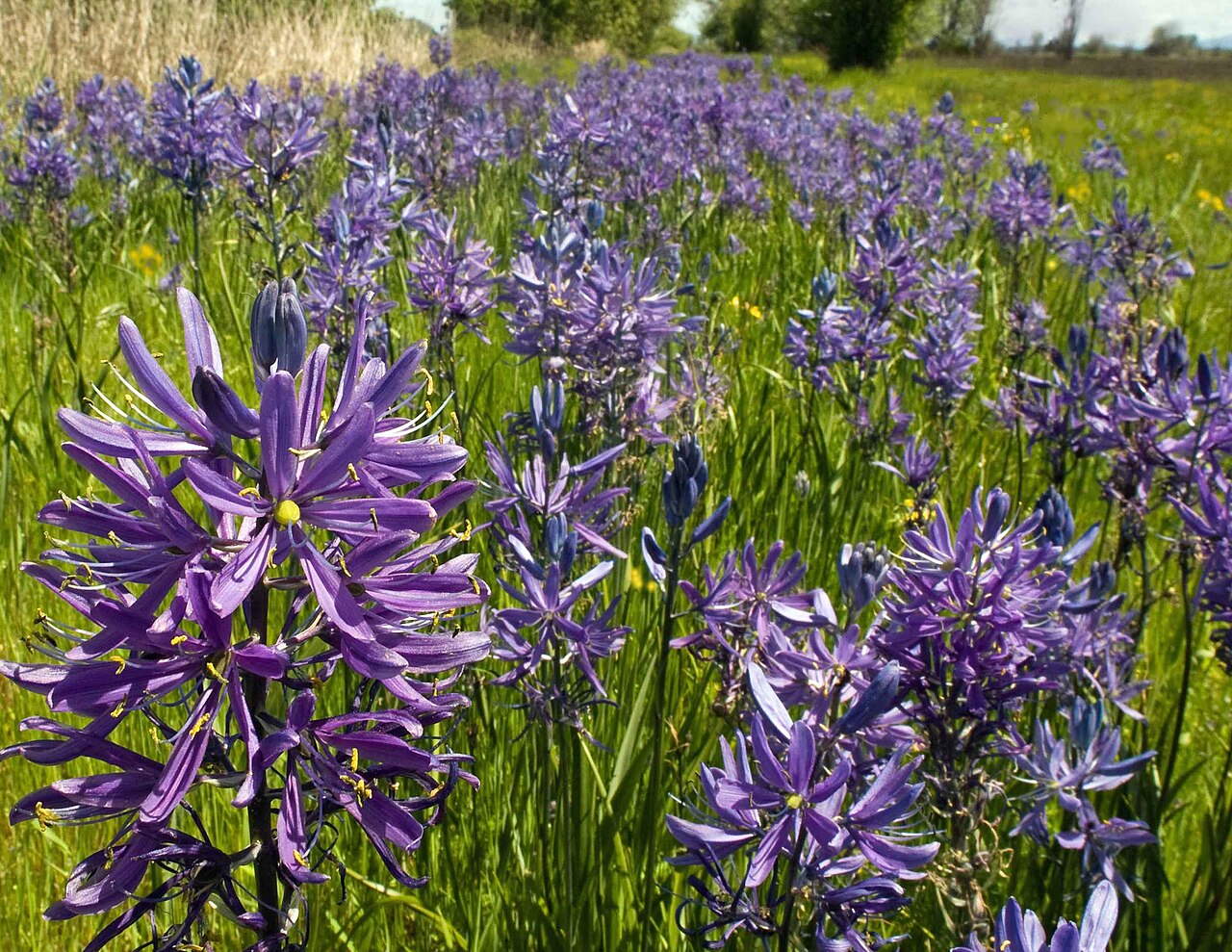
Camassia leichtlinii, known as Great Camas or large camas, is a tall spring-blooming bulb of the asparagus family (Asparagaceae) native to the Pacific Northwest and northern California. From April to June it sends up leafless stems 2 to 4 feet tall, each topped with a long spike of starry, blue-violet (rarely cream-white) flowers that open from the bottom up. In wet meadows and prairies it can grow in such numbers that whole fields turn blue.
Great camas is the larger, later-blooming cousin of blue camas (Camassia quamash), and the two often grow near each other. Like blue camas, it was an important food plant: its starchy bulbs were dug and pit-roasted by Indigenous peoples of the Northwest for thousands of years. It also has a long history in gardens, both in North America and in Europe, where named selections such as ‘Caerulea’ and ‘Blue Danube’ are common in borders and naturalized meadows.
In the garden, great camas is one of the easiest and showiest native bulbs for soil that is wet in winter and spring and dry in summer, the classic pattern of the Pacific Northwest. It feeds early native bees and bumble bees, then goes dormant by midsummer. This guide covers how to identify it (including how to tell it from the deadly death camases), where it grows, how to plant it, and its role in wildlife and culture.
Identification
Great camas is a grass-leaved bulb with a tall spike of blue-violet stars. Out of flower it is easy to confuse with other bulbs, including the poisonous death camases, so identify it in bloom.
Bulb & Growth Habit
Each plant grows from a deep, onion-like bulb, roughly 1 to 2 inches across, with a dark outer coat. A clump of narrow basal leaves appears in late winter or early spring, followed by a single, leafless flowering stem that is usually 2 to 4 feet tall in good conditions. Over the years, bulbs offset slowly to form small clumps, and colonies spread by seed.
Leaves
The leaves are long, narrow and grass-like, about 1/2 to 1 inch wide and up to about 2 feet long, keeled and slightly bluish-green. They are all basal. They wither in early summer as the soil dries and the seed ripens.
Flowers
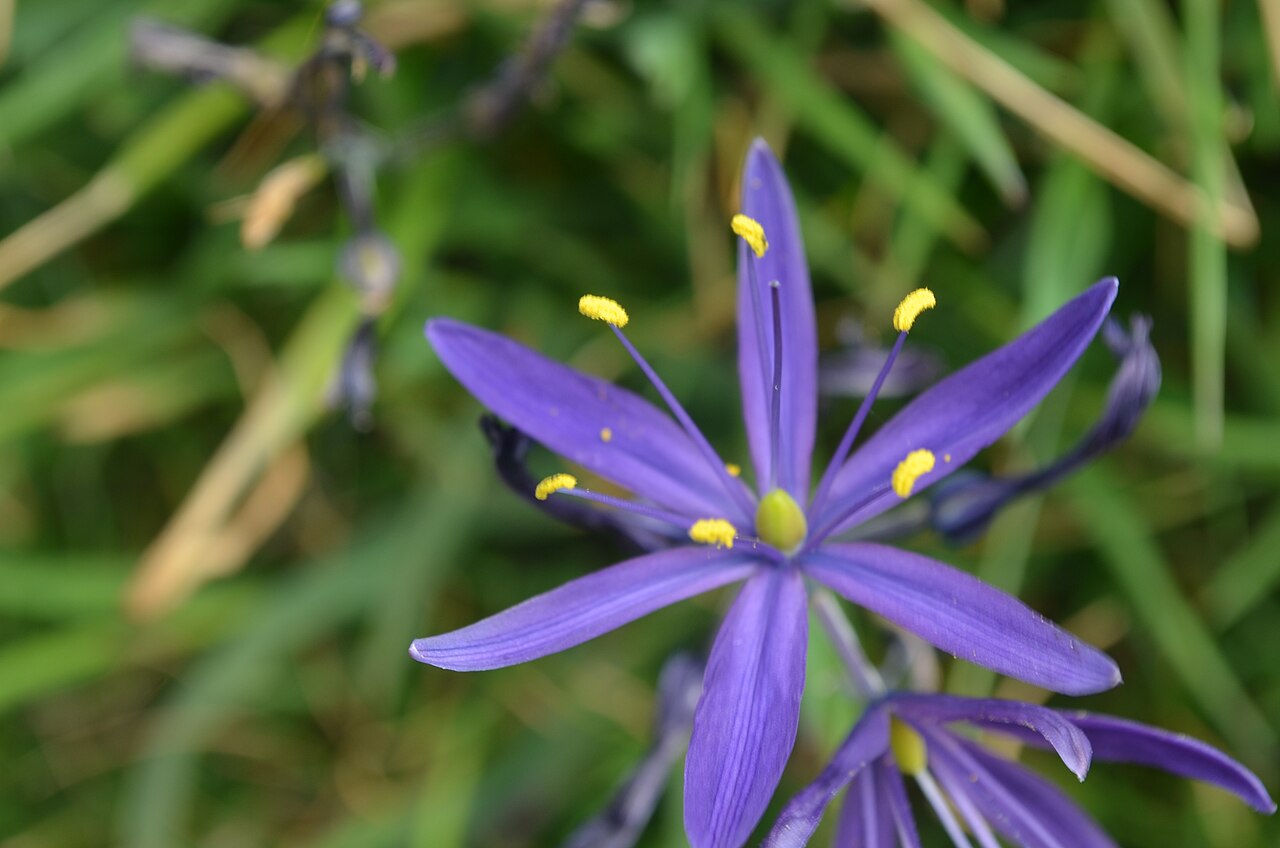
The flowers are borne in a long raceme, often with dozens of buds. Each flower has six narrow tepals, usually 1 to 1-1/2 inches long, spreading evenly to form a symmetrical star, with six stamens tipped by yellow anthers. Most wild plants have blue-violet to deep purple flowers; the white- to cream-flowered subspecies leichtlinii is restricted to southwestern Oregon. A good field mark: after a flower fades, its tepals twist together over the developing capsule, rather than withering separately as in blue camas.
Fruit & Seeds
The fruit is an upright, three-parted capsule that ripens and turns papery in early summer, splitting to release shiny black seeds. Seeds fall near the parent, which is why camas forms dense patches over time.
Look-alikes & Death Camas
Blue camas (C. quamash) is usually shorter, blooms a week or two earlier, and often has slightly irregular flowers with one tepal set apart from the other five; its withered tepals do not twist together. More importantly, camas grows in the same meadows as the death camases, including meadow death camas (Toxicoscordion venenosum), which has creamy-white flowers in a shorter, denser cluster. Their bulbs and leaves look very similar, and death camas is highly poisonous to people and livestock. Never dig or eat a camas bulb unless you are certain of the identification, ideally marked while in flower.
Quick Facts
| Scientific Name | Camassia leichtlinii (Baker) S. Watson |
| Family | Asparagaceae (asparagus family; formerly Liliaceae) |
| Plant Type | Perennial bulb; summer-dormant |
| Mature Height | 2–4 ft in flower |
| Mature Spread | 6–12 in per clump |
| Growth Rate | Moderate; slowly forms clumps and colonies |
| Sun Exposure | Full sun to part shade |
| Water Needs | Moist to wet in winter and spring; dry summer dormancy is fine |
| Soil Type | Heavy clay, loam or seasonally wet soils; tolerates poor drainage in winter |
| Soil pH | About 5.5–7.0 |
| Bloom Time | April–June |
| Flower Color | Blue-violet to deep purple; cream-white in subsp. leichtlinii |
| Fall Color | None; dormant from midsummer |
| Fruit | Upright three-parted capsule with shiny black seeds |
| Deer Resistant | Moderate; bulbs are eaten by gophers and voles |
| USDA Hardiness Zones | 4–8 |
Native Range
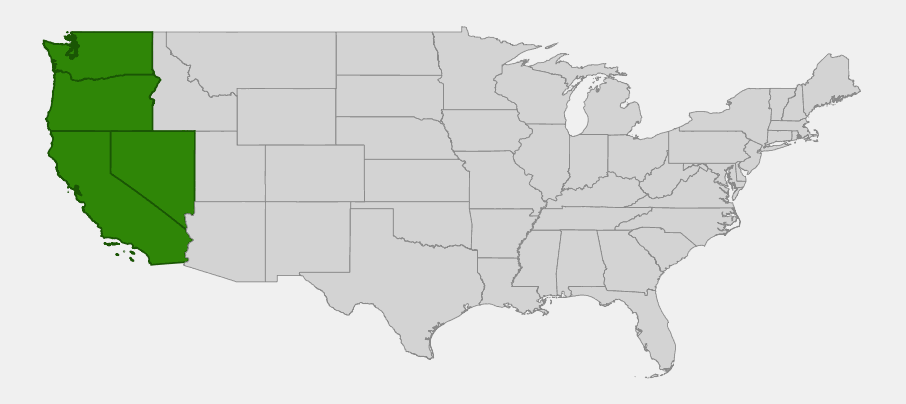
Great camas is a plant of the Pacific Northwest and northern California. USDA PLANTS lists it as native to California, Nevada, Oregon and Washington, and to British Columbia in Canada, where it grows on southern Vancouver Island and the nearby Gulf Islands. Its stronghold is west of the Cascades, in the Puget Trough, the San Juan Islands, the Willamette Valley and the valleys of southwestern Oregon.
In California it grows in the northern part of the state, from the Klamath Mountains and North Coast Ranges east to the Cascades and the northern Sierra Nevada. Nevada records are few and are best treated as outlying populations at the eastern edge of the Sierra. A handful of herbarium and observation records come from east of the Cascades in Oregon and Washington, but there blue camas is the common species.
Typical habitats are wet meadows, wet prairies, seasonally flooded grasslands, oak savannas, streambanks and moist openings in conifer forest, from near sea level to middle elevations in the mountains. Two subspecies are usually recognized: the widespread, blue-flowered subsp. suksdorfii, and the cream-flowered subsp. leichtlinii of southwestern Oregon.
📋 Regional plant lists featuring Great Camas: Western Oregon & Western Washington · California & Nevada · Idaho, Eastern Oregon & Eastern Washington
Growing & Care Guide
Great camas is one of the most reliable native bulbs for gardens with a wet winter and a dry summer. It is widely sold as bulbs, but many garden bulbs are European selections. For restoration or a truly local planting, look for regional native nurseries and seed of local origin.
Light
Plant it in full sun for the best flowering and strongest stems. It also grows in part shade, such as under deciduous oaks or along woodland edges, where it flowers a little less and may lean toward the light.
Soil & Water
Great camas likes moisture in winter and spring, and tolerates heavy clay and soil that stays wet or even briefly flooded while it is growing. That makes it a good choice for rain gardens, swales and low spots where many bulbs would rot. Once the leaves yellow in summer, it needs no water at all, and it also tolerates regular garden watering in well-drained beds.
Planting Tips
Plant bulbs in fall, about 4 to 6 inches deep and 4 to 6 inches apart, in drifts rather than single rows. Camas looks best in groups of a dozen or more, and in a meadow or among bunchgrasses, where the grasses hide its fading leaves in summer. It combines well with other spring wildflowers and with deciduous shrubs.
Pruning & Maintenance
Little care is needed. Let the leaves die back naturally so the bulb can store energy for next year. Cut the flower stems after the seed has dropped if you want more plants, or earlier if you want a tidier look. In meadows, mow only after the plants have gone dormant and set seed, usually from July on.
Propagation
Divide crowded clumps when the bulbs are dormant in late summer or early fall. Camas also grows readily from seed sown outdoors in fall; the seeds need a winter of cold, moist conditions to germinate. Seedlings form a single grass-like leaf the first year and take about three to five years to reach flowering size, so seeding is best for large plantings and restoration.
Landscape Uses
- Rain gardens and swales: tolerates winter wet and clay, then goes dormant in summer
- Meadow and prairie gardens: a dramatic spring bloom among native bunchgrasses
- Oak savanna restoration: a signature wildflower of Willamette Valley and Puget Trough prairies
- Pollinator plantings: early-season pollen and nectar for bumble bees and native bees
- Perennial borders: tall blue spikes in late spring that pair well with later-blooming perennials
Wildlife & Ecological Value
Great camas is part of the spring flush of wildflowers in Northwest prairies and wet meadows. It supports early-season insects and is part of the larger camas prairie ecosystem.
For Pollinators
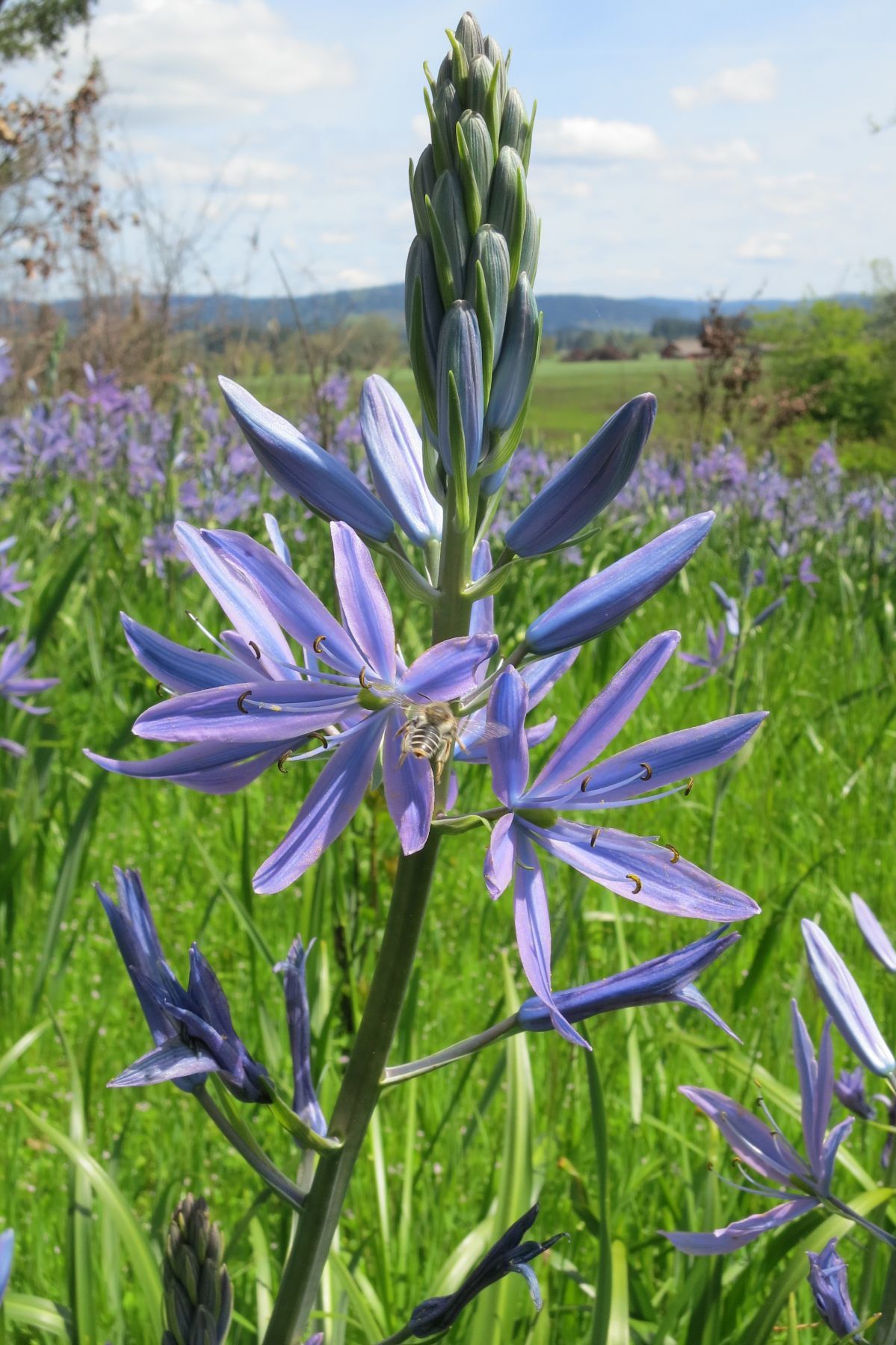
The open, upward-facing flowers offer easy access to pollen and nectar. Bumble bees, mining bees, sweat bees and other native bees visit them in spring, along with flies and beetles. The Xerces Society notes great camas as having special value to native bees, and long flower spikes provide a steady source over several weeks.
For Birds
Seed-eating birds may pick seeds from open capsules, and camas meadows support insects that feed nesting birds in spring. Wet prairies with camas are also used by birds such as the streaked horned lark and western meadowlark in parts of the range, though camas itself is not a major bird food.
For Mammals
The starchy bulbs are eaten by pocket gophers, voles and other rodents, and deer and elk sometimes graze the leaves and flower stems. In gardens with heavy gopher pressure, plant bulbs in wire baskets.
Ecosystem Role
Great camas is a characteristic plant of the wet prairies and oak savannas of western Oregon and Washington, among the most endangered ecosystems in the Northwest. Many of these prairies were maintained for centuries by Indigenous burning and harvesting, which kept trees and shrubs at bay and favored camas. Today, camas is a key species in prairie restoration in the Willamette Valley and the Puget Sound region.
Cultural & Historical Uses
Camas bulbs were among the most important plant foods of the Pacific Northwest. Many Indigenous peoples, including Kalapuya, Coast Salish and other nations, dug camas each year, often from family-tended beds, and roasted the bulbs in earth ovens for a day or more. Long cooking turns the bulb’s indigestible inulin into sweet, digestible sugars, giving it a flavor often compared to sweet potato. The bulbs were eaten fresh, pressed into cakes and dried, and traded widely.
Harvesting was carefully managed. People dug the largest bulbs, replanted small ones, and burned the prairies to keep them open. The camas prairies that early settlers admired in the Willamette Valley and on Vancouver Island were in large part cultural landscapes. Many of these traditions continue today through tribal camas harvests and restoration projects.
The genus name Camassia comes from camas or quamash, an Indigenous name for the plant that entered English through Chinook Jargon. The species is named for Max Leichtlin (1831–1910), a German plant collector in Baden-Baden who grew and distributed many new bulbs. Great camas has been grown in European gardens since the 19th century.
Frequently Asked Questions
What is the difference between great camas and blue camas?
Great camas (Camassia leichtlinii) is usually taller, blooms a little later, and has symmetrical flowers whose withered tepals twist together over the seed capsule. Blue camas (C. quamash) is generally shorter, has a wider range across the West, and its withered tepals stay separate.
Are camas bulbs edible?
Camas bulbs were a traditional staple food when correctly identified and slow-roasted. However, they grow alongside the highly poisonous death camases, whose bulbs look almost the same. Never eat a wild bulb unless an expert has confirmed it, and leave wild camas meadows undisturbed.
Will great camas grow in clay or wet soil?
Yes. It is one of the best bulbs for heavy clay and for soil that stays wet in winter and spring, as long as it is not underwater all summer.
When should I plant great camas bulbs?
Plant bulbs in fall, about 4 to 6 inches deep. They root over winter and flower from April to June, depending on location.
Does great camas spread?
Slowly. Bulbs form small offsets and plants self-sow where the seed can fall on open ground, forming larger drifts over several years.

Looking for a nursery that carries Great Camas?
Browse our native plant nursery directory: California · Nevada · Oregon · Washington

