
Wisteria: Native American and Kentucky Wisteria (Wisteria)
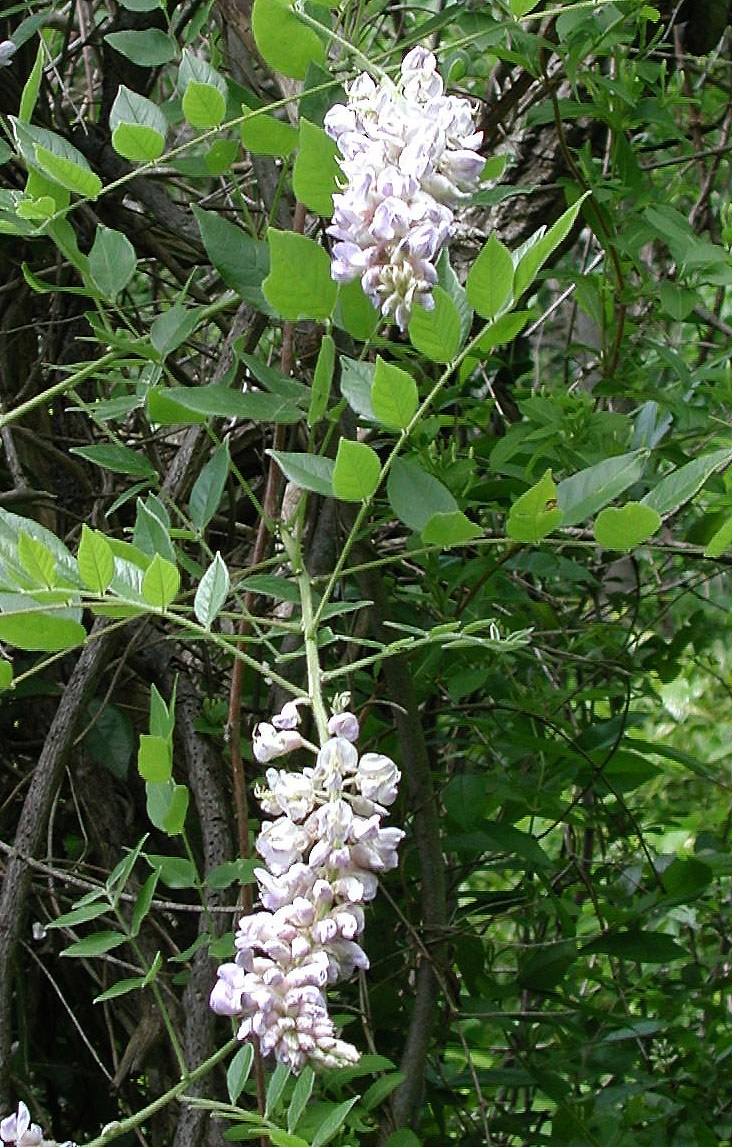
Wisteria is a small genus of twining, woody vines in the pea family (Fabaceae), famous for hanging clusters of purple, lilac or white flowers in spring. The wisteria most people know, the huge vine that drapes old porches and climbs into treetops, is Chinese wisteria (Wisteria sinensis) or Japanese wisteria (Wisteria floribunda), or a hybrid of the two. Both are Asian, and both have escaped to become invasive in forests across much of the eastern United States.
The United States has its own wisterias, and they make far better garden plants for most yards. American wisteria (Wisteria frutescens) grows wild in swamps, riverbanks and wet woods across the Southeast, and Kentucky wisteria (Wisteria macrostachya) grows along rivers and bottomland forests of the lower Mississippi and Ohio valleys. Some botanists treat Kentucky wisteria as a variety of American wisteria (W. frutescens var. macrostachya); for gardeners the two are distinct enough to discuss separately.
Native wisterias are smaller, slower and far better-mannered than the Asian species. They reach roughly 15 to 30 feet rather than 60 feet or more, bloom after the leaves come out (so late frosts rarely ruin the flowers), and usually start flowering within a few years of planting instead of making you wait a decade. If you came here from one of our state vine or tree guides, this page explains which wisteria is native where you live, and how to spot the invasive look-alikes.
Identification
All wisterias are twining vines with alternate, pinnately compound leaves (a central stalk with paired leaflets and one at the tip) and pea-shaped flowers in hanging clusters (racemes), followed by bean-like pods. The clues below separate the native species from each other and from their Asian relatives.
Stems & Bark
Young stems are slender, green to brown and twine tightly around supports. Older stems become woody with smooth gray bark, but native wisterias seldom develop the massive, trunk-like stems of old Asian vines. Native vines are typically 15 to 30 feet long, while Chinese and Japanese wisteria can climb 60 feet or more into tree canopies and strangle the trees they climb.
Leaves
Leaves are 7 to 12 inches long with usually 9 to 15 leaflets in American wisteria and Kentucky wisteria. The leaflets are oval to lance-shaped, smooth-edged and dark green, turning yellow before they drop in fall. Leaflet count alone does not reliably separate native from Asian species, but combined with flower timing and pods (below) it helps.
Flowers
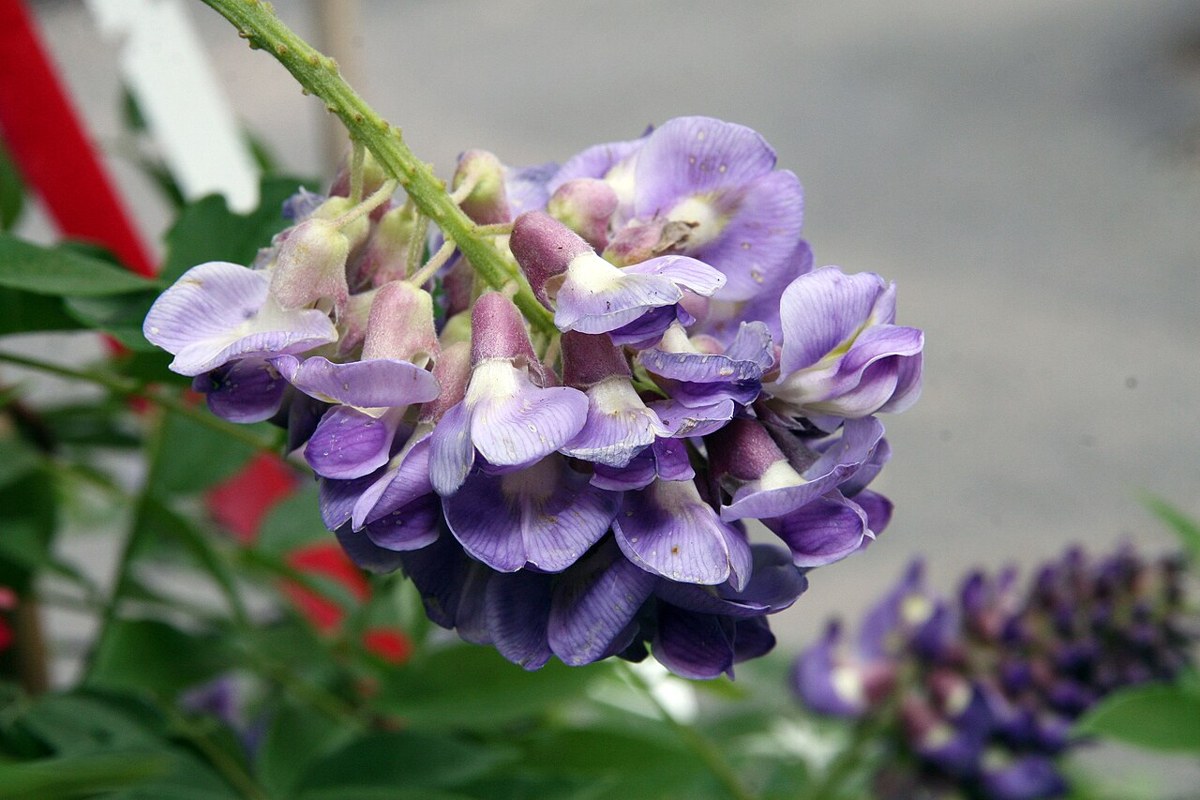
American wisteria produces short, dense, cylindrical clusters about 2 to 6 inches long of lilac to blue-purple flowers, each with a yellowish-green spot at the base of the upper petal. Kentucky wisteria has noticeably longer, looser clusters, typically 8 to 12 inches, of lilac-blue flowers, and it tends to bloom a week or two later. Both bloom from mid to late spring after the leaves have expanded, and both often produce a few scattered clusters again in summer. They are lightly fragrant at most. White-flowered forms of both exist in the nursery trade.
Fruit & Seeds
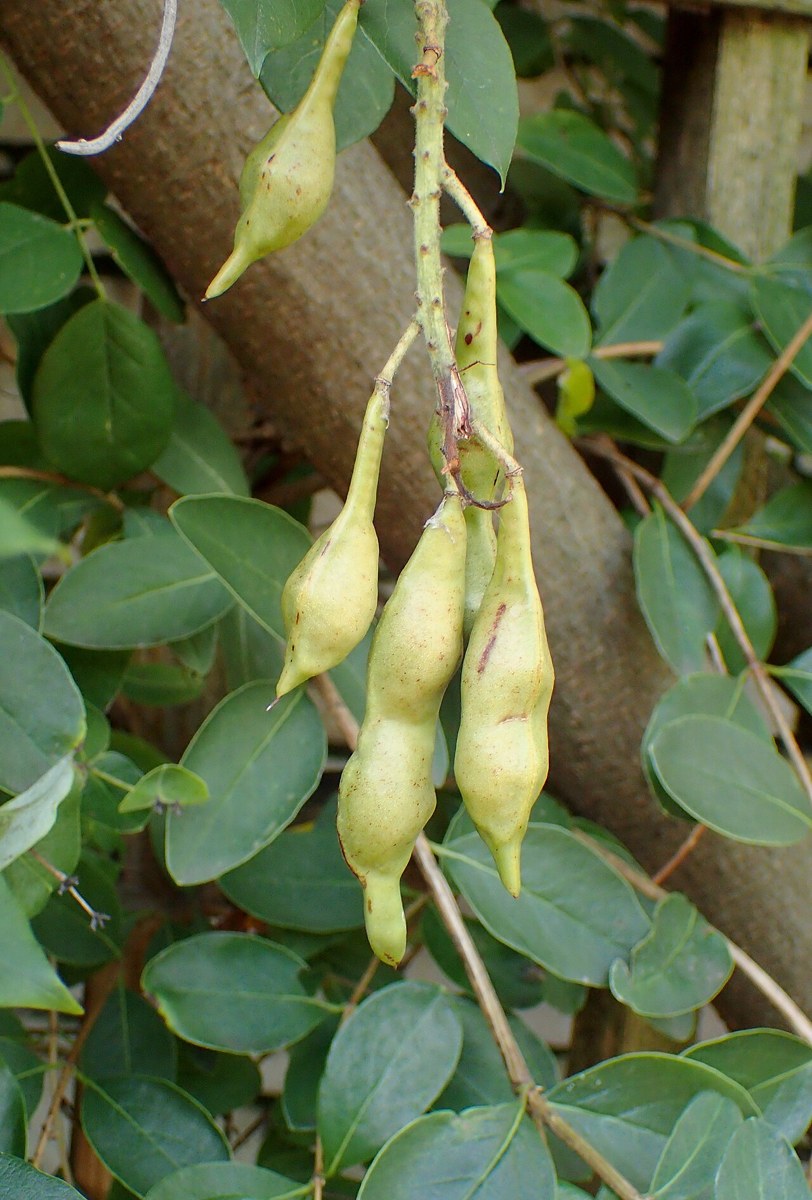
The pods are the single most reliable way to tell native from Asian wisteria. Native wisterias have smooth, hairless pods, 2 to 5 inches long, often slightly constricted between the seeds. Chinese and Japanese wisteria have velvety, fuzzy pods. Pods of all wisterias split in fall or winter, sometimes with a snap, releasing a few large, flat, round seeds.
Quick Facts
| Scientific Name | Wisteria (genus): W. frutescens and W. macrostachya native |
| Family | Fabaceae (Pea or Legume) |
| U.S. Native Species | 2 (often treated as one species with two varieties) |
| Plant Type | Deciduous twining woody vine |
| Mature Height | 15–30 ft (vine length) |
| Growth Rate | Moderate to fast; far less aggressive than Asian wisteria |
| Sun Exposure | Full sun to part shade (best flowering in full sun) |
| Water Needs | Moist to average; tolerates periodic flooding |
| Soil Type | Moist loam, clay or sandy soils; streambanks and bottomlands |
| Soil pH | Slightly acidic to neutral |
| Bloom Time | Mid to late spring after leaf-out, with scattered summer rebloom |
| Flower Color | Lilac, blue-purple or lavender; white forms in cultivation |
| Fall Color | Yellow |
| Fruit | Smooth, hairless pods 2–5 in long |
| Toxicity | Seeds and pods are poisonous if eaten |
| USDA Hardiness Zones | 5–9 (American); 4–9 (Kentucky) |
Native Range
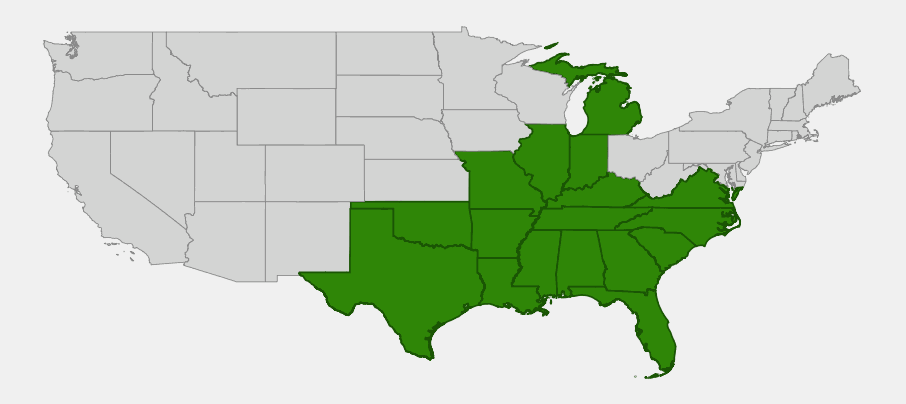
American wisteria is a plant of the southeastern Coastal Plain and Piedmont. It grows wild from southeastern Virginia south through the Carolinas, Georgia and Florida, west along the Gulf Coast to Louisiana and eastern Texas, and north through Arkansas, Tennessee and Kentucky into Missouri, southern Illinois and Oklahoma. It is a characteristic vine of swamp forests, river and creek banks, wet thickets and the edges of bottomland hardwood forests.
Kentucky wisteria occupies the lower Mississippi and Ohio river valleys: Illinois, Indiana, Kentucky, Tennessee, Missouri, Arkansas, Mississippi, Louisiana, eastern Oklahoma and eastern Texas. It grows in similar wet, rich bottomland woods. Native wisteria also reaches southeastern Michigan, where it is rare, at the northern edge of its range. Where the two native species overlap, intermediate plants are common, which is one reason some botanists combine them.
No wisteria is native to New England, New York, Pennsylvania, the upper Midwest, the Great Plains or anywhere in the West. Wisteria seen in Massachusetts, Wisconsin, Utah or California is planted, and in eastern states the large vines climbing trees along roads and woods are almost always escaped Chinese or Japanese wisteria. Gardeners outside the native range can still grow American or Kentucky wisteria as far better-behaved alternatives to the Asian species, with Kentucky wisteria the hardier choice in colder states.
📋 Regional plant lists covering native wisteria’s range: Arkansas, Louisiana, Eastern Oklahoma & Eastern Texas · Georgia, Alabama & Mississippi · North Carolina & South Carolina · Maryland, Virginia & West Virginia · Kentucky & Tennessee · Illinois, Iowa & Missouri · Ohio & Indiana · Michigan, Wisconsin & Eastern Minnesota
Native Species
American Wisteria (Wisteria frutescens)
Native to: the Southeast, from Virginia to Florida and west to Texas, Oklahoma, Missouri and southern Illinois. The compact native wisteria, with short, dense, 2- to 6-inch clusters of lilac-purple flowers in mid to late spring and often again in summer. It flowers young, often within two or three years from a nursery plant, and is the best wisteria for small gardens and arbors in zones 5 to 9. Popular selections include ‘Amethyst Falls’ (lavender-purple, compact) and white-flowered forms such as ‘Nivea’.
Kentucky Wisteria (Wisteria macrostachya)
Native to: the lower Mississippi and Ohio river valleys, from Illinois and Kentucky south to Louisiana and eastern Texas. Larger and somewhat more vigorous than American wisteria, with longer, 8- to 12-inch clusters that look closer to the Asian species, blooming slightly later. It is the most cold-hardy wisteria; the cultivar ‘Blue Moon’, selected in Minnesota, is widely grown in zone 4 and is the usual choice for northern gardens that want wisteria without planting an invasive species. ‘Aunt Dee’ is another popular selection.
Because the two native species intergrade where their ranges meet, nursery plants may be labeled Wisteria frutescens var. macrostachya or W. frutescens ‘Blue Moon’. Any of these names refers to a native American wisteria.
Non-Native Look-Alikes
Chinese and Japanese wisteria are sold everywhere, are often simply labeled “wisteria”, and are by far the most common wisterias in American yards. Both are listed as invasive by state invasive plant councils and agencies across much of the East and South, where they spread by long runners and seed into forests, climb and girdle trees, and smother native vegetation. Neither should be planted.
Chinese Wisteria (Wisteria sinensis), invasive
Blooms in early spring before or as the leaves emerge, with 6- to 12-inch clusters in which all flowers open at about the same time, giving a strongly fragrant, lilac-blue cloud. Leaves usually have 7 to 13 leaflets, and the pods are velvety. It is the most widespread invasive wisteria from the Mid-Atlantic and Ohio Valley through the Southeast, where it forms dense thickets along forest edges, roadsides and old homesites.
Japanese Wisteria (Wisteria floribunda), invasive
Has very long flower clusters, often 12 to 36 inches, that open gradually from the top of the cluster to the bottom, and leaves with more leaflets (usually 13 to 19). Pods are velvety. It is also invasive in the eastern United States, though somewhat less widespread than Chinese wisteria. Hybrids between the two Asian species (Wisteria × formosa) are common in gardens and in the wild.
How to tell native from Asian wisteria
- Timing: Asian wisterias bloom on bare or barely leafed stems in early spring; native wisterias bloom later, among fully expanded leaves.
- Flower clusters: American wisteria clusters are short and dense (2–6 in); Asian clusters are long (6–36 in). Kentucky wisteria (8–12 in) overlaps with Chinese wisteria, so check the other clues.
- Pods: smooth and hairless on natives; velvety on Chinese and Japanese wisteria. This is the most dependable clue in summer and fall.
- Size and behavior: a vine with trunk-like stems climbing high into trees, or runners spreading across the ground into nearby woods, is almost certainly Asian.
If you have an Asian wisteria, cut the vines at the base, pull or treat resprouts, and remove runners; then plant American or Kentucky wisteria in its place for a similar look without the invasive behavior.
Growing & Care Guide
Native wisterias are some of the easiest flowering vines to grow. Give them sun, moisture and something sturdy to climb, and prune once or twice a year to keep them in bounds.
Light
Full sun gives the most flowers. Plants grow well in part shade, as they do along wooded riverbanks, but bloom less heavily. At least six hours of direct sun is ideal for a heavy display.
Soil & Water
Both natives are floodplain plants that like moist, fertile soil, but they adapt to ordinary garden loam and clay. Water regularly during the first two summers and during droughts. Avoid high-nitrogen fertilizer, which encourages leaves at the expense of flowers; like other legumes, wisterias need little feeding.
Planting Tips
Plant in spring or fall next to a strong support: a sturdy arbor, pergola, fence or heavy trellis with wires or posts the vine can twine around. Native wisterias are lighter than Asian ones but still become heavy with age. Do not plant them where they can climb into trees or onto gutters and siding, since twining stems can damage both. Buy plants that are clearly labeled Wisteria frutescens or W. macrostachya (or a named native cultivar), not just “wisteria”.
Pruning & Maintenance
Native wisterias bloom on the current season’s growth. Cut long, whippy shoots back to a few buds in late winter to shape the vine and encourage flowering spurs, and trim again in summer after the main bloom to control size; a summer trim often triggers additional flowers. Remove suckers and stray shoots that wander away from the support.
Propagation
Softwood cuttings taken in late spring or early summer root readily. Layering a low stem into the soil is also easy. Seed-grown plants take longer to bloom and may not match the parent, so most gardeners buy named cultivars or take cuttings.
Landscape Uses
- Arbors, pergolas and fences, where the flower clusters can hang freely
- Rain gardens and pond edges, matching the wet habitats where native wisteria grows wild
- Replacing invasive Asian wisteria on existing structures
- Mixed native vine plantings with crossvine, coral honeysuckle and virgin’s bower
- Large containers with a sturdy obelisk, for compact cultivars such as ‘Amethyst Falls’
Wildlife & Ecological Value
Unlike the Asian species, native wisterias support native insects that have evolved with them, and they do so without displacing the plants around them.
For Pollinators
The pea-shaped flowers are built for strong bees. Bumble bees and carpenter bees are the main pollinators, pushing down the lower petals to reach nectar and pollen. Butterflies and other bees also visit.
For Caterpillars
Wisteria leaves are a host for the caterpillars of the silver-spotted skipper, one of the most familiar skippers in eastern gardens, and in the Deep South for the long-tailed skipper. These caterpillars fold leaflets into small shelters but rarely cause noticeable damage.
For Birds & Mammals
The dense foliage gives songbirds cover and nest sites, and the insects on the vine feed nestlings. The seeds are poisonous and are not an important wildlife food. Deer browse wisteria only lightly.
Ecosystem Role
In bottomland forests, native wisteria is one of many vines that drape streambanks and forest edges, holding soil and adding structure. Planting a native wisteria in place of an Asian one removes a source of invasive seed and runners from the neighborhood.
Cultural & Historical Uses
The genus was named in 1818 by botanist Thomas Nuttall in honor of Caspar Wistar, a Philadelphia physician and anatomist. The spelling difference (Wisteria rather than “Wistaria”) has been debated ever since, but Wisteria is the accepted name.
American wisteria was in cultivation in Europe by the early 1700s, well before the Asian species arrived. When Chinese wisteria was introduced to the West in the 1810s and Japanese wisteria later in the 1800s, their longer, showier flower clusters quickly made them garden favorites, and the native species fell out of fashion. Only in recent decades, as the invasiveness of Asian wisteria became clear, have native wisterias returned to popularity.
All parts of wisteria, especially the seeds and pods, contain compounds that are toxic if eaten, and children and dogs have been poisoned by chewing the pods. Wisteria is grown purely as an ornamental; keep seed pods away from small children and pets.
Frequently Asked Questions
Is wisteria native to the United States?
Two wisterias are native: American wisteria (Wisteria frutescens) of the Southeast and Kentucky wisteria (Wisteria macrostachya) of the Mississippi and Ohio valleys. The common, large purple wisterias in most yards are Chinese or Japanese wisteria, which are not native and are invasive in much of the East.
Is wisteria invasive?
Chinese wisteria (Wisteria sinensis) and Japanese wisteria (Wisteria floribunda) are invasive across much of the eastern and southern United States, where they climb and kill trees and spread into woods. American and Kentucky wisteria are native and are not invasive, although they still need regular pruning.
Can I grow native wisteria in Massachusetts, Wisconsin or Utah?
Wisteria is not native to those states, but Kentucky wisteria, especially the cultivar ‘Blue Moon’, is hardy in zone 4 and is a much safer choice than Asian wisteria in cold-climate gardens. In dry western states, give it regular summer water. Gardeners who want a plant native to their own state can look at native vines such as virgin’s bower.
Is wisteria poisonous?
Yes. The seeds and pods of all wisterias are toxic if eaten and can cause vomiting, stomach pain and diarrhea; children and dogs are most at risk. The flowers are grown for ornament only.
Why won’t my wisteria bloom?
Asian wisterias often take 7 to 15 years to bloom, especially when grown from seed. Native wisterias usually flower within a few years. For any wisteria, too much shade, too much nitrogen fertilizer and pruning at the wrong time are the most common causes of poor flowering.

Looking for a nursery that carries Native Wisteria?
Browse our native plant nursery directory: Arkansas & Alabama · Georgia & Florida · Illinois & Indiana · Louisiana, Mississippi, Kentucky, Missouri & Michigan · Oklahoma & North Carolina · Texas, South Carolina, Virginia & Tennessee

