
Puget Sound Gumweed (Grindelia integrifolia)
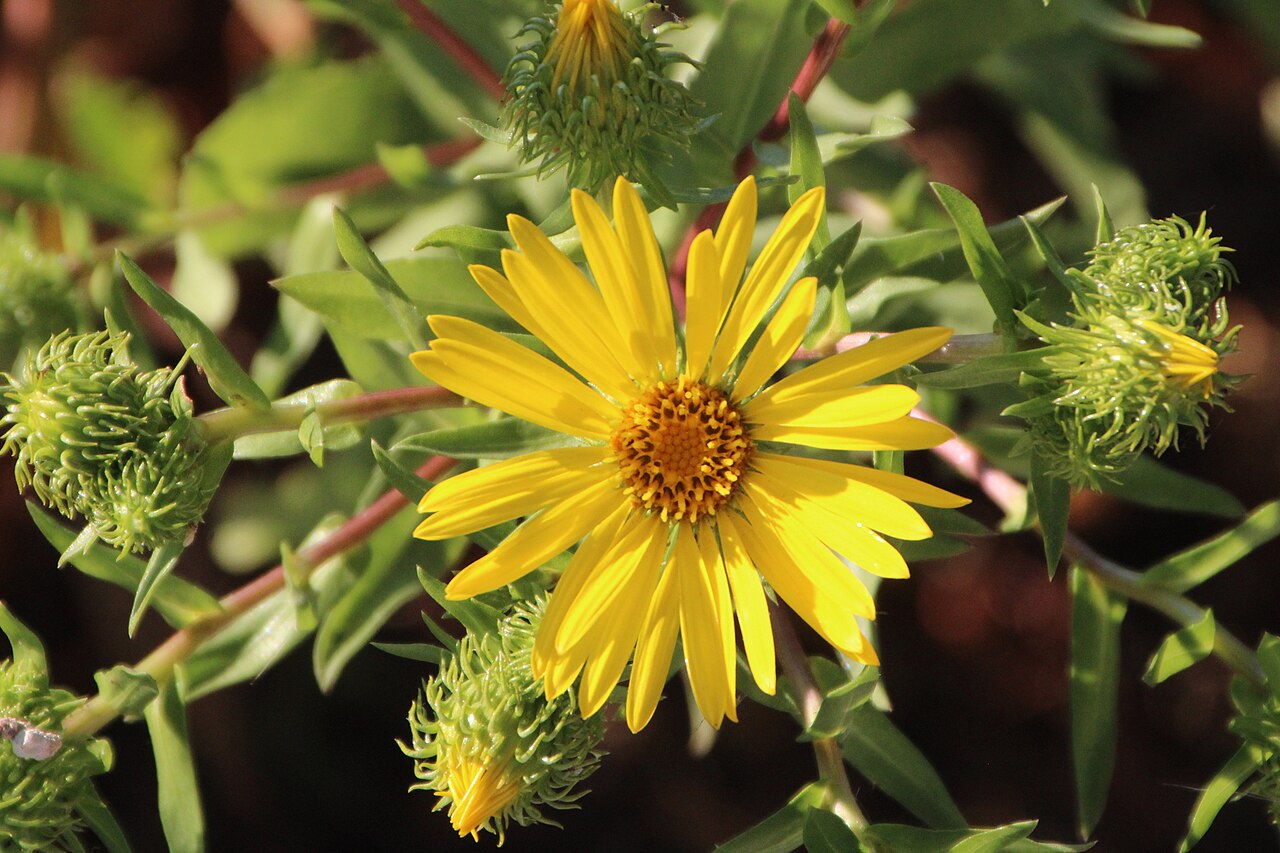
Grindelia integrifolia, known as Puget Sound Gumweed, Puget Sound gumplant or Willamette Valley gumweed, is a sturdy, late-blooming wildflower of the Pacific Northwest coast. From midsummer into early fall it carries bright yellow, daisy-like flower heads 1½ to 2 inches across above clumps of long, narrow leaves. Before they open, the buds are coated in a white, sticky resin, the “gum” in its common name. It belongs to the aster family (Asteraceae).
Puget Sound gumweed grows along the edges of salt marshes, on rocky shorelines, sea bluffs and beach backshores, and inland in the wet prairies and meadows of the Puget Trough and the Willamette Valley. It handles salt spray, poor soil, winter wet and summer drought, and it flowers when most other prairie wildflowers have long since set seed. That makes it a valuable late-season nectar source for native bees.
For gardeners west of the Cascades it is one of the easiest native perennials to grow in a sunny, lean spot, and it is widely used in prairie and shoreline restoration. This guide covers how to identify it, where it grows, and how to grow it in rain gardens, coastal gardens and meadow plantings.
Identification
Gumweeds are easy to recognize as a group: yellow daisies with a sticky, resinous cup of bracts below each flower head. Telling the Pacific Northwest species apart is harder, and botanists have long disagreed on how to divide them.
Habit & Stems
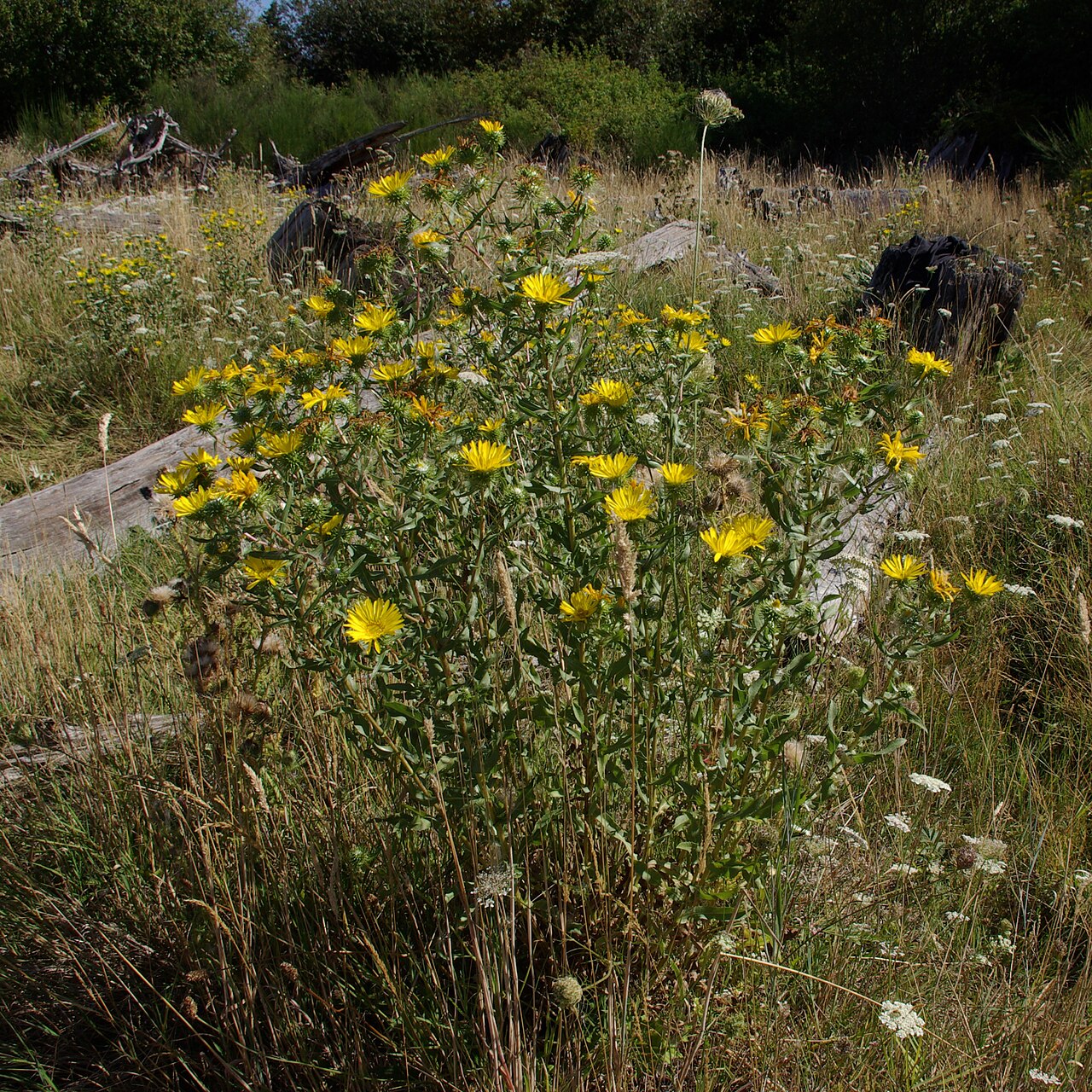
Puget Sound gumweed is a perennial that forms a clump of leafy stems from a woody base and a stout taproot. Stems are usually 1 to 2½ feet tall, sometimes taller in rich meadow soil, upright or leaning outward, and often reddish. They branch near the top, each branch ending in a single flower head. The whole plant is only slightly hairy, and the upper parts are often sticky.
Leaves
The lower leaves are the largest: long, narrow and lance-shaped to oblong, often 4 to 12 inches long, with smooth (entire) edges or a few small teeth, which is what integrifolia (“entire-leaved”) refers to. A rosette of these leaves often stays green through the winter. Leaves up the stem become smaller, stalkless and partly clasp the stem. They are somewhat thick and slightly succulent in salt marsh plants.
Flowers
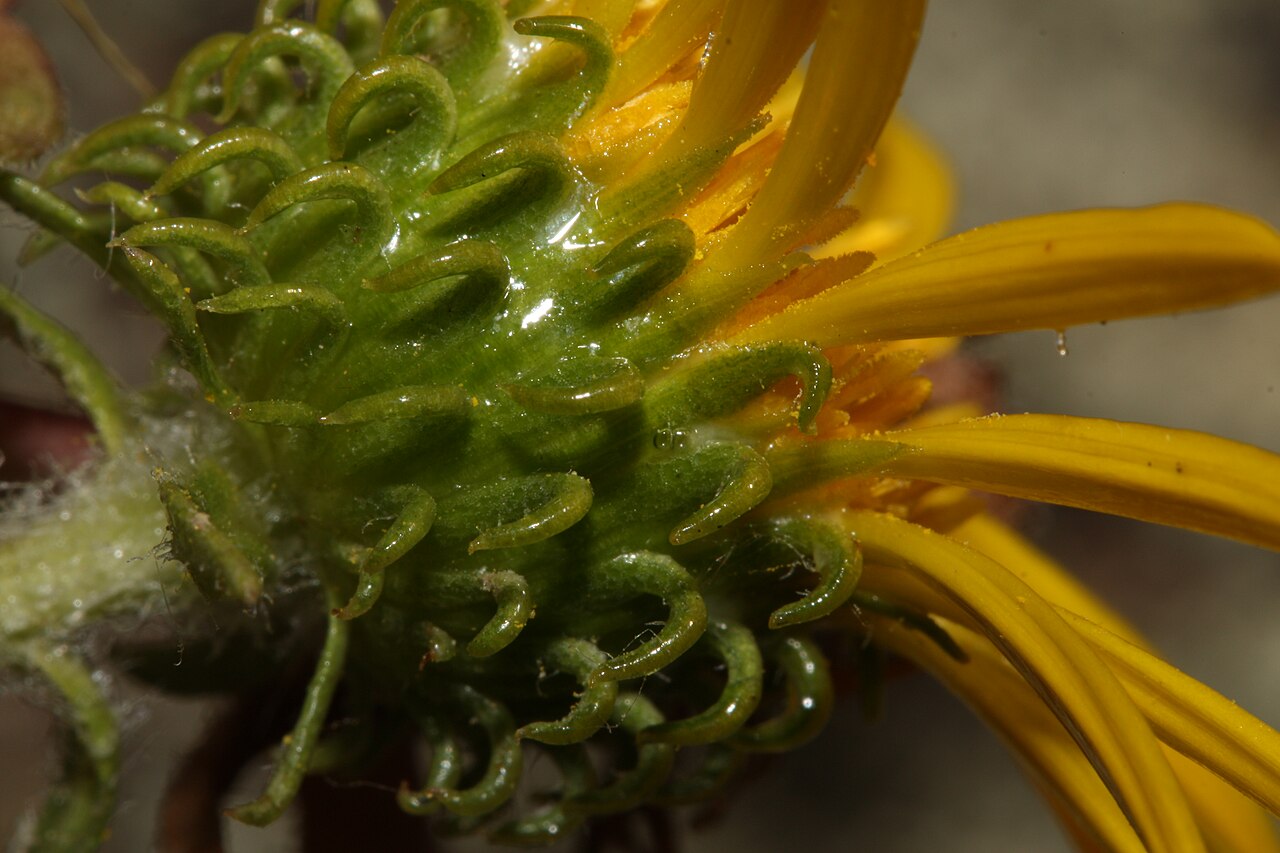
Each flower head is ¾ to 1 inch tall and 1½ to 2 inches across, with 15 to 40 golden-yellow ray flowers around a yellow central disc. Underneath, the rounded involucre is made of several rows of narrow green bracts (phyllaries) with slender, spreading to curled-back tips. In bud these are covered in a milky, sticky resin that dries to a glossy gum. Bloom runs from about July to September, occasionally into October.
Seeds
After flowering the heads produce small, angled seeds (cypselae) topped with a few stiff, early-falling bristles (awns) rather than a fluffy parachute, so most seed drops close to the parent plant.
Look-alikes
Coastal Gumplant (G. stricta) of the outer coast is very similar and is sometimes treated as the same species; it tends to be lower and more sprawling, with fleshier leaves. Curlycup Gumweed is a biennial or short-lived weedy species of drier, disturbed ground, with strongly hooked bracts and toothed, rounded leaves; it has spread west of the Cascades along roadsides. Arnicas and other yellow daisies lack the sticky, resinous bracts.
Quick Facts
| Scientific Name | Grindelia integrifolia DC. |
| Family | Asteraceae (aster family) |
| Plant Type | Herbaceous perennial from a woody base and taproot |
| Mature Height | 1–2½ ft (occasionally to 3 ft) |
| Mature Spread | 1–2 ft |
| Growth Rate | Moderate to fast |
| Sun Exposure | Full sun |
| Water Needs | Low to moderate; tolerates winter wet and summer drought |
| Soil Type | Sand, gravel, clay or salt marsh margins; tolerates poor soil |
| Soil pH | About 5.5–8.0 |
| Bloom Time | July–September |
| Flower Color | Golden yellow |
| Fall Color | Dry brown seed heads; basal rosette often stays green |
| Fruit | Small angled seeds with a few deciduous bristles |
| Deer Resistant | Generally yes; resinous and seldom browsed |
| USDA Hardiness Zones | 6–9 |
Native Range
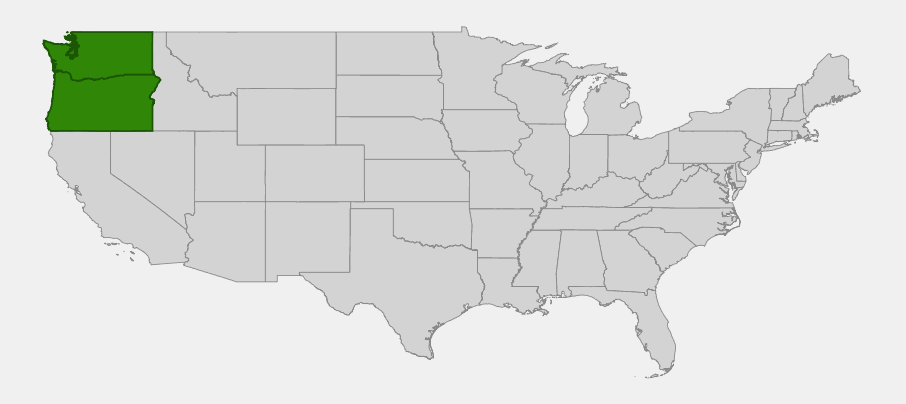
USDA PLANTS lists Puget Sound gumweed as native in Washington and Oregon. Beyond the United States it grows in southwestern British Columbia, on Vancouver Island, the Gulf Islands and the lower mainland coast.
It is a plant of the lowlands west of the Cascades. Along the coast and the inland waters of the Salish Sea it grows on the upper edges of salt marshes, gravel and sand beaches, rocky shores and bluffs. Inland it occurs in the wet prairies, seasonally flooded meadows and riverbanks of the Puget Trough and the Willamette Valley, where it was often called Willamette Valley gumweed. Plants in these two settings can look quite different, and older floras split them into separate varieties.
Grindelia is a notoriously difficult genus, and the Pacific Northwest gumweeds intergrade with each other. Some references treat Puget Sound gumweed as a form of G. stricta or merge several coastal gumweeds into one variable species. Whatever name is used, the native gumweed of Puget Sound and Willamette Valley shores and prairies is the plant described here.
📋 Regional plant lists featuring Puget Sound Gumweed: Western Oregon & Western Washington
Growing & Care Guide
Puget Sound gumweed is a forgiving, long-lived perennial for sunny gardens in western Oregon and Washington. It is sold by many native plant nurseries in the region and is included in Pacific Northwest prairie and coastal restoration seed mixes. Give it sun and room, and leave it alone.
Light
Full sun. It tolerates a little afternoon shade but becomes floppy and flowers less. In nature it never grows under trees.
Soil & Water
It accepts almost any soil that is not shaded or constantly waterlogged in summer: sand, gravel, clay, rocky slopes and the salty edges of marshes. It handles winter flooding and summer drought equally well, which makes it a good choice for the edge of a rain garden or a bioswale. Once established it needs no summer water west of the Cascades, and rich soil or irrigation only makes it lanky.
Planting Tips
Plant nursery starts in fall or early spring, about 18 inches apart. It works well in drifts among native bunchgrasses, with camas and other spring bloomers that will be dormant by the time gumweed flowers. It is a good plant for coastal gardens exposed to wind and salt spray.
Pruning & Maintenance
Cut stems back to the basal rosette in late fall or winter, or leave the seed heads standing for birds and cut them in late winter. Plants that lean in a rich garden can be cut back by about a third in early June to make them bushier. It may self-sow lightly into open gravel.
Propagation
Grow from seed sown outdoors in fall, or cold-moist stratify it for about 30 to 60 days before spring sowing. Barely cover the seed. Seedlings often bloom in their second year. Plants can also be grown from cuttings of young basal shoots in spring. Collect seed only with permission and in small amounts from large populations.
Landscape Uses
- Coastal and shoreline gardens: tolerates salt spray, wind and sandy or gravelly soil
- Rain gardens and bioswales: the upper edges, where water stands in winter but dries in summer
- Prairie and meadow restoration: a late-flowering component of Puget Trough and Willamette Valley prairie plantings
- Pollinator gardens: late-summer nectar when few other natives bloom
- Low-maintenance dry borders: no summer water needed west of the Cascades once established
Wildlife & Ecological Value
Because it flowers late, Puget Sound gumweed fills a gap in the Pacific Northwest bloom calendar, when spring prairie flowers have finished and before the asters peak.
For Pollinators
The flowers are visited by many native bees, including bumble bees, leafcutter bees, sweat bees and mining bees, and by butterflies, hover flies and beetles. The Xerces Society lists it as having special value to native bees. A clump in full bloom can be busy all day in August.
For Birds
Seed-eating songbirds pick at the ripe heads in fall, and the open, sunny habitats where it grows are used by birds such as western meadowlarks, savannah sparrows and shorebirds along the coast. Leaving seed heads standing over winter gives birds food and insects shelter.
For Mammals
The resinous foliage is seldom eaten by deer or rabbits, which is one reason it does well in gardens with deer pressure.
Ecosystem Role
Its deep taproot and persistent rosettes help hold sand and soil on bluffs and marsh edges. In salt marshes it marks the transition from tidal marsh to upland. In prairies it is part of the late-season flower community that sustains pollinators until fall.
Cultural & Historical Uses
The genus Grindelia honors David Hieronymus Grindel, an 18th- and 19th-century Baltic German botanist and pharmacist. Augustin Pyramus de Candolle described G. integrifolia in 1836. The species name means “with entire (untoothed) leaves,” although many plants have a few small teeth.
Gumweeds have a long history in North American herbal medicine. Several Indigenous peoples of the West used gumweed resin and leaves, and dried gumweed was later sold as a remedy for coughs and for poison-oak rash. This history is interesting, but gumweed should not be used as a medicine without professional advice, and plants growing on salt marshes or roadsides can take up contaminants.
Today Puget Sound gumweed is valued mainly as a restoration and garden plant. It is one of the late-blooming species used to rebuild the native prairies of the Puget Lowland and the Willamette Valley, of which only a small fraction remains, and it is planted on restored shorelines around the Salish Sea.
Frequently Asked Questions
Why is it called gumweed?
The flower buds and bracts under each flower head are coated in a white, sticky resin that dries to a glossy gum. It can stick to your fingers when you handle the plant.
Is Puget Sound gumweed the same as curlycup gumweed?
No. Curlycup gumweed (G. squarrosa) is a shorter-lived plant of dry, disturbed ground with strongly hooked bracts. It is native east of the Cascades and has spread elsewhere along roads. Puget Sound gumweed is a long-lived perennial of coastal shores and wet prairies west of the Cascades.
Does Puget Sound gumweed need water in summer?
Not once established. West of the Cascades it gets through the dry summer on its deep taproot. Extra water and rich soil tend to make it floppy.
Can it grow in a rain garden?
Yes, on the upper slopes and edges of a rain garden or swale, where water may pond briefly in winter but the soil dries in summer. Avoid the lowest point if water stands for weeks.
When does Puget Sound gumweed bloom?
Mainly from July to September, sometimes into October. It is one of the latest-blooming native perennials of Pacific Northwest prairies and shorelines.

Looking for a nursery that carries Puget Sound Gumweed?
Browse our native plant nursery directory: Oregon · Washington

