
Ashy Hydrangea (Hydrangea cinerea)
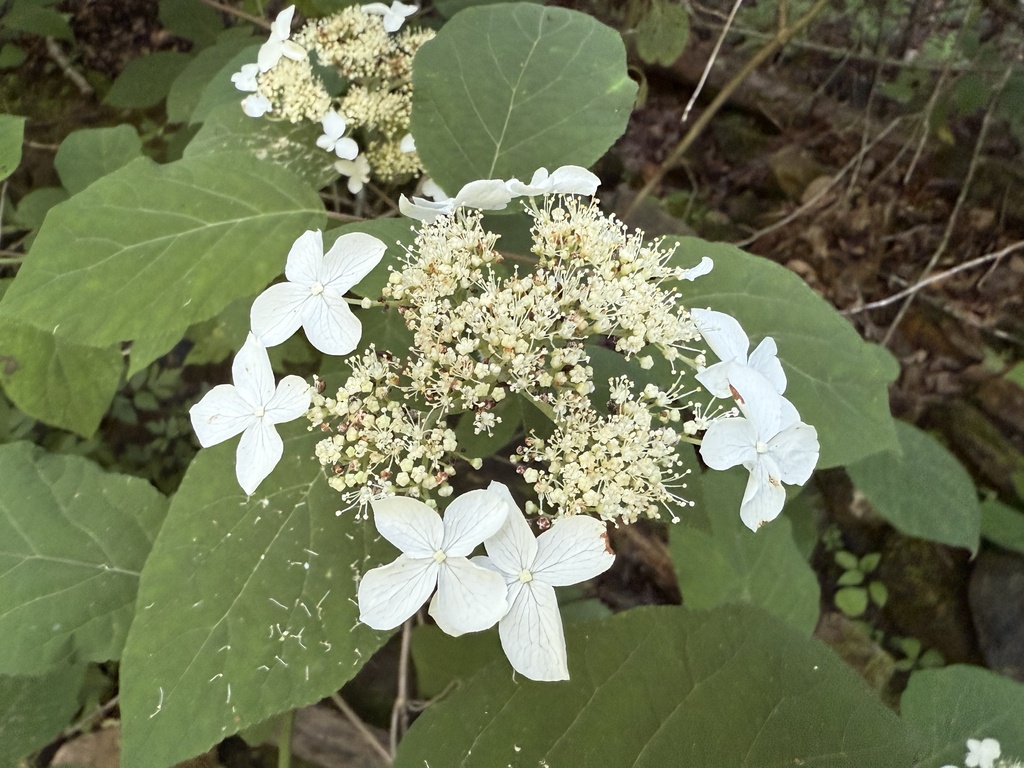
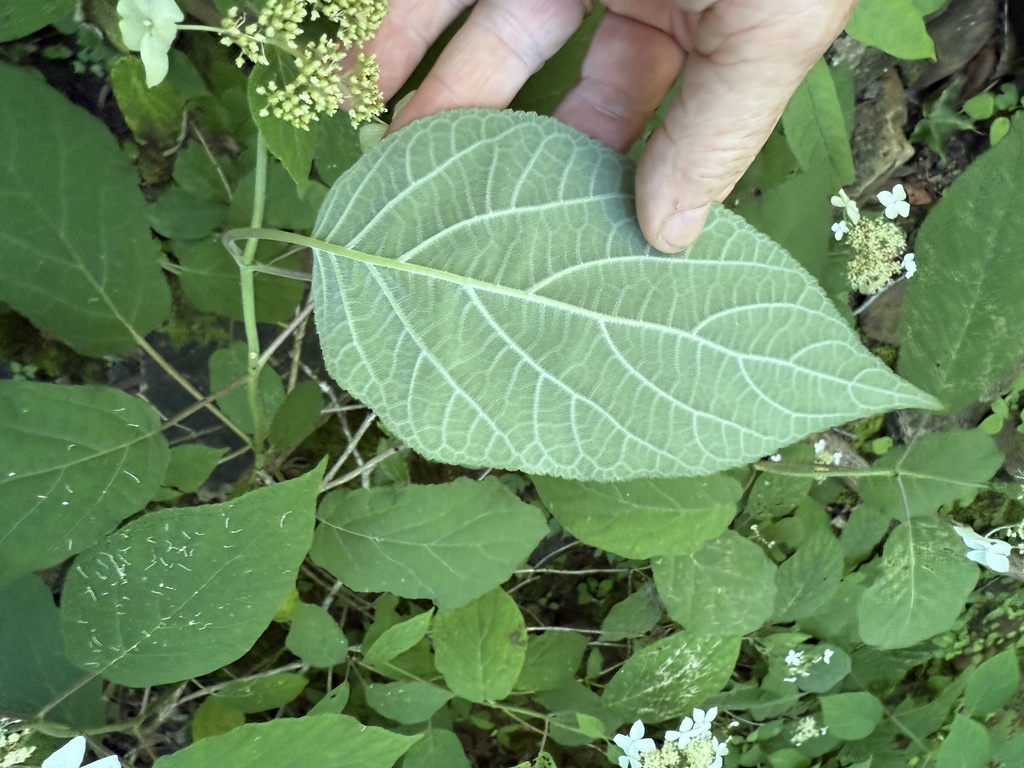
Hydrangea cinerea, known as Ashy Hydrangea or gray hydrangea, is a deciduous shrub of rocky woods and bluffs in the interior Southeast. It looks much like the familiar smooth or Wild Hydrangea (Hydrangea arborescens), with flat, white flower clusters in early summer, but the undersides of its leaves are grayish with fine hairs. That ashy color gives the plant its common and scientific names; cinerea means “ash-gray” in Latin.
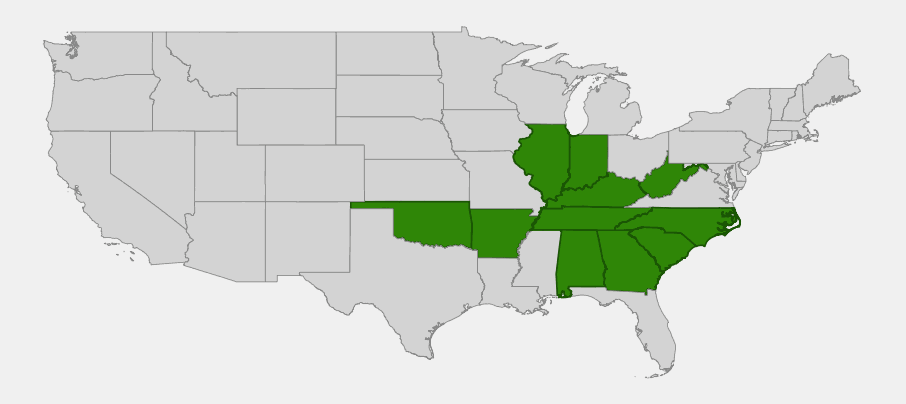
Its native range runs from the southern Appalachians and the Cumberland Plateau west through Kentucky, Tennessee and southern Illinois and Indiana to the Ozarks of Arkansas and eastern Oklahoma, and south into Alabama and Georgia. It favors base-rich soils over limestone and other calcareous rock.
Botanists have long debated its rank. Many references, including the Flora of North America, treat it as Hydrangea arborescens subsp. discolor, a subspecies of wild hydrangea, while USDA PLANTS and many state floras keep it as its own species. This page covers how to tell it apart, where it grows, how to grow it, its value for wildlife, and a safety note.
Identification
In bloom, ashy hydrangea looks like a wild hydrangea with a few extra-large white flowers around the edge of each cluster. The surest test is the leaf underside.
Size & Form
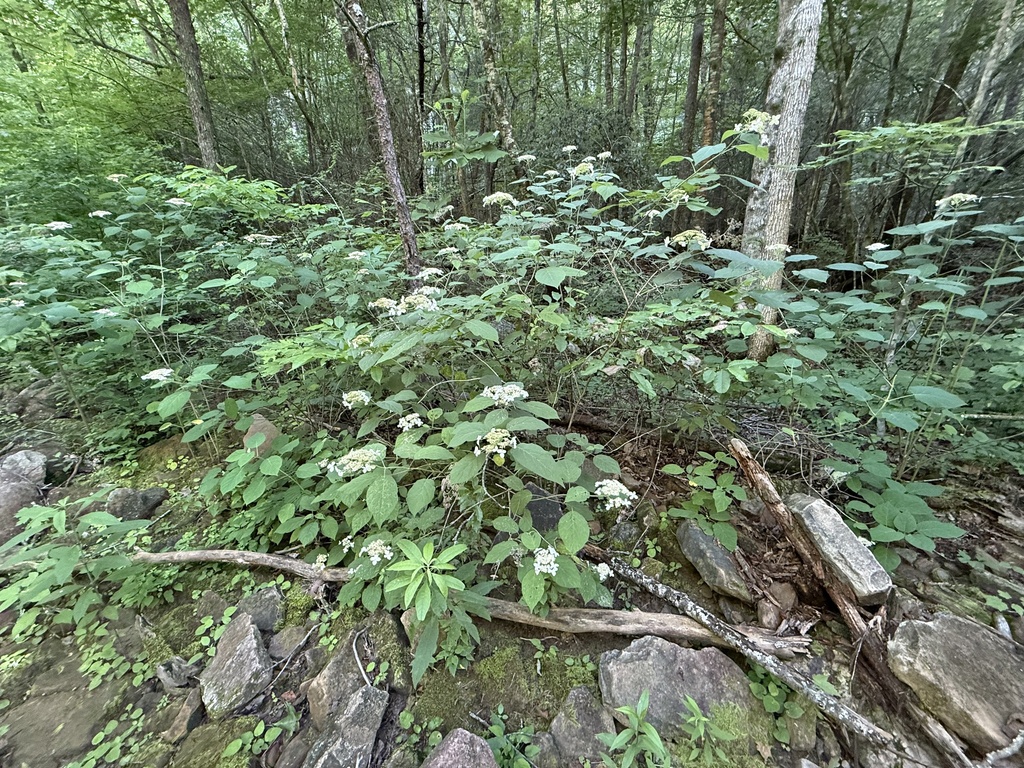
It is a loose, multi-stemmed shrub usually 3 to 6 feet tall, occasionally to about 10 feet, spreading by suckers into small colonies. The bark on older stems peels in thin, papery layers.
Leaves
The leaves are opposite, broadly oval to heart-shaped, about 3 to 6 inches long, with toothed edges and a pointed tip. The upper surface is dull green. The lower surface is covered with short, bumpy-based hairs that make it look gray or ashy, though the hairs usually do not hide the green surface completely. Leaves turn pale yellow in fall.
Flowers
Flat-topped clusters (corymbs) 3 to 6 inches across open in late spring and early summer, from about May to July. Most of the flowers are small, fertile and creamy white. Usually a few large sterile flowers, each more than about 1/2 inch across with three or four white petal-like sepals, ring the edge of the cluster, giving it a lacecap look.
Fruit
The fertile flowers become tiny, ribbed brown capsules that hold dust-like seeds. Dry flower heads often persist on the shrub into winter.
Similar Species
Wild hydrangea has leaves that are green and nearly hairless beneath, and usually few or no large sterile flowers. Silverleaf or snowy hydrangea (Hydrangea radiata) of the southern Blue Ridge has leaves that are bright silvery-white beneath with a dense felt of hairs that hides the leaf surface. Ashy hydrangea is in between: its leaf undersides are gray, not green and not snow-white. Where the three meet, intermediate plants occur, which is one reason many botanists treat them as subspecies of one species.
Quick Facts
| Scientific Name | Hydrangea cinerea Small (syn. Hydrangea arborescens subsp. discolor) |
| Family | Hydrangeaceae (hydrangea family) |
| Plant Type | Deciduous shrub |
| Mature Height | 3–6 ft (occasionally to 10 ft) |
| Mature Spread | 3–6 ft, wider in colonies |
| Growth Rate | Moderate to fast |
| Sun Exposure | Part shade; full sun with steady moisture |
| Water Needs | Medium; tolerates short dry spells once established |
| Soil Type | Rich, well-drained loam; rocky or calcareous soils |
| Soil pH | About 6.0–7.5 (neutral to slightly alkaline) |
| Bloom Time | May–July |
| Flower Color | Creamy white, with a few white sterile flowers |
| Fall Color | Pale yellow |
| Fruit | Small, ribbed brown capsule |
| Deer Resistant | No; deer browse hydrangeas |
| USDA Hardiness Zones | 5–9 |
Native Range
USDA PLANTS lists ashy hydrangea as native in Alabama, Arkansas, Georgia, Illinois, Indiana, Kentucky, North Carolina, Oklahoma, South Carolina, Tennessee and West Virginia. Its center is the Cumberland Plateau, the Interior Low Plateaus and the southern Appalachians of Tennessee, Kentucky, North Carolina and northern Alabama and Georgia, with outlying populations in the Ozark and Ouachita region of Arkansas and eastern Oklahoma, and some sources extend it into southern Missouri.
USDA also lists Massachusetts, but New England floras consider the few hydrangea populations there to be introduced, mostly from disturbed sites, so the map leaves it out.
Ashy hydrangea grows on wooded slopes, rocky bluffs, ravines and stream banks, often on limestone, dolomite or other base-rich soils. It is more tolerant of heat and dry soil than silverleaf hydrangea, which helps explain its wider range at lower elevations.
📋 Regional plant lists featuring Ashy Hydrangea: Alabama, Georgia & Mississippi · Arkansas, Louisiana, Eastern Oklahoma & Eastern Texas · Illinois, Iowa & Missouri · Ohio & Indiana · Kentucky & Tennessee · Maryland, Virginia & West Virginia · North & South Carolina
Growing & Care Guide
Ashy hydrangea is grown like wild hydrangea and is just as easy. It is sold under its own name and as Hydrangea arborescens subsp. discolor. Selections with more large sterile flowers, such as ‘Sterilis’ and ‘Pink Pincushion’, and the gray-leaved ‘Frosty’ are offered by specialty and native plant nurseries; check the label, because names vary from nursery to nursery.
Light
Part shade suits it best, especially afternoon shade in the South. It takes full sun in cooler areas if the soil stays moist, and flowers less in deep shade.
Soil & Water
Plant it in rich, well-drained soil with plenty of organic matter. It handles neutral to slightly alkaline and rocky soils well. Water regularly the first season; established plants tolerate short droughts better than most hydrangeas, though leaves wilt in hot, dry weather and recover when watered.
Planting Tips
Plant in spring or fall, 3 to 5 feet apart for a massed planting. It suits woodland edges, shady slopes and the north or east side of a house. It spreads slowly by suckers, so give it room or plant it where a colony is welcome.
Pruning & Maintenance
Like wild hydrangea, it blooms on new wood, so prune in late winter or early spring. You can cut stems back by a third to a half, or close to the ground every few years to renew the plant. Leave some dried flower heads for winter interest. Hydrangea flower color does not change with soil pH in this species; the flowers stay white.
Propagation
Softwood cuttings taken in early summer root readily. You can also dig and replant rooted suckers in early spring, or layer low stems. Seed is tiny and needs light to germinate; sow it on the surface of moist mix.
Landscape Uses
- Shade gardens: long-blooming white flowers for woodland edges and part-shade beds
- Slopes and banks: suckering roots help hold soil on shady slopes
- Native foundation planting: a native alternative to Asian bigleaf hydrangeas
- Rock and limestone gardens: tolerates base-rich, rocky soils
- Pollinator gardens: fertile flowers feed many small bees, beetles and flies
Wildlife & Ecological Value
Wild-type ashy hydrangea, with its many fertile flowers, is more useful to insects than the heavy “snowball” forms of hydrangea, which are mostly sterile.
For Pollinators
The small fertile flowers attract many small bees, flower beetles, flies and wasps, and occasionally butterflies. The large sterile flowers around the edge act as signposts for insects but produce no pollen or nectar.
For Birds
Birds do not eat the tiny seeds much, but the dense shrubs give cover, and birds forage for insects among the leaves.
For Mammals
White-tailed deer browse the leaves and young stems.
Ecosystem Role
On steep, rocky slopes its suckering stems help stabilize thin soils, and it is part of the rich shrub layer of limestone woods in the interior Southeast.
Cultural & Historical Uses
The Cherokee used hydrangeas medicinally, and ashy hydrangea was likely used in similar ways to wild hydrangea, whose root was later used by settlers and in herbal medicine for kidney and bladder complaints. Do not use it as a home remedy.
The species was described by the botanist John Kunkel Small in 1897. Its relationship to wild hydrangea and silverleaf hydrangea has been debated ever since, and it moves between species and subspecies rank depending on the reference.
Safety note: hydrangea leaves, buds and flowers contain cyanogenic glycosides that can release cyanide when chewed. Eating them can cause vomiting, stomach pain and diarrhea in people and pets; serious poisoning is rare because large amounts would be needed. Keep children and pets from chewing the plant, and do not use it as food or tea.
Frequently Asked Questions
How do I tell ashy hydrangea from wild hydrangea?
Turn a leaf over. Ashy hydrangea leaves are grayish beneath with short hairs, while wild (smooth) hydrangea leaves are green and nearly smooth beneath. Ashy hydrangea also usually has a few large white sterile flowers around each flower cluster.
Is ashy hydrangea a separate species?
It depends on the reference. USDA PLANTS and many state floras treat it as Hydrangea cinerea, while the Flora of North America and some other sources treat it as a subspecies of wild hydrangea, Hydrangea arborescens subsp. discolor. Gardeners grow it the same way either way.
When should I prune ashy hydrangea?
In late winter or early spring. It flowers on new growth, so pruning then does not remove flower buds. Cut stems back by a third to a half, or near the ground every few years to renew the plant.
Is ashy hydrangea poisonous?
Hydrangeas contain cyanogenic glycosides, and eating the leaves or flowers can upset the stomach in people, dogs, cats and horses. Serious poisoning is rare, but the plant should not be eaten.
Where does ashy hydrangea grow wild?
It grows on rocky wooded slopes, bluffs and stream banks in the interior Southeast, from North Carolina, Tennessee and Kentucky to southern Illinois and Indiana, Arkansas, eastern Oklahoma, Alabama and Georgia, often over limestone.

Looking for a nursery that carries Ashy Hydrangea?
Browse our native plant nursery directory: Alabama & Arkansas · Georgia · Illinois & Indiana · Kentucky · North Carolina & Oklahoma · South Carolina & Tennessee · West Virginia

