
Alabama Croton (Croton alabamensis)
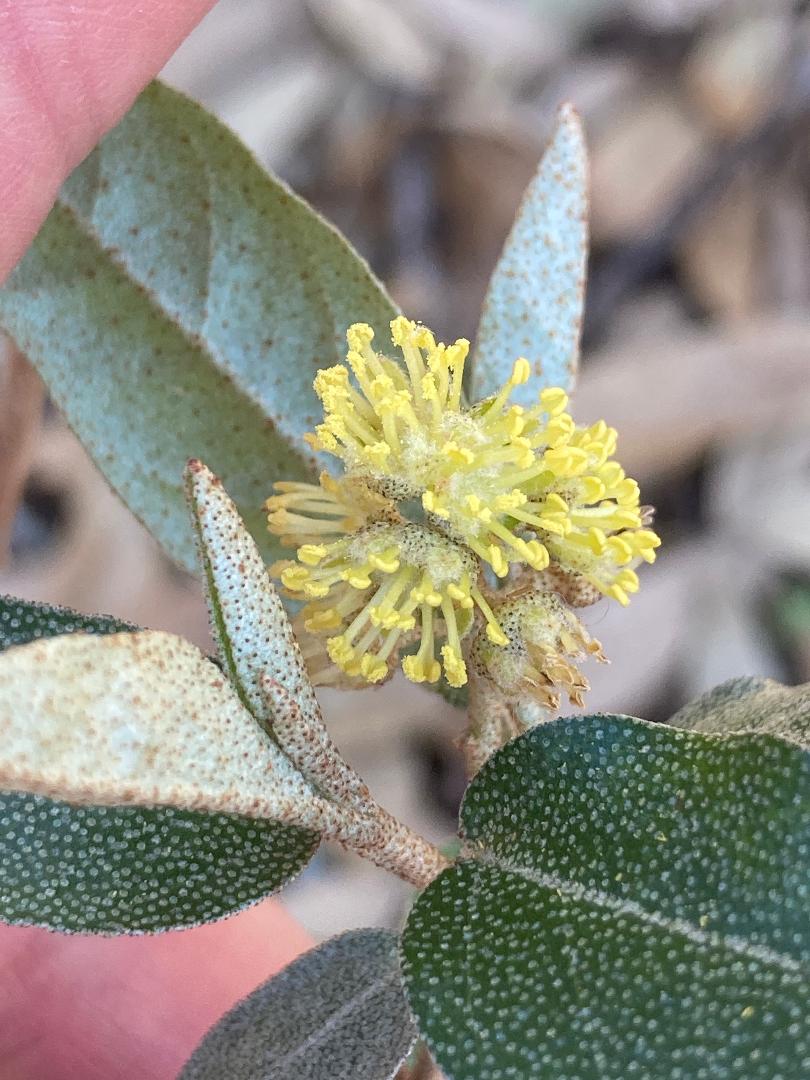
Croton alabamensis, known as Alabama Croton, is a rare semi-evergreen shrub with one of the strangest ranges of any North American plant. One variety grows only in two counties of central Alabama, and the other only in three counties of central Texas, more than 600 miles (about 1,000 km) away. Its leaves are green above and shimmer silver to coppery below, thanks to a dense coat of tiny scales, and when crushed they give off a fruity scent often compared to apples and bananas.
It is the northernmost shrubby Croton in North America and the largest member of the spurge family (Euphorbiaceae) native to the continent. Its closest relatives live in the American tropics, and DNA studies suggest its lineage split from them roughly 40 million years ago, which makes it a living relict. NatureServe ranks the species as Vulnerable and the Texas variety, called Texabama croton, as Imperiled.
Despite its rarity in the wild, Alabama croton has become a sought-after garden shrub for its silvery foliage, early spring flowers, orange fall leaves, drought tolerance and deer resistance. It is not related to the tropical houseplant sold as “croton” (Codiaeum variegatum). This page covers identification, its split range, how to grow it, its wildlife value and a safety note, since Croton seeds and sap are toxic. Buy only nursery-propagated plants.
Identification
Alabama croton is easiest to recognize by its two-toned leaves: dark green above, silvery or coppery and scaly below. Few other shrubs in its range look anything like it.
Size & Form
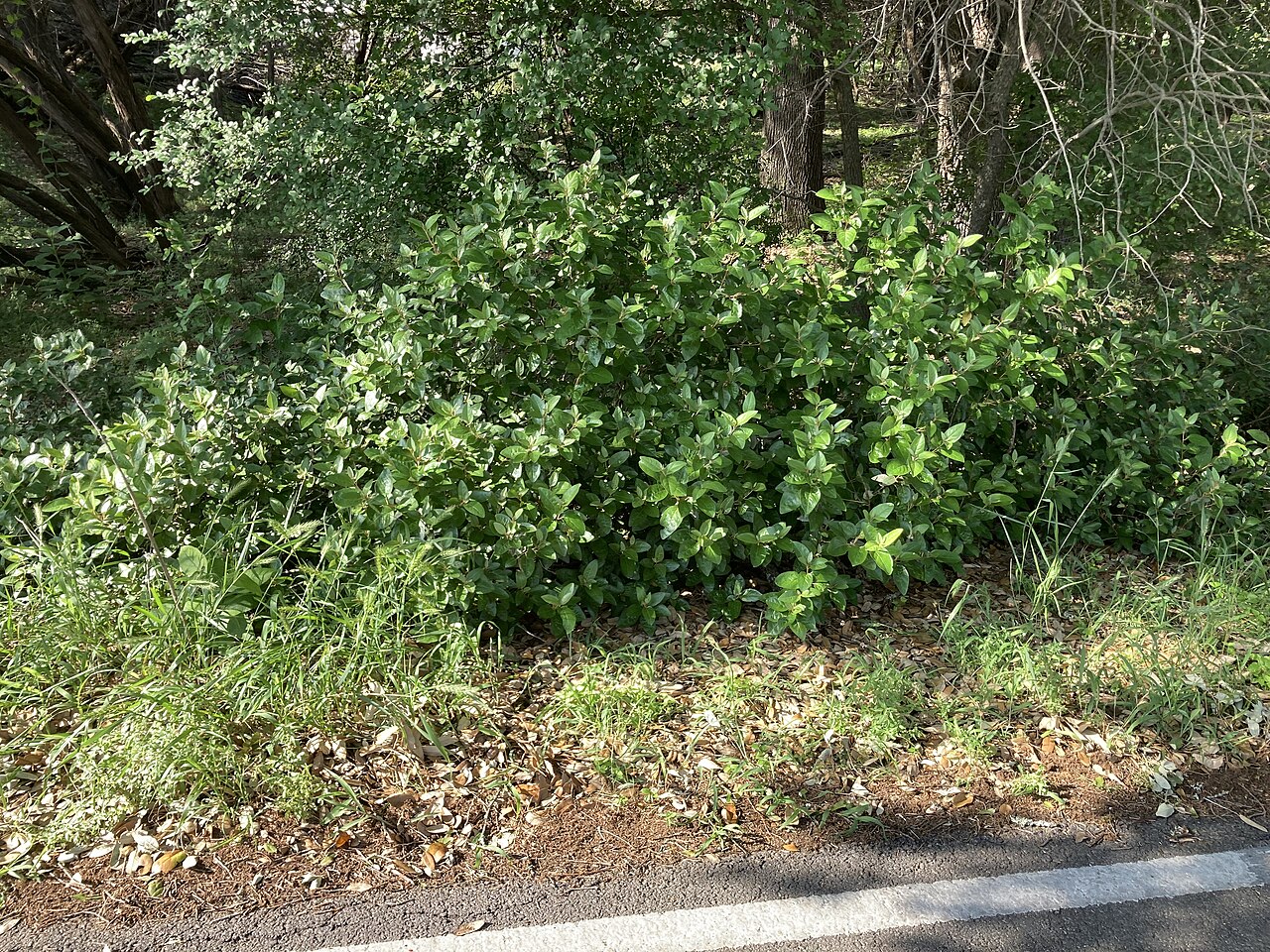
It is a loosely branched, multi-stemmed shrub usually 3 to 10 feet tall, occasionally up to about 11 feet. In the wild it spreads by root suckers into open clonal thickets that Alabama locals once called “privet brakes.” In gardens it can be pruned into a denser shrub or even trained to a single trunk.
Leaves
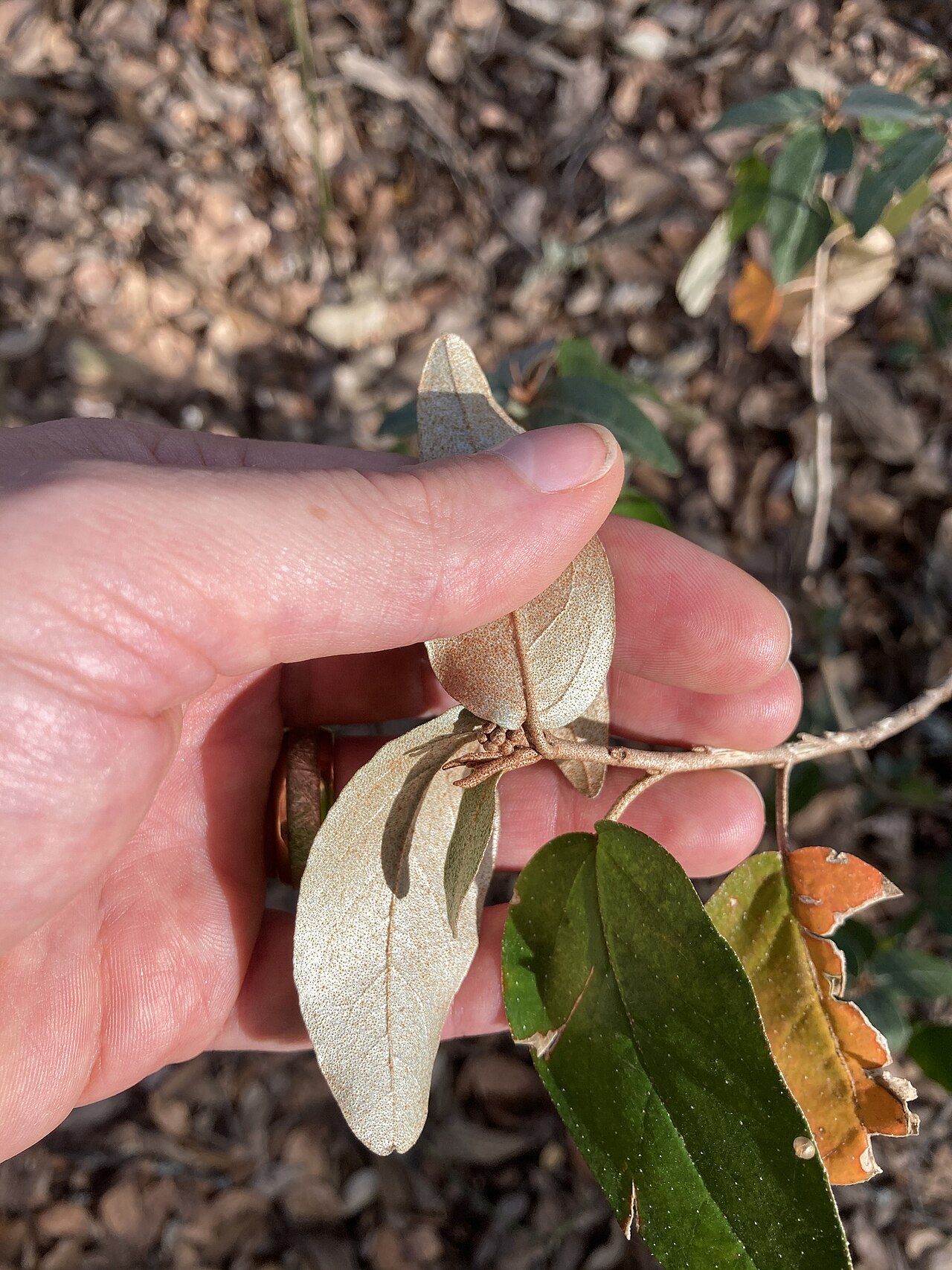
The alternate leaves are clustered toward the branch tips. They are elliptic to oblong, about 1 1/4 to 4 inches long, with smooth or slightly wavy edges and no teeth. The upper surface is green and sparsely dotted with silvery scales; the underside is densely covered with flat, overlapping scales (lepidote) that look silvery when young and coppery with age. Crushed leaves smell fruity. In fall and late winter many older leaves turn bright orange before dropping, while younger leaves persist, so the shrub is semi-evergreen.
Flowers
Short spikes (racemes) about 1 to 2 inches long appear at the branch tips in late winter and early spring, peaking around mid-March. The plant is monoecious: male and female flowers grow on the same shrub. The male flowers are the showy ones, each with 10 to 22 yellowish stamens that together form a fluffy, pale yellow tuft. Female flowers sit lower in the cluster and are small and greenish.
Fruit & Seeds
The fruit is a small, three-parted capsule that ripens by early summer and splits explosively, flinging out large, shiny seeds about 1/3 inch long. Seeds need a cold period (stratification) before they will germinate.
Similar Species
Other native crotons, such as Bush Croton and Prairie Tea, are much smaller, mostly herbaceous plants with star-shaped hairs rather than silvery scales. Silverberry and autumn olive (Elaeagnus) also have silvery-scaled leaves, but their leaves are silver on both sides and they bear fleshy fruits; autumn olive is an invasive exotic. The houseplant “croton” (Codiaeum) has thick, glossy, multicolored leaves and is not a Croton at all.
Quick Facts
| Scientific Name | Croton alabamensis E.A. Sm. ex Chapm. |
| Family | Euphorbiaceae (spurge family) |
| Plant Type | Semi-evergreen shrub |
| Mature Height | 3–10 ft (occasionally to 11 ft) |
| Mature Spread | 4–8 ft; spreads slowly by suckers |
| Growth Rate | Slow to moderate |
| Sun Exposure | Part shade to full sun |
| Water Needs | Low to medium; drought tolerant once established |
| Soil Type | Well-drained loam or rocky soil; tolerates thin limestone soils |
| Soil pH | About 6.0–8.0 (neutral to alkaline) |
| Bloom Time | February–April |
| Flower Color | Pale yellow (male flowers); greenish (female flowers) |
| Fall Color | Bright orange on older leaves |
| Fruit | Small three-parted capsule; ejects seeds in early summer |
| Deer Resistant | Yes |
| USDA Hardiness Zones | 6–9 |
Native Range
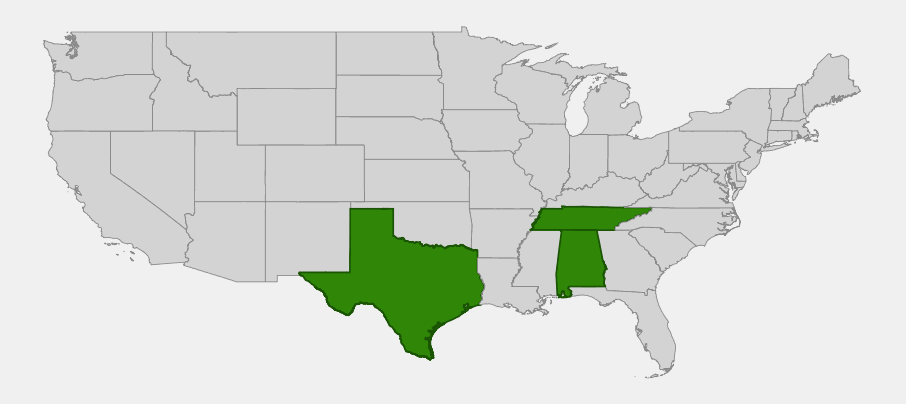
USDA PLANTS lists Alabama croton as native in Alabama, Tennessee and Texas. The typical variety, var. alabamensis, grows in Tuscaloosa County along the Black Warrior River and in Bibb County near the Cahaba River, on dry wooded slopes, bluffs and dolomite glades with thin, alkaline soils. USDA’s Tennessee listing rests on very few records, and at least one old Coffee County herbarium collection has been questioned, so treat Tennessee as an outlying record rather than a well-known population.
The Texas variety, var. texensis (Texabama croton), was only discovered in 1989. It grows in Travis, Bell and Coryell counties on the eastern edge of the Edwards Plateau and the southern Cross Timbers, including on Fort Cavazos (formerly Fort Hood). There it is patchy, abundant in a few spots and absent elsewhere, growing in pockets of deeper soil in shaded, moist limestone canyons and in upland oak groves at roughly 650 to 1,300 feet.
Both varieties grow on limestone, shale or dolomite near the edge of the coastal plain. The huge gap between them is thought to reflect a once wider range that shrank as the climate changed, leaving two isolated remnants. Habitat loss, development and some forestry practices are the main threats.
📋 Regional plant lists featuring Alabama Croton: Alabama, Georgia & Mississippi · Kentucky & Tennessee · South & West Texas
Growing & Care Guide
Alabama croton is an easy, low-maintenance shrub once it is established, and native plant nurseries in the Southeast and Texas propagate it. Because wild populations are small and rare, buy only nursery-propagated plants and never dig or collect from the wild.
Light
It grows in part shade to full sun. In hot southern gardens, light afternoon shade keeps the foliage looking its best; in full sun it stays denser and more compact. In deep shade it becomes open and leggy.
Soil & Water
Plant it in well-drained soil. It is adapted to thin, rocky, alkaline soils over limestone but grows well in ordinary garden loam, and tolerates mildly acidic soil. Water regularly through its first summer; after that it is quite drought tolerant and seldom needs extra water except in long droughts. Avoid poorly drained, waterlogged sites.
Planting Tips
Plant in fall or early spring, setting the root ball at the same depth it grew in the pot. Give it room to sucker into a small colony, or plan to remove suckers to keep a single clump. It works as a specimen where its silvery leaf undersides catch the light, for example on a slope or beside a path where the wind turns the leaves.
Pruning & Maintenance
Little pruning is needed. Cut back leggy stems after flowering in spring to keep it dense, and remove unwanted suckers at ground level. It has few pest or disease problems, and deer and rabbits usually leave it alone. Wear gloves when pruning, because the sap can irritate skin.
Propagation
Propagate it by layering, by digging and replanting rooted suckers from garden plants, or by softwood cuttings in early summer. Seeds are hard to collect, because the capsules fling them away when ripe; bag a few developing capsules with fine mesh to catch them. Sow fresh seed outdoors in fall or give it about 60 to 90 days of cold, moist stratification before spring sowing.
Landscape Uses
- Specimen shrub: silvery leaf undersides, early flowers and orange fall leaves give year-round interest
- Dry shade and woodland edges: tolerates thin, rocky soil and drought under trees
- Deer-resistant borders: rarely browsed by deer
- Limestone and rock gardens: suited to alkaline, well-drained sites in central Texas and the Southeast
- Conservation gardens: growing nursery-propagated plants helps keep a rare relict species in cultivation
Wildlife & Ecological Value
Alabama croton flowers very early, when few other shrubs are in bloom, and its thickets give cover to small animals.
For Pollinators
Its flowers are pollinated by bees, which visit the male flowers for pollen in late winter and early spring. Early native bees and honey bees are among the first visitors.
For Birds
The dense thickets offer nesting cover and shelter for songbirds. The seeds are thrown from the capsules, so they are less available to birds than fleshy fruits, but ground-feeding birds and rodents may eat fallen seeds.
For Mammals
Deer generally avoid the scaly, aromatic foliage, which is one reason it is valued in gardens. Small mammals use the thickets for cover.
Ecosystem Role
As a relict species with ancient tropical relatives, Alabama croton is an important part of the rare limestone and dolomite glade and canyon communities where it grows, which also support other rare plants. Its clonal thickets help hold soil on steep, rocky slopes.
Cultural & Historical Uses
Alabama croton was discovered in July 1877 by Eugene Allen Smith, Alabama’s state geologist, on limestone bluffs at Pratt’s Ferry near Centreville during a geological survey. Specimens passed through botanist Charles Mohr to Alvan Wentworth Chapman, who described the species in the second edition of his Flora of the Southern United States. For more than a century it was thought to grow only in Alabama, until biologists found it at Fort Hood (now Fort Cavazos) in Coryell County, Texas, in April 1989, and independently in northwestern Travis County two months later. Botanist Steve Ginzbarg described the Texas plants as var. texensis in 1992, and the nickname Texabama croton recalls that two-state story.
Botanists place it in its own section (Alabamenses) within Croton. Its nearest relatives grow on serpentine soils in Cuba and in other moist tropical regions, making it one of the clearest examples of a tropical lineage that survived far north in the southeastern United States. Protected populations grow in The Nature Conservancy’s Pratt’s Ferry Preserve and the Cahaba River National Wildlife Refuge in Alabama, and in Balcones Canyonlands National Wildlife Refuge and Pace Bend Park in Texas. Public gardens such as the Lady Bird Johnson Wildflower Center, Mt. Cuba Center and the JC Raulston Arboretum grow it on display.
Safety note: like many members of the spurge family, Croton species contain irritating compounds. The seeds of several crotons are strongly purgative and can be poisonous if eaten, and the sap may irritate skin and eyes. Don’t eat any part of Alabama croton, keep seeds away from children and pets, and wear gloves when pruning. If someone swallows seeds, contact Poison Control (1-800-222-1222 in the U.S.).
Frequently Asked Questions
Is Alabama croton the same as the houseplant croton?
No. The colorful houseplant called croton is Codiaeum variegatum, a tropical shrub from Asia and the Pacific. Alabama croton is a true Croton native to Alabama and Texas, with green leaves that are silvery underneath. Both are in the spurge family.
Where does Alabama croton grow in the wild?
Only in a few places: Bibb and Tuscaloosa counties in central Alabama, and Bell, Coryell and Travis counties in central Texas, with an outlying record in Tennessee. It grows on limestone and dolomite slopes, bluffs, glades and wooded canyons.
Is Alabama croton endangered?
It is not federally listed, but it is rare. NatureServe ranks the species as Vulnerable and the Texas variety as Imperiled. Buy only nursery-propagated plants and never collect from the wild.
Is Alabama croton evergreen?
It is semi-evergreen. Many older leaves turn bright orange and drop in fall or late winter, but younger leaves usually stay on the plant through winter in mild climates.
Is Alabama croton poisonous?
Don’t eat it. Croton seeds and sap contain irritating, purgative compounds, and seeds of some species are poisonous. Wear gloves when pruning and keep seeds away from children and pets.

Looking for a nursery that carries Alabama Croton?
Browse our native plant nursery directory: Alabama · Tennessee & Texas

