Texas Red Oak (Quercus buckleyi)
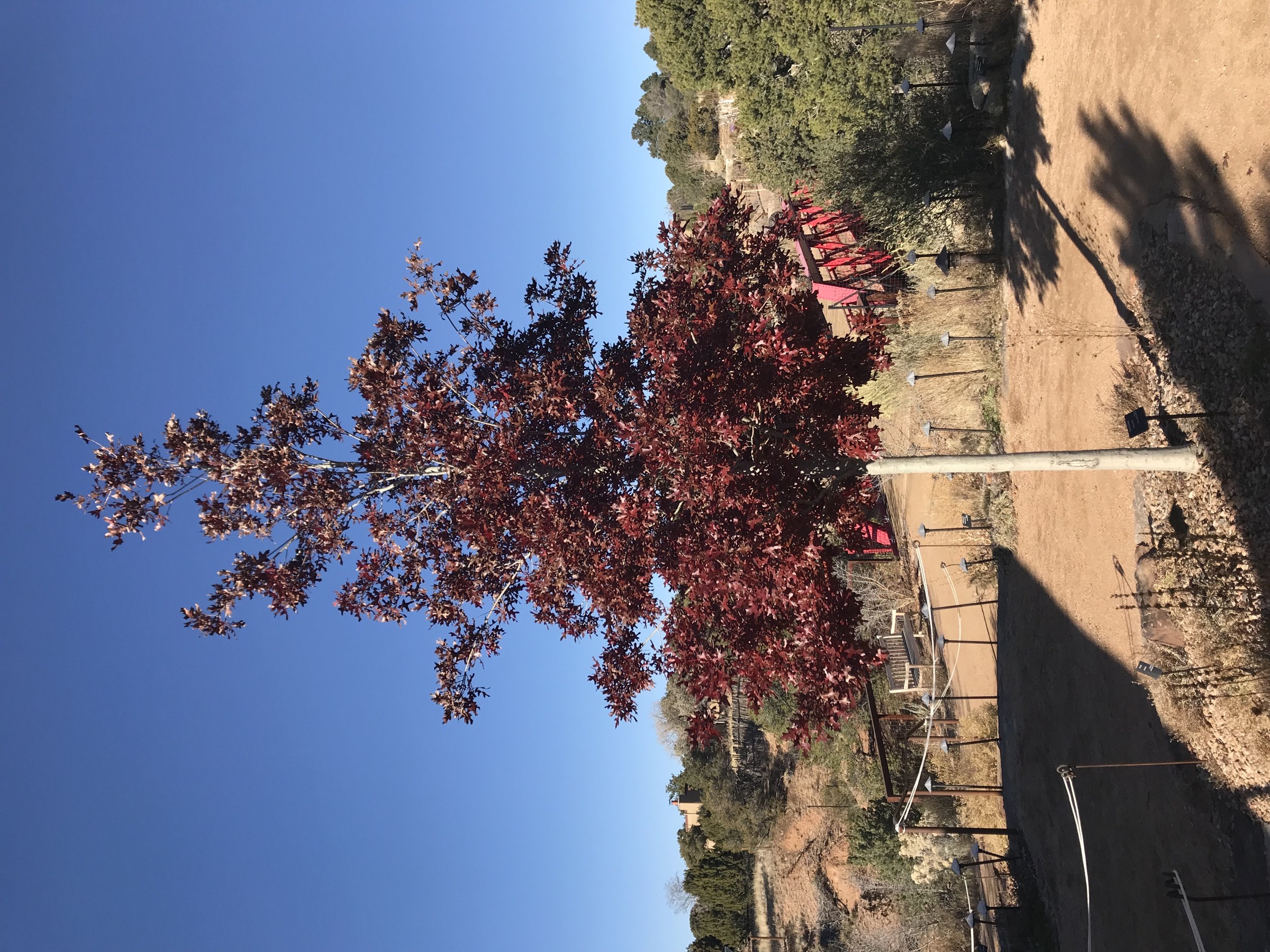
Quercus buckleyi, the Texas Red Oak (also called Spotted Oak or Buckley Oak), is a medium-sized deciduous tree found almost nowhere outside the limestone hill country of central Texas. It belongs to the red oak group (section Lobatae), and it is the reason Austin, San Antonio and the Texas Hill Country get any real autumn color at all — in a region where most native trees skip fall color entirely and go straight to brown, Texas red oak turns a dependable, often brilliant, scarlet to deep red.
In the wild it grows on dry limestone hills, canyon slopes and rocky uplands of the Edwards Plateau and the Lampasas Cut Plain, usually in thin, rocky, alkaline soils that would stunt most other oaks. It is closely related to, and sometimes confused with, Shumard oak (Quercus shumardii); Texas red oak is smaller in every dimension, with smaller leaves, smaller acorns and a shorter mature stature, and it sticks to limestone-derived soils rather than the richer bottomland sites Shumard oak favors.
For Texas gardeners, Texas red oak is one of the best shade trees available: moderately fast-growing, genuinely drought tolerant once established, unbothered by alkaline clay or caliche, and reliably colorful in a region short on fall color options. It has become a staple street and yard tree throughout central and north Texas nurseries.
Identification
Texas red oak is a single-trunked deciduous tree, typically 30 to 50 feet tall with a rounded to spreading crown about as wide as it is tall. Growth is moderate, somewhat faster than other oaks in its range, and trees commonly live well over a century.
Bark
Young bark is smooth and light gray, developing shallow furrows and narrow gray-brown ridges with age. It never becomes as deeply or darkly furrowed as the bark of Shumard oak or the true red oaks of the eastern U.S., staying comparatively light in color and texture throughout the tree’s life.
Leaves
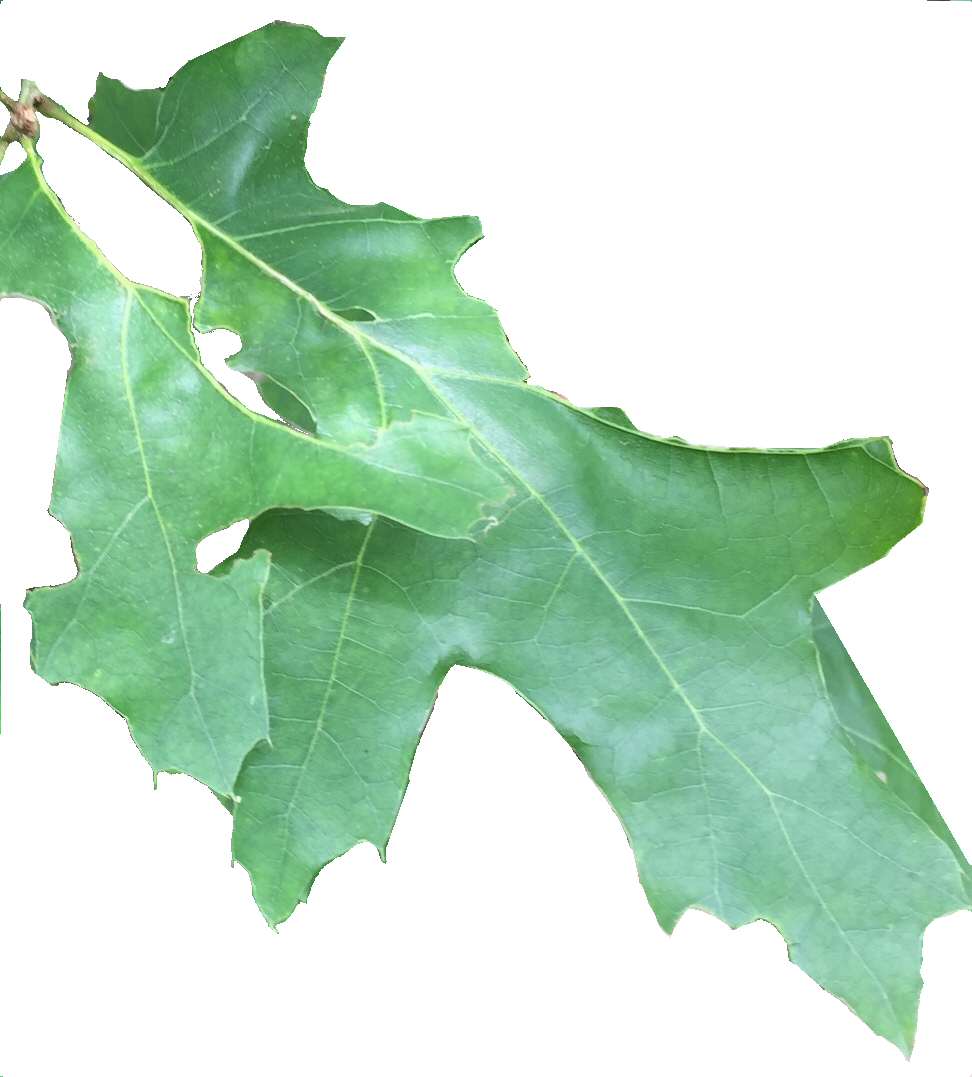
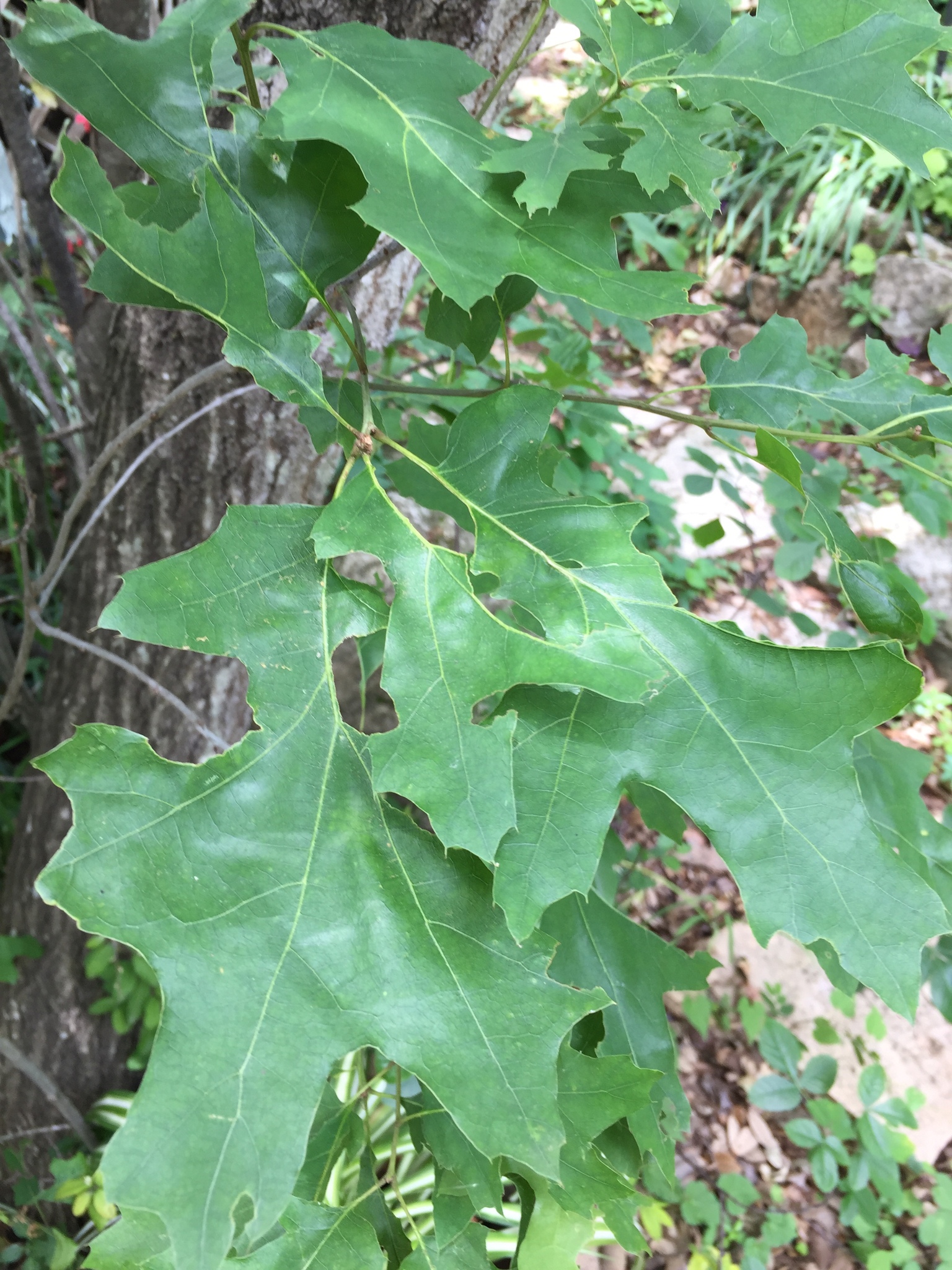
Leaves are 3 to 6 inches long, deeply cut into five to nine narrow, bristle-tipped lobes separated by wide, rounded sinuses that often reach nearly to the midrib — giving the leaf an open, lacy silhouette distinct from the shallower lobing of Shumard oak. The upper surface is glossy dark green; the lower surface is paler with small tufts of hair in the vein axils. Fall color is the signature trait: a clear, saturated red to scarlet, occasionally shading to orange, that holds for several weeks before the leaves drop.
Flowers & Acorns
Like other oaks, Texas red oak is wind-pollinated. Male flowers hang in slender yellow-green catkins in early spring as the new leaves emerge; female flowers are tiny and inconspicuous in the leaf axils. Being in the red oak group, acorns take two growing seasons to mature. They are small, roughly ½ to ¾ inch long, with a shallow, thin, scaly cup covering about a quarter of the nut; the nut itself is often faintly striped. A heavy acorn crop usually follows a mild spring with good pollination weather.
Quick Facts
| Scientific Name | Quercus buckleyi |
| Family | Fagaceae (Beech/Oak) |
| Plant Type | Deciduous Tree |
| Mature Height | 30–50 ft |
| Mature Spread | 25–40 ft |
| Growth Rate | Moderate |
| Sun Exposure | Full Sun |
| Water Needs | Low to moderate once established |
| Soil Type | Rocky, shallow, well-drained; limestone-based |
| Soil pH | Neutral to alkaline (6.5–8.5) |
| Bloom Time | March – April |
| Flower Color | Yellow-green catkins (inconspicuous) |
| Fall Color | Red to scarlet, sometimes orange |
| Fruit | Small striped acorns, mature in 2nd year |
| Deer Resistant | Moderate (young growth may be browsed) |
| USDA Hardiness Zones | 6–9 |
Native Range
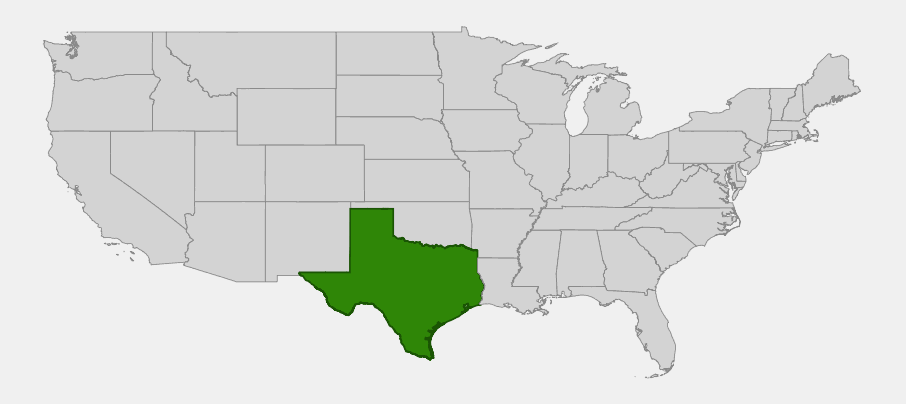
Texas red oak is a Texas endemic in the strictest sense: its confirmed native range is essentially limited to the Edwards Plateau and adjacent Lampasas Cut Plain of central Texas, roughly the band of limestone hill country running from the Austin and San Antonio area northwest through the Hill Country toward Brownwood and the southern edge of the Rolling Plains. It does not occur natively outside Texas.
Within that range it is a plant of rocky uplands rather than bottomlands: limestone hillsides, canyon rims, caliche flats and thin-soiled ridgetops, often growing in crevices and rubble where few other trees can root. It is a defining component of Hill Country oak-juniper woodlands, typically growing alongside Ashe juniper, Texas live oak and various walnuts and elms on the better pockets of soil.
Because it tolerates poor, rocky, alkaline soil so well, Texas red oak is now planted well beyond its native range throughout much of Texas and the southern Plains as a landscape and street tree. Gardeners outside the Hill Country should treat it as an introduced ornamental in their area rather than a native planting, even though it is native elsewhere in Texas.
📋 Regional plant lists featuring Texas Red Oak: Texas red oak’s native range does not fall within one of our current regional plant lists; browse the full native plant directory instead.
Growing & Care Guide
Texas red oak is forgiving and tough, built for a climate of hot summers, thin alkaline soil and unreliable rainfall. It rewards very little care with decades of shade and, unusually for a Texas native, real fall color.
Light
Give it full sun. Like most oaks it develops the strongest structure and best fall color in open, sunny sites; in heavy shade it grows leggy and thin and colors poorly.
Soil & Water
This is a tree built for rocky, shallow, alkaline soil, and it actually performs worse in rich, constantly moist garden beds than in the lean limestone conditions it evolved in. Good drainage matters more than fertility. Water young trees regularly for the first two to three years to establish a deep root system; after that, established trees handle Texas summers with only occasional deep watering during extended drought.
Planting Tips
Plant in fall or winter so roots can establish before summer heat arrives. Avoid amending the planting hole with rich soil or heavy compost, since this can discourage roots from pushing out into native ground — backfill with the native soil removed from the hole. Stake loosely only if needed in windy sites, and remove stakes within a year.
Pruning & Maintenance
Prune in winter dormancy to establish a strong central leader and remove crossing or low branches; avoid pruning in spring and early summer in areas with oak wilt disease pressure, since fresh wounds can attract the beetles that spread the fungus. Beyond early structural pruning, Texas red oak needs little maintenance and is not notably prone to pests in its native range.
Landscape Uses
Texas red oak is widely planted well beyond its native Hill Country range as a street and shade tree:
- Shade tree for residential yards and parks across central and north Texas
- Street tree tolerant of reflected heat, compacted soil and limited irrigation
- Fall color specimen in landscapes that otherwise rely on evergreens
- Xeriscape and low-water gardens once established
- Restoration plantings on limestone slopes within its native range
Wildlife & Ecological Value
As a mast-producing oak in a landscape where large trees are often scarce, Texas red oak punches above its weight ecologically for its size.
For Birds
Acorns are eaten by wild turkey, scrub jays and woodpeckers, and the canopy provides nesting and foraging habitat for a wide range of Hill Country songbirds. The tree also hosts numerous caterpillar species that in turn feed nesting songbirds in spring.
For Mammals
White-tailed deer browse young foliage and twigs, and acorns are an important fall and winter food source for deer, squirrels, and, in parts of south-central Texas, collared peccary (javelina). Fox squirrels in particular rely heavily on red oak acorns where the species grows.
Ecosystem Role
On the thin, rocky soils of the Edwards Plateau, Texas red oak’s root system helps stabilize slopes and limestone outcrops, and its canopy moderates summer soil temperatures for the understory plants and smaller oaks and junipers growing beneath it. As a long-lived canopy tree, it anchors the oak-juniper woodland structure that much of the region’s wildlife depends on.
Cultural & Historical Uses
Texas red oak was named for Samuel Botsford Buckley, a 19th-century Texas state geologist and botanist who collected extensively across the Hill Country. Like other oaks, its acorns contain bitter tannins and were historically processed by Indigenous peoples of the region through leaching — soaking or boiling shelled acorns in several changes of water to remove the tannins — before being ground into meal; this was a labor-intensive practice, not something acorns can be eaten as-is.
The wood is hard and heavy like other red oaks, and settlers in the Hill Country used it for fence posts, tool handles and firewood, though its typically modest trunk diameter limited its use as sawn lumber compared to larger eastern red oaks.
Today the tree’s main value is horticultural: it is one of the most widely recommended native shade trees for Texas gardens specifically because it offers fall color in a region where that is genuinely hard to come by, and nurseries throughout central Texas propagate it for exactly that reason.
Frequently Asked Questions
Is Texas red oak the same as Shumard oak?
No, though they are closely related and often confused. Texas red oak is smaller in every respect — shorter at maturity, with smaller leaves and smaller acorns — and it sticks to thin, rocky, alkaline limestone soils, while Shumard oak grows larger and prefers deeper, richer bottomland soils.
Can you eat Texas red oak acorns?
Not raw. Like all oaks, the acorns are high in bitter tannins and are not edible without extensive leaching to remove them. Indigenous peoples historically processed acorns this way, but this is a historical practice, not a casual foraging tip, and the foliage and unleached acorns can be harmful to livestock if eaten in quantity.
Does Texas red oak get oak wilt?
Yes — as a member of the red oak group, it is highly susceptible to oak wilt, a fungal disease spread by beetles and root grafts that is a serious concern in parts of central Texas. Avoid pruning red oaks in spring and early summer, and promptly treat or remove freshly cut wood to reduce beetle attraction.
Why does Texas red oak have such good fall color compared to other Texas oaks?
It is genetically closer to the eastern red oak group than most Texas natives, and that lineage carries the same pigment chemistry responsible for scarlet fall color in trees like northern red oak and scarlet oak — a trait most Hill Country natives, including the live oaks, simply don’t share.
How fast does Texas red oak grow?
Moderately fast for an oak, often 1.5 to 2 feet per year while young with adequate water, slowing as the tree matures. It is noticeably faster-growing than the Hill Country’s live oaks.

Looking for a nursery that carries Texas Red Oak?
Browse our native plant nursery directory: Texas