
Western Lily (Lilium occidentale)
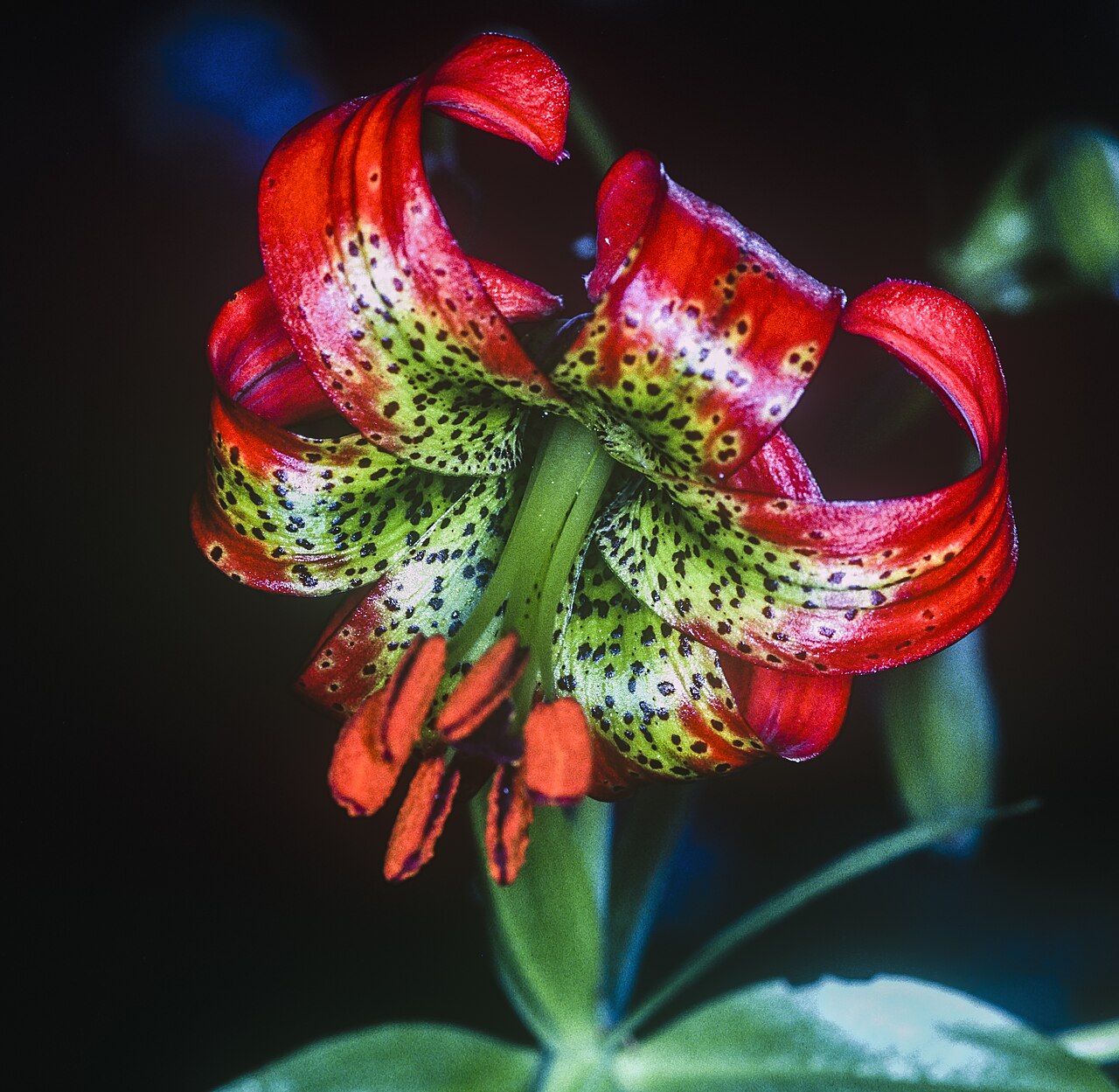
Lilium occidentale, the Western Lily, is one of the rarest and most beautiful lilies in North America. In June and July its tall stems carry nodding, deep crimson flowers whose tepals curl back like a Turk’s cap, revealing a bright green and yellow heart flecked with dark maroon spots.
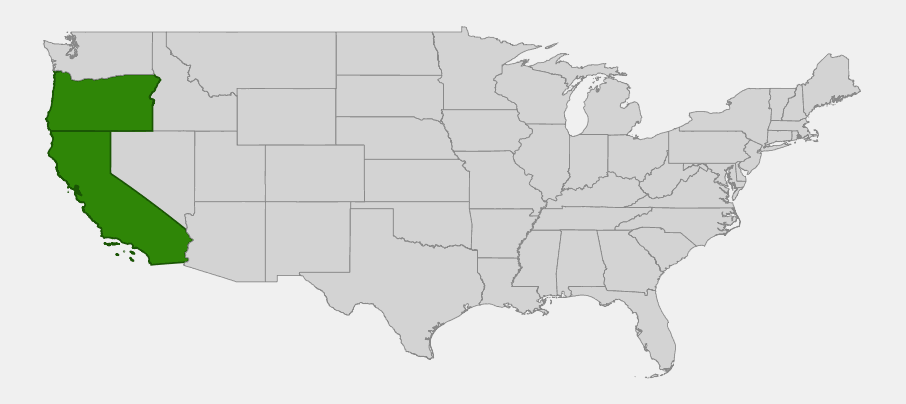
It grows only in a narrow band within a few miles of the Pacific Ocean, from Coos Bay in southern Oregon to Humboldt Bay in northern California. There it lives in coastal bogs, fens, wet meadows and the edges of coastal scrub and Sitka spruce forest, habitats that have been drained, developed, farmed or overgrown by shrubs. It is listed as endangered under the U.S. Endangered Species Act (since 1994) and is also endangered under California and Oregon state law.
This page is an identification and appreciation guide. The western lily is not a garden plant, and wild plants and their bulbs must never be dug or disturbed. Here you’ll learn how to recognize it, where it grows, why it is endangered, and how people are working to save it.
Identification
Several red and orange native lilies grow along the Pacific coast. The western lily is distinguished by its deep red color, its green-and-yellow center, its strongly recurved tepals and its bog and coastal-prairie habitat.
Bulb & Stems
Plants grow from a scaly bulb, sometimes with a short rhizome, buried in wet peat or sandy soil. A mature plant sends up a single, unbranched stem usually 2 to 5 feet tall, occasionally taller. Young plants produce only a leaf or two for several years before they are old enough to flower.
Leaves
The leaves are narrow and lance-shaped, 2 to 6 inches long, smooth and glossy green. They are arranged in one or more whorls around the stem and scattered singly above and below.
Flowers
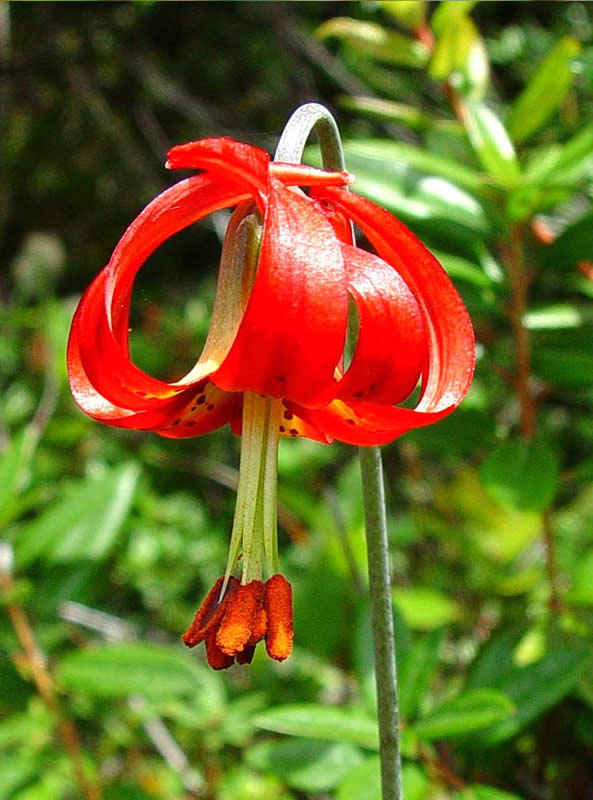
Mature plants carry 1 to about 20 flowers (usually fewer) at the top of the stem, each nodding on a long, arching stalk. The six tepals are 1½ to 2 inches long, crimson to red-orange on the outer half and green to yellow toward the base, with maroon spots, and they curl back strongly so their tips nearly touch the stalk. The stamens and style hang down from the center, with red-brown to orange anthers. Flowering is from late June into July.
Fruit
Pollinated flowers form upright, three-chambered capsules 1 to 2 inches long that split in fall to release many flat, papery seeds.
Look-alikes
Columbia Lily (L. columbianum) has smaller, orange to yellow-orange flowers spotted throughout, and grows in drier meadows and forest openings over a much larger range. Leopard lily (L. pardalinum) is larger, with orange flowers spotted and tipped with red, and grows along streams. Western lily differs in its deep crimson color with a sharply contrasting green-yellow center, and in its bog habitat close to the ocean.
Quick Facts
| Scientific Name | Lilium occidentale Purdy |
| Family | Liliaceae (lily family) |
| Plant Type | Bulbous herbaceous perennial |
| Mature Height | 2–5 ft (occasionally to 6 ft) |
| Mature Spread | Single stems; under 1 ft |
| Growth Rate | Slow; several years from seed to flowering |
| Sun Exposure | Full sun to partial shade; flowers in sun |
| Water Needs | High; wet, peaty soil |
| Soil Type | Acidic peat, sandy or silty soils of bogs and coastal meadows |
| Soil pH | Acidic, about 4.5–6.0 |
| Bloom Time | Late June–July |
| Flower Color | Crimson red with a green and yellow, maroon-spotted center |
| Fall Color | Stems yellow and die back |
| Fruit | Upright capsule with flat papery seeds |
| Deer Resistant | No; deer and elk browse the buds and stems |
| USDA Hardiness Zones | 8–9 (coastal fog belt) |
Native Range
The western lily is endemic to the Pacific coast of southern Oregon and northern California. Its known populations lie within about 4 miles of the ocean, from near Coos Bay, Oregon, south through Curry County and Del Norte County to the Humboldt Bay area near Arcata and Eureka, California. Many populations are small, some with only a few flowering plants.
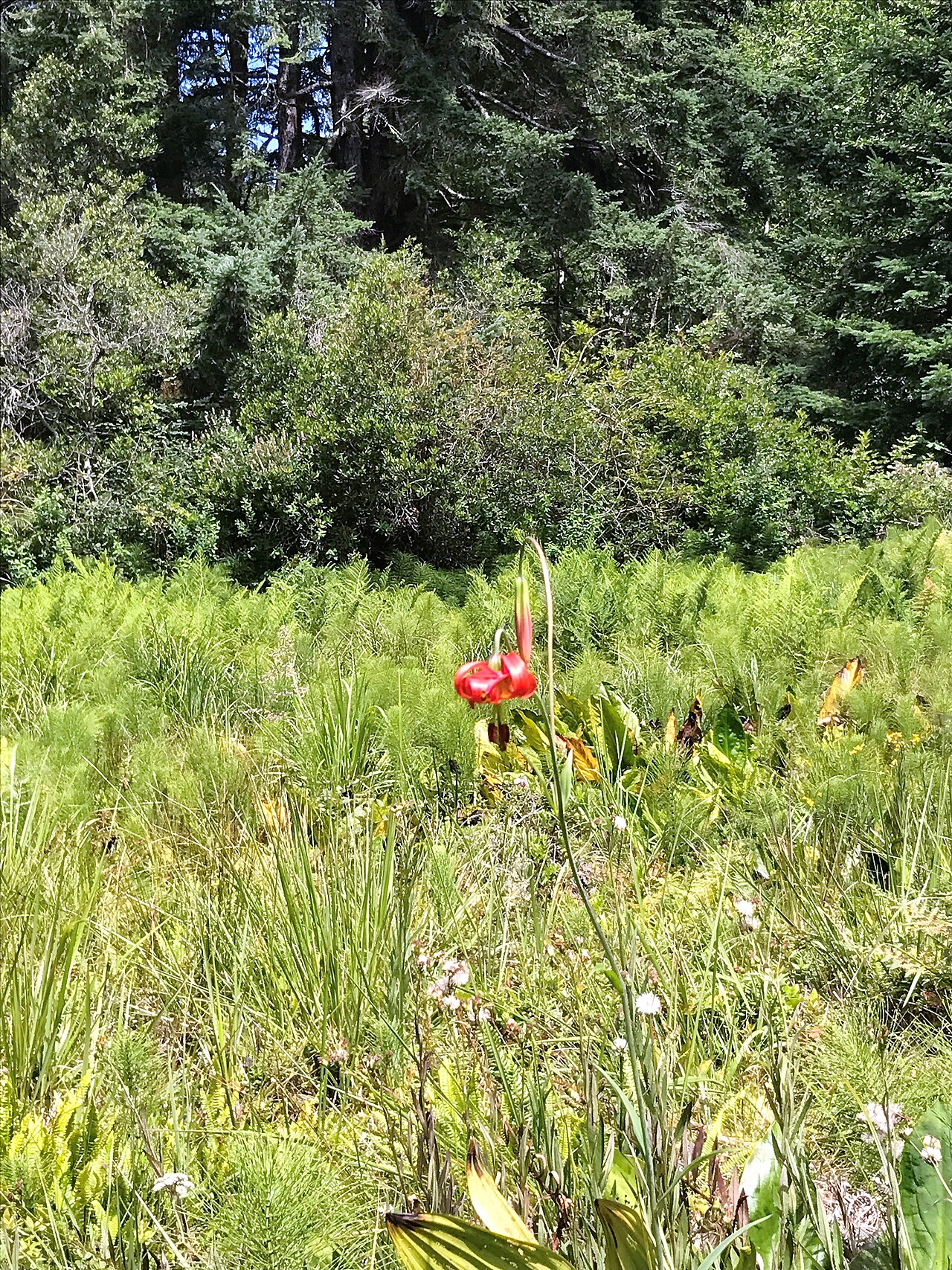
It grows in the coastal fog belt at elevations below about 330 feet, in sphagnum bogs and fens, coastal prairies, wet meadows, and the edges of salal, wax myrtle and Labrador tea scrub and of Sitka spruce and shore pine forest. It needs open sun to flower well but usually grows near shrubs, which shade its base and support its tall stems.
Historically, natural fires, grazing by elk and the practices of Indigenous peoples kept these coastal openings from becoming forest. Today many sites are slowly filling in with shrubs and trees. Others have been lost to housing, roads, cranberry farming, drainage and livestock grazing, and the bulbs have been dug illegally by collectors. These threats led to its federal listing in 1994.
📋 Regional plant lists featuring Western Lily: Western Oregon & Western Washington · California & Nevada
Can You Grow It?
Not in an ordinary garden. The western lily is federally endangered, it is not available from nurseries, and its narrow requirements (cool coastal fog, wet acidic peat, sun on the flowers and shade at the base) are almost impossible to meet in cultivation. Conservation programs grow it from seed under permit for research and to restore wild populations. Never dig western lily bulbs or collect seed from the wild. Illegal collection has already eliminated some populations.
Safety note: all parts of true lilies (Lilium), including pollen, are highly toxic to cats and can cause fatal kidney failure. Keep cats away from any lily, wild or cultivated.
Light
In the wild it needs open sun for its flowers, with its base and bulb shaded by low shrubs or tall grasses. Too much shade from encroaching trees stops flowering.
Soil & Water
It grows in wet, acidic, low-nutrient peat or sandy soils that stay moist all year in the cool, foggy coastal climate.
Planting Tips
If you love native lilies, choose species sold as nursery-propagated bulbs for your region, such as Columbia lily in the Pacific Northwest or Humboldt lily in California. Buy only from reputable nurseries that propagate their stock.
Pruning & Maintenance
In its habitat, land managers maintain open conditions by cutting back encroaching shrubs and trees and, in some places, by controlled grazing or burning. Protecting plants from deer browsing and from trampling is also part of recovery work.
Propagation
Recovery programs grow it from seed, which germinates slowly and takes several years to produce a flowering bulb. Genetic studies have shown that populations differ from each other, so reintroductions use local seed sources. This work is done only under federal and state permits.
Where to See It
- Protected coastal bogs and meadows: several populations are on public and conservation land along the southern Oregon and northern California coast, and some have trails or open days during flowering
- Late June to July: the best time to look, when plants are in bloom; stay on trails and never step into the bog
- Guided wildflower walks: local native plant society chapters on the Oregon and California coast lead field trips to see it
- Photographs and herbarium records: for anyone unable to visit, a way to appreciate one of the West Coast’s rarest wildflowers
Wildlife & Ecological Value
The western lily is one part of the rich community of coastal bogs and prairies, and it depends on other species, especially hummingbirds, for its survival.
For Pollinators
Its nodding red flowers, rich in nectar, are pollinated mainly by hummingbirds, especially Allen’s and rufous hummingbirds. Bees and butterflies visit occasionally, but hummingbirds are by far the most effective pollinators.
For Birds
Hummingbirds that visit the flowers also nest and feed in the surrounding coastal scrub and forest. The coastal bogs and prairies where it grows support many other birds, from wrentits and sparrows to raptors that hunt over the meadows.
For Mammals
Deer and elk browse the buds and stems, and rodents such as gophers and voles eat the bulbs. In small populations this browsing can prevent plants from flowering or setting seed, so some populations are protected with fencing.
Ecosystem Role
As a long-lived bulb in rare coastal bog and prairie habitats, it is an indicator of healthy, open coastal wetlands. Efforts to save it also protect other rare plants of these habitats, such as the California pitcher plant.
Cultural & Historical Uses
Carl Purdy, a well-known California bulb grower and plant explorer, described Lilium occidentale in 1897 from plants found in Humboldt County, California. Its species name means “western.” Bulb collecting for gardens has been one of the threats to wild populations.
The U.S. Fish and Wildlife Service listed it as endangered in 1994 and published a recovery plan in 1998. Recovery work has included protecting habitat, clearing encroaching shrubs, fencing plants from browsing, genetic studies, seed banking and growing plants for reintroduction, carried out by federal and state agencies, universities, botanical gardens and conservation organizations.
For lily enthusiasts the western lily is a legendary plant: a native lily with crimson flowers that grows nowhere in the world except a few miles of foggy coast. Seeing it in bloom in a coastal bog, with hummingbirds visiting, is one of the great botanical experiences of the West Coast.
Frequently Asked Questions
Is the western lily endangered?
Yes. It is listed as endangered under the U.S. Endangered Species Act (since 1994) and is also protected under California and Oregon state law. Only a limited number of populations survive along the southern Oregon and northern California coast.
Can I buy western lily bulbs?
No. It is not legally available from nurseries for gardens, and it is extremely difficult to grow outside its foggy coastal bog habitat. Grow nursery-propagated native lilies such as Columbia lily or Humboldt lily instead.
How do I tell western lily from other red lilies?
Look for deep crimson flowers with a sharply contrasting green and yellow, spotted center, tepals curled far back, and a habitat in coastal bogs or meadows within a few miles of the ocean in southern Oregon or far northern California.
What pollinates the western lily?
Mainly hummingbirds, especially Allen’s and rufous hummingbirds, which are attracted to its red, nectar-rich, nodding flowers.
Are lilies poisonous to cats?
Yes. All true lilies (Lilium), including the western lily, are highly toxic to cats. Even a small amount of leaf or pollen can cause kidney failure. Contact a veterinarian immediately if a cat chews on a lily.

Looking for a nursery that carries Western Lily?
Browse our native plant nursery directory: California · Oregon

