
Low Serviceberry (Amelanchier humilis)
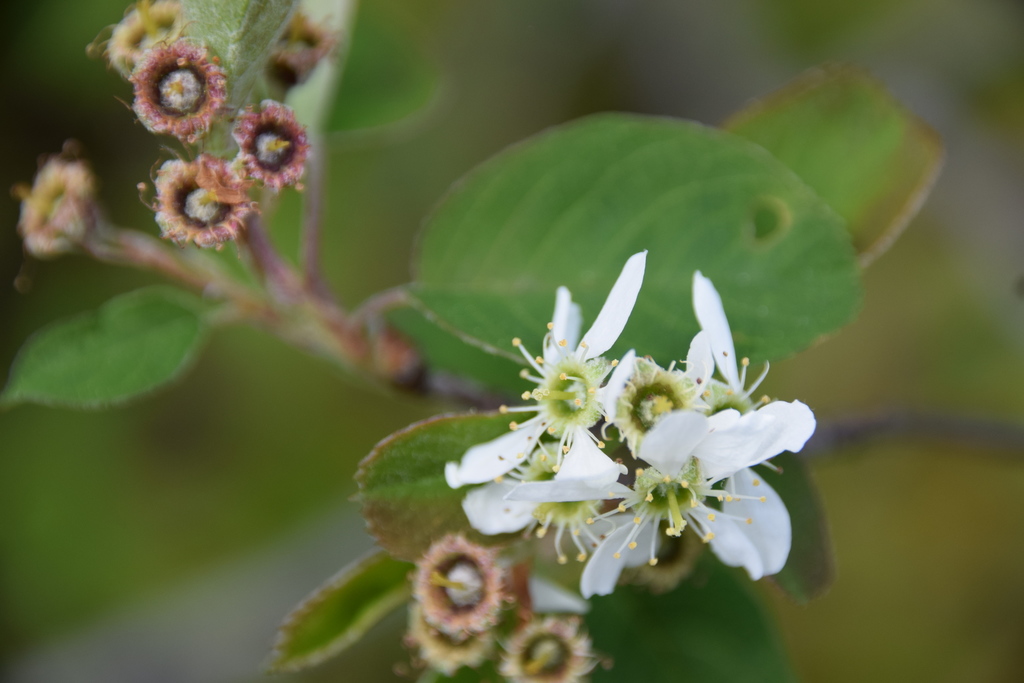
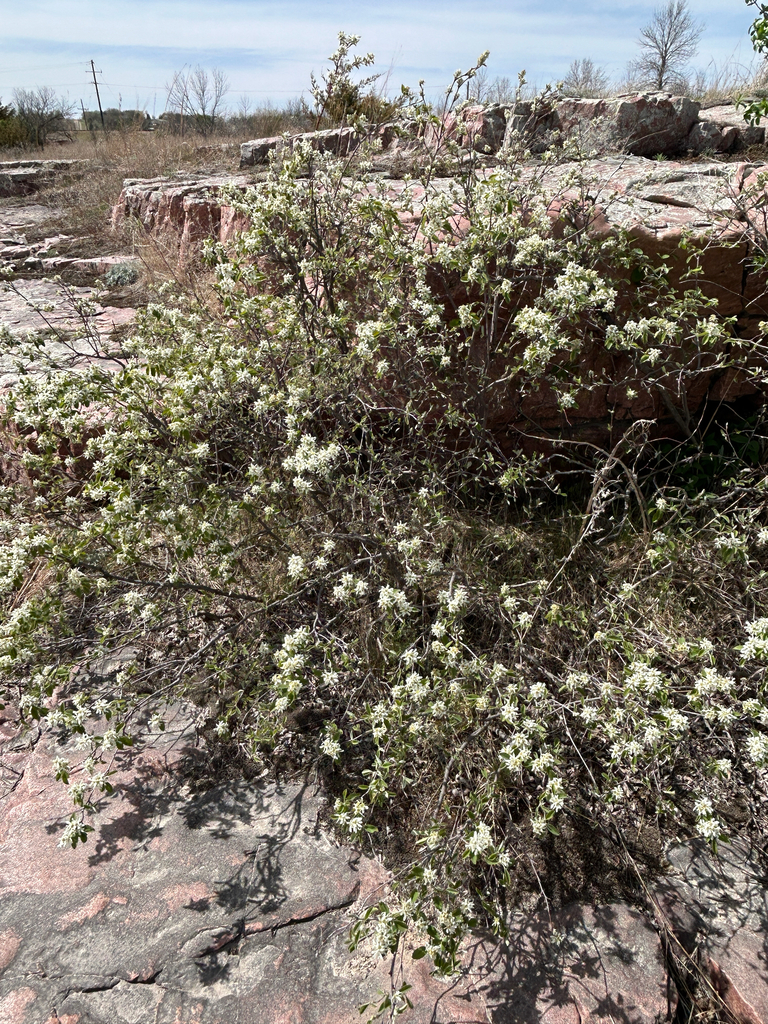
Amelanchier humilis, known as Low Serviceberry, low shadbush or low juneberry, is a small, suckering native shrub of rocky ledges, bluffs, lake shores, sand dunes and dry prairies across the northern Great Plains, the Great Lakes region and parts of the Northeast. Usually only 1 to 4 feet tall, it spreads by underground stems into colonies that are covered in short clusters of white flowers in spring, followed by sweet, dark purple-black berries in early summer.
Serviceberries are a notoriously difficult group, and low serviceberry sits in the middle of the confusion. It is closely related to the eastern Running Serviceberry (Amelanchier stolonifera, often called A. spicata), and some botanists have treated the low, running serviceberries as one variable group, or regarded A. spicata as a hybrid involving A. humilis. USDA PLANTS and many regional floras keep low serviceberry as a separate species, and this page follows that treatment.
For gardeners, low serviceberry is a tough, cold-hardy native for dry, sunny, often alkaline sites where taller serviceberries struggle. This page covers how to tell it from running serviceberry and other serviceberries, its native range, how to grow it, its value to wildlife, and the edible fruit.
Identification
Low serviceberry is a small, colony-forming shrub. Its best features are its very hairy young leaves and flower clusters, and the veins of its leaves, which run straight into the teeth.
Size & Form
It is a low, multi-stemmed shrub usually 1 to 4 feet tall, occasionally taller in sheltered spots. Upright stems rise from spreading underground stems (rhizomes), so a single plant can form a patch several yards across over time.
Leaves
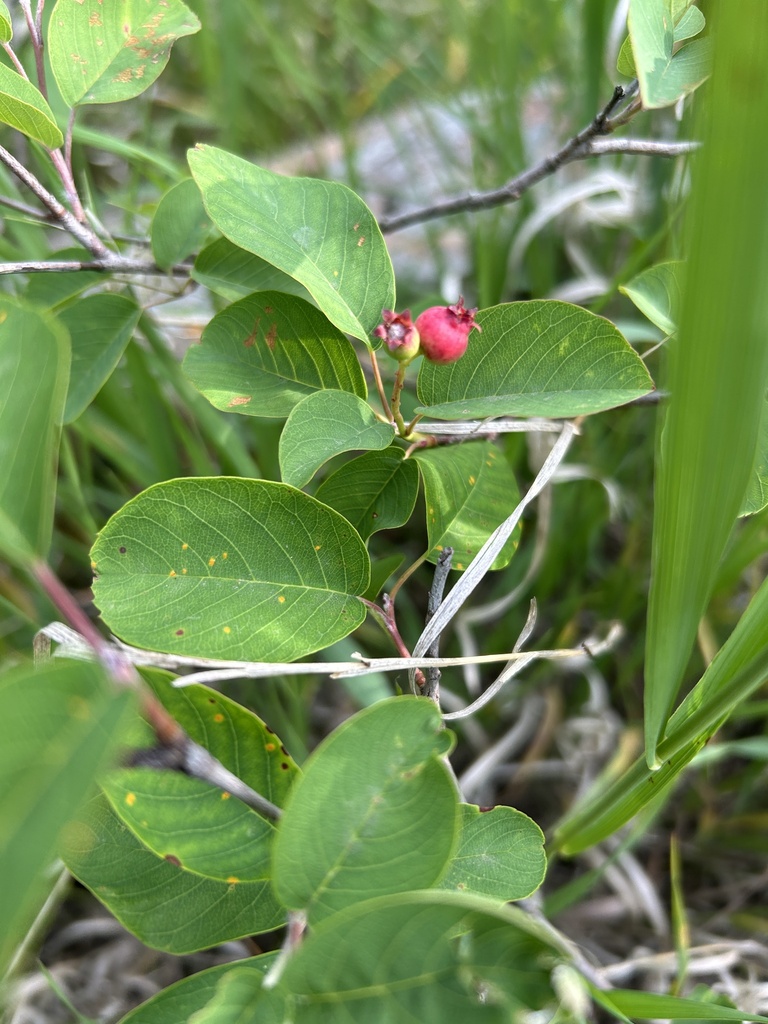
The alternate leaves are oval to nearly round, about 1 to 2 inches long, with coarse teeth along most of the edge. When they unfold in spring, their undersides are densely covered with white woolly hairs; they become smoother with age. The side veins are fairly straight and run out to the leaf edge, branching once or twice and ending in the teeth. In fall the leaves turn yellow to orange-red.
Flowers
In April and May, as the leaves expand, it produces short, compact, upright clusters (racemes) of white flowers. Each flower has five narrow petals about 1/4 to 1/2 inch long. The axis of the flower cluster and the flower stalks are densely hairy, a helpful clue.
Fruit
The fruits are small pomes about 1/4 inch across that ripen from red to dark purple-black in June and July. They are juicy and sweet, with a mild apple- or almond-like flavor, and are eaten quickly by birds.
Low vs. Running Serviceberry
Running Serviceberry (A. stolonifera, also listed as A. spicata) is the most similar species and also forms low, suckering colonies. Running serviceberry has finely toothed leaves whose veins curve and join each other before reaching the edge, so they do not run into the teeth, and its fruits are slightly larger. It is mainly an eastern plant of acidic sandy soils, fields and ledges. Low serviceberry has coarser teeth with veins entering them, woollier young leaves and inflorescences, and usually grows on limestone or other high-pH rock, dunes and prairies farther west. The two can be hard to separate, and intermediate plants occur.
Other Serviceberries
Tree-forming serviceberries such as Downy Serviceberry, Allegheny Serviceberry and Shadblow are much taller and don’t form low colonies. The western Saskatoon Serviceberry (A. alnifolia) overlaps with low serviceberry on the northern plains; it is usually taller, with leaves toothed mainly toward the tip.
Quick Facts
| Scientific Name | Amelanchier humilis Wiegand |
| Family | Rosaceae (rose family) |
| Plant Type | Deciduous, suckering shrub |
| Mature Height | 1–4 ft (occasionally to 6 ft) |
| Mature Spread | Forms colonies several feet wide or more |
| Growth Rate | Moderate |
| Sun Exposure | Full sun to part shade |
| Water Needs | Low to medium; drought tolerant |
| Soil Type | Well-drained rocky, gravelly or sandy soil; often limestone |
| Soil pH | About 6.0–8.0 (tolerates alkaline soil) |
| Bloom Time | April–May |
| Flower Color | White |
| Fall Color | Yellow to orange-red |
| Fruit | Small, sweet, purple-black pome; June–July |
| Deer Resistant | No; browsed by deer and rabbits |
| USDA Hardiness Zones | 3–7 |
Native Range
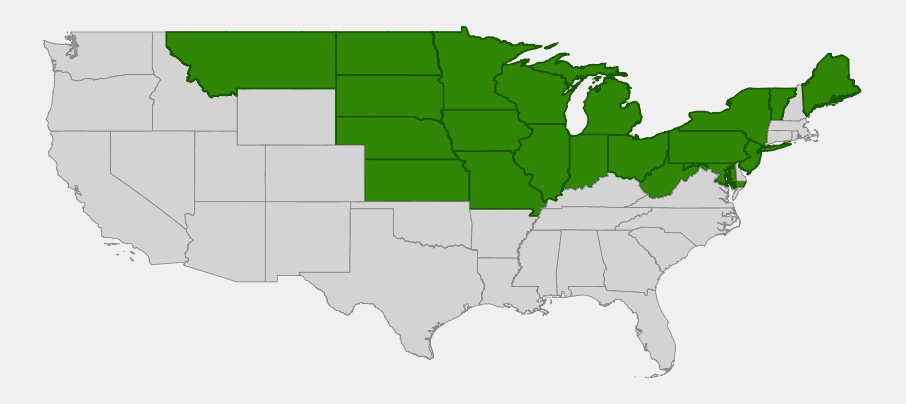
USDA PLANTS lists low serviceberry as native from Montana, North Dakota, South Dakota, Nebraska and Kansas east through Minnesota, Iowa, Missouri, Wisconsin, Illinois, Michigan, Indiana and Ohio to New York, Pennsylvania, New Jersey, Maryland, West Virginia, Vermont and Maine. In Canada it grows from Saskatchewan and Manitoba to Ontario and Québec. It is most frequent in the upper Midwest and the northern Great Plains.
It grows in open, sunny or lightly shaded places with thin or sandy soil: limestone and dolomite ledges and headlands, rocky lake and river shores, bluffs, sand dunes, rocky prairies, open oak and pine woods, and quartzite and granite outcrops. In New England, Flora Novae Angliae records it only from Vermont, mainly in the Lake Champlain Valley on high-pH bedrock, so the USDA record for Maine is best treated as an outlying record. It is local and uncommon at the edges of its range, for example in Maryland, West Virginia and New Jersey.
Because serviceberries hybridize and are often misidentified, range maps differ between sources, and some records of “low serviceberry” in the East may belong to running serviceberry, and vice versa.
📋 Regional plant lists featuring Low Serviceberry: Montana & Wyoming · North Dakota, South Dakota & Western Minnesota · Nebraska, Kansas & Eastern Colorado · Michigan, Wisconsin & Eastern Minnesota · Illinois, Iowa & Missouri · Ohio & Indiana · New York, Pennsylvania & Northern New Jersey · Delaware, Southern New Jersey & Long Island · Maryland, Virginia & West Virginia · New Hampshire, Maine & Vermont
Growing & Care Guide
Low serviceberry is not as widely sold as the tree serviceberries, but native plant nurseries in the upper Midwest and Great Plains offer it, sometimes under the name Amelanchier spicata or A. stolonifera. Check the botanical name and, if possible, the seed source, since plants grown from local seed are best adapted to your region.
Light
It flowers and fruits best in full sun and tolerates part shade. In heavy shade it grows thin and produces little fruit.
Soil & Water
Plant it in well-drained soil. It is adapted to thin, rocky, sandy or gravelly soils and grows well on limestone and other alkaline soils, though it also tolerates mildly acidic soil. Water regularly through the first growing season; after that it is quite drought tolerant. Avoid heavy, poorly drained clay.
Planting Tips
Plant in spring or fall, spacing plants about 3 feet apart for a low hedge or massed planting. Let it sucker into a colony on slopes and banks, or plant it where mowing or edging can contain it. It is very cold hardy and suits exposed, windy sites. Protect young plants from rabbits and deer with wire cages.
Pruning & Maintenance
Little pruning is needed. Remove dead or crowded old stems at ground level in late winter to keep the colony vigorous. Like other serviceberries, it can get cedar-apple rust, leaf spots, fire blight and powdery mildew; good air circulation and full sun reduce these problems. Don’t plant it right next to eastern red cedar or other junipers if rust is common in your area.
Propagation
The easiest method is to dig and replant rooted suckers from garden plants in early spring. It can also be grown from seed: clean the seeds from ripe fruit and sow them outdoors in fall, or give them about 90 to 120 days of cold, moist stratification before spring sowing. Seedlings are slow for the first year or two.
Landscape Uses
- Dry, sunny slopes: a low, suckering shrub that holds rocky or sandy banks
- Wildlife and bird gardens: early flowers for bees and summer fruit for birds
- Low hedges and masses: forms a dense, knee-high to waist-high thicket
- Prairie and savanna edges: fits naturally with prairie grasses and oaks
- Edible landscaping: small, sweet berries for fresh eating, jam and baking
Wildlife & Ecological Value
Like all serviceberries, low serviceberry is a valuable wildlife plant, offering early spring flowers and summer fruit.
For Pollinators
The early flowers are visited by native bees, including mining bees (Andrena) and small sweat bees, as well as flies and early butterflies. Serviceberries are larval host plants for butterflies such as the striped hairstreak and red-spotted purple, and for many moths.
For Birds
The fruits ripen in early summer when few other fruits are available and are eaten by many birds, including cedar waxwings, American robins, gray catbirds, brown thrashers, thrushes and grouse. The low thickets provide cover and nest sites for ground- and shrub-nesting birds.
For Mammals
Black bears, foxes, chipmunks and squirrels eat the fruit, and deer, moose and rabbits browse the twigs and leaves, especially in winter.
Ecosystem Role
Its suckering colonies stabilize thin soils on ledges, bluffs and dunes, and provide shelter for small animals in otherwise open habitats. As one of the earliest shrubs to bloom in prairie and rocky-shore communities, it supports pollinators when few other flowers are open.
Cultural & Historical Uses
Serviceberry fruits, often called juneberries or saskatoons, were an important food for many Indigenous peoples of the Great Plains and Great Lakes. They were eaten fresh, dried for winter, and pounded with dried meat and fat to make pemmican. The small, low serviceberries of rocky ground and prairies were among the fruits gathered.
The species was described in 1912 by American botanist Karl McKay Wiegand, who also named running serviceberry, A. stolonifera, at the same time. Humilis means “low” or “humble” in Latin, for its small size. The common name serviceberry is often said to come from early settlers holding church services when the shrubs bloomed in spring, but it more likely derives from “sarvis,” an old name related to the European service tree (Sorbus).
The fruits are safe and good to eat. As in apples and cherries, the seeds contain small amounts of cyanogenic compounds; eating fruit with seeds in normal amounts is not a concern, but don’t crush and eat large quantities of seeds.
Frequently Asked Questions
Is low serviceberry the same as running serviceberry?
They are closely related and sometimes combined, but USDA PLANTS and many floras treat them as separate species. Low serviceberry (A. humilis) has coarsely toothed leaves with veins running into the teeth, very hairy young growth, and usually grows on limestone, dunes and prairies in the Midwest and Plains. Running Serviceberry (A. stolonifera or A. spicata) has finer teeth and curved veins that don’t enter the teeth, and is mainly eastern.
How tall does low serviceberry get?
Usually 1 to 4 feet, occasionally up to about 6 feet. It spreads by underground stems into colonies.
Can you eat low serviceberry fruit?
Yes. The small, dark purple-black berries ripen in June and July and are sweet and juicy. Eat them fresh or use them in jam, pies and muffins. Birds will compete for them.
Does low serviceberry grow in alkaline soil?
Yes. It is one of the best serviceberries for alkaline soils and often grows wild on limestone and dolomite ledges. It needs good drainage.
Where does low serviceberry grow?
From Montana and the Dakotas east through the upper Midwest and Great Lakes to New York, Pennsylvania, New Jersey, Maryland, West Virginia and Vermont, and in Canada from Saskatchewan to Québec, on rocky, sandy and open sites.

Looking for a nursery that carries Low Serviceberry?
Browse our native plant nursery directory: Illinois, Indiana, Iowa & Kansas · Maine, Maryland, Michigan, Minnesota, Missouri & Montana · Nebraska, New Jersey, New York, North Dakota & Ohio · Pennsylvania, South Dakota & Vermont · West Virginia & Wisconsin

