
Tufted Bulrush (Trichophorum cespitosum)
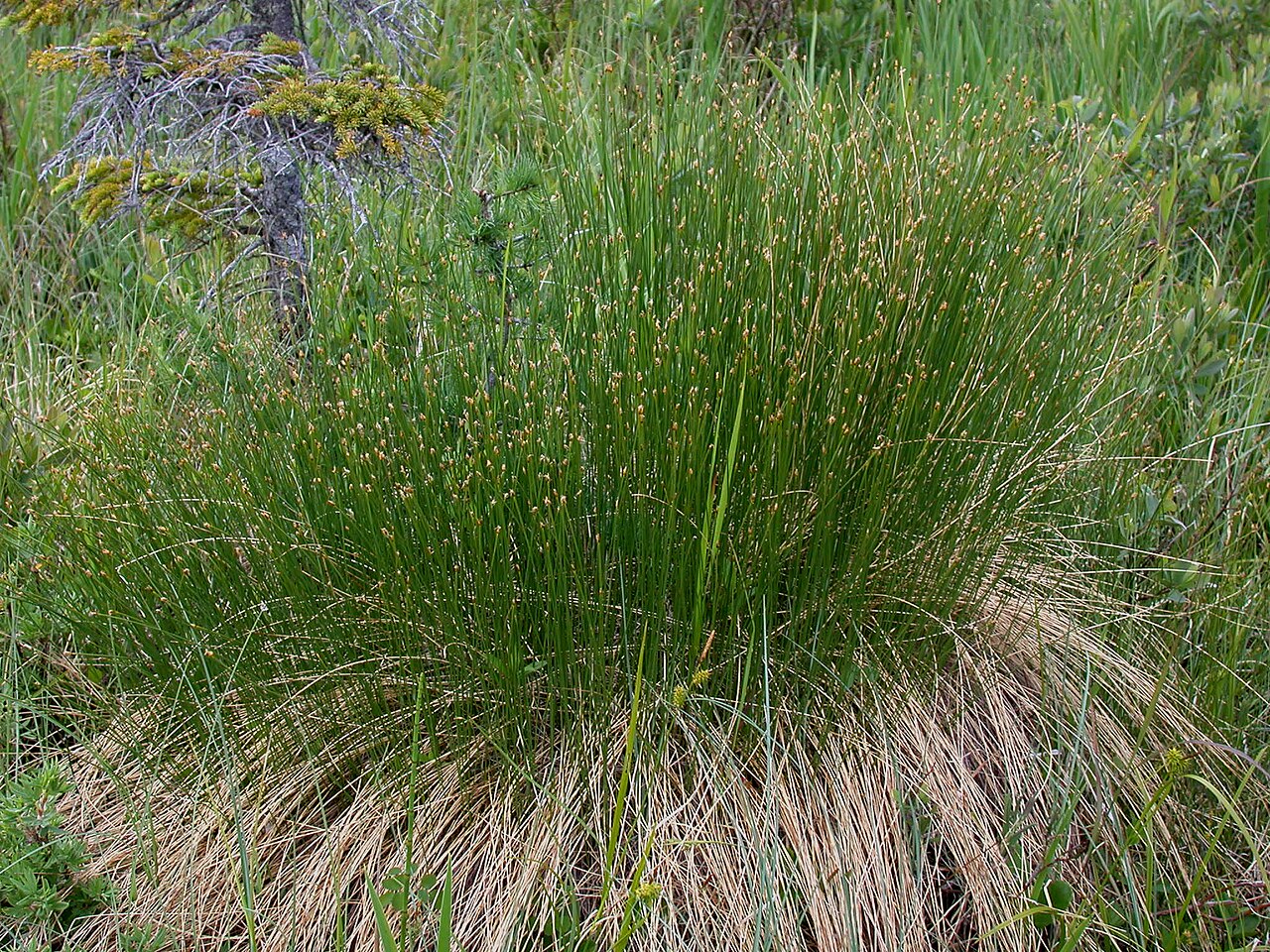
Trichophorum cespitosum, the Tufted Bulrush (also called deergrass, tufted clubrush and cespitose bulrush, and long known as Scirpus cespitosus), is a small, densely tufted sedge of peat bogs, fens, wet tundra, alpine meadows and wet rock ledges across the cold regions of the Northern Hemisphere. It forms neat, firm tussocks of thin, wiry stems, each topped by a single tiny spikelet.
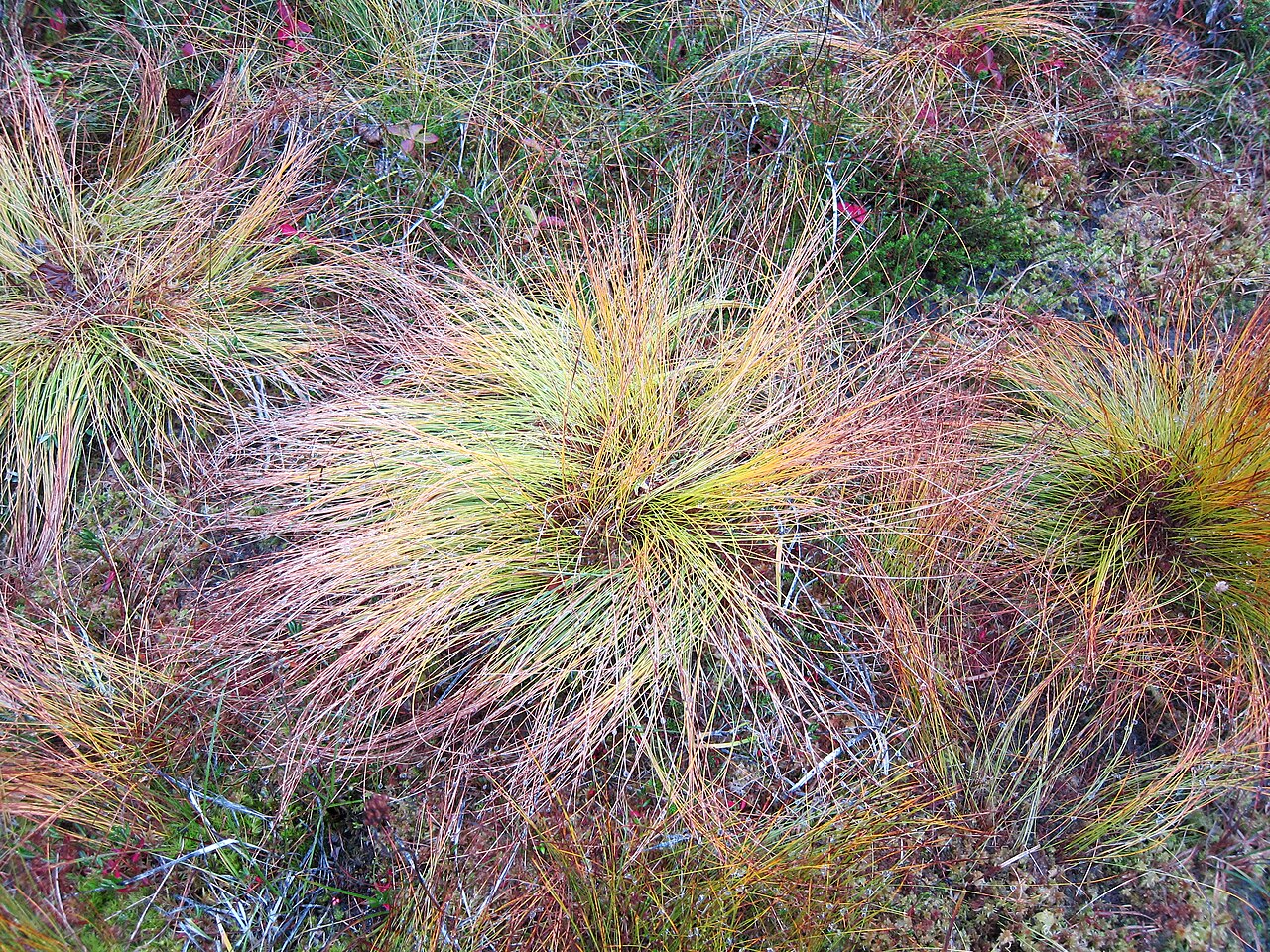
In North America it is a characteristic plant of Alaska’s muskegs, northern and mountain bogs and fens, and Arctic and alpine tundra. Its fine, bright green tufts turn striking shades of gold, orange and rust in fall, coloring whole bogs and moorlands. In the United States it reaches south along the mountains to Colorado and Utah and, in the East, to a few cool, high-elevation sites in the southern Appalachians.
Despite the names, it is not a true grass and not a “bulrush” in the cattail sense; it is a member of the sedge family. The British name “deergrass” also causes confusion with the large California bunchgrass Deergrass (Muhlenbergia rigens), a completely different plant. This guide covers identification, taxonomy, range, use in bog gardens and restoration, and its value to wildlife.
Identification
Tufted bulrush is easy to recognize once you know it: a firm, dense tuft of slender, round, unbranched stems, almost no leaf blades, and one tiny spikelet at the very tip of each stem.
Stems & Leaves
Plants form dense, firm tussocks 2 to 16 inches tall, often with many dozens of stems. The stems are smooth, round and wiry, about 1 millimeter thick. Leaves are reduced to shiny brown or straw-colored sheaths at the base of each stem; only the uppermost sheath has a very short blade, usually less than ½ inch long, that looks like a tiny bristle partway up the stem. Old sheaths build up at the base of the tuft.
Flowers
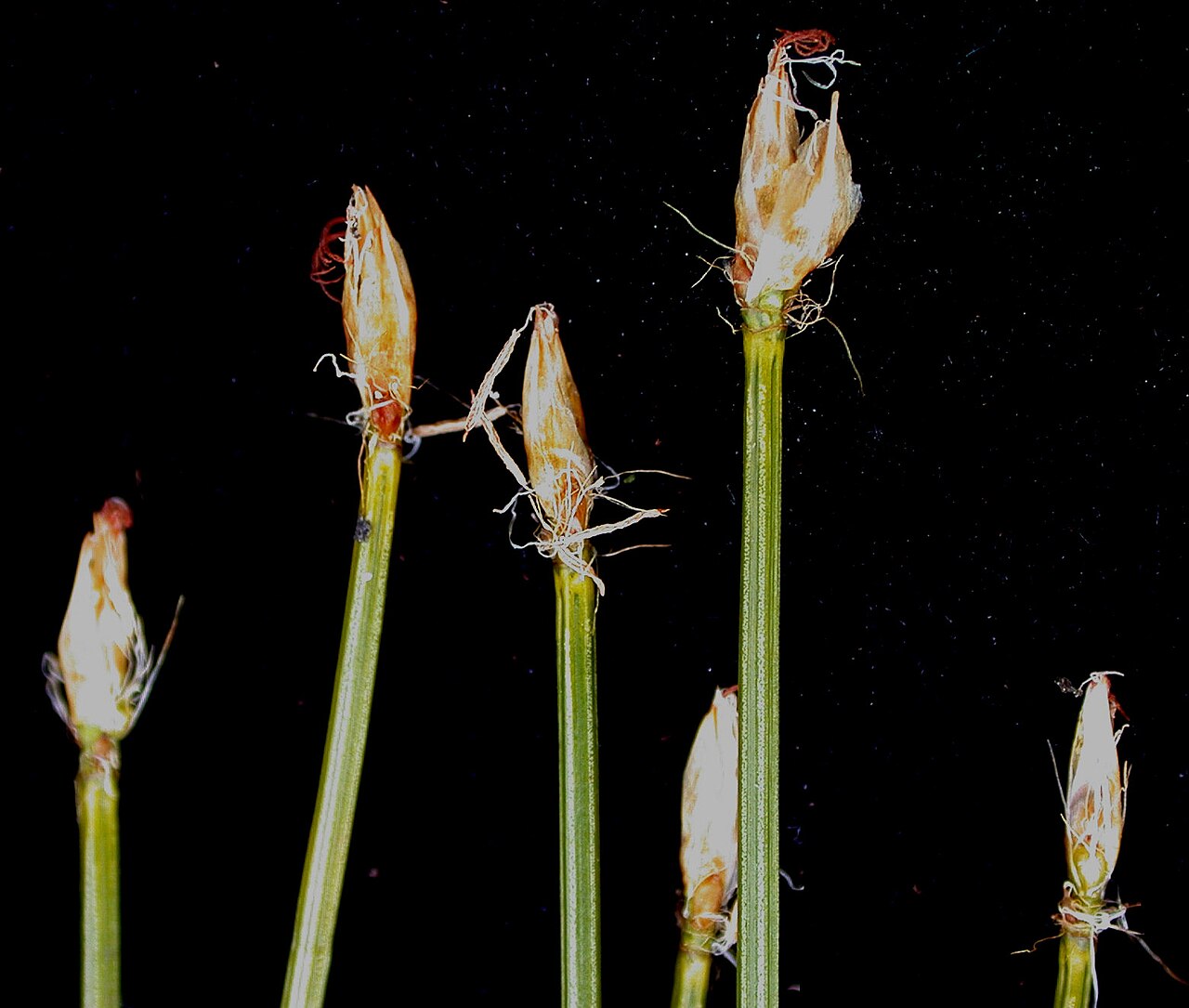
Each stem ends in a single, small, egg-shaped, brownish spikelet about ⅛ to ¼ inch long with only a few flowers. The lowest scale of the spikelet is about as long as the spikelet and has a short tip. At flowering in late spring and early summer, feathery white stigmas and yellowish anthers stick out between the scales. It is wind-pollinated.
Fruit
The fruit is a tiny, three-sided, brown achene, surrounded by up to six fine bristles that are about as long as the achene or slightly longer. Spikelets ripen in mid to late summer.
Look-alikes
Spike-rushes (Eleocharis) also have a single spikelet atop each stem, but they lack the short leaf blade on the upper sheath and usually have a swollen base (tubercle) on the achene. Alpine bulrush (Trichophorum alpinum) has long, white, cottony bristles that make the fruiting heads look like tiny cottongrass. Sedges such as Tussock Sedge have flat leaves and multiple spikes. Rushes such as Baltic Rush have small six-parted flowers, not spikelets with scales.
Quick Facts
| Scientific Name | Trichophorum cespitosum (L.) Hartm.; syn. Scirpus cespitosus L. |
| Family | Cyperaceae (sedge family) |
| Plant Type | Densely tufted perennial sedge |
| Mature Height | 2–16 in |
| Mature Spread | 2–12 in per tussock |
| Growth Rate | Slow |
| Sun Exposure | Full sun to light shade |
| Water Needs | High; constantly moist to wet peat or seepage |
| Soil Type | Peat, wet sand or gravel, wet rock crevices |
| Soil pH | About 4.0–7.5 (acidic bogs to mildly calcareous fens) |
| Bloom Time | May–July |
| Flower Color | Brownish spikelets with white stigmas |
| Fall Color | Gold, orange and rusty red |
| Fruit | Tiny three-sided brown achene with bristles |
| Deer Resistant | Moderate; grazed by deer, caribou and livestock in some areas |
| USDA Hardiness Zones | 1–6 |
Native Range
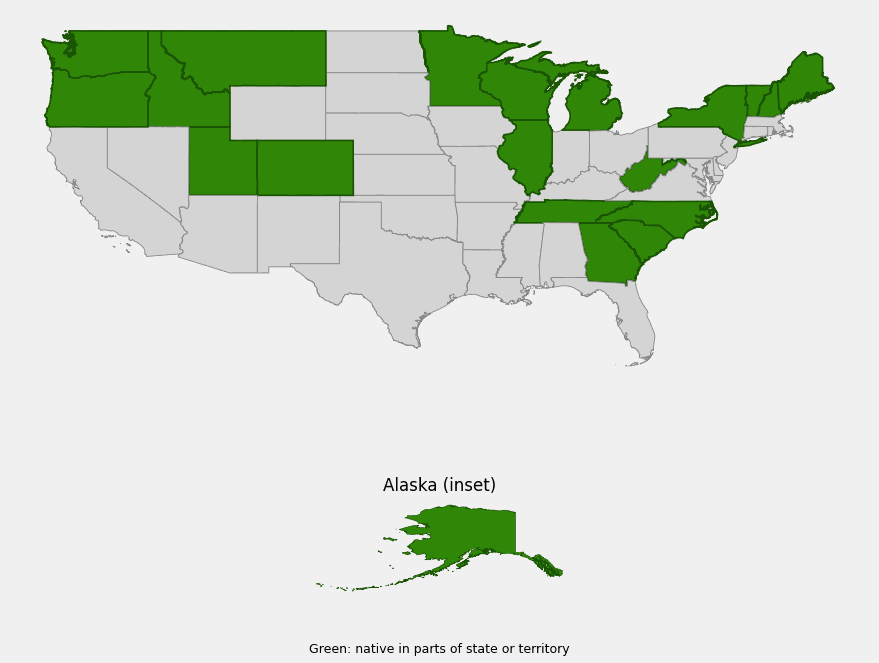
Tufted bulrush is circumboreal, native across northern Europe, Asia and North America. In North America it ranges from Alaska and all of northern Canada to Greenland, Labrador and Newfoundland. In the United States, USDA PLANTS lists it in Alaska, Washington, Oregon, Idaho, Montana, Utah, Colorado, Minnesota, Wisconsin, Michigan, Illinois, New York, Vermont, New Hampshire, Maine, West Virginia, North Carolina, Tennessee, South Carolina and Georgia.
It is common in Alaska’s muskegs and tundra, and in the West it grows in bogs, fens and wet alpine meadows of the Cascades, Olympic Peninsula and coastal bogs of Washington and Oregon, east of the Cascades, and in the northern Rockies and the Uinta Mountains and Colorado Rockies. In the Great Lakes region it grows in bogs, fens, interdunal swales and wet rocky shores, especially around Lake Superior, with outlying sites in northeastern Illinois (Lake and McHenry counties) and southern Minnesota. In the Northeast it is a plant of bogs, alpine areas and wet ledges in the mountains of New York and northern New England.
The southern Appalachian populations are outlying records, far south of the main range. They grow on high-elevation wet rock outcrops, cliff seepages and grassy summits in western North Carolina (for example Grandfather Mountain and the Roan Highlands region), eastern Tennessee (Carter and Sevier counties), and on a few seepy rock faces in the Blue Ridge escarpment of northwestern South Carolina and northeastern Georgia. These small, isolated populations are thought to be relicts of cooler glacial climates and are considered rare in those states.
📋 Regional plant lists featuring Tufted Bulrush: Alaska · Western Oregon & Western Washington · Idaho, Eastern Oregon & Eastern Washington · Montana & Wyoming · Utah & Western Colorado · North Dakota, South Dakota & Western Minnesota · Michigan, Wisconsin & Eastern Minnesota · Illinois, Iowa & Missouri · New York, Pennsylvania & Northern New Jersey · Delaware, Southern New Jersey & Long Island · New Hampshire, Maine & Vermont · Maryland, Virginia & West Virginia · Kentucky & Tennessee · North & South Carolina · Alabama, Georgia & Mississippi
Growing & Care Guide
Tufted bulrush is rarely sold, but specialist bog and native wetland nurseries occasionally offer it, and it is used in bog and fen restoration. It is a fine-textured, slow-growing tuft for a permanently moist bog garden in cool climates. Buy nursery-propagated plants, and never dig it from the wild, especially from the rare southern Appalachian sites.
Light
Full sun gives the densest tufts and best fall color. It tolerates light shade but does not compete well with taller plants.
Soil & Water
It needs soil that never dries out: acidic peat and sand in a bog garden, or a seepy gravel bed for fen and rock-ledge forms. Use rainwater or low-mineral water in acidic bog gardens. It does best in cool summers and struggles in hot, humid lowlands.
Planting Tips
Plant small plugs in spring among sphagnum moss and other bog plants such as sundews, pitcher plants and cranberries. Space them 6 to 10 inches apart; tufts expand slowly.
Pruning & Maintenance
Little care is needed. Remove old, dead stems from the center of the tuft in early spring if you wish, and keep vigorous neighbors from shading it.
Propagation
Divide established tussocks in spring, or sow fresh seed on a surface of moist peat after cold stratification. Germination is slow and erratic.
Landscape Uses
- Bog gardens: a fine-textured tuft with fall color among carnivorous plants
- Fen and peatland restoration: used in plug plantings on bare peat
- Alpine and rock gardens: for seepy, cool, wet rock beds
- Northern rain gardens and pond edges: where soil stays wet and cool
Wildlife & Ecological Value
Tufted bulrush is one of the dominant plants in many northern bogs and moorlands, and its tussocks shape the structure of these wetlands.
For Pollinators
It is wind-pollinated and not important to pollinators. Its tussocks give shelter to spiders, beetles and other invertebrates of wet ground.
For Birds
Its dense tufts provide nesting and hiding cover for ground-nesting birds of bogs and tundra, such as sandpipers, plovers, ptarmigan, grouse and sparrows, and birds eat the small seeds.
For Mammals
Deer, caribou, moose and mountain goats graze it, especially new spring growth, and in Scotland and Scandinavia it is grazed by red deer and sheep, which is how it earned the name “deergrass.” Voles and lemmings shelter and feed among the tussocks.
Ecosystem Role
Its tussocks help build and stabilize peat, and on wet tundra and moorland it can dominate the vegetation. The rare southern Appalachian populations are part of unusual high-elevation seep and rock-outcrop communities that also shelter other northern relict species.
Cultural & Historical Uses
Linnaeus described this plant in 1753 as Scirpus cespitosus; cespitosus (also spelled caespitosus) means “growing in tufts.” It was later moved to the small genus Trichophorum, Greek for “hair-bearing,” for the fine bristles around the fruit. Older North American manuals and some field guides still call it Scirpus cespitosus.
Its taxonomy was revised in the early 2000s. European botanists found that what had been called tufted bulrush actually includes two closely related species and their hybrid: Trichophorum cespitosum in the strict sense, which is circumboreal and widespread in mountains and the north, and Trichophorum germanicum, a plant of lowland bogs and moors in western Europe, which was formerly treated as a subspecies (T. cespitosum subsp. germanicum). The two cross, producing the hybrid T. ×foersteri. North American plants are treated as T. cespitosum in the strict sense; T. germanicum is essentially a plant of western Europe.
In Scotland and northern England, deergrass is one of the main plants of wet heather moorland and blanket bog, and it has been grazed by livestock and deer for centuries. In North America, its sweeping orange fall color in Alaskan muskegs and the bogs of the Pacific Northwest is a familiar autumn sight for hikers.
Frequently Asked Questions
Is tufted bulrush a grass?
No. Tufted bulrush is a sedge (family Cyperaceae). Its round, wiry stems, tiny spikelets with scales and bristled achenes set it apart from true grasses.
Is tufted bulrush the same as deergrass?
“Deergrass” is the British name for tufted bulrush. In California, the same common name is used for Muhlenbergia rigens, a large bunchgrass that is a completely different plant.
What is the difference between Trichophorum cespitosum and T. germanicum?
They are closely related species once treated as one. T. cespitosum in the strict sense is circumboreal and is the species native in North America. T. germanicum is a lowland bog plant of western Europe with slightly different stems and leaf sheaths. They hybridize where they meet.
Does tufted bulrush grow in the southern Appalachians?
Yes, in a few outlying, high-elevation sites: wet rock outcrops, cliff seeps and grassy summits in western North Carolina, eastern Tennessee and the Blue Ridge escarpment of South Carolina and Georgia. These relict populations are rare and should never be disturbed.
Can I grow tufted bulrush?
Yes, in a cool-climate bog garden with constantly wet, acidic peat and full sun. Buy nursery-propagated plants from a specialist bog or native wetland nursery; do not dig wild plants.

Looking for a nursery that carries Tufted Bulrush?
Browse our native plant nursery directory: Alaska · Colorado & Georgia · Idaho & Illinois · Maine, Michigan, Minnesota & Montana · New Hampshire, New York & North Carolina · Oregon · South Carolina, Tennessee, Utah & Vermont · Washington · West Virginia & Wisconsin

