
Round-Leaved Sundew (Drosera rotundifolia)
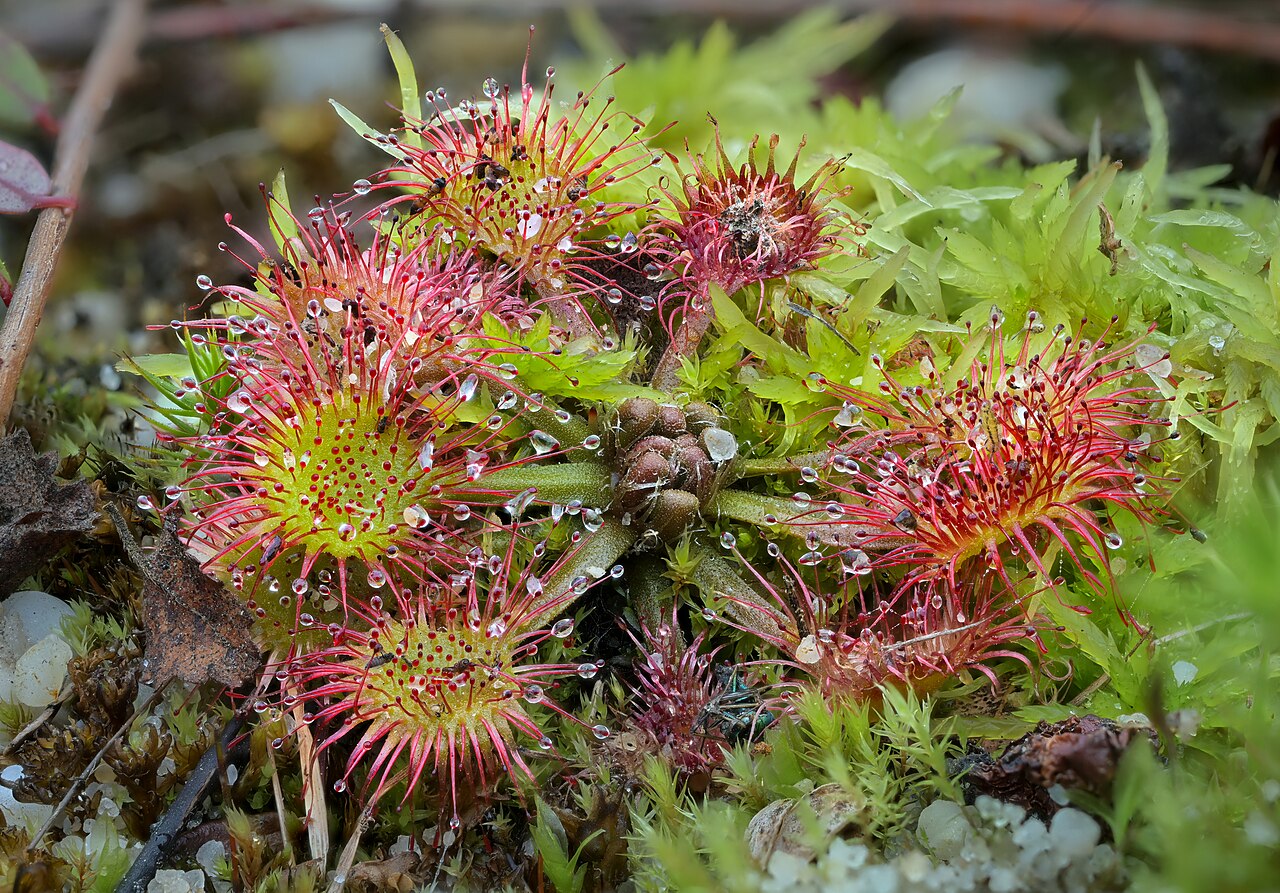
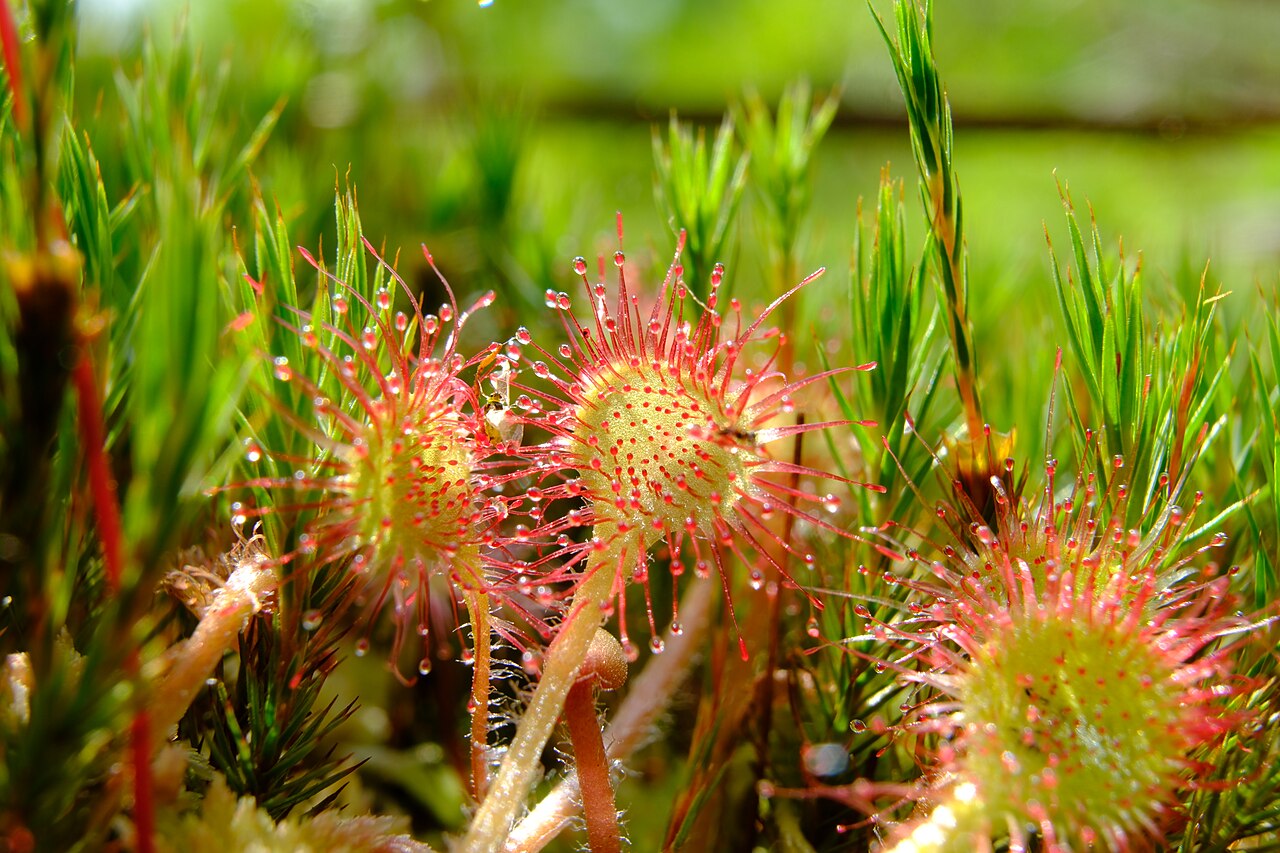
Drosera rotundifolia, known as Round-Leaved Sundew (USDA: roundleaf sundew), is a small carnivorous perennial of bogs, fens and wet, acidic places across the cooler parts of the Northern Hemisphere. It belongs to the sundew family (Droseraceae). Each plant is a flat rosette only 1 to 3 inches wide, made of round, reddish leaves on long stalks. The leaves are covered with red, hair-like tentacles, each tipped with a glistening drop of sticky fluid that looks like dew, the source of the names Drosera (“dewy”) and sundew.
Those drops are a trap. Small insects such as gnats, midges and mosquitoes are attracted to the shining droplets and become stuck. The tentacles slowly bend inward, pressing the prey against the leaf surface, where digestive enzymes break it down. The nutrients, especially nitrogen and phosphorus, let sundews thrive in waterlogged, acidic peat where nutrients are scarce. In midsummer each plant sends up a slender stalk with a few small white or pale pink flowers.
Round-leaved sundew is the most widespread sundew in North America, found from Alaska and across Canada south to California, Colorado and the southern Appalachians. It is also protected or considered rare in some states at the edges of its range, and its bog habitats are fragile. Never dig sundews from the wild. Buy nursery-propagated plants only, and grow them in a properly built bog garden or container.
Identification
Round-leaved sundew is small but distinctive. Look for the nearly round leaf blades on long, flat stalks, set in a flat rosette among sphagnum moss or on wet sand or peat.
Rosette & Roots
The plant forms a ground-hugging rosette 1 to 3 inches across. Its roots are short and weak, since the plant gets much of its nitrogen from prey and anchors loosely in moss or peat. In bogs, plants are often half-buried in growing sphagnum, and each year the rosette grows up through the moss.
Leaves
Each leaf has a nearly circular blade about 1/4 to 1/2 inch across, wider than long, at the end of a flat, hairy stalk 1/2 to 2 inches long. The upper surface and edges of the blade are covered with up to about 200 reddish tentacles, longest at the margin, each ending in a gland that secretes a drop of clear, sticky mucilage. Plants in full sun are bright red; in shade they are greener.
Flowers
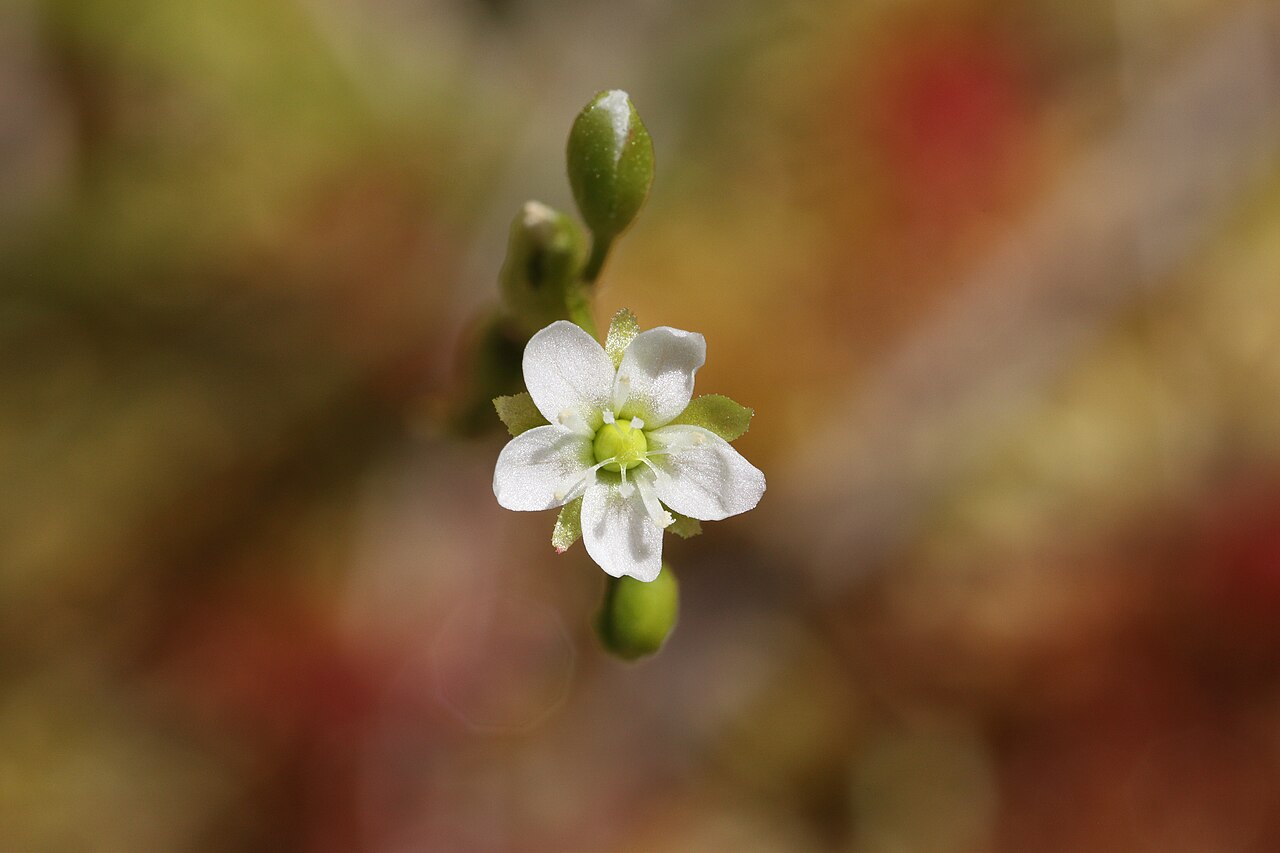
From June to August, each rosette produces one or two leafless flower stalks 4 to 10 inches tall. The flowers are arranged along one side of the upper stalk, which is coiled at first and straightens as they open. Each flower is about 1/4 inch across, with five white or pale pink petals, and opens for a few hours, usually only in bright sunshine. Several open over a period of weeks. The flowers can self-pollinate when insects do not visit.
Fruit & Seeds
Each flower produces a small capsule that splits to release many tiny, spindle-shaped seeds, which are dispersed by wind and water. In autumn, the plant withdraws into a tight winter bud (hibernaculum) at the moss surface and survives the winter dormant under snow and ice.
Look-alikes
Spoon-leaved sundew (Drosera intermedia) has spoon-shaped leaves that are longer than wide and often grows in wetter spots, even in shallow water. English sundew (D. anglica) has long, narrow leaves held upright. Pink sundew (D. capillaris) of the Southeast has spoon-shaped leaves and pink flowers. Hybrids between round-leaved and English sundew (D. × obovata) occur where the two grow together.
Safety & Conservation
Sundews are harmless to people and pets; their traps catch only very small insects. The main safety concern is for the plants themselves. Bogs and fens recover slowly from trampling, and collecting can wipe out small populations. Several states list round-leaved sundew as rare, threatened or endangered near the edges of its range. Never dig plants from the wild; buy only nursery-propagated sundews from reputable carnivorous plant growers.
Quick Facts
| Scientific Name | Drosera rotundifolia |
| Family | Droseraceae (sundew family) |
| Plant Type | Carnivorous herbaceous perennial; winter-dormant rosette |
| Mature Height | Rosette 1–2 in tall; flower stalks 4–10 in |
| Mature Spread | 1–3 in per rosette |
| Growth Rate | Slow |
| Sun Exposure | Full sun to light shade |
| Water Needs | High; constantly wet, saturated soil |
| Soil Type | Sphagnum moss, acidic peat, wet sand |
| Soil pH | About 4.0–6.0 (strongly acidic) |
| Bloom Time | June–August |
| Flower Color | White to pale pink |
| Fall Color | Leaves redden, then die back to a winter bud |
| Fruit | Small capsule with many tiny, dust-like seeds |
| Deer Resistant | Yes; too small and sticky to be browsed |
| USDA Hardiness Zones | 2–8 |
Native Range
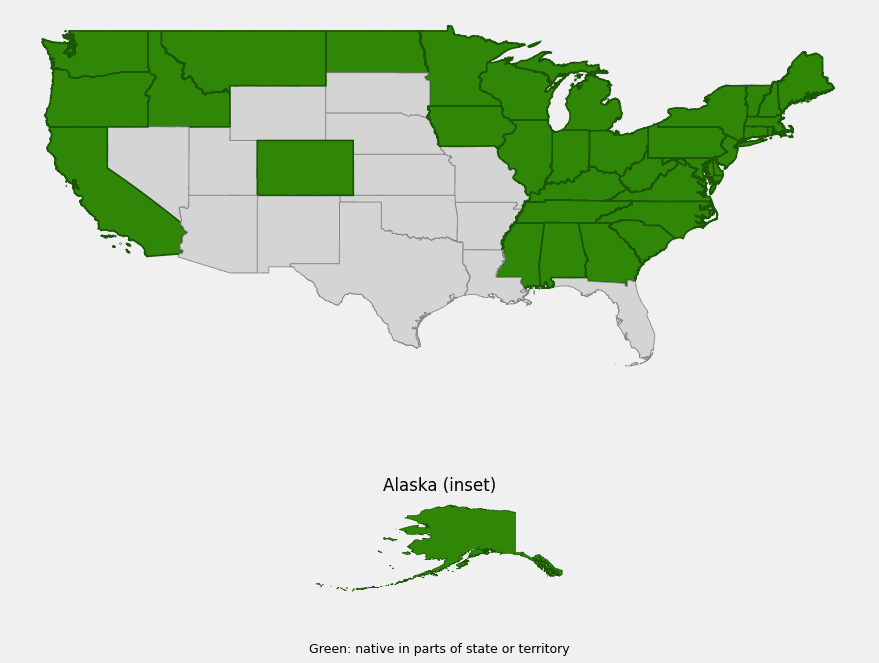
Round-leaved sundew is circumboreal, growing across the cooler parts of North America, Europe and Asia. In North America USDA PLANTS lists it as native in Alaska, Canada, Greenland, Saint Pierre and Miquelon and the lower 48 states, and records it from 35 states and the District of Columbia. In Canada it grows in every province and territory except the high Arctic, from Yukon and British Columbia east to Newfoundland and Labrador.
The Lady Bird Johnson Wildflower Center describes its range as the Sierra Nevada and northward, east from Washington across northern Montana and North Dakota, and throughout the eastern United States. It is common in the glaciated Northeast and Great Lakes states and in the Pacific Northwest, and it is scattered in mountain bogs and seeps of the southern Appalachians, south to Georgia and Alabama, in Coastal Plain seepage bogs of the Carolinas and Mississippi, and in fens of the Rocky Mountains in Colorado, Idaho and Montana.
Habitats include sphagnum bogs, poor fens, floating peat mats around ponds and lakes, wet sandy and peaty shores, seepage slopes and wet ditches, almost always where the soil is acidic, low in nutrients and constantly wet. It does poorly where taller plants shade it out.
📋 Regional plant lists featuring Round-Leaved Sundew: New York, Pennsylvania & Northern New Jersey · Idaho, Eastern Oregon & Eastern Washington · Ohio & Indiana · Montana & Wyoming · Michigan, Wisconsin & Eastern Minnesota · Kentucky & Tennessee · Connecticut, Massachusetts & Rhode Island · New Hampshire, Maine & Vermont · Maryland, Virginia & West Virginia · Delaware, Southern New Jersey & Long Island · Illinois, Iowa & Missouri · Alabama, Georgia & Mississippi · Alaska
Growing & Care Guide
Round-leaved sundew can be grown by gardeners who build a proper bog garden or bog container, but it is not a plant for ordinary garden soil. Buy nursery-propagated plants from a carnivorous plant specialist. Never take plants from the wild: collected plants rarely survive and digging damages fragile bog habitats.
Light
Give it full sun or very bright light. Strong light keeps the leaves red and the dew abundant. In shade the plants become green, leggy and weak.
Soil & Water
Plant it in pure, live or dried, long-fiber sphagnum moss, or a mix of about two parts sphagnum peat to one part lime-free sand or perlite. Keep the medium constantly wet, for example by standing the pot in a tray of water. Use only rainwater, distilled water or reverse-osmosis water. Tap water and hard water contain minerals that slowly kill sundews. Never fertilize the soil.
Planting Tips
Plant in spring in a lined bog garden, a mini-bog container without drainage holes, or a pot set in a water tray. Combine it with other bog plants such as pitcher plants and small sedges, keeping taller neighbors from shading it. Do not feed it meat; it catches enough insects outdoors.
Pruning & Maintenance
It needs a cold winter dormancy. Leave outdoor bog gardens alone in winter; in containers, protect the winter buds from drying out and from repeated hard freezing and thawing, for example by sinking the pot in the ground or covering it with mulch or snow. Remove weeds, tree seedlings and fast-growing moss that could smother the rosettes.
Propagation
Fresh seed sown on the surface of moist sphagnum peat germinates after a cold, moist stratification of several weeks. Plants also reproduce from leaf cuttings laid on wet sphagnum and from offsets. Established bog gardens often produce volunteer seedlings.
Landscape Uses
- Bog gardens: a classic small companion for pitcher plants and native orchids
- Container mini-bogs: a tub or tray of sphagnum kept wet with rainwater
- Nature education: an easy way to show carnivorous plants and insect trapping
- Bog and fen conservation: an indicator of intact, nutrient-poor, acidic wetlands
- Pond-edge plantings: on floating peat mats or wet sphagnum margins of acid ponds
Wildlife & Ecological Value
Round-leaved sundew is a predator of tiny insects, but it also depends on other insects for pollination and is part of the specialized community of bogs and fens.
For Pollinators
The small flowers are visited by small bees, flies and other insects, which are usually too big to be trapped by the low leaves. The tall flower stalks hold the blooms well above the sticky rosette, which reduces the chance of catching would-be pollinators. The plant can also self-pollinate.
For Birds
Sundews have little direct food value for birds. They grow in bogs and fens that are home to birds such as palm warblers, Lincoln’s sparrows and sandhill cranes in the North.
For Mammals
Mammals rarely eat sundews. The plants are vulnerable mainly to trampling by people and animals in bogs.
Ecosystem Role
Sundews capture gnats, midges, mosquitoes, small flies and other tiny insects, recycling nitrogen and phosphorus in nutrient-poor peatlands. A few specialized insects, such as certain plume moth caterpillars, can feed on sundew leaves without getting stuck. Their abundance is a sign of a healthy, acidic, unpolluted wetland; nutrient runoff and drainage cause them to disappear.
Cultural & Historical Uses
Round-leaved sundew has a long history in European medicine. Extracts, often sold under the old name herba rorellae or simply “drosera,” were used for coughs and respiratory complaints, and sundew is still used in some herbal and homeopathic cough products in Europe. Heavy wild collection contributed to declines, and commercial supplies now come partly from cultivated plants. Sundews contain plumbagin and related compounds that can irritate the skin and digestive tract, so they should not be used as a home remedy.
Charles Darwin studied round-leaved sundew in detail and described his experiments in Insectivorous Plants (1875). He showed that the tentacles respond to tiny amounts of nitrogen-containing substances and that the plant digests its prey, helping to establish that some plants are truly carnivorous. He famously wrote that he cared more about Drosera than the origin of all the species in the world at the time.
In North America, sundews were noted by early naturalists as curiosities of the bogs, and some Native American peoples used them in traditional medicine. Today round-leaved sundew is a favorite of bog gardeners and nature educators, and its presence is used by wetland ecologists as a sign of intact, nutrient-poor peatland.
Frequently Asked Questions
Is round-leaved sundew dangerous to people or pets?
No. Its sticky leaves catch only very small insects, and the plant is harmless to touch. Do not eat it or use it as a remedy, since it contains compounds that can irritate the digestive tract.
Can I dig sundews from a bog?
No. Wild plants rarely survive transplanting, bogs are easily damaged by trampling, and the species is protected or rare in some states. Buy nursery-propagated plants from a reputable carnivorous plant grower.
Do I need to feed my sundew?
Outdoors, no; it catches its own insects. Indoors, an occasional small insect is enough. Never fertilize the soil or feed it meat.
Why is my sundew dying in tap water?
Most tap water contains dissolved minerals and salts that build up and harm sundews. Use rainwater, distilled water or reverse-osmosis water, and keep the plant constantly wet.
Does round-leaved sundew go dormant in winter?
Yes. In autumn it forms a tight winter bud (hibernaculum) and needs several months of cold dormancy. Without a cold winter, it weakens and dies.

Looking for a nursery that carries Round-Leaved Sundew?
Browse our native plant nursery directory: Alabama & Alaska · California · Colorado, Connecticut, Delaware & Georgia · Idaho, Illinois, Indiana & Iowa · Kentucky, Maine, Maryland, Massachusetts, Michigan, Minnesota, Mississippi & Montana · New Hampshire, New Jersey, New York, North Carolina, North Dakota & Ohio · Oregon · Pennsylvania, Rhode Island, South Carolina, Tennessee, Vermont & Virginia · Washington · West Virginia & Wisconsin