Leatherleaf (Chamaedaphne calyculata)
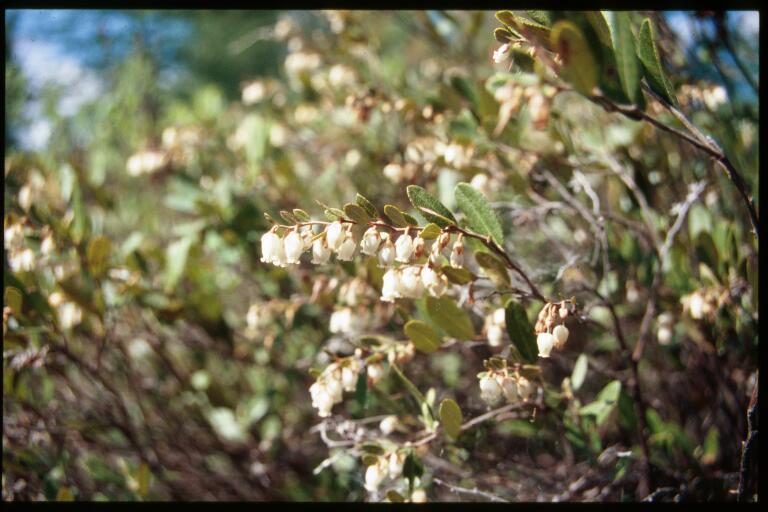
Chamaedaphne calyculata, commonly called Leatherleaf, is a low, wiry evergreen shrub of northern bogs and acid peatlands. It belongs to the heath family (Ericaceae) and is the only species in its genus, recognized by botanists for its tough, leathery, scurfy-scaled leaves and its rows of small white, bell-shaped flowers that open along one side of arching branchlets in earliest spring, often while snow still lingers at the bog’s edge. Few native shrubs are as closely tied to a single habitat: leatherleaf is a near-constant presence in sphagnum bogs and poor fens across the northern half of the continent.
In the wild, leatherleaf forms dense, spreading colonies on floating or quaking sphagnum mats, in boggy conifer swamp margins, and along the still edges of bog ponds. Its wiry stems root and layer as they spread, so a single plant can slowly expand into a thicket many feet across over the course of decades. The foliage stays green through winter, turning a dull bronze-olive in cold months, and the plant’s low, twiggy structure gives bog edges their characteristic rough texture even outside the brief bloom period.
For gardeners with a wet, acidic, sunny spot — a rain garden edge, a bog garden, or the margin of a constructed wetland — leatherleaf is a genuinely low-maintenance native that asks for little once it is established in the right conditions. It is not a plant for ordinary garden soil; it is a specialist that rewards gardeners who can replicate the saturated, nutrient-poor, acidic peat it evolved in. Where those conditions exist, it provides reliable structure, early-season flowers for emerging pollinators, and a direct link to the bog ecosystems it shares with carnivorous plants, cranberries, and sphagnum moss.
Identification
Leatherleaf is a much-branched, low-growing shrub, typically 1 to 3 feet tall but occasionally reaching 4 to 5 feet in favorable bog conditions, with wiry, upright to spreading stems that form dense, often extensive colonies. The twigs are rusty-brown (fulvous) and finely scaled, and the overall silhouette is twiggy and irregular rather than rounded or formal.
Stems & Growth Habit
Stems are slender and much-branched, spreading or ascending from a woody base, and often layer where they touch wet sphagnum, rooting at the nodes and allowing the colony to creep outward. This rhizomatous, layering habit is slow — expansion is measured in inches per year — but over decades a single plant can form a thicket many feet wide, a pattern well documented in Massachusetts bog populations.
Leaves
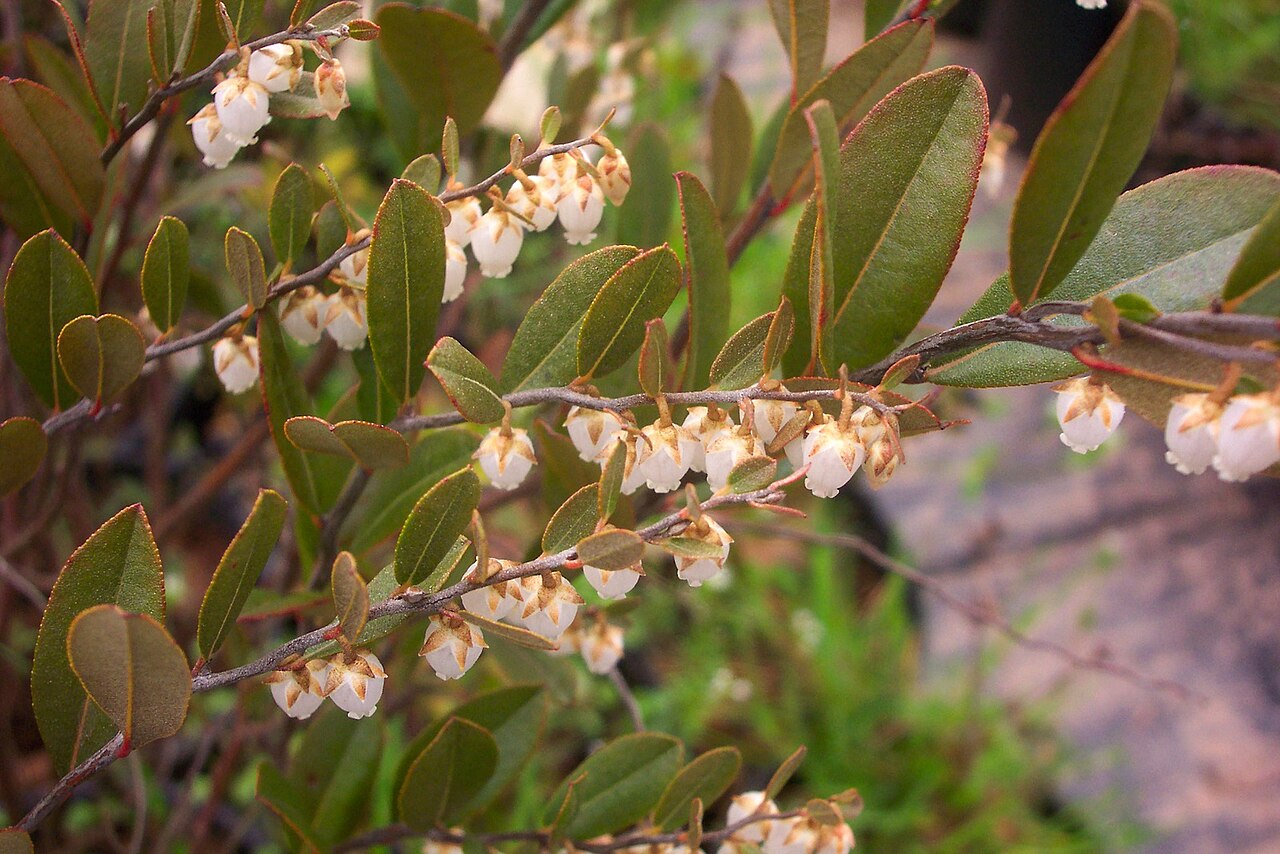
The evergreen leaves are alternate, oblong to elliptic, usually 1 to 4 cm long, with a dull olive-green upper surface and a covering of minute, rust-colored, scurfy scales that is especially dense on the paler underside. Leaf margins are entire or very slightly toothed. Leaves become progressively smaller up the stem toward the flowering raceme, and in winter the foliage often takes on a bronzed or purplish cast before greening up again in spring.
Flowers & Fruit
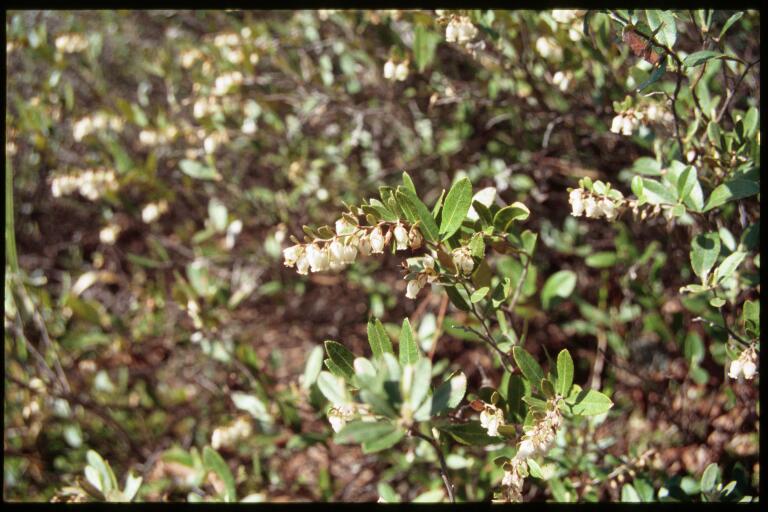
Flowers appear in nodding, one-sided racemes 4 to 12 cm long at the branch tips, each small white to creamy bell-shaped corolla about a quarter inch long, held in the axil of a leaf-like bract. Flower buds actually form the previous summer and overwinter on the plant, ready to open the moment conditions allow in late winter or early spring — often among the first native shrubs to bloom in a northern bog. The fruit is a small, dry, five-valved capsule about 1/8 inch across, splitting at maturity to release tiny golden-brown seeds that are shaken out by wind and passing animals rather than offered as food.
Quick Facts
| Scientific Name | Chamaedaphne calyculata |
| Family | Ericaceae (Heath) |
| Plant Type | Evergreen Shrub |
| Mature Height | 1–3 ft (less commonly to 5 ft) |
| Mature Spread | 2–4 ft per plant; colonies spread slowly by layering |
| Growth Rate | Slow |
| Sun Exposure | Full Sun to Part Shade |
| Water Needs | High; requires consistently saturated soil |
| Soil Type | Peaty, acidic, poorly drained; sphagnum bogs and fens |
| Soil pH | 3.5–5.5 (strongly acidic) |
| Bloom Time | March – June, earliest in southern populations |
| Flower Color | White to creamy white |
| Fall Color | Evergreen; foliage bronzes in winter |
| Fruit | Small dry capsule (not fleshy or edible) |
| Deer Resistant | Yes, generally avoided by deer |
| USDA Hardiness Zones | 2–6 |
Native Range
Leatherleaf has one of the broadest native ranges of any North American heath shrub, occurring from Alaska across virtually all of Canada and south through the boreal and north-temperate peatlands of the Northeast, the Upper Midwest, and the Great Lakes region, with scattered, often disjunct, relict populations reaching the Mid-Atlantic coastal plain and the mountains and coastal plain of the Carolinas. It shares this circumboreal distribution with populations across northern Eurasia, from Scandinavia to Japan.
Throughout this range, leatherleaf is tied almost exclusively to acidic peatlands: sphagnum bogs, poor fens, and the boggy margins of ponds and conifer swamps, from sea level up to roughly 4,300 feet in the mountains. It is often one of the first woody plants to colonize a floating sphagnum mat, and mature bogs frequently show leatherleaf growing in a dense, nearly continuous band at the transition between open water or sedge mat and the surrounding black spruce or tamarack swamp.
Leatherleaf’s southern and disjunct populations are a conservation concern in several states: it is considered critically imperiled in Illinois and Maryland, imperiled in Ohio and in the mountains of North Carolina (where it survives in a single small bog), and it is believed extirpated from Iowa and Georgia. These outlying populations are thought to be relicts of a more widespread ice-age distribution, persisting in isolated bogs long after the climate warmed around them — a reminder that even a wide-ranging species can be locally rare and worth protecting.
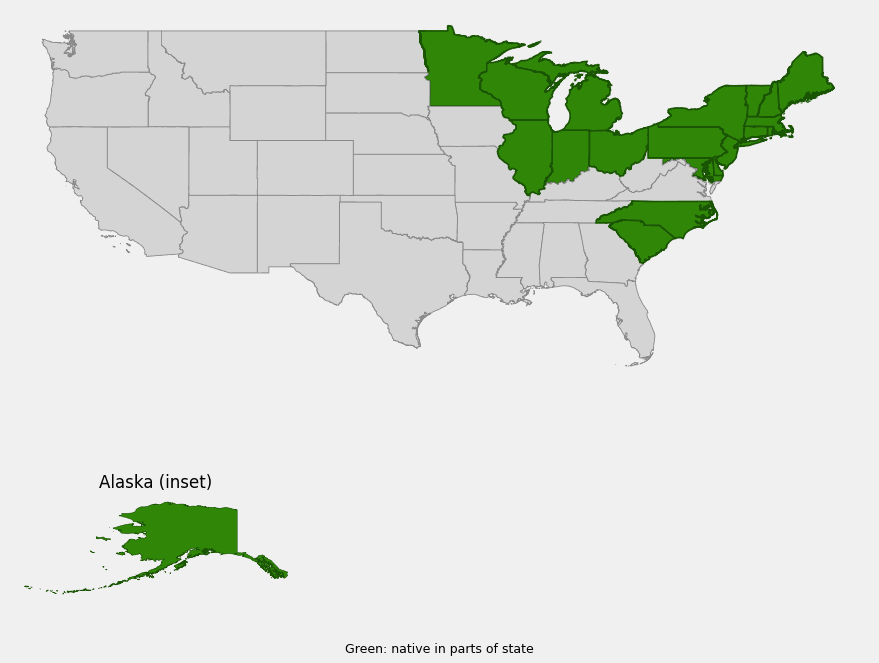
📋 Regional plant lists featuring Leatherleaf: Alaska · New Hampshire, Maine & Vermont · Connecticut, Massachusetts & Rhode Island · New York, Pennsylvania & Northern New Jersey · Delaware, Southern New Jersey & Long Island · Maryland, Virginia & West Virginia · North Carolina & South Carolina · Illinois, Iowa & Missouri · Ohio & Indiana · Michigan, Wisconsin & Eastern Minnesota
Growing & Care Guide
Leatherleaf is not a plant for an average perennial border, but for the right wet, acidic site it is one of the most reliable and undemanding native shrubs available. Success starts with matching its very specific soil and moisture requirements before planting.
Light
Leatherleaf grows best in full sun to light shade, which mirrors its native setting on open sphagnum mats and bog margins. In denser shade it becomes leggy and flowers sparsely. Full sun also helps keep the saturated soil it prefers from turning stagnant and fosters the densest flowering.
Soil & Water
This is the limiting factor for most gardeners: leatherleaf needs consistently wet, strongly acidic, low-fertility peat. It will not thrive in average garden loam, in soil that dries out between waterings, or in neutral to alkaline soil. It is best suited to constructed bog gardens, rain garden basins with a peat-based substrate, or the saturated margins of a pond, where sphagnum peat moss has been worked into the planting area. Never fertilize leatherleaf or plant it in rich soil; it is adapted to nutrient-poor bogs and performs poorly where nutrients are abundant.
Planting Tips
Plant container-grown leatherleaf in spring, setting the root ball at the same depth it grew in the nursery pot and working in sphagnum peat moss if the native soil is not already strongly acidic. Water thoroughly after planting and keep the root zone saturated through the first growing season. Space plants 2 to 3 feet apart if establishing a bog-edge planting, since the colony will slowly fill in the gaps over time.
Pruning & Maintenance
Leatherleaf needs almost no pruning. Remove dead or winter-damaged stems in early spring before new growth begins, if needed. Because it spreads slowly by layering, an established planting rarely needs dividing or thinning; gardeners who want to contain its spread can simply trim rooted layers at the colony’s edge.
Propagation
Leatherleaf propagates most reliably from semi-hardwood cuttings taken in late summer and rooted in a moist, acidic medium, or by dividing and transplanting rooted layers from the edge of an established colony. Seed propagation is possible but slow, requiring the same saturated, acidic conditions the species needs as a mature plant, and germination can be uneven.
Landscape Uses
Leatherleaf fits a narrow but valuable set of garden situations:
- Bog gardens built with a peat-based, saturated substrate
- Pond and rain garden margins that stay consistently wet
- Wetland restoration plantings on acidic, peaty sites
- Naturalized plantings alongside Black Spruce, Labrador Tea, and sphagnum moss
- Early-season pollinator habitat in a dedicated bog planting
Wildlife & Ecological Value
Within the bog ecosystems it dominates, leatherleaf plays a quiet but important structural and seasonal role, offering some of the earliest flowers of the year in a habitat where little else is in bloom.
For Pollinators
Leatherleaf’s late-winter and early-spring flowers are an important early nectar source for native bees emerging in bog habitats, at a time when few other plants are flowering. Bumblebee queens in particular are frequent visitors, and the dense racemes of small flowers make an efficient early foraging stop.
For Birds
The dense, twiggy structure of a leatherleaf colony provides low cover and nesting habitat for bog-dwelling songbirds, including sparrows and warblers that favor the open, shrubby margins of peatlands. While the dry seed capsules are not a significant food source, the physical structure of the plant is valuable habitat in an otherwise sparse landscape.
For Mammals
Leatherleaf is generally avoided as browse by deer and most other mammals, likely due to compounds in the foliage, which is one reason it persists so successfully in wild bogs. Moose have occasionally been reported browsing leatherleaf in parts of its northern range, particularly in winter when more palatable forage is scarce.
Ecosystem Role
As one of the characteristic shrubs of sphagnum bogs, leatherleaf helps stabilize floating peat mats with its spreading, layering stems, and its presence often signals a healthy, undisturbed acid peatland. It grows alongside other bog specialists such as cranberry, Labrador tea, and carnivorous pitcher plants, contributing to one of the more distinctive and ecologically sensitive plant communities in North America.
Cultural & Historical Uses
Leatherleaf has a far more modest record of human use than many native shrubs, largely because its bog habitat kept it out of easy reach and because the plant itself offers little of practical value. Unlike its bog neighbor Labrador tea, leatherleaf was not generally brewed or used medicinally by Indigenous peoples in most documented traditions, and it carries none of the culinary or medicinal history attached to other heath-family plants like blueberries or cranberries.
Where leatherleaf appears in historical and natural-history writing, it is almost always as an indicator species — a plant botanists and naturalists used to identify a true acid bog at a glance, long before soil testing was routine. Its presence in a wetland signaled the specific combination of saturated, nutrient-poor, acidic conditions that define a sphagnum bog, distinguishing it from richer fens or marshes.
Today, leatherleaf’s main cultural role is as a hallmark species of healthy peatland ecosystems and as a specialty plant for native bog gardeners and wetland restoration projects. Its scientific name, and the genus it anchors alone, reflect its status as a true botanical curiosity — unrelated closely to any other North American shrub and tied to one of the continent’s most distinctive habitats.
Frequently Asked Questions
Can leatherleaf grow in regular garden soil?
No. Leatherleaf needs consistently saturated, strongly acidic, peaty soil, similar to a sphagnum bog. In average garden loam it will struggle or fail outright. It is best reserved for dedicated bog gardens or saturated wetland margins.
Is leatherleaf the same as other bog shrubs like Labrador tea?
No, though they often grow side by side in the same bogs. Leatherleaf (Chamaedaphne calyculata) is the only species in its genus, distinguished by its scurfy, scale-covered leaves and one-sided racemes of small white flowers, while Labrador tea belongs to a different genus entirely.
Does leatherleaf have showy flowers?
The flowers are small and white rather than showy, but they appear in dense rows along the stems in very early spring, often before most other shrubs have leafed out, which gives them real value as one of the season’s first blooms.
Is leatherleaf edible or used medicinally?
No. Leatherleaf has no documented culinary or medicinal use and should not be consumed. Its value is ecological and ornamental, not edible.
Why is leatherleaf considered rare in some states?
In states at the southern or outlying edge of its range, such as Illinois, Maryland, Ohio, and the mountains of North Carolina, leatherleaf survives only in isolated relict bogs left over from cooler, wetter climate periods. As those bogs have been drained or degraded, the plant has become critically imperiled or nearly extirpated locally, even though it remains common across the core of its northern range.

Looking for a nursery that carries Leatherleaf?
Browse our native plant nursery directory: Alaska · Connecticut & Delaware · Illinois & Indiana · Maine, Maryland, Massachusetts, Michigan & Minnesota · New Hampshire, New Jersey, New York, North Carolina & Ohio · Pennsylvania, Rhode Island, South Carolina & Vermont · Wisconsin