Top 5 Best Moss Poles and Climbing Supports for Monstera and Pothos in 2026
We independently select all products and services. If you click through links we provide, Plant Native may earn a commission with no extra cost to you. As an Amazon Associate I earn from qualifying purchases.
Last updated: August 23, 2026
If you’re growing Monstera, Pothos, or any climbing aroid indoors, a moss pole or climbing support isn’t just a nice-to-have — it’s essential. These tropical plants evolved to climb trees in the wild, and giving them vertical support encourages larger leaves, stronger aerial roots, and healthier overall growth.
But with dozens of options on the market — from traditional coco coir poles to innovative bendable designs and modern wooden trellises — choosing the right one can be overwhelming. We researched and compared the most popular moss poles and climbing supports available in 2026, evaluating them on build quality, ease of use, aesthetics, and value for money.
Whether you need a flexible pole you can shape around corners, a budget-friendly multi-pack, or a designer trellis that doubles as home décor, we’ve got you covered. Here are our top 5 picks.
Our top pick

- Stunning natural wood design that doubles as home décor
- Modular and extendable — add sections as your plant grows
- No messy moss or coir to deal with; clean and low-maintenance
- Higher price point than traditional moss poles
- Doesn’t retain moisture like sphagnum or coco coir options
The Treleaf Zella Regular Starter Kit is our top pick for anyone who wants their plant support to look as good as the plant itself. This modular wooden trellis system comes with 2 bases and 2 extensions, giving you a customizable climbing structure that grows with your Monstera or Pothos.
Unlike traditional moss poles that can look bulky and utilitarian, the Treleaf Zella has a minimalist, Scandinavian-inspired design that complements modern interiors. The wooden slats provide ample surface area for aerial roots to grip, and the modular design means you can extend height as needed without replacing the entire support.
The main trade-off is that wood doesn’t hold moisture the way sphagnum moss or coco coir does, so plants that benefit from humid root contact may grow aerial roots slightly slower. But for most indoor growers who prioritize aesthetics alongside function, this is the best option on the market in 2026.
Best bendable moss pole

- Fully bendable — shape it into curves, arches, or spirals
- Made from 100% sustainably farmed sphagnum moss
- 30-inch length provides excellent support for mature plants
- Premium price compared to basic coir poles
- Sphagnum moss can dry out quickly in low-humidity environments
- Requires regular misting to maintain moisture
Mossify pioneered the bendable moss pole category, and their 30-inch Original remains the gold standard. Unlike rigid poles that only allow straight vertical growth, the Mossify pole has a flexible inner wire that lets you guide your Monstera or Pothos into curves, arches, and creative shapes.
The pole is wrapped in 100% sustainably farmed sphagnum moss, which retains moisture far better than coco coir and encourages aerial root attachment. When kept moist, plants latch on and grow noticeably faster compared to bare or dry supports. The handmade construction is solid, and the 30-inch length is generous enough for most mature indoor climbing plants.
The downside is maintenance — sphagnum moss dries out faster than coir, especially in homes with central heating. You’ll want to mist it regularly or set up a drip system. But if you’re willing to put in that extra care, no other pole matches the creative freedom Mossify offers.
Best budget pick

- Outstanding value — 6 poles for the price of most 2-packs
- Coco coir retains moisture well and resists mold
- Compact 12-inch size is ideal for young plants and propagations
- 12-inch height is too short for mature Monstera without stacking
- Not stackable or extendable — fixed length only
If you’re just starting out with climbing plants or need supports for multiple pots without breaking the bank, the GARDENERA 6-pack is the clear winner. At a fraction of the cost of premium options, you get six sturdy 12-inch coco coir poles that do exactly what they need to do.
The coco coir construction holds moisture effectively and provides a natural, rough surface that aerial roots grip easily. These poles are especially well-suited for younger Monstera, Pothos cuttings, or smaller aroids like Philodendron Brasil that don’t need tall supports yet.
The obvious limitation is height — at 12 inches, you’ll outgrow these quickly with a vigorous Monstera deliciosa. They’re also not stackable, so there’s no way to extend them. Think of these as starter poles: perfect for the first year or two, after which you’ll likely upgrade to a taller solution.
Best stackable option
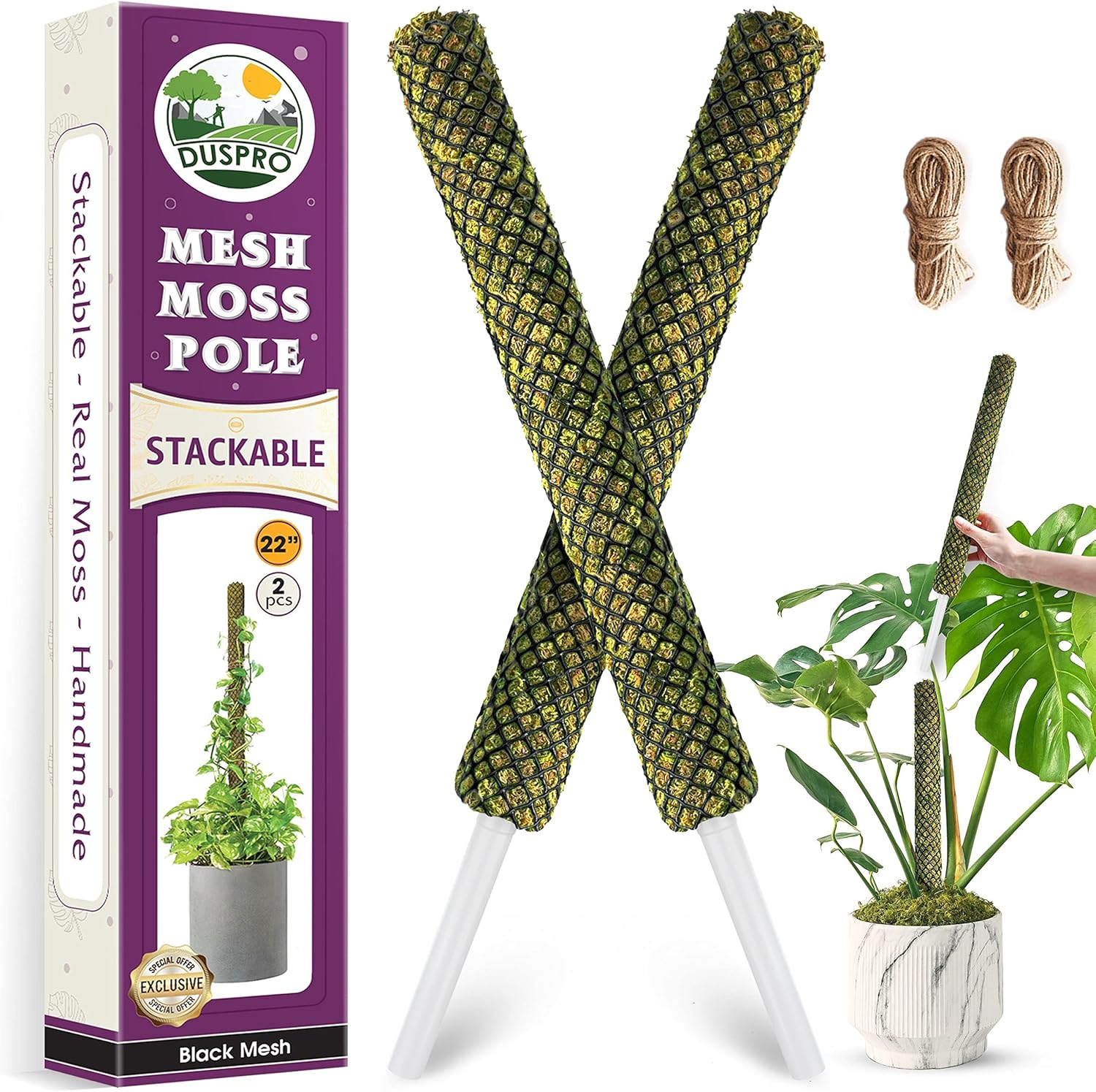
- Stackable design lets you extend height as your plant grows
- Open mesh allows you to fill with sphagnum moss, perlite, or coir
- Sturdy construction that supports heavy mature plants
- Requires you to source and stuff your own moss separately
- Mesh appearance is more utilitarian than decorative
- Can be tricky to keep moss evenly distributed inside
For plant parents with ambitious, fast-growing Monstera that keep outpacing their supports, the DUSPRO Stackable Mesh Moss Pole is the answer. Each pole is 22 inches tall, and the clever stacking mechanism lets you add additional sections on top as your plant reaches new heights — no repotting or replacing required.
The open mesh design is what makes DUSPRO unique: instead of pre-applied coir or moss, you fill the mesh tube with your preferred medium. Most growers use long-fiber sphagnum moss for maximum moisture retention, but you can also mix in perlite for drainage or use coco coir chunks. This customization means your plant gets exactly the growing medium it prefers.
The trade-off is convenience. You’ll need to buy moss separately, spend time stuffing the poles, and occasionally redistribute the filling as it settles. The mesh look is also more functional than pretty. But if you want a moss pole system that literally grows with your plant, DUSPRO delivers.
Best traditional sphagnum pole

- Made in the USA with real sphagnum moss for superior root attachment
- Heavy-gauge steel wire frame is extremely sturdy and long-lasting
- Proven design trusted by growers for decades
- Not extendable or stackable — 24 inches is the fixed maximum
- Sphagnum moss can decompose over time and need replacing
Sometimes the classics earn their reputation for a reason. The Mosser Lee Totem Pole has been a staple in plant shops and nurseries for years, and it remains one of the most reliable sphagnum moss poles you can buy. Made in the USA, it features a heavy-gauge painted steel wire frame wrapped in genuine sphagnum moss.
The sphagnum moss is what makes this pole special for serious growers. Unlike coco coir, sphagnum retains significantly more moisture and has mild antifungal properties, creating an ideal microenvironment for aerial roots. Plants tend to attach faster and more firmly to sphagnum compared to other materials, which is why many experienced collectors still swear by it.
At 24 inches, it’s a good mid-range height for most indoor plants, though you can’t extend it. The moss will also gradually decompose over 2-3 years and may need refreshing. But for anyone who wants the tried-and-true approach to supporting climbing plants, Mosser Lee is a rock-solid choice.
Buyer’s Guide: How to Choose the Right Moss Pole or Climbing Support
Moss Pole Materials: Sphagnum vs. Coco Coir vs. Wood
Sphagnum moss holds the most moisture and promotes the fastest aerial root attachment, but requires regular misting and decomposes over time. Coco coir is more durable, resists mold, and still retains decent moisture — it’s the best all-around choice for low-maintenance growers. Wood and mesh options prioritize aesthetics and customization but don’t provide the humid root environment that moss-based poles do.
Height and Extendability
Consider how tall your plant will grow. A young Monstera might only need 12 inches now, but a mature specimen can easily reach 6-8 feet indoors. Stackable poles (like the DUSPRO) or modular systems (like the Treleaf) let you add height over time without disturbing the plant. Fixed-length poles work well for smaller plants or as temporary supports.
Bendable vs. Rigid
Bendable moss poles like the Mossify let you create custom shapes — arches, curves, or spiral paths. This is great for creative displays or training plants around obstacles. Rigid poles are simpler and more traditional, providing straight vertical support. Most plants do perfectly fine with either style; the choice comes down to your aesthetic preference and how much creative control you want.
How to Attach Your Plant
Use soft plant ties, velcro strips, or small clips to gently secure stems to the pole. Avoid tying too tightly — you want to guide the plant, not strangle it. Most climbing aroids will eventually grip the pole on their own through aerial roots, especially if you keep the pole surface moist. Check ties monthly and loosen as stems thicken.
Moisture and Maintenance
For fastest growth, keep your moss pole consistently moist. You can mist it daily, set up a slow-drip watering system at the top, or place the pot on a humidity tray. Sphagnum poles need the most moisture attention, coco coir poles are more forgiving, and wood/mesh poles need none. In dry winter months with central heating, consider running a humidifier near your climbing plants regardless of pole type.