
Árbol de Navidad (Gesneria pedunculosa)
Gesneria pedunculosa, known in Puerto Rico as árbol de navidad (“Christmas tree”), is a shrub or small tree found nowhere else in the world. It belongs to the gesneriad family, the same family as African violets and Cape primroses, but unlike those soft-stemmed houseplants it grows into a woody shrub or small tree.
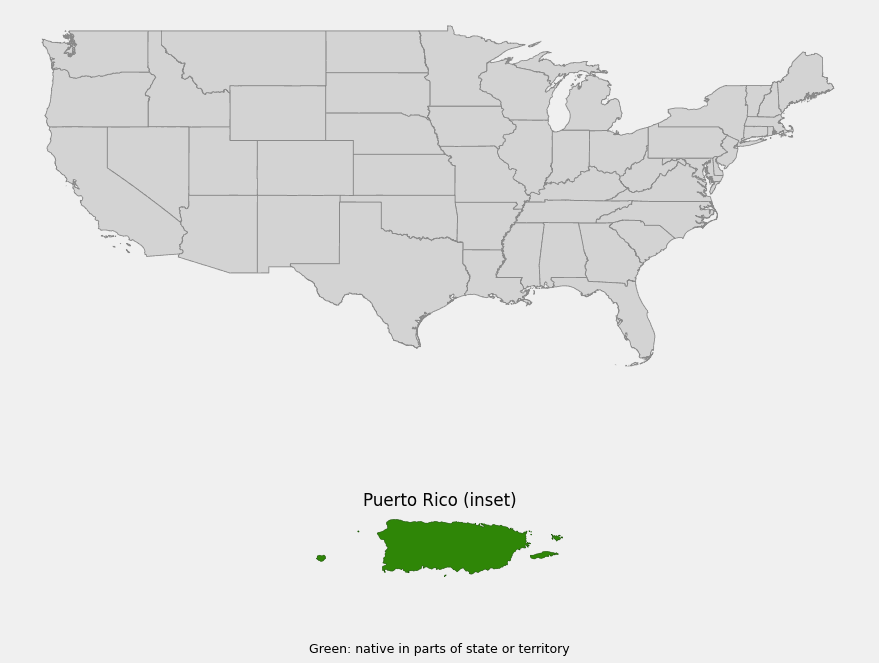
USDA PLANTS lists it as native in Puerto Rico, and the Smithsonian’s Flora of the West Indies records it as a Puerto Rican endemic. It grows in the island’s moist forests and on wooded slopes, banks and roadsides in the hills and mountains, with many records from the western mountains around Maricao, San Germán and Mayagüez, and others from the northern karst near Arecibo and Camuy.
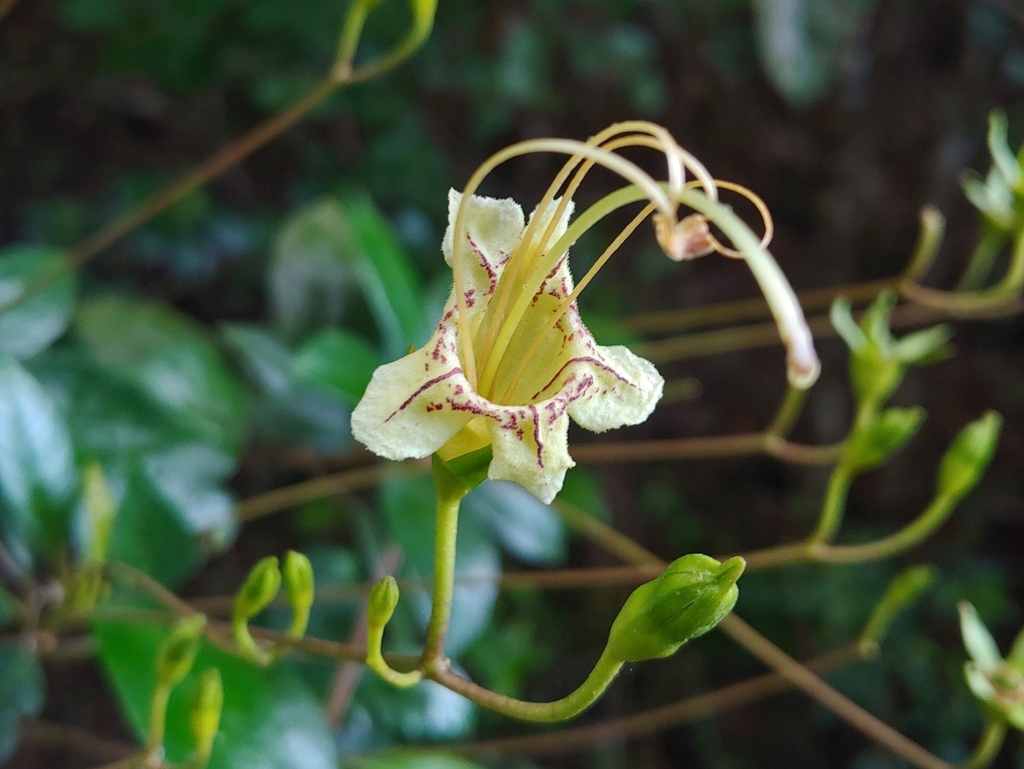
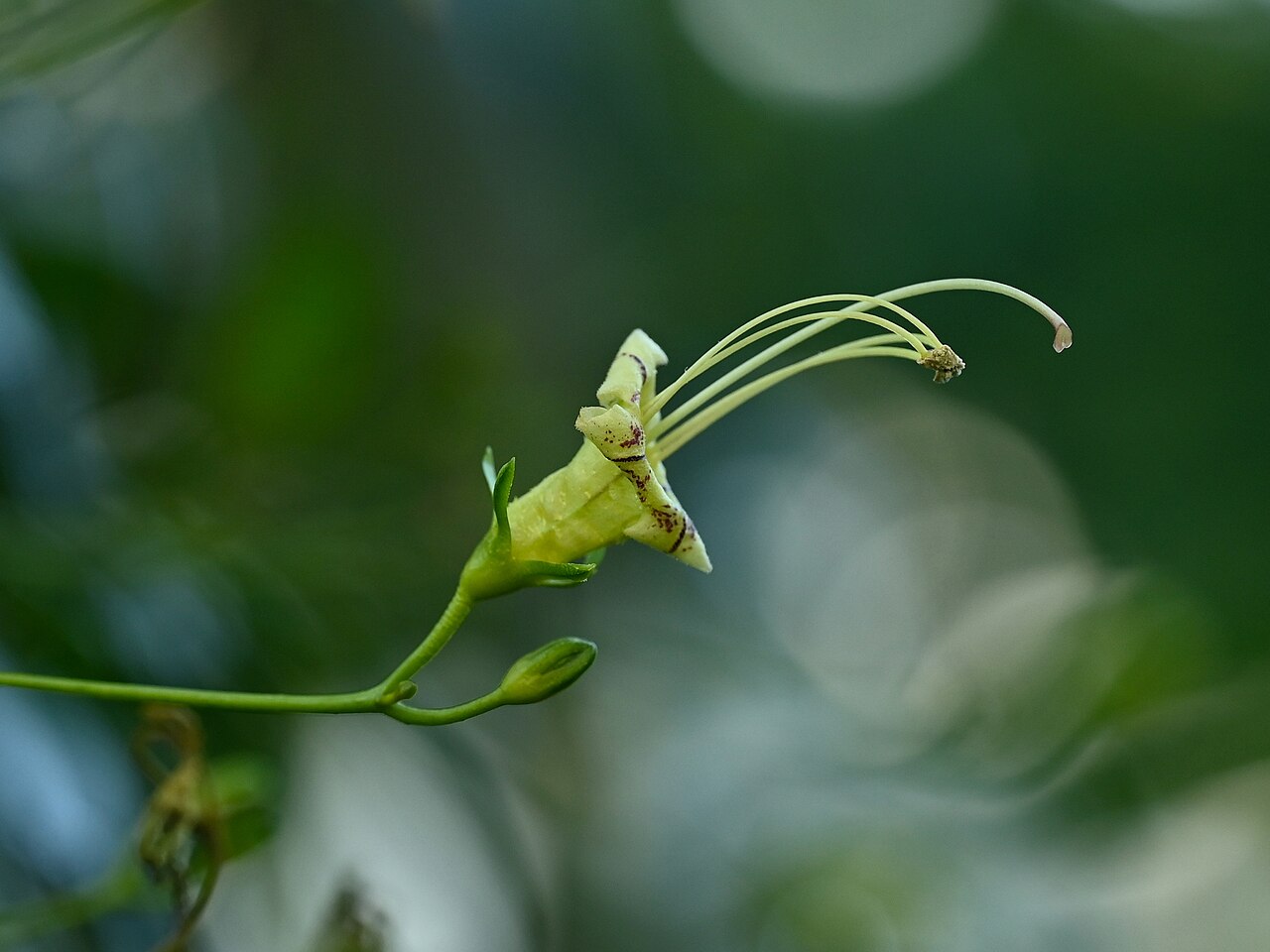
Its most striking feature is its flowers: pale greenish-yellow bells marked with reddish brown, each hanging from a long, slender stalk, with stamens and style that curve far out of the flower. The plant often blooms heavily in late fall and early winter, around the Christmas season. It is a distinctive native for shady, humid gardens in Puerto Rico’s uplands.
Identification
Árbol de navidad is easy to recognize when in flower. The combination of glossy leaves crowded at the branch tips and pale bell-shaped flowers on long stalks is distinctive among Puerto Rican shrubs.
Form
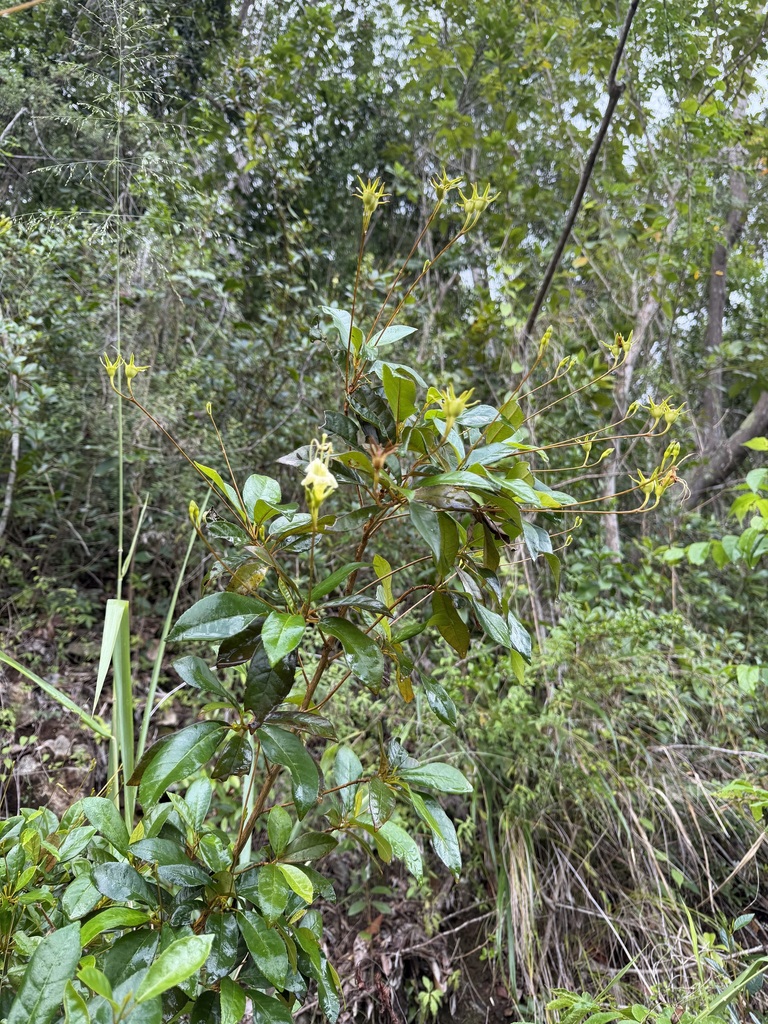
It is an evergreen shrub or small tree, usually under about 15 feet tall, with a few upright, sparingly branched stems. The leaves are crowded toward the ends of the branches, giving the plant a tufted look.
Leaves
The leaves are simple, alternate and narrowly elliptic to oblanceolate, widest above the middle and tapering to the base. They are glossy dark green above, often with reddish leaf stalks and young growth, and paler beneath.
Flowers
The flowers are borne singly or a few together on long, slender stalks (peduncles), the feature recorded in the species name pedunculosa. Each flower has a short, broad, bell-shaped corolla, pale yellow-green to cream with reddish-brown spots and streaks, and the stamens and style project well beyond the mouth of the bell, curving outward.
Fruit & Seeds
The fruit is a small, dry capsule that splits to release many tiny, dust-like seeds, as in other gesneriads.
Quick Facts
| Scientific Name | Gesneria pedunculosa (DC.) Fritsch |
| Family | Gesneriaceae (gesneriad family) |
| Plant Type | Evergreen shrub or small tree |
| Mature Height | Usually 4–15 ft |
| Mature Spread | 3–8 ft |
| Growth Rate | Moderate |
| Sun Exposure | Partial shade to light sun |
| Water Needs | Moderate to high; humid sites |
| Soil Type | Moist, well-drained soils, including limestone and serpentine |
| Soil pH | Acidic to alkaline |
| Bloom Time | Mainly late fall and winter; some flowers at other times |
| Flower Color | Pale greenish yellow with reddish-brown markings |
| Fall Color | None; evergreen |
| Fruit | Small dry capsule with tiny seeds |
| Deer Resistant | Not a concern in Puerto Rico, which has no native deer |
| USDA Hardiness Zones | 11–12; frost-sensitive |
Native Range
Árbol de navidad is endemic to Puerto Rico. USDA PLANTS lists it as native only in Puerto Rico, and the Smithsonian’s Flora of the West Indies records it as a Puerto Rican endemic found nowhere else in the Antilles.
Most records come from the western half of the island, in the mountains of the Cordillera Central and its western foothills, including Maricao Commonwealth Forest with its serpentine soils, the hills around San Germán and Mayagüez, and the Indiera area. It also grows in the northern karst region near Arecibo and Camuy, among the haystack hills (mogotes).
It favors moist, shaded to partly sunny places in forest, on wooded slopes and stream banks, and on road cuts and forest edges, where its pale flowers stand out against the dark foliage.
📋 Regional plant lists featuring Árbol de Navidad: Puerto Rico
Growing & Care Guide
Árbol de navidad is rarely offered for sale, but it is worth seeking out from native plant nurseries in Puerto Rico. It suits shady, humid gardens in the hills better than hot, dry lowland sites.
Light
Give it partial shade or bright, filtered light, such as at a forest edge or under high trees. It tolerates some morning sun but can scorch in hot afternoon sun at low elevations.
Soil & Water
It does best in moist, well-drained soil rich in organic matter. Keep it evenly moist and avoid long dry spells, especially while it is establishing; it is not suited to waterlogged soil.
Planting Tips
Plant it where its hanging flowers can be seen up close, such as along a shaded path or at the edge of a woodland garden. It combines well with ferns, wild coffee and other understory natives. Buy only nursery-propagated plants and never dig plants from the wild.
Pruning & Maintenance
Little pruning is needed. Tip-prune young plants lightly if a bushier shape is wanted, and remove dead stems. A layer of leaf mulch helps keep the roots cool and moist.
Propagation
Like many gesneriads, it can be grown from stem cuttings rooted in a humid, shaded propagation bed. The dust-like seeds can be sown on the surface of a fine, moist mix and kept humid until they germinate.
Landscape Uses
- Shade gardens: a distinctive flowering shrub for humid, partly shaded sites
- Woodland edges: pale flowers that stand out against dark foliage
- Endemic plant collections: a showcase for Puerto Rico’s unique flora
- Upland restoration: suited to plantings in western and central moist forests
- Wildlife plantings: flowers for nectar-feeding animals
Wildlife & Ecological Value
Árbol de navidad is part of a remarkable group of Caribbean gesneriads whose flowers have evolved to attract different kinds of animal pollinators.
For Pollinators
Its pale, bell-shaped flowers with long, protruding stamens belong to a flower type that, in Caribbean Gesneria, is associated with visits from bats at night and from hummingbirds by day, both of which brush against the exposed anthers while feeding on nectar.
For Birds
Hummingbirds visit many Caribbean gesneriads for nectar, and the shrub’s dense, tufted foliage gives small birds cover.
For Mammals
Nectar-feeding bats are important pollinators of many Antillean Gesneria with pale, open, bell-shaped flowers, and árbol de navidad’s flowers fit that pattern.
Ecosystem Role
As an endemic shrub of Puerto Rico’s moist forests, it adds to the diversity of the forest understory and edges, and it is one of many species that make the western mountains and northern karst important for conservation.
Cultural & Historical Uses
The common name árbol de navidad means “Christmas tree.” The plant often flowers abundantly in late fall and winter, around the Christmas season, which may explain the name, though its origin is not well documented.
The genus Gesneria honors the sixteenth-century Swiss naturalist Conrad Gessner and gives its name to the whole gesneriad family, which includes popular houseplants such as African violets, gloxinias and lipstick plants. The Caribbean islands are a center of diversity for Gesneria, with many species found on only a single island.
The species was first described by Augustin Pyramus de Candolle, and later transferred to Gesneria by the Austrian botanist Karl Fritsch, which is why its full name is Gesneria pedunculosa (DC.) Fritsch. An older name for the plant, Pentaraphia albiflora, is now treated as a synonym.
Frequently Asked Questions
Is árbol de navidad native to Puerto Rico?
Yes. It is endemic to Puerto Rico, meaning it grows wild nowhere else in the world. USDA PLANTS lists it as native in Puerto Rico.
Why is it called árbol de navidad?
The name means “Christmas tree.” The plant often blooms heavily in late fall and winter, around Christmas, though the exact origin of the name is not well documented.
Is it related to African violets?
Yes. It belongs to the gesneriad family (Gesneriaceae), which also includes African violets, gloxinias and lipstick plants, but it grows into a woody shrub or small tree.
Where can I see it in the wild?
Look in moist forests and on wooded roadsides in western Puerto Rico, such as around Maricao and San Germán, and in the northern karst near Arecibo. Admire it in place and do not collect it.
Can I grow it in my garden?
Yes, in a humid, partly shaded spot with moist, well-drained soil, especially at higher elevations. Buy nursery-propagated plants from native plant nurseries rather than taking plants from the wild.

Looking for a nursery that carries Árbol de Navidad?
Our nursery directory does not yet include Puerto Rico. Browse the native plant nursery directory by state: Alabama–Arkansas · California · Colorado–Hawaii · Idaho–Kansas · Kentucky–Montana · Nebraska–Oklahoma · Oregon · Pennsylvania–Virginia · Washington · West Virginia–Wyoming