Arizona Madrone (Arbutus arizonica)
Arbutus arizonica, the Arizona Madrone, is a small evergreen tree of the Sky Island mountain ranges of the Southwest. It belongs to the Ericaceae, the heath family, and shares its genus with the Pacific madrone of the West Coast and the strawberry tree (Arbutus unedo) of the Mediterranean — but the Arizona madrone is its own species, found nowhere else but the mountains of southeastern Arizona, southwestern New Mexico, and northwestern Mexico. Gardeners sometimes see it mislabeled “strawberry tree” because of the similar orange-red, warty-skinned berries, but the true strawberry tree is a European import; Arizona madrone is the real native.
Growing slowly to 20–45 feet, Arizona madrone is prized for its smooth, pinkish-brown, exfoliating bark, glossy evergreen leaves, and small white to pink urn-shaped flowers that give way to orange-red berries relished by birds. It is a classic companion of Arizona white oak, silverleaf oak, and Arizona pine in the mixed oak-pine woodlands between about 4,000 and 8,200 feet, where it often marks the cooler, moister canyons and north-facing slopes of ranges like the Santa Catalinas, Santa Ritas, Chiricahuas, and Huachucas.
For a xeriscape or wildlife garden in the Arizona-New Mexico highlands, Arizona madrone offers year-round structure, striking bark color, and a long season of bird activity that few other native trees can match. It is slow-growing and somewhat particular about drainage, so it rewards patience, but a mature specimen is one of the most handsome native trees the Southwest has to offer.
Identification
Arizona madrone is an evergreen tree or large shrub, usually 20 to 45 feet tall, with a broad, rounded crown and often a leaning or multi-trunked form where it has resprouted after fire or storm damage. The trunk and major limbs are its most eye-catching feature, and the tree is often identified from a distance by its warm, pinkish-brown color against the gray-green of surrounding oaks.
Bark & Stems
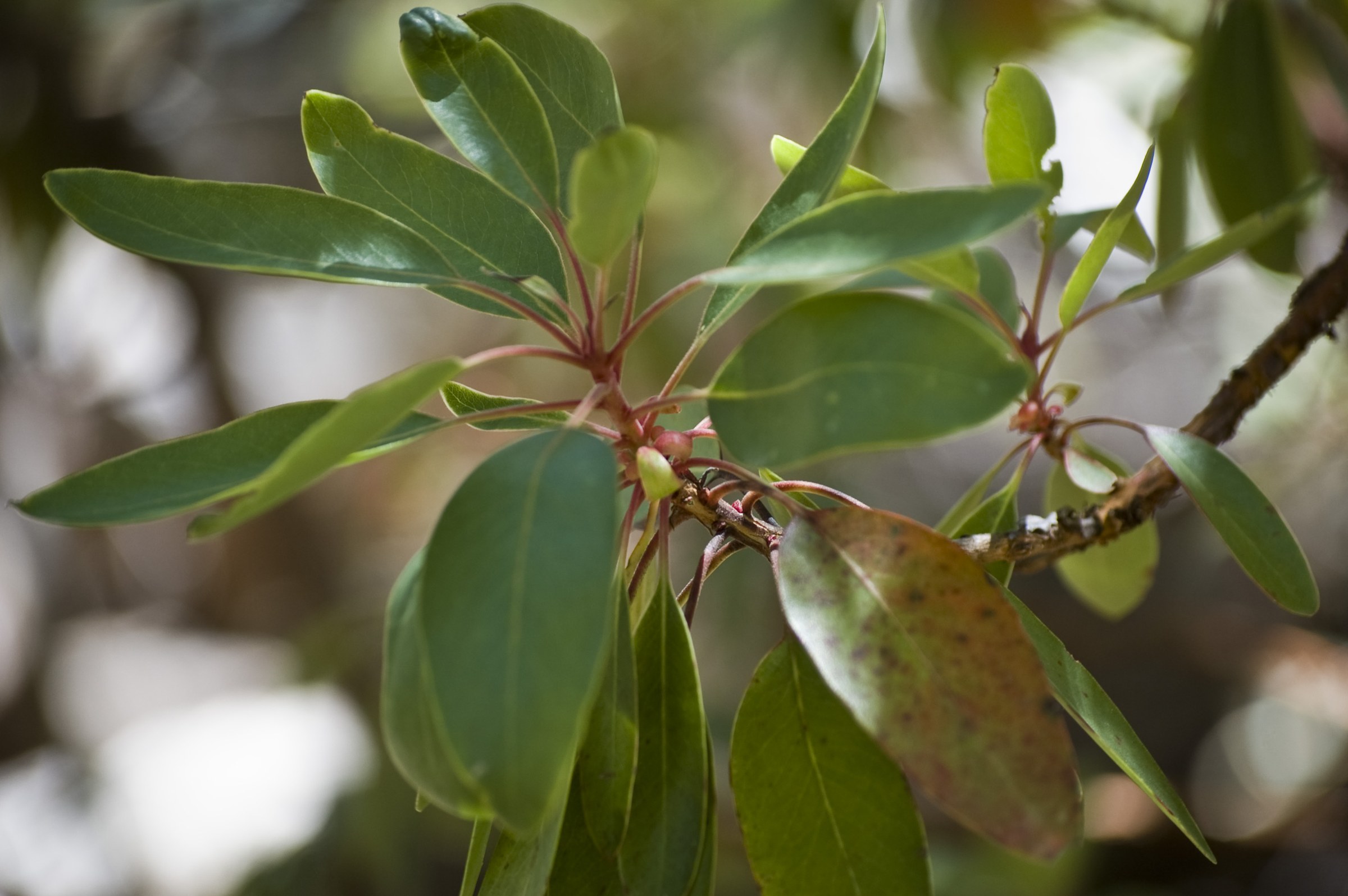
The bark is thin, smooth, and pinkish-brown to cinnamon-red, peeling away in thin, papery flakes to reveal pale, almost polished new bark beneath — a close relative of the “peeling” bark habit familiar from Pacific madrone. Young twigs are often reddish and finely hairy, aging to smooth gray-brown.
Leaves
Leaves are evergreen, simple, and alternate, oval to elliptic, 1.5 to 3 inches long, with smooth (entire) margins and a glossy, deep green upper surface; the underside is paler and duller. New leaves often emerge with a reddish tinge before maturing to glossy green. Unlike Pacific madrone, Arizona madrone’s leaf margins lack teeth, which is a useful field mark where the two might otherwise be confused.
Flowers & Fruit
In late spring and summer, small, bell- or urn-shaped flowers about a quarter-inch long open in drooping clusters at the branch tips. They are white to pale pink, similar in shape to the flowers of manzanita and blueberry, both relatives in the heath family, and they attract bees and other pollinating insects. The flowers ripen into small, round, orange-red berries with a finely warty surface, maturing in fall. The berries are an important late-season food for birds, though they are mealy and seedy and not a food source people rely on.
Quick Facts
| Scientific Name | Arbutus arizonica |
| Family | Ericaceae (Heath) |
| Plant Type | Evergreen Tree |
| Mature Height | 20–45 ft |
| Mature Spread | 15–25 ft |
| Growth Rate | Slow |
| Sun Exposure | Full Sun |
| Water Needs | Low once established |
| Soil Type | Rocky, well-drained; tolerates limestone |
| Soil pH | 6.0–7.5 (slightly acidic to neutral) |
| Bloom Time | May – August |
| Flower Color | White to pale pink |
| Fall Color | None (evergreen) |
| Fruit | Orange-red berries, ripening in fall |
| Deer Resistant | Mostly (browsed occasionally by mule deer and goats) |
| USDA Hardiness Zones | 7–9 |
Native Range
Arizona madrone is native to the “Sky Island” mountain ranges of southeastern Arizona and southwestern New Mexico — isolated, high-elevation ranges such as the Santa Catalina, Santa Rita, Huachuca, Chiricahua, and Pinaleño Mountains that rise out of the surrounding desert like forested islands. From there its range continues south along the Sierra Madre Occidental of Mexico into Sonora, Chihuahua, Durango, Sinaloa, and Jalisco, with an isolated population recorded as far away as Tamaulipas. Within the United States it does not range beyond Arizona and New Mexico.
Across this range, Arizona madrone grows in Madrean evergreen woodland and the lower edge of mixed conifer forest, typically between about 4,000 and 8,200 feet in elevation. It favors canyon bottoms, north-facing slopes, and other relatively cool, moist microsites within an otherwise dry landscape, and it is a minor component of riparian woodlands along with Arizona sycamore and velvet ash. It is most often found growing with Arizona white oak, silverleaf oak, Emory oak, and Arizona pine.
Because Arizona madrone needs the particular combination of elevation and moisture found in these sky island canyons, it does not occur in the low desert basins between the ranges, and plantings outside the AZ–NM highlands (for example, at low desert elevations) should not be expected to thrive. Its closest native relative in cultivation, the Pacific madrone (Arbutus menziesii), belongs to the cooler, wetter mountains and coastline of California, Oregon, and Washington and is a different, non-overlapping species.
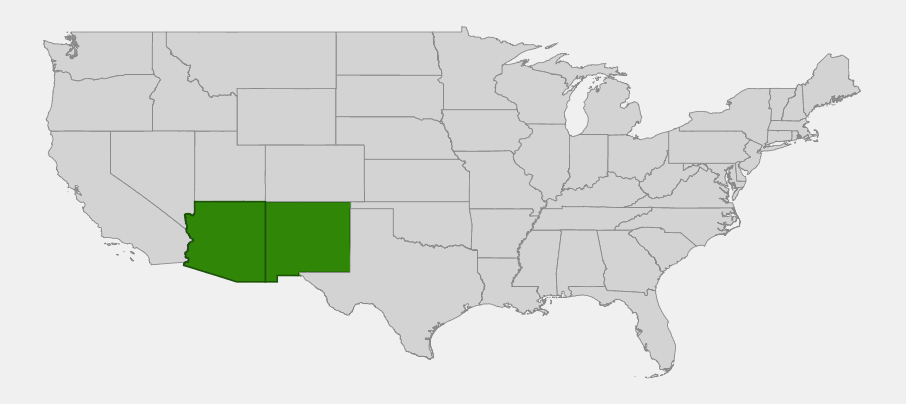
📋 Regional plant lists featuring Arizona Madrone: Arizona & New Mexico
Growing & Care Guide
Arizona madrone is a rewarding but unhurried garden tree. It is best suited to gardens within or near its native elevation band in Arizona and New Mexico, where it can be given the sharp drainage and dry summers it expects.
Light
Give Arizona madrone full sun to very light shade. In the wild it often grows on open, rocky slopes and in canyon-bottom woodland with a fairly open canopy, and it flowers and fruits best with good light exposure.
Soil & Water
Plant Arizona madrone in rocky, fast-draining soil; it is not tolerant of heavy clay or soils that stay wet, which quickly leads to root rot. It is adapted to a summer-monsoon, winter-dry climate and needs only occasional deep watering once established — regular watering is most important for the first one to two years after planting. Like many heath-family plants, Arizona madrone can be fussy about root disturbance, so choose a permanent site and avoid moving established plants.
Planting Tips
Use small container stock rather than large transplants; madrones generally establish better from younger plants with less-disturbed roots. Plant in fall or early spring to allow roots to settle before summer heat, and choose a site with excellent drainage, such as a slope or raised bed, mimicking the rocky canyon slopes where the species grows wild. Because growth is slow, be patient — a young tree may take several years to show significant height gain.
Pruning & Maintenance
Minimal pruning is needed. Remove dead or crossing branches in late winter, and resist heavy pruning, which the species tolerates poorly. Established trees are drought-tolerant and largely self-sufficient, needing little more than an occasional deep soak during extended dry spells.
Propagation
Arizona madrone is propagated from seed collected from ripe fall berries; germination can be slow and somewhat erratic, as with other madrones. Seedlings are sensitive to overwatering and benefit from the same sharp drainage required by mature plants. It is rarely available from general nurseries but can sometimes be found through native plant societies and specialty growers in the Southwest.
Landscape Uses
Arizona madrone’s year-round structure and colorful bark make it valuable in several garden roles:
- Specimen tree where its peeling, pinkish bark can be appreciated up close
- Xeriscape and rock gardens paired with native oaks, agaves, and manzanitas
- Wildlife gardens — the fall berries draw a range of birds
- Slope and canyon plantings that mimic its natural rocky habitat
- Native woodland gardens in the Arizona-New Mexico highlands, paired with Arizona white oak and silverleaf oak
Fire Ecology
Arizona madrone can resprout from the root crown after low- to moderate-severity fire, a trait shared with many Madrean evergreen woodland trees. Severe, stand-replacing fire can kill mature trees outright, but surviving root crowns in burned woodlands often produce vigorous new stems within a year or two.
Wildlife & Ecological Value
Arizona madrone contributes food and structure to the oak-pine woodlands of the sky islands across much of the year, from its spring and summer flowers through its fall and winter berry crop.
For Birds
The orange-red berries are eaten by a range of woodland birds that move through sky island canyons, including robins, thrushes, and various woodpeckers, and the evergreen canopy offers year-round cover and nest sites in a landscape where many surrounding trees are deciduous oaks.
For Mammals
Foliage and twigs are browsed occasionally by mule deer, and domestic and feral goats will also take the leaves where they have access; otherwise the tree is not a preferred browse species, which helps mature specimens persist. Black bears and other mammals opportunistically eat the fallen berries in fall.
For Pollinators
The small, urn-shaped flowers, similar in form to manzanita and blueberry blossoms, are visited by native bees and other pollinating insects during the late spring and summer bloom period, when they add a dependable nectar source in oak-pine woodland.
Ecosystem Role
As an evergreen tree scattered through largely deciduous oak woodland, Arizona madrone adds structural and seasonal diversity, offering cover when surrounding oaks are bare and a mid-canopy layer in the Madrean evergreen woodland community. Its presence is often used by ecologists as an indicator of the moister, north-facing or canyon-bottom microsites within sky island forests.
Cultural & Historical Uses
The Mountain Pima and other Indigenous peoples of the Sierra Madre Occidental region historically made use of Arizona madrone’s berries as a traditional food, eating them fresh or incorporating them into other foods, as documented in ethnobotanical surveys of the region’s plant foods.
The common name “madrone” (and the Spanish “madroño”) traces back to early Spanish colonizers, who applied the name of the related Mediterranean strawberry tree (Arbutus unedo) — itself called “madroño” in Spain — to the similar-looking native madrones they encountered in Mexico and the American Southwest. This history is also the likely source of the persistent, but inaccurate, habit of calling Arizona madrone “strawberry tree” in English; the true strawberry tree is the unrelated European species, not the native Southwestern tree described here.
Beyond its food use, Arizona madrone has long been valued simply as a striking element of sky island woodlands, and it remains primarily an ornamental and ecological tree today rather than a commercial timber or product species, since its slow growth and typically modest stature limit its use as lumber.
Frequently Asked Questions
Is Arizona madrone the same as strawberry tree?
No. “Strawberry tree” properly refers to Arbutus unedo, a related but separate species native to the Mediterranean region and sometimes planted ornamentally in the U.S. Arizona madrone (Arbutus arizonica) is a distinct, native Southwestern species; the “strawberry tree” label is a historical mix-up based on their similarly warty, orange-red berries.
Can you eat Arizona madrone berries?
The berries have a history of traditional food use among Indigenous peoples of the Sierra Madre region, but they are mealy, seedy, and not particularly palatable by modern standards. They are best left for the birds that depend on them in fall and winter.
Why is Arizona madrone hard to find in nurseries?
It is slow-growing, sensitive to root disturbance, and adapted to a fairly narrow set of growing conditions (rocky, sharply drained soil and a dry-summer climate), which makes it less commercially practical to grow than faster, easier native trees. Specialty native plant nurseries in Arizona and New Mexico are the best source.
Will Arizona madrone grow outside Arizona and New Mexico?
It is only reliably adapted to the elevation band and climate of the sky island ranges in southeastern Arizona and southwestern New Mexico (and the matching habitat in northwestern Mexico). Gardeners outside this region, including at low desert elevations within Arizona, should not expect it to thrive.
How fast does Arizona madrone grow?
Growth is slow, among the slower native Southwestern trees. Expect gradual size increases over many years rather than a quick-maturing landscape tree, which is part of why established specimens are especially valued.

Looking for a nursery that carries Arizona Madrone?
Browse our native plant nursery directory: Arizona · New Mexico