
Birdsfoot Violet (Viola pedata)
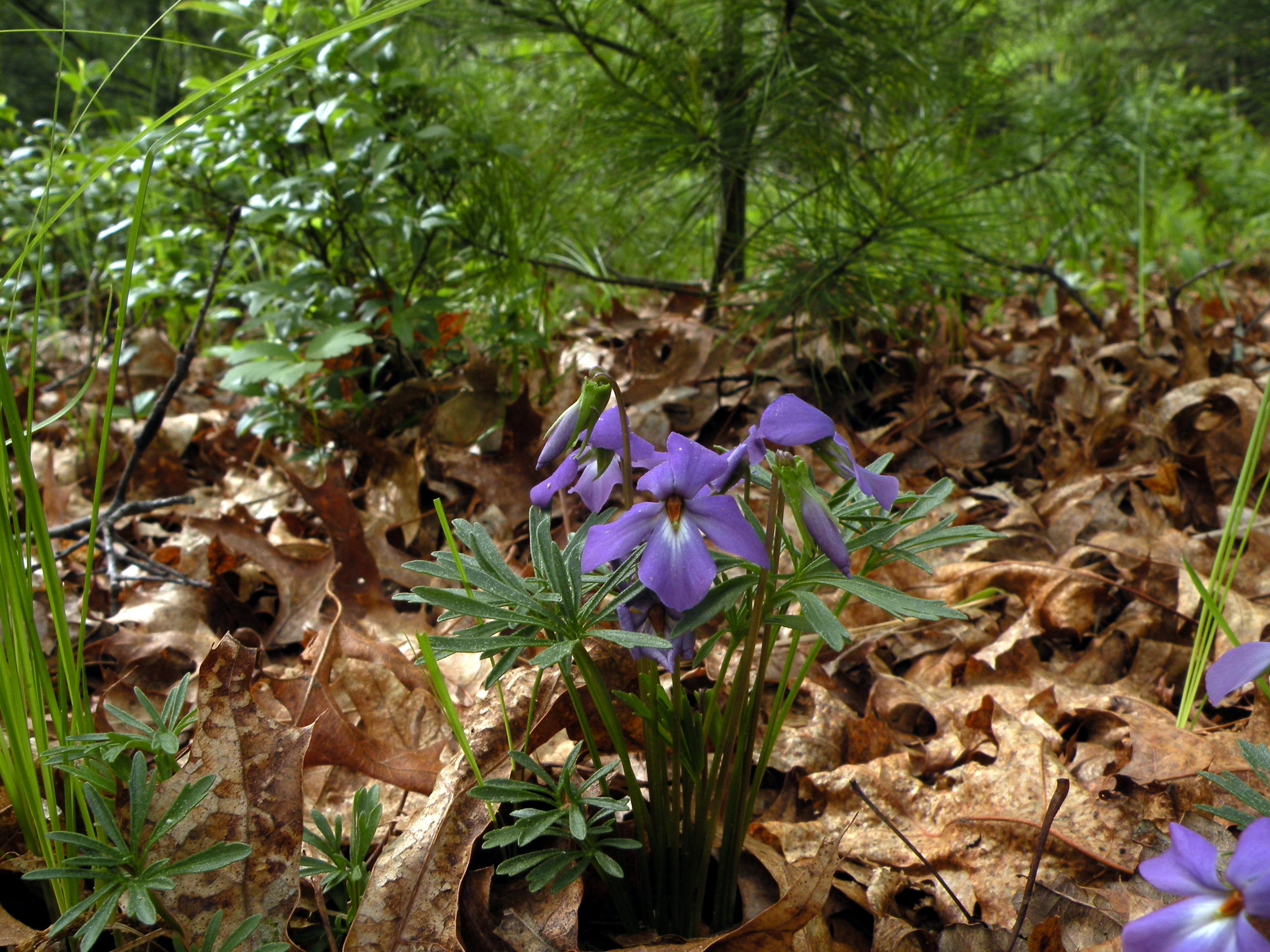
Viola pedata, commonly known as Birdsfoot Violet, is one of the most striking and unusual native violets in eastern North America. Unlike the familiar heart-leaved violets that carpet shaded lawns in spring, Birdsfoot Violet demands attention with its bold, deeply divided leaves that resemble the foot of a bird — the source of its evocative common name. Its flowers are among the largest in the violet genus, measuring up to an inch across, and come in a palette ranging from rich lavender to near-white, sometimes displaying a dramatic bicolored pattern with dark purple upper petals and paler lilac lower petals.
This is a plant of open, sun-drenched places — the dry rocky hillsides, sandy barrens, and open woodland glades that many gardeners find challenging to plant. Birdsfoot Violet thrives precisely where others fail: in nutrient-poor, well-drained soils with full sun. It is a defining species of the globally imperiled sandplain grassland and barrens communities that once covered much of the New England coastal plain. Across its wide eastern range from Maine to Florida, Birdsfoot Violet is a reliable indicator of high-quality, undisturbed natural areas — its presence signals that a site has never been plowed or heavily disturbed.
For gardeners working with dry, sandy, or rocky soils, Birdsfoot Violet is an exceptional choice that rewards patience with breathtaking spring blooms. It is also one of the most important early-season nectar sources for native bees, including several specialist bee species that depend on it almost exclusively. Growing Birdsfoot Violet is an act of conservation — this beautiful plant is declining across much of its range as open sandy habitats are lost to development and fire suppression.
Identification
Birdsfoot Violet is a low-growing herbaceous perennial reaching just 3 to 6 inches tall in bloom. It lacks the above-ground stems of many violets — all leaves and flower stalks arise directly from the underground rootstock (acaulescent growth form). It forms loose rosettes or small spreading clumps that expand slowly over time.
Leaves
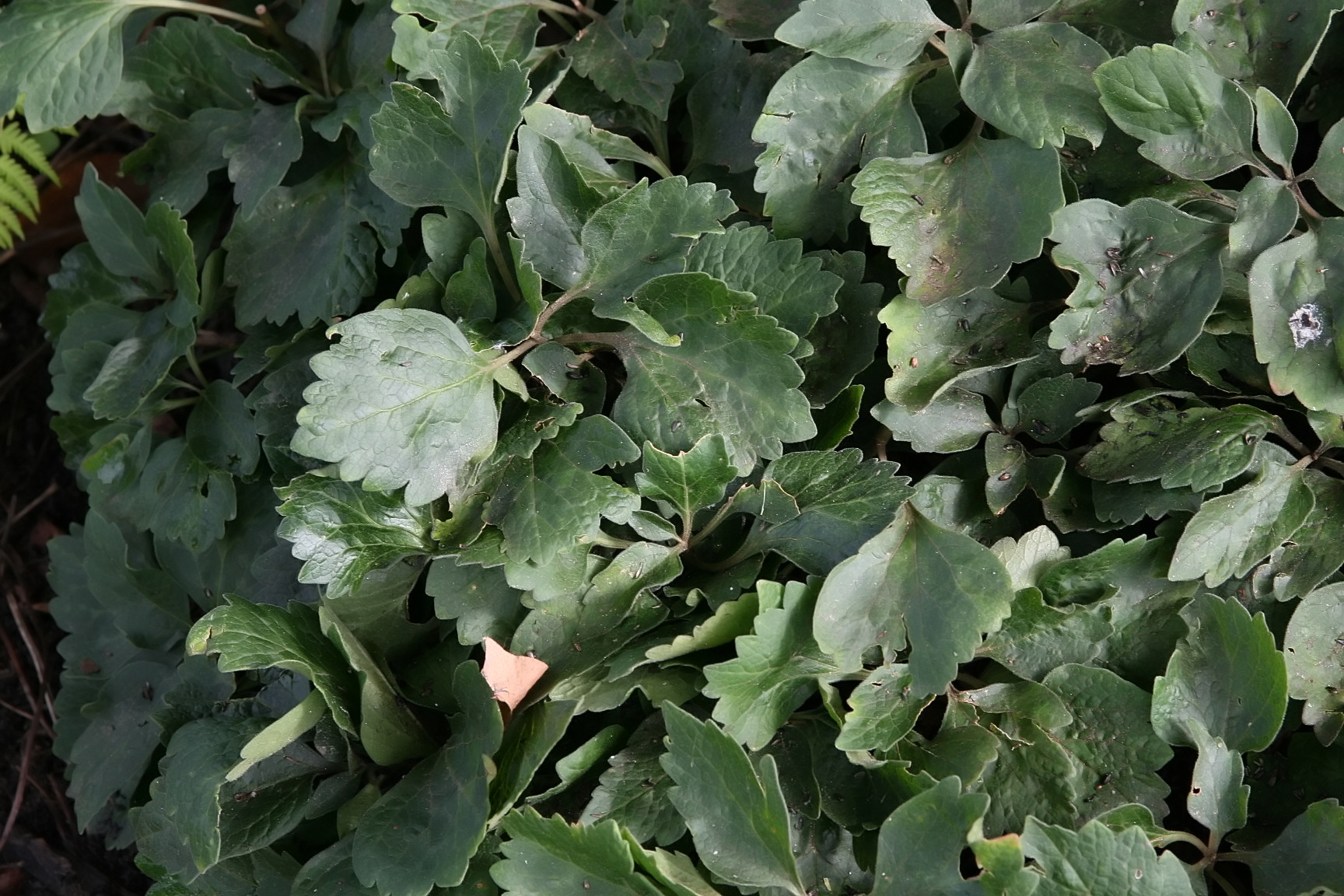
The leaves are the most distinctive feature of this violet. Each leaf is deeply divided into narrow, linear segments in a palmate pattern, creating a shape that resembles a bird’s foot — hence the common name. The leaves are 1 to 3 inches long, bright to medium green, and somewhat leathery in texture. The narrow segments (typically 3 main lobes, each further divided) immediately distinguish this species from all other eastern violets, which have rounded or heart-shaped leaves. The leaves emerge in early spring and remain attractive throughout the growing season, providing low ground cover in dry, sunny spots.
Flowers
The flowers are among the showiest in the genus — large for a violet, reaching ¾ to 1 inch across, and held on slender naked stalks above the foliage in April and May. Five rounded petals are arranged asymmetrically: the two upper petals are typically smaller and may be darker in color, while the three lower petals are larger and often have fine dark veining at their bases that guides pollinators to the nectar.
Two color forms occur in nature. The more common form has all five petals in shades of lavender to blue-violet, with the lower three petals somewhat paler and delicately veined. The rarer bicolored form — sometimes called Viola pedata f. bicolor — has striking dark purple upper petals contrasting with pale lilac lower petals, creating a dramatic two-toned effect that makes it one of the most beautiful wildflowers in eastern North America. Both forms can occur in the same population.
Like all violets, Birdsfoot Violet also produces inconspicuous, self-fertilizing cleistogamous flowers close to the ground in late summer and fall, which produce abundant seed without opening.
Fruit & Seeds
The fruit is a small 3-parted capsule that ripens in late spring or early summer, splitting explosively to scatter tiny seeds. The seeds have a small fatty appendage called an elaiosome that attracts ants, which carry the seeds short distances and bury them — a mutualistic relationship called myrmecochory that aids seed dispersal. This is why violets often establish in new areas along ant trails.
Quick Facts
| Scientific Name | Viola pedata |
| Family | Violaceae (Violet family) |
| Plant Type | Herbaceous perennial wildflower |
| Mature Height | 3–6 in |
| Sun Exposure | Full Sun to Part Shade |
| Water Needs | Low (Drought Tolerant) |
| Bloom Time | April – June |
| Flower Color | Lavender to blue-violet; bicolored form has dark purple upper petals |
| USDA Hardiness Zones | 4–9 |
Native Range
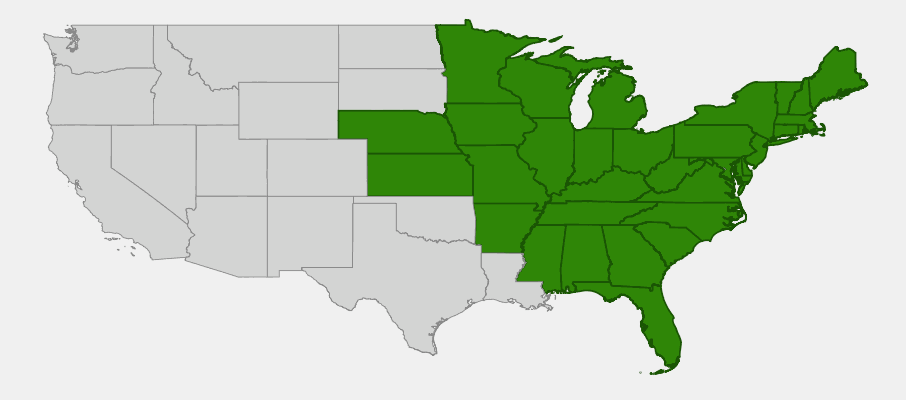
Birdsfoot Violet has a broad range across eastern North America, stretching from southern Maine and the Great Lakes region south to northern Florida and west to Nebraska, Kansas, and the eastern Great Plains. It is most abundant in the Mid-Atlantic states, the Appalachian region, and the upper Midwest, where dry open habitats are more common. In New England, it is found primarily in Rhode Island, Connecticut, and Massachusetts, where it is associated with the coastal sandplain grassland communities of the coastal plain.
This violet is a specialist of dry, nutrient-poor, open habitats — a dramatically different ecological niche from the moist woodland violets most gardeners know. It grows in sandy barrens, rocky glades, open pine woodlands, dry hillside prairies, and along rocky outcrops where competing vegetation is sparse. These open habitats were historically maintained by periodic fire in most of its range, and fire suppression has caused significant habitat loss throughout the Northeast.
In the New England coastal plain (where the rpl-nes states of Connecticut, Massachusetts, and Rhode Island lie), Birdsfoot Violet is considered a rare or uncommon species and is associated with the globally imperiled sandplain grassland ecosystem. Sites supporting this violet in New England represent some of the most botanically significant natural areas in the region.
📋 Regional plant lists featuring Birdsfoot Violet: Southeastern U.S.
Growing & Care Guide
Birdsfoot Violet is famously challenging to grow in the wrong conditions — but in the right spot, it is extraordinarily rewarding and virtually maintenance-free. The key is giving it what it needs: bright sun, excellent drainage, and lean soil. This is not a plant for rich garden beds.
Light
Birdsfoot Violet must have full sun or light part shade to thrive. It evolved in open, sun-drenched habitats and will decline or disappear if overshaded. Unlike woodland violets, which prefer dappled shade, Birdsfoot Violet needs at least 6 hours of direct sun daily. Morning sun with afternoon shade is acceptable, but full sun all day produces the most robust plants and flowers. Avoid placing it under dense tree canopy.
Soil & Water
This is a plant built for adversity: it grows best in dry, lean, well-drained soils — sandy loam, rocky clay, or even gravel. Rich soil makes it floppy and disease-prone. It is notably drought-tolerant once established and actually does better with minimal watering. The worst thing you can do to Birdsfoot Violet is plant it in rich, moist garden soil and water it frequently — this reliably kills it within a season or two. If your soil is too rich, amend with sand or fine gravel before planting.
Planting Tips
Birdsfoot Violet is best planted in spring or early fall from container stock. Handle the roots carefully — it resents root disturbance and may sulk for a full season before establishing. Set plants at the same depth they were growing in the container, water them in thoroughly, then leave them mostly alone. Do not mulch heavily around the crown — good air circulation at soil level is important. A light gravel mulch is acceptable and looks natural. For New England gardeners, this violet is an outstanding choice for a “rain garden” outflow area, rock garden, or sandy slope.
Pruning & Maintenance
Once established, Birdsfoot Violet requires almost no care. Deadheading spent flowers is unnecessary — the inconspicuous cleistogamous flowers that follow will produce all the seed the plant needs to spread slowly through a planting. If plants begin to look congested after several years, division in early spring or fall can rejuvenate them, though they are slow to multiply. The biggest maintenance issue is weeding: Birdsfoot Violet is not competitive and can be crowded out by more aggressive plants if not given adequate space.
Landscape Uses
Birdsfoot Violet is perfect for challenging dry, sunny sites where conventional plants struggle:
- Rock gardens — thrives in the lean, well-drained conditions between stones
- Dry slopes and hillsides — excellent for sunny, dry exposures
- Sandy meadow gardens — pairs beautifully with Wild Lupine, Little Bluestem, and Butterfly Weed
- Native lawn alternatives — forms attractive low mats in dry, sunny turf areas
- Prairie and barrens gardens — a signature species for open, well-drained native plantings
- Container gardens — spectacular in shallow terracotta pots with lean, gritty mix
Wildlife & Ecological Value
Birdsfoot Violet is one of the most ecologically significant early-season wildflowers in the eastern United States, supporting a remarkable diversity of specialist pollinators and serving as a host plant for several butterfly species.
For Pollinators
The large, showy flowers of Birdsfoot Violet are among the most important early-spring nectar sources for native bees. Several bee species are oligoleges (pollen specialists) that collect pollen almost exclusively from violets, including the violet specialist mason bee Andrena violae. Bumblebees are major pollinators, along with various mining bees, sweat bees, and early-flying syrphid flies. The flowers are designed for cross-pollination: the style and anthers are arranged so that visiting bees pick up and deliver pollen in specific patterns, ensuring outcrossing.
For Butterflies — Host Plant
Birdsfoot Violet is a host plant for several fritillary butterflies, whose caterpillars feed exclusively on violet leaves. The Great Spangled Fritillary (Speyeria cybele), Aphrodite Fritillary (Speyeria aphrodite), and Regal Fritillary (Speyeria idalia) — all spectacular large orange-and-silver butterflies — depend on violets as their sole larval host. The Variegated Fritillary (Euptoieta claudia) and several other smaller fritillaries also use violet species. Female fritillaries lay their eggs not on the plant itself but in the leaf litter near violets in late summer, and the newly hatched caterpillars overwinter, beginning to feed on violet leaves only in early spring.
For Birds
The seeds of Birdsfoot Violet are consumed by several ground-feeding birds, including Mourning Doves, Bobwhite Quail, and Wild Turkey. The low, dense foliage provides cover for small ground-nesting birds and mammals in open habitats.
Ecosystem Role
In sandplain grassland and dry barrens communities, Birdsfoot Violet plays a keystone role as one of the few early-blooming forbs that provide nectar before other spring wildflowers open. Its presence supports the entire food web of specialist pollinators and their dependent predators. The myrmecochory (ant-mediated seed dispersal) characteristic of the violet family helps create fine-scale mosaic planting patterns within communities.
Cultural & Historical Uses
Birdsfoot Violet was known and used medicinally by several Indigenous nations of eastern North America. Various tribes used violet preparations for headaches, as a respiratory aid, and as a mild pain reliever. The Iroquois (Haudenosaunee) used violet leaves and roots in a variety of medicinal preparations, while other eastern woodland nations used the roots topically for treating skin conditions. Cherokee healers used violet poultices for joint pain and headaches.
Early American herbalists and botanists were fascinated by Birdsfoot Violet’s unusual appearance — its deeply divided leaves set it apart immediately from all other native violets and drew attention from the earliest botanical surveys of the New World. John Bartram, the Pennsylvania botanist who corresponded with Linnaeus and established America’s first botanic garden, collected and described Birdsfoot Violet in the 18th century. The species was formally described by Linnaeus in 1753 in his landmark Species Plantarum.
In modern herbalism, various violet species (including Viola pedata) are used as a gentle demulcent — the mucilaginous leaves and flowers are consumed as a mild anti-inflammatory food supplement. Violet flowers and young leaves are edible and have been used as a salad ingredient and cooked green throughout the centuries. The flowers are rich in vitamins A and C. However, the roots of Viola pedata in particular are mildly emetic and cathartic in larger doses, and should not be consumed in quantity.
Today, Birdsfoot Violet is increasingly recognized as an indicator species for high-quality, unplowed natural areas — its presence in a landscape signals undisturbed, sandy or rocky, open habitat that may support a broad community of rare plants and specialist insects. Conservation organizations in New England actively survey for this species as part of assessments of sandplain grassland quality and biodiversity.
Frequently Asked Questions
Why does my Birdsfoot Violet keep dying?
The most common cause is soil that is too rich or too moist. Birdsfoot Violet is adapted to lean, dry, well-drained soils and will decline rapidly in the fertile, moist soils typical of cultivated gardens. If your plant is declining, check drainage first — improve it by adding coarse sand or gravel and avoid mulching the crown heavily. Reduce or eliminate supplemental watering once the plant is established.
Is Birdsfoot Violet different from other violets?
Yes — dramatically so. While most violets have heart-shaped or rounded leaves and grow in moist, shaded spots, Birdsfoot Violet has deeply divided, bird-foot-shaped leaves and grows in dry, sunny, open habitats. It also has much larger, more showy flowers than most native violets. It belongs to the same genus (Viola) but occupies a completely different ecological niche.
Will Birdsfoot Violet spread aggressively in my garden?
No — it is a slow, well-mannered species. Unlike common violets (Viola sororia) that can spread aggressively by seed, Birdsfoot Violet expands slowly and does not become weedy. It spreads mainly by seeds dispersed by ants (myrmecochory), which tend to move seeds only short distances. In appropriate conditions, it will form gradually expanding clumps but will not overtake a garden.
Which fritillary butterflies use Birdsfoot Violet?
Several species use it as a larval host plant, including the Great Spangled Fritillary, Aphrodite Fritillary, and (historically) the Regal Fritillary — all larger fritillaries in the genus Speyeria. The female butterflies lay eggs near the plants in late summer, and the tiny caterpillars overwinter in leaf litter before climbing the plants to feed in spring. Planting Birdsfoot Violet in a sunny meadow garden is one of the best ways to support fritillary butterflies.
Can I grow Birdsfoot Violet from seed?
Yes, but it requires patience. Seeds need a cold, moist stratification period of 60–90 days (mimic winter) before they will germinate. Direct-sow seeds outdoors in fall for spring germination, or cold-stratify in the refrigerator and sow indoors in late winter. Seedlings are tiny and slow-growing; expect flowering plants in their second or third year.

Looking for a nursery that carries Birdsfoot Violet?
Browse our native plant nursery directory: Virginia · North Carolina · Georgia