
Black Spruce (Picea mariana)
Picea mariana, the Black Spruce, is one of the most cold-hardy and ecologically important conifers in North America. A dominant tree of the boreal forest — the vast subarctic band of coniferous forest that stretches across Canada and Alaska and dips southward into the northern United States — Black Spruce is a defining species of the northern landscape, found from the treeline of the Arctic south through Maine, New Hampshire, Vermont, and the Great Lakes states. Its scientific name, mariana, honors the Province of Maryland (then called “Terra Mariae”), from which the species was first formally described by European botanists in the 18th century, though its true heartland lies far to the north.
Black Spruce is immediately recognizable by its distinctive growth form: a narrow, spire-like crown that tapers to a point, often with a tufted “bottle-brush” appearance at the very top. Its short, blue-green needles and tiny, persistent purple-brown cones distinguish it from other northeastern spruces. One of its most remarkable characteristics is its ability to reproduce vegetatively through a process called layering — when lower branches are weighed down by snow or touch the ground, they take root and produce new stems, allowing the tree to slowly expand outward even in harsh conditions where seed germination is unreliable. In New England bogs, Black Spruce stands often consist largely of clonal individuals spreading by this method.
This adaptable conifer thrives in saturated, acidic soils — particularly the cold, nutrient-poor sphagnum bogs and fens where few other trees can survive. For restoration projects in wet, boggy sites, or for creating wind-breaking screens in cold northern locations, Black Spruce is an outstanding native choice. Its cold-hardiness (to USDA Zone 2), adaptability to wet or dry conditions, and exceptional wildlife value as a year-round habitat tree make it a foundational species for any northern New England landscape.
Identification
Black Spruce is a medium-sized evergreen conifer that typically reaches 30 to 50 feet (9–15 m) in its natural range, though exceptional specimens in favorable southern locations can reach 80 feet (24 m). The crown is distinctively narrow and spire-like, often described as “columnar” or “steeple-shaped,” with short, upward-sweeping branches and a characteristic tuft or “flag” of dense branches at the very apex. The overall form is quite different from the broader, more symmetrical crown of Red or White Spruce.
Needles
The needles are short — just ¼ to ¾ inch (6–18 mm) long — and are borne singly in a spiral arrangement around the branch (unlike firs, whose needles are attached in flat rows). Each needle is four-sided (square in cross-section) with a distinct blue-green color and a pale, whitish cast from the waxy coating that helps the tree resist desiccation in cold, dry winter winds. The needles persist on the tree for 4 to 7 years before dropping, giving older branches a somewhat bare, twig-like appearance near their bases. The four-sided nature of the needles means they can be rolled between the fingers — unlike the flat needles of firs, which cannot.
Cones
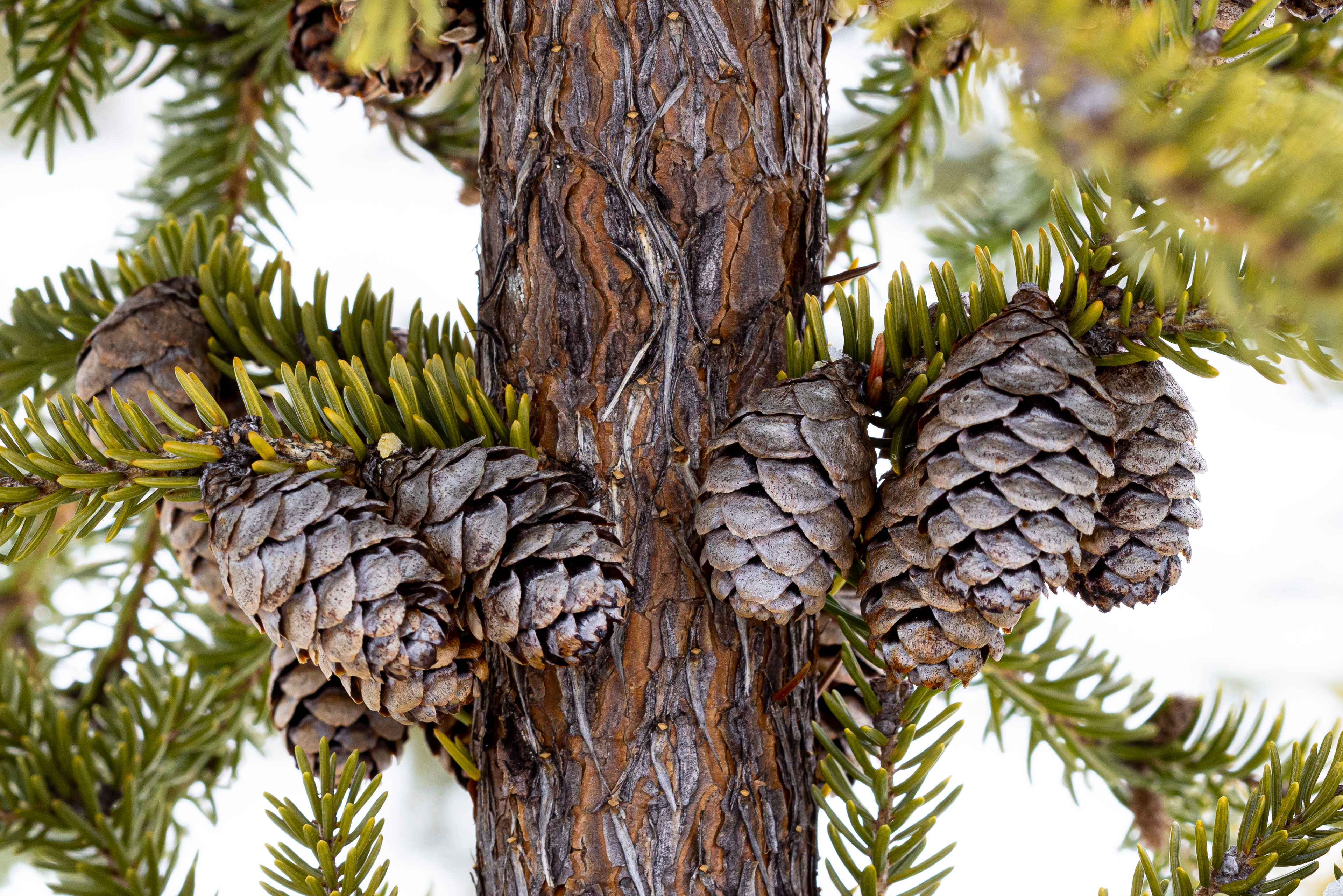
The cones are among the smallest of any North American spruce — typically ½ to 1½ inches (1.5–3.5 cm) long — and are egg-shaped to almost spherical. They are dark purple when young, turning reddish-brown to gray-brown at maturity. One of Black Spruce’s most distinctive characteristics is its serotinous cones — the cones remain on the tree for many years (sometimes 20 or more) without opening, gradually releasing their seeds over time. Fire triggers mass seed release by melting the waxy resin that seals the cone scales, making Black Spruce exceptionally well-adapted to fire-prone boreal landscapes. Small clusters of cones are typically concentrated near the tips of branches, giving the crown its characteristic “bottle-brush” appearance.
Bark & Twigs
The bark on young trees is grayish-brown to dark brown and relatively smooth, developing thin, flaky scales with age. Older trees have bark that is grayish and scaly, often with a slight purplish tinge. The twigs are slender and brown, covered with fine reddish-brown hairs (pubescent). A key identification feature is the presence of peg-like projections (sterigmata) where needles attach to the twig — when needles drop, these woody pegs remain, giving old branches a rough, bumpy texture. This feature distinguishes spruces from firs, whose needles leave smooth, round scars when they drop.
Quick Facts
| Scientific Name | Picea mariana |
| Family | Pinaceae (Pine) |
| Plant Type | Evergreen Conifer (Boreal Tree) |
| Mature Height | 40–80 ft |
| Sun Exposure | Full Sun to Part Shade |
| Water Needs | High |
| Bloom Time | April – May (cone development) |
| Cone Color | Purple (young) to reddish-brown (mature) |
| Needle Color | Blue-green |
| Special Features | Layering habit; serotinous cones; extremely cold-hardy |
| USDA Hardiness Zones | 2–5 |
Native Range
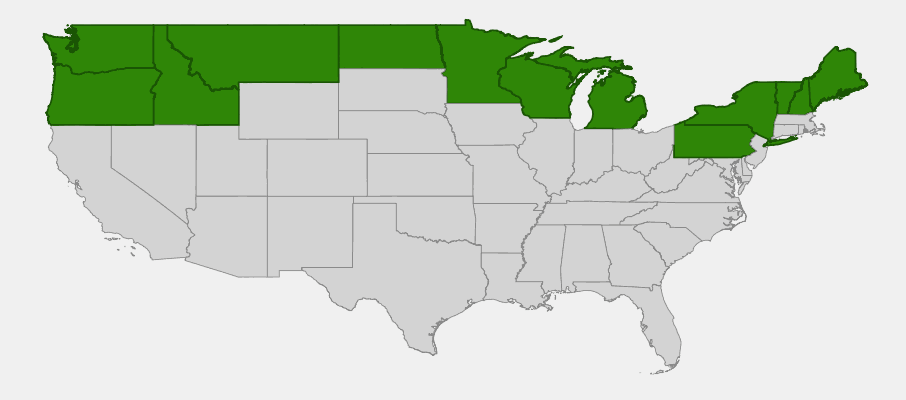
Black Spruce has one of the largest ranges of any North American tree, spanning the entire breadth of the boreal forest from Newfoundland and Labrador in the east to Alaska and the Aleutian Islands in the west. In the United States, its range dips southward from Canada into the northeastern states — Maine, New Hampshire, Vermont, New York, and the Great Lakes states of Michigan, Wisconsin, and Minnesota — wherever cold, wet, acidic conditions exist that mimic its favored boreal habitat. It also extends south along the high Appalachians into Pennsylvania in limited locations.
Within New England, Black Spruce is most common in Maine, where extensive bogs, fens, and cold lowland forests provide ideal conditions. It grows at elevations from near sea level (in coastal and valley bogs) up to the subalpine zone on higher mountains. The species is a characteristic component of sphagnum bog communities throughout its range — those cold, waterlogged, nutrient-poor habitats dominated by sphagnum moss where the tree grows slowly, often reaching only 10 to 20 feet even after a century of growth. In better-drained upland sites, particularly in Canada, Black Spruce grows much taller and is a major commercial timber species.
Across its massive boreal range, Black Spruce forms pure stands or mixes with other boreal conifers including Tamarack (Larix laricina), Jack Pine (Pinus banksiana), Balsam Fir (Abies balsamea), and White Spruce (Picea glauca). In wet sites it associates with Leatherleaf (Chamaedaphne calyculata), Labrador Tea (Rhododendron groenlandicum), and sundews (Drosera spp.). The tree’s vast range — covering an estimated 500 million acres of forest — makes it one of the most abundant conifers on Earth.
📋 Regional plant lists featuring Black Spruce: New England
Growing & Care Guide
Black Spruce is most at home in cool, moist, acidic conditions — the more closely you can replicate its natural bog and northern forest environment, the better it will perform. While it is famously tough and cold-hardy, it does have specific soil and moisture requirements that should be considered before planting.
Light
Black Spruce grows well in full sun to partial shade. In its natural habitat, it tolerates significant shade, particularly when young, growing slowly beneath the canopy of taller trees or in the open light of bogs. For the fastest growth and best form, plant in full sun. In partial shade, growth will be slower and the crown less dense, but the tree remains healthy. Black Spruce is not suited to deep shade.
Soil & Water
This spruce prefers consistently moist to wet, acidic soils (pH 4.0–5.5) with high organic matter content. It is one of the few conifers that genuinely thrives in waterlogged conditions — it is frequently found growing directly in sphagnum moss over saturated peat. At the same time, it adapts reasonably well to better-drained, moist soils as long as the pH is sufficiently acidic. Avoid planting in alkaline or calcareous soils, which will cause chlorosis (yellowing of needles) and poor growth. If your soil is not naturally acidic, amend with elemental sulfur or plant with acid-forming organic matter like peat moss or pine bark mulch.
Planting Tips
Black Spruce transplants best in spring or fall from container-grown stock. It grows slowly, particularly in its first few years, so patience is important. Plant in groups or masses for the best visual effect and windbreak function — single specimens can look lonely in large landscapes. Space trees 10 to 15 feet apart for a windbreak planting, or 6 to 8 feet apart for a tighter screen. Mulching with pine bark or wood chips helps maintain soil acidity and moisture. Do not plant in hot, dry sites — it will decline rapidly without adequate moisture in warm summer weather.
Pruning & Maintenance
Black Spruce requires virtually no pruning under normal circumstances. The naturally narrow, spire-like form requires no shaping. Remove any dead or diseased branches as needed. The layered, low-growing branches are a natural characteristic — do not remove them unless necessary, as they contribute to the tree’s distinctive appearance. Black Spruce is generally resistant to most pests and diseases when grown in appropriate conditions, though Spruce Budworm (Choristoneura fumiferana) can cause significant defoliation during outbreak years across the boreal zone.
Landscape Uses
- Windbreak and screening — narrow, dense form is excellent for northern wind protection
- Boggy or wet site planting — one of the best native trees for saturated soils
- Boreal garden — create an authentic northern landscape with Tamarack, Labrador Tea, and bog plants
- Wildlife habitat — year-round shelter and food source for birds and small mammals
- Restoration planting — excellent for restoring disturbed bog and fen habitats
- Specimen tree — distinctive spire form adds vertical interest
Wildlife & Ecological Value
Black Spruce is a foundational wildlife tree throughout the boreal zone, providing year-round food and shelter for a wide range of species adapted to northern forest conditions.
For Birds
Black Spruce stands are prime habitat for boreal-nesting birds. Blackpoll Warblers (Setophaga striata), Yellow-rumped Warblers, Palm Warblers, and Tennessee Warblers nest in or near Black Spruce bogs and forests. The seeds are consumed by Red and White-winged Crossbills (which are specially adapted to extract seeds from spruce cones), Pine Siskins, Common Redpolls, and various sparrows. Spruce Grouse depend heavily on Black Spruce needles as a winter food source and use dense spruce stands for thermal cover. Yellow-bellied Flycatchers and Olive-sided Flycatchers breed in bog Black Spruce stands. Boreal Chickadees and Gray Jays are year-round residents of Black Spruce forests.
For Mammals
Snowshoe Hares use Black Spruce thickets extensively for cover and browse the young twigs and bark in winter. Canada Lynx and their snowshoe hare prey are closely associated with dense Black Spruce stands. Moose browse the foliage and use spruce bogs as thermal refuges in summer heat. American Red Squirrels (and the larger Gray Squirrels in southern parts of the range) harvest cones throughout the year, creating “middens” of cone debris beneath favored trees. Woodland Caribou across the boreal zone depend on the arboreal lichens that festoon Black Spruce branches as a critical winter food source.
For Pollinators
While conifers are wind-pollinated and not dependent on insect pollinators, Black Spruce stands support diverse arthropod communities. Many native insects are adapted to the cold, moist conditions of spruce bogs, including specialized bees, flies, and beetles. The trees also support numerous moth caterpillars, including those of several Rheumaptera and Eupithecia species that are virtually obligate on spruce.
Ecosystem Role
Black Spruce is a keystone species of the boreal forest ecosystem — arguably the most ecologically important tree in the North American taiga. Its ability to grow in waterlogged, nutrient-poor sphagnum bogs makes it the dominant tree in habitats that few other species can occupy. The trees’ slow decomposition rate and the persistent sphagnum moss beneath them leads to massive carbon storage in peat — boreal Black Spruce forests and their associated peatlands are among the most significant terrestrial carbon sinks on Earth. The layering habit allows Black Spruce to maintain populations even when seed germination conditions are unfavorable, providing remarkable resilience in harsh environments.
Cultural & Historical Uses
Black Spruce has been integral to the lives of Indigenous peoples across the boreal zone for thousands of years. The Cree, Ojibwe, Algonquin, and other northern nations used virtually every part of the tree. The inner bark was consumed as an emergency food and prepared as medicinal tea for colds, respiratory ailments, and vitamin C deficiency (scurvy). The roots — notably flexible and strong — were split and used to make birch bark canoes, baskets, and other woven items, a technique known as watap or wattap in Cree and Ojibwe traditions. The gum was chewed like modern chewing gum.
European settlers and early fur traders quickly adopted Indigenous knowledge of Black Spruce’s uses. The strong, flexible roots became prized for lashing together canoe ribs and planks — Indigenous-style birch bark canoes stitched with spruce root were arguably the most important vehicle of North American exploration and the fur trade. Black Spruce wood — lightweight, straight-grained, and resonant — became a preferred material for violin and piano soundboards, a tradition that continues today with high-end instrument makers who use “Adirondack spruce” or “Canadian spruce” for tonewood. The tree’s resinous pitch was used as a waterproofing compound and adhesive.
Commercially, Black Spruce is the single most important pulpwood species in Canada, providing the raw material for much of the world’s newsprint and paper products. It is also used for lumber, boxes, and crates. “Spruce beer” — a fermented beverage made from Black Spruce twigs and needles — was used by sailors and explorers as a scurvy preventative, as the needles are rich in vitamin C. The drink, once common across northeastern North America, has been revived by craft brewers and homebrewers interested in historical and foraged beverages.
Frequently Asked Questions
How do I tell Black Spruce apart from Red Spruce?
Both are northeastern native spruces, but Black Spruce (Picea mariana) has shorter, blue-green needles (¼–¾ in) and smaller, nearly round cones that cluster near branch tips. Red Spruce (Picea rubens) has longer, yellower-green needles (½–¾ in) and larger, more cylindrical cones. Black Spruce also tends to grow in wetter, boggier sites, while Red Spruce prefers well-drained upland forests and higher elevations in the Appalachians.
Can Black Spruce grow outside of bogs?
Yes! While it is most famous as a bog species, Black Spruce grows well on moist, acidic upland soils. In northern and boreal forests, it is a common upland tree on well-drained soils. The key requirements are acidity (pH below 5.5) and consistent moisture — it is much less tolerant of dry, alkaline conditions than other spruces.
What does “layering” mean for Black Spruce?
Layering is a form of vegetative reproduction where lower branches that touch the ground develop roots and eventually become new, genetically identical trees. In dense Black Spruce stands, particularly in bogs, much of the population may consist of clonal trees spreading this way. The low branches are naturally weighed down by snow and ice each winter, promoting contact with the moist, organic substrate beneath.
How do I create an acidic soil environment for Black Spruce?
Amend the soil with elemental sulfur (follow package rates), peat moss, or pine bark mulch. Mulching heavily with acidic organic matter and watering with collected rainwater (which is naturally slightly acidic) will also help. Avoid using lime or wood ash near Black Spruce, which will raise pH and cause problems.
Is Black Spruce good for windbreaks in New England?
Yes — its narrow, dense, evergreen form makes it excellent for windbreaks in cold, exposed northern locations. Plant it in rows of 2–3 trees deep for maximum effectiveness. It will withstand the harshest New England winters and salt spray from roads, though it doesn’t perform as well in hot, dry summer conditions as further south.

Looking for a nursery that carries Black Spruce?
Browse our native plant nursery directory: Maine · New Hampshire · Vermont · Connecticut