
Fox Grape (Vitis labruscas)
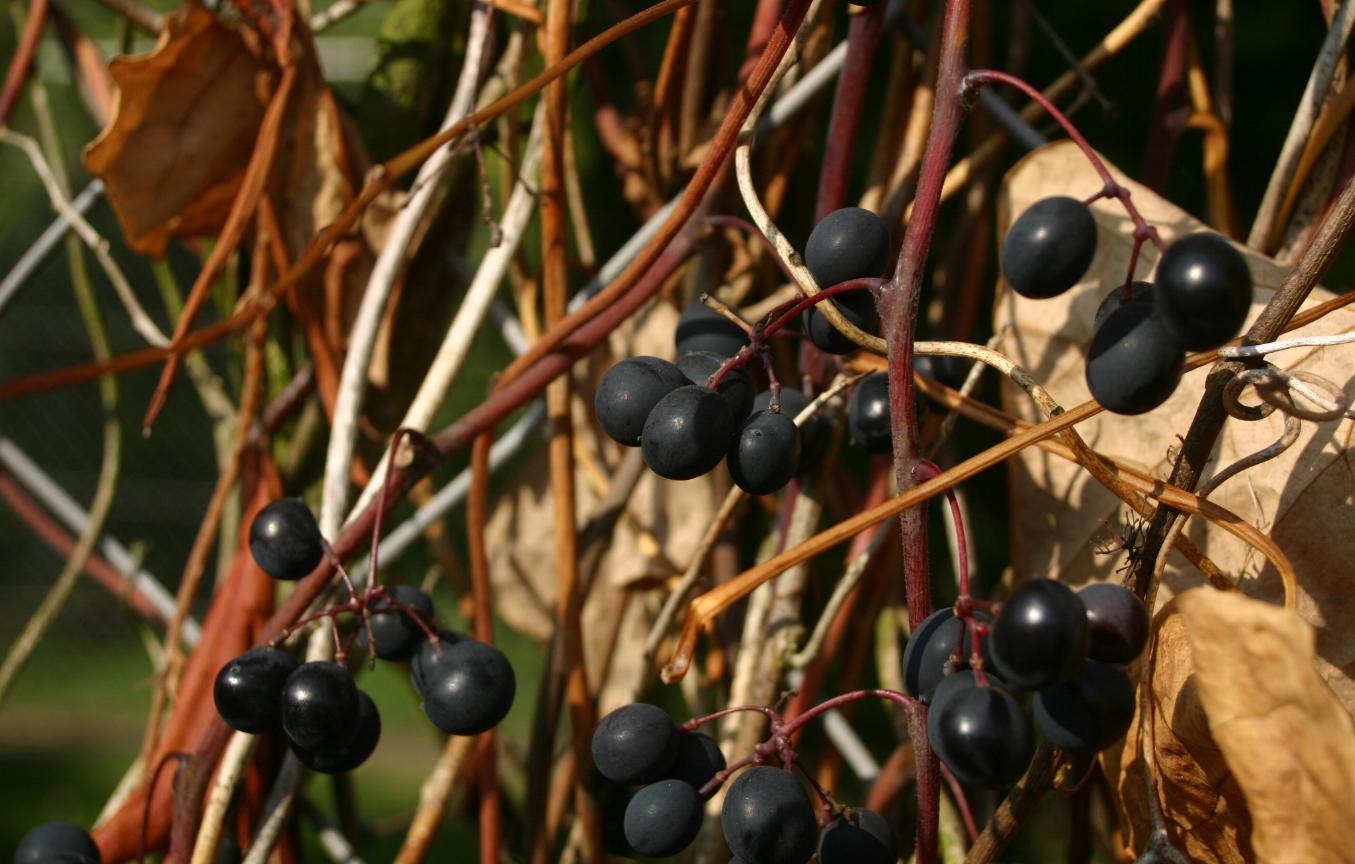
Vitis labrusca, the Fox Grape or Northern Fox Grape, is a vigorous native deciduous vine of the northeastern United States that holds a unique place at the intersection of ecology, gastronomy, and horticultural history. This robust, climbing member of the Vitaceae (grape) family scrambles through forest edges, hedgerows, and thickets across the eastern seaboard, its large, handsome leaves and abundant dark purple-black fruit clusters making it one of the most recognizable and beloved native vines in New England and beyond. Its powerful, distinctively musky “foxy” aroma — quite unlike the subtle fragrance of European wine grapes — gives the plant its evocative common name.
The Fox Grape is the wild ancestor — or at least a major genetic contributor — of many of North America’s most famous cultivated grape varieties. The beloved Concord grape, developed in 1849 by Ephraim Wales Bull in Concord, Massachusetts, was selected from wild Vitis labrusca seedlings growing in his backyard. Catawba, Niagara, and dozens of other familiar American grape varieties trace much of their parentage to the Fox Grape, giving this unassuming wild vine a remarkable legacy in American food and beverage culture. The distinctive “foxy” flavor — that signature quality found in Concord grape juice, Welch’s jelly, and many American wines — comes directly from the wild Fox Grape’s genetic heritage.
Beyond its horticultural legacy, the Fox Grape is an exceptional native plant for wildlife-friendly gardens and natural landscapes. Its large, textured leaves provide habitat structure and caterpillar food; its summer clusters of greenish flowers attract bees and other pollinators; and its abundant fall fruits feed dozens of bird and mammal species at a critical time of year. On arbors, trellises, fences, and pergolas, Fox Grape’s handsome foliage and natural abundance make it both a beautiful and ecologically productive garden vine for New England landscapes.
Identification
Fox Grape is a robust, vigorous deciduous vine that can climb 50 feet or more into the canopy of supporting trees, though it more typically reaches 15 to 30 feet in garden settings. It climbs by means of bifurcated (forked) tendrils that coil tightly around supporting structures. The overall impression is of lush, bold foliage and cascading fruit clusters — a characteristic grape-vine silhouette familiar from paintings and mythology.
Leaves
The leaves are large — typically 3 to 6 inches (7.5–15 cm) across — broadly heart-shaped to nearly circular in outline, with 3 to 5 shallow lobes (though some leaves may be almost unlobed). The leaf margin is coarsely toothed. The upper surface is dark green and essentially hairless (glabrous) to slightly hairy, while the underside is covered with a distinctive dense, rusty to whitish woolly tomentum (felty coating of matted hairs) — this woolly underside is one of the key identification features of V. labrusca and distinguishes it from many other wild grape species. The leaves turn yellow to reddish in autumn before dropping.
Flowers & Fruit
The flowers are tiny and inconspicuous, produced in dense, elongated clusters (panicles) from late May to June. They are greenish-yellow and strongly fragrant with a sweet, musky scent that attracts a variety of bees and other pollinators. The fruit clusters (bunches) are much looser and less compact than cultivated grapes, typically with 6 to 20 berries per cluster. Each berry is ½ to ¾ inch (1–2 cm) in diameter, ripening from green to deep purple-black (occasionally reddish or amber in color variants). The berries have a thick, tough skin and contain 1–4 seeds; the pulp inside is soft, juicy, and intensely flavored with the characteristic musky “foxy” quality unique to this species. Fruits ripen from late August through October, depending on location and year.
Bark & Tendrils
The bark on older stems is brown, shredding in long, fibrous strips — a characteristic shared with other native grapes and useful for identification. The tendrils are bifurcated (forked into two tips) and coil tightly around supporting structures. Unlike some other vine species, Fox Grape tendrils do not develop adhesive pads — the plant relies entirely on twining for support and requires a trellis, fence, or tree to climb.
Quick Facts
| Scientific Name | Vitis labrusca |
| Family | Vitaceae (Grape) |
| Plant Type | Deciduous Vine |
| Mature Height / Reach | 15–50 ft (climbing vine) |
| Sun Exposure | Full Sun |
| Water Needs | Moderate |
| Bloom Time | May – June |
| Flower Color | Greenish-yellow (fragrant) |
| Fruit Color | Deep purple-black (occasionally reddish) |
| Fruit Ripens | August – October |
| USDA Hardiness Zones | 4–8 |
Native Range
Fox Grape is native to eastern North America, ranging from southern Maine south through the entire Atlantic Coastal Plain to Georgia, and westward through the Appalachian Mountains to Tennessee, Kentucky, Ohio, Indiana, and Wisconsin. Its range corresponds broadly with the eastern deciduous forest biome, where it grows in the edges and semi-open conditions it prefers. The vine is most abundant in the mid-Atlantic and southern New England states but is native and commonly encountered throughout its range, often in disturbed habitats, old fields, and forest margins.
Within New England, Fox Grape reaches the northern limit of its range in southern Maine and southern Vermont and New Hampshire. It is more common and robust in Connecticut, Rhode Island, Massachusetts, and southern New Hampshire than in the cooler northern areas. The vine thrives particularly in the warm, protected valleys and lowlands of southern New England, where it can produce prodigious quantities of fruit annually. It commonly colonizes forest edges, stone walls, old fence lines, and roadsides, often draped dramatically over shrubs and small trees.
Fox Grape grows in a wide variety of soil types and is tolerant of both moist and moderately dry conditions, acidic to slightly alkaline pH, and heavy clay to sandy loam. This adaptability — combined with its vigorous growth habit — makes it an aggressive colonizer of disturbed areas throughout its range. The vine associates broadly with other edge species including Wild Black Cherry (Prunus serotina), Virginia Creeper (Parthenocissus quinquefolia), Eastern Red Cedar (Juniperus virginiana), and various native shrubs.
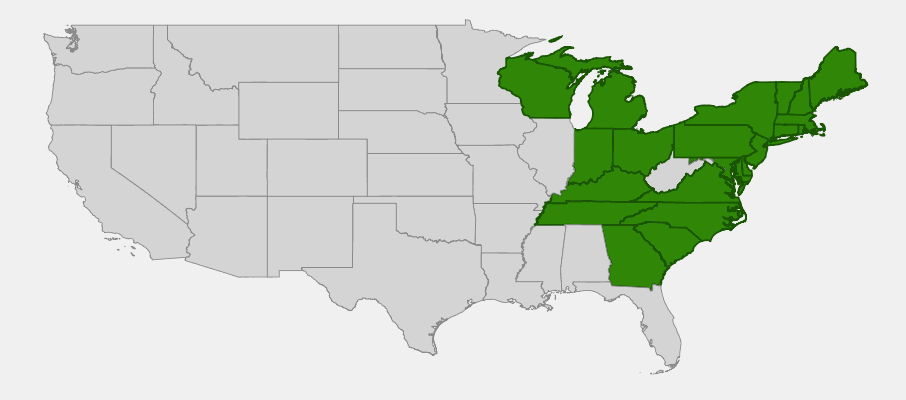
📋 Regional plant lists featuring Fox Grape: New England
Growing & Care Guide
Fox Grape is one of the most vigorous and adaptable native vines for eastern landscapes. Once established, it requires remarkably little care while delivering exceptional wildlife value and ornamental interest. Its primary needs are sun, support, and occasional management to prevent it from overwhelming neighboring plants.
Light
Fox Grape performs best in full sun — at least 6 hours of direct sunlight per day. While it will survive and grow in partial shade, fruit production drops dramatically without abundant light. In full sun, a well-established vine can produce enormous quantities of fruit annually, providing a significant wildlife food source. Plant on a south or west-facing structure for maximum sun exposure.
Soil & Water
Fox Grape tolerates a remarkably wide range of soil conditions — clay, loam, sand, slightly acidic to slightly alkaline. It prefers moderate moisture but once established shows considerable drought tolerance. Good drainage is important; it does not thrive in constantly waterlogged soils. The vine generally does not require supplemental fertilization — in fact, excessive nitrogen promotes lush foliage at the expense of fruit production. Allow the soil to dry somewhat between waterings once established.
Planting Tips
Plant Fox Grape near a sturdy support structure — an arbor, pergola, trellis, fence, or even a large tree. Provide a support with at minimum 3/4-inch grid spacing so the tendrils can grasp effectively. Start with container-grown stock and plant in spring or early fall. The vine will grow slowly in its first year while establishing roots, then accelerate dramatically in years 2 and 3. Once mature, it can put on 10 to 20 feet of new growth annually in favorable conditions.
Pruning & Maintenance
Without pruning, Fox Grape will grow into a massive, sprawling tangle — impressive and beautiful in a naturalized setting, but potentially overwhelming in a structured garden. Prune in late winter while the vine is dormant. Remove dead and crossing canes, and cut back the previous year’s growth to 2–4 buds from the main stem to encourage fruiting spurs. The vine bleeds clear sap when pruned — this is normal and not harmful. Regular pruning is essential to keep the vine on its support structure and prevent it from engulfing nearby shrubs and trees.
Landscape Uses
- Arbor and pergola coverage — creates dense, attractive summer canopy and abundant fall fruit
- Wildlife garden — exceptional food plant for birds and mammals
- Fence coverage — rapidly covers fences with attractive foliage
- Naturalized areas — allows to ramble freely over brush piles and hedgerows
- Edible landscaping — fruit for jelly, juice, and wine
- Native hedge base — interplanted with native shrubs for layered habitat
Wildlife & Ecological Value
Fox Grape is one of the most ecologically productive native vines in the eastern United States, providing food, shelter, and habitat structure for a remarkable variety of wildlife species across all seasons.
For Birds
The fruit is consumed by at least 60 species of birds, including many priority conservation species. American Robins, Gray Catbirds, Brown Thrashers, Hermit Thrushes, Cedar Waxwings, Northern Cardinals, and many other fruit-eaters consume the berries eagerly as they ripen in late summer and fall. The vine’s dense, sheltered growth provides excellent nesting habitat for species including Yellow Warbler, Song Sparrow, Common Yellowthroat, and others. In winter, dried fruits that remain on the vine provide food for American Robins, Northern Mockingbirds, and wintering thrushes.
For Mammals
White-tailed Deer browse the foliage and consume the fruit. Red and Gray Foxes, Raccoons, Skunks, Opossums, and Black Bears eagerly consume fallen and low-hanging fruit. Eastern Chipmunks and Gray Squirrels cache the seeds. The dense, tangled growth of established Fox Grape vines provides excellent cover and escape habitat for cottontails, mice, and other small mammals.
For Pollinators
The fragrant flowers are visited by a diversity of native bees, including specialist bees of the genus Anthidium and others. Various species of sphinx moths (Darapsa spp.) use grape foliage as larval food, and numerous moth species have caterpillars that feed on Vitis leaves, making the vine an important contribution to the local food web that supports insectivorous birds during breeding season.
Ecosystem Role
Fox Grape plays an important structural role in edge habitats, creating the dense, layered vegetation that provides habitat complexity for dozens of species. Its large, fast-growing canopy quickly covers disturbances, preventing erosion and providing rapid habitat restoration. The berries’ large size and high sugar content makes them a critical high-energy food source for migratory birds during fall migration — a “gas station” of calories for warblers, thrushes, and other species building fat reserves for long flights south.
Cultural & Historical Uses
The Fox Grape’s importance to human civilization in North America begins long before European contact. Indigenous peoples throughout the vine’s range consumed the fruit fresh and dried, fermented them into alcoholic beverages, and used the large leaves as food wrappers. The Haudenosaunee (Iroquois), Algonquin, Lenape, and many other nations used various parts of wild grapes medicinally — the leaves and bark as wound dressings, the sap as a wash for sore eyes, and decoctions of the root and leaf for various conditions. Leaf patterns were incorporated into beadwork and other decorative traditions.
The pivotal moment in the Fox Grape’s cultural history came in 1849, when Ephraim Wales Bull of Concord, Massachusetts, selected a superior seedling from wild Vitis labrusca plants growing near his home and began developing what would become the Concord grape — arguably the most culturally important cultivated grape in American history. By 1854, he had introduced the Concord to the market, and within decades it had become the dominant American juice and jelly grape. Today, Welch’s, founded in 1869 specifically to produce “unfermented grape juice” from Concord grapes, processes hundreds of millions of pounds of Concord grapes annually, and the distinctive “foxy” flavor of the Fox Grape’s wild ancestor reaches billions of people through the iconic purple grape juice and jelly that form part of American childhood experience.
Beyond the Concord, many other beloved American grape varieties trace their ancestry to the Fox Grape: Catawba, Niagara, Delaware, Isabella, and dozens of others. American viticulture and the development of cold-hardy grape varieties that can survive northern winters owes an enormous debt to the native Fox Grape’s genetic cold-hardiness and disease resistance. Today, plant breeders continue to use Vitis labrusca genetics in developing cold-hardy wine grapes for northern vineyards.
Frequently Asked Questions
Can I eat Fox Grape fruits raw?
Yes! The fruits are edible raw, though they have a much stronger “foxy” flavor than cultivated grapes and fairly large seeds. Many people enjoy them directly from the vine. They make excellent jelly, juice, and wine — the classic Concord grape flavor comes directly from wild Fox Grape genetics. Pick fruits at peak ripeness (deep purple-black, slightly soft) for the best flavor.
How do I keep Fox Grape from taking over my garden?
Regular annual pruning in late winter is essential. Cut back aggressively — Fox Grape fruits on new wood, so hard pruning encourages both manageable growth and better fruit production. Without annual pruning, the vine will grow 10–20 feet per season and can overwhelm structures and neighboring plants within a few years.
Is Fox Grape the same as Concord grape?
Concord grape is a cultivated variety selected from Fox Grape seedlings. The two plants look very similar and have the same characteristic “foxy” flavor. Concord and other labrusca-type cultivars are generally considered more productive and consistent than wild Fox Grape, but wild plants have greater genetic diversity and provide better wildlife habitat.
How do I distinguish Fox Grape from other wild grapes?
Look at the underside of the leaves — Fox Grape leaves have a dense, rusty to whitish woolly coating (tomentum) that is characteristic and distinctive. Other wild grapes in the northeast (like Riverbank Grape, V. riparia) have more sparsely hairy leaf undersides. The strong “foxy” scent of Fox Grape fruits is also very distinctive.
Will Fox Grape damage my arbor or fence?
The vine itself won’t damage solid structures, but the weight and vigorous growth can become substantial over time. Ensure your arbor or trellis is sturdy — a mature Fox Grape in full leaf can be very heavy, especially after rain. Wooden fences should be in good repair; the vine’s shredding bark and moist foliage can accelerate wood decay if not managed.

Looking for a nursery that carries Fox Grape?
Browse our native plant nursery directory: Maine · New Hampshire · Vermont · Connecticut