
Blue Skullcap (Scutellaria tuberosa)
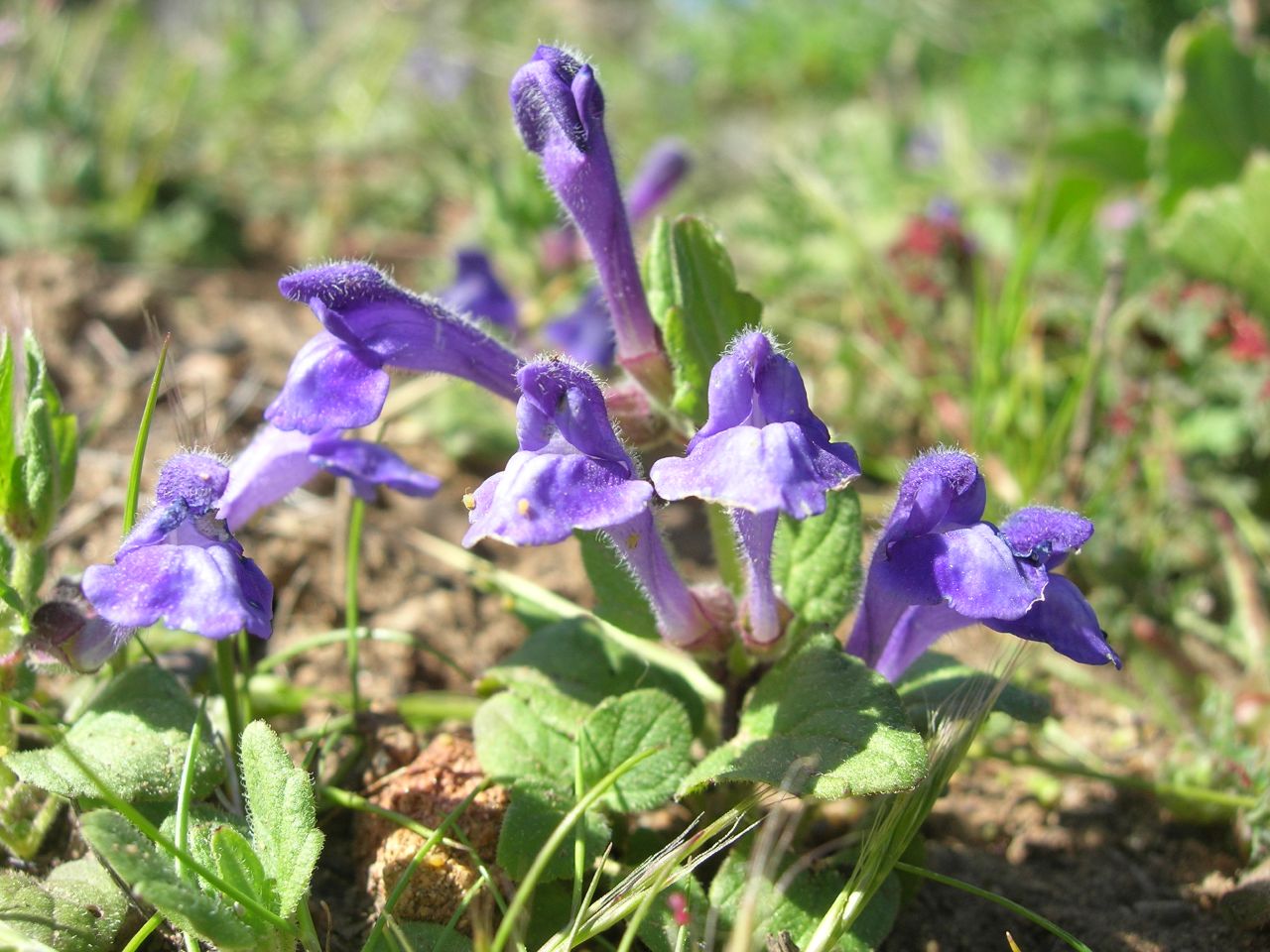
Scutellaria tuberosa, known as Blue Skullcap and listed by USDA as Danny’s skullcap, is a small spring wildflower of the chaparral, oak woodlands and grassy openings of California, southwestern Oregon and northern Baja California. It is a low, soft-hairy plant, usually only 2 to 8 inches tall, that carries surprisingly large, violet-blue, two-lipped flowers in pairs along its short stems.
As its name tuberosa suggests, it grows from small tubers strung along thin underground stems. These let it spread into small patches, survive the long dry summers dormant underground and resprout quickly after fire. It is one of the many small “fire followers” that appear in abundance in the years after chaparral burns, and it also grows in undisturbed woodland and on grassy slopes.
The name skullcap comes from a small ridge or bump on the calyx that looks like a little cap. Note that “blue skullcap” is also a name used for the eastern Scutellaria lateriflora, a different, taller species of wet places. This guide covers how to identify the western blue skullcap, where it grows, how to grow it, and its value to wildlife.
Identification
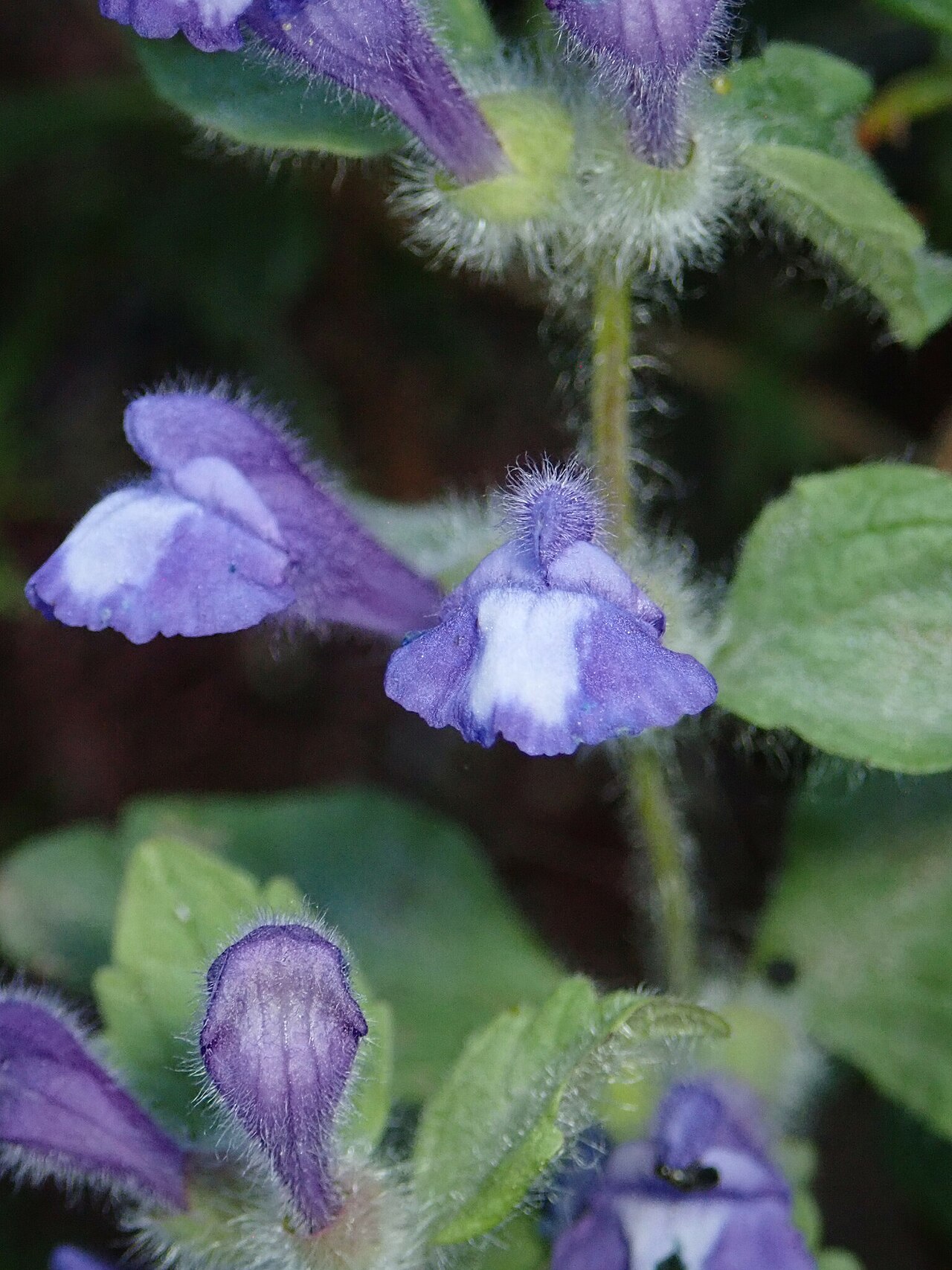
In spring, look for a very short, hairy plant with opposite, rounded, scalloped leaves and comparatively large violet-blue flowers, each with a hooded upper lip and a white-marked lower lip. Its small size and big flowers make it stand out on bare or grassy ground.
Growth Habit
It is a low perennial herb, usually 2 to 8 inches tall (up to about 10 inches), with one or a few upright or leaning stems. The stems arise from slender rhizomes bearing small, potato-like tubers, so plants may appear in loose groups. Stems are covered in short, spreading hairs.
Leaves
The leaves are opposite, ovate to nearly round, about 1/2 to 1 1/4 inches long, with scalloped or bluntly toothed edges. They are soft and hairy, and the lower leaves have short stalks.
Flowers
The flowers grow singly from the leaf axils, usually in pairs facing the same direction. Each is a tubular, two-lipped corolla about 1/2 to 3/4 inch long, violet-blue with white patches or spots on the lower lip. The small calyx has a raised crest, the “skullcap”, on its upper side. Bloom is mainly March through May, extending into July at higher or cooler sites.
Fruit & Seeds
After flowering, the calyx closes around four small, black nutlets. When ripe, the upper part of the calyx breaks away and the nutlets drop to the ground.
Look-alikes
Austin’s skullcap (Scutellaria austiniae), found mostly in the Sierra Nevada foothills and northern California, has narrower, mostly untoothed leaves. Marsh skullcap (Scutellaria galericulata) and other skullcaps of wet places are taller plants of streambanks and marshes. Blue skullcap is recognized by its very short, hairy stems, rounded scalloped leaves and tubers.
Quick Facts
| Scientific Name | Scutellaria tuberosa Benth. |
| Family | Lamiaceae (mint family) |
| Plant Type | Low herbaceous perennial from tuberous rhizomes |
| Mature Height | 2–8 in |
| Mature Spread | 4–8 in; slowly forms small patches |
| Growth Rate | Moderate |
| Sun Exposure | Full sun to part shade |
| Water Needs | Low; summer-dormant and dry in summer |
| Soil Type | Well-drained sandy, rocky or loamy soils |
| Soil pH | About 5.5–7.5 |
| Bloom Time | March–July (mainly March–May) |
| Flower Color | Violet-blue with white marks on the lower lip |
| Fall Color | None; summer-dormant |
| Fruit | Four small black nutlets |
| Deer Resistant | Somewhat; small size and hairy leaves limit browsing |
| USDA Hardiness Zones | 7–10 |
Native Range
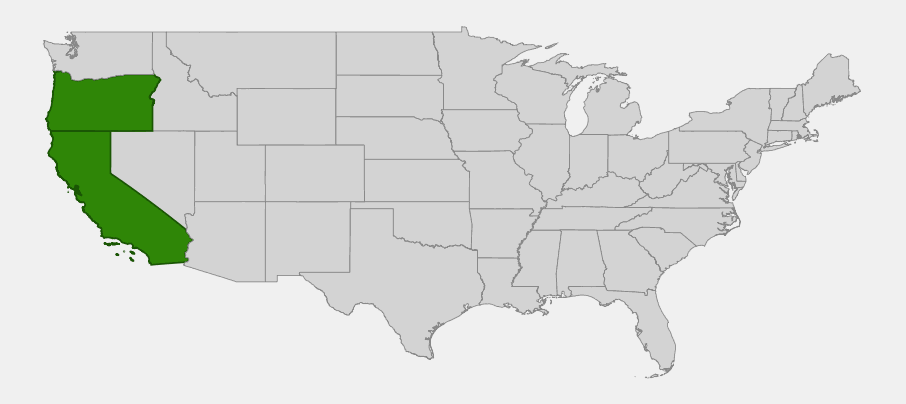
Blue skullcap is native to the California Floristic Province. USDA PLANTS lists it in California and Oregon, and it also extends south into northern Baja California, Mexico, reaching about the foothills near Ensenada.
In California it is widespread in the foothills and mountains and along the coast, from the Klamath Mountains and North Coast Ranges through the San Francisco Bay Area, the Sierra Nevada foothills, the Central and South Coast Ranges and the Channel Islands to the Transverse and Peninsular Ranges. It is generally absent from the deserts and from most of the Central Valley floor, except the isolated Sutter Buttes. In Oregon it is found in the southwestern part of the state, in the Siskiyou Mountains and the valleys of the Rogue River region, west of the Cascades.
It grows in chaparral, oak woodland, coastal scrub, grassy openings and mixed forest edges, often on sandy, gravelly or rocky soil, from near sea level to about 4,750 feet. It is especially common in the first few springs after a wildfire, when its tubers resprout in the newly opened, sunny ground.
📋 Regional plant lists featuring Blue Skullcap: California & Nevada · Western Oregon & Western Washington
Growing & Care Guide
Blue skullcap is a charming little wildflower for native gardens in California and southwestern Oregon, best suited to the front of a dry border, a rock garden, a container or a woodland edge under oaks. It is offered now and then by California native plant nurseries, and once established it comes back from its tubers each spring.
Light
It grows in full sun near the coast and in part shade inland, such as at the edge of oaks or shrubs.
Soil & Water
Give it well-drained soil; sandy, gravelly or rocky soil is ideal. Water during dry spells in winter and spring while it is growing and blooming. In summer it goes dormant and should be kept mostly dry, like the native bulbs it grows with, since summer water can rot the tubers.
Planting Tips
Plant tubers or potted plants in fall, when the rains start. Because the plants are small, group several together and place them where they won’t be hidden by taller plants, for example with bluedicks, buttercups, shooting stars and small grasses. It also does well in pots that can be left dry in summer.
Pruning & Maintenance
No pruning is needed. Mark where it grows, because the plant disappears in summer. Avoid thick mulch over the crowns, which can smother the small stems in spring.
Propagation
The simplest method is to divide established patches and replant the tubers in fall while dormant. It can also be grown from seed sown in fall. Collect tubers and seed only from garden plants or where permitted, and never dig plants from the wild.
Landscape Uses
- Rock gardens and containers: small plant with large blue flowers
- Oak woodland gardens: grows in light shade under native oaks
- Waterwise gardens: summer-dormant; needs no summer water
- Pollinator gardens: spring flowers for small native bees
- Post-fire restoration: a native fire-follower that resprouts from tubers
Wildlife & Ecological Value
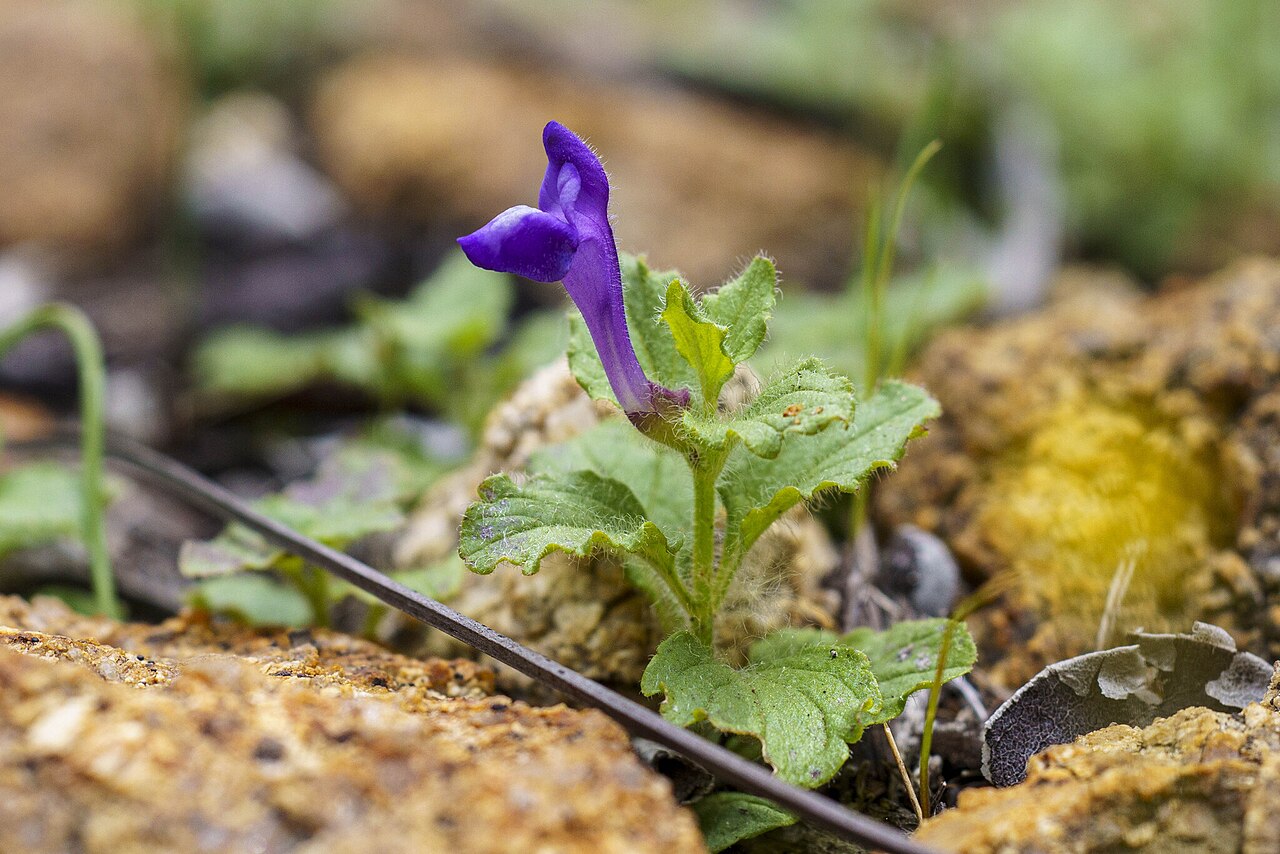
Blue skullcap is a modest but useful early-season nectar plant in the chaparral and oak woodlands, and its tubers let it bounce back quickly after fire.
For Pollinators
Its flowers are visited by native bees, especially small to medium-sized bees such as mason bees and digger bees, which land on the broad lower lip and push into the throat for nectar. Bee flies and small butterflies may also visit.
For Birds
Ground-foraging birds such as towhees, quail and sparrows feed among the low plants of open woodland and burned slopes where it grows, eating insects and seeds.
For Mammals
Rodents such as pocket gophers may eat the small tubers, and rabbits and deer occasionally nibble the leaves.
Ecosystem Role
As a fire follower, it is part of the burst of wildflowers that covers chaparral slopes after fire, providing early cover and nectar while shrubs regrow. Its underground tubers let it persist through drought and fire.
Cultural & Historical Uses
Blue skullcap was described by the English botanist George Bentham in 1834 in his Labiatarum Genera et Species, a monograph of the mint family, from a specimen collected by the Scottish plant explorer David Douglas in California in 1833.
The genus name Scutellaria comes from the Latin scutella, “a small dish”, referring to the crest on the calyx, which also gave the English name skullcap. The genus is found worldwide, and several species have long been used in herbal medicine.
Because it is small and blooms early, blue skullcap is often overlooked, but after a wildfire it can be one of the most abundant wildflowers on burned chaparral slopes, flowering among fire poppies, whispering bells and other fire followers.
Frequently Asked Questions
Where does blue skullcap grow?
It grows in chaparral, oak woodland, coastal scrub and grassy openings in California, southwestern Oregon and northern Baja California, mostly below about 4,750 feet.
Is this the same as the blue skullcap used in herbal medicine?
No. The herbal “blue skullcap” is usually Scutellaria lateriflora, a taller eastern species of wet places. Scutellaria tuberosa is a small western wildflower, also called Danny’s skullcap.
How tall does blue skullcap grow?
It is a small plant, usually 2 to 8 inches tall.
Why does blue skullcap disappear in summer?
It goes dormant during the dry summer and survives underground as small tubers, then resprouts with the fall and winter rains.
Does blue skullcap grow after fires?
Yes. It resprouts from its tubers and is often abundant on chaparral slopes in the first springs after a fire.

Looking for a nursery that carries Blue Skullcap?
Browse our native plant nursery directory: California · Oregon

