Brewer Spruce (Picea breweriana)
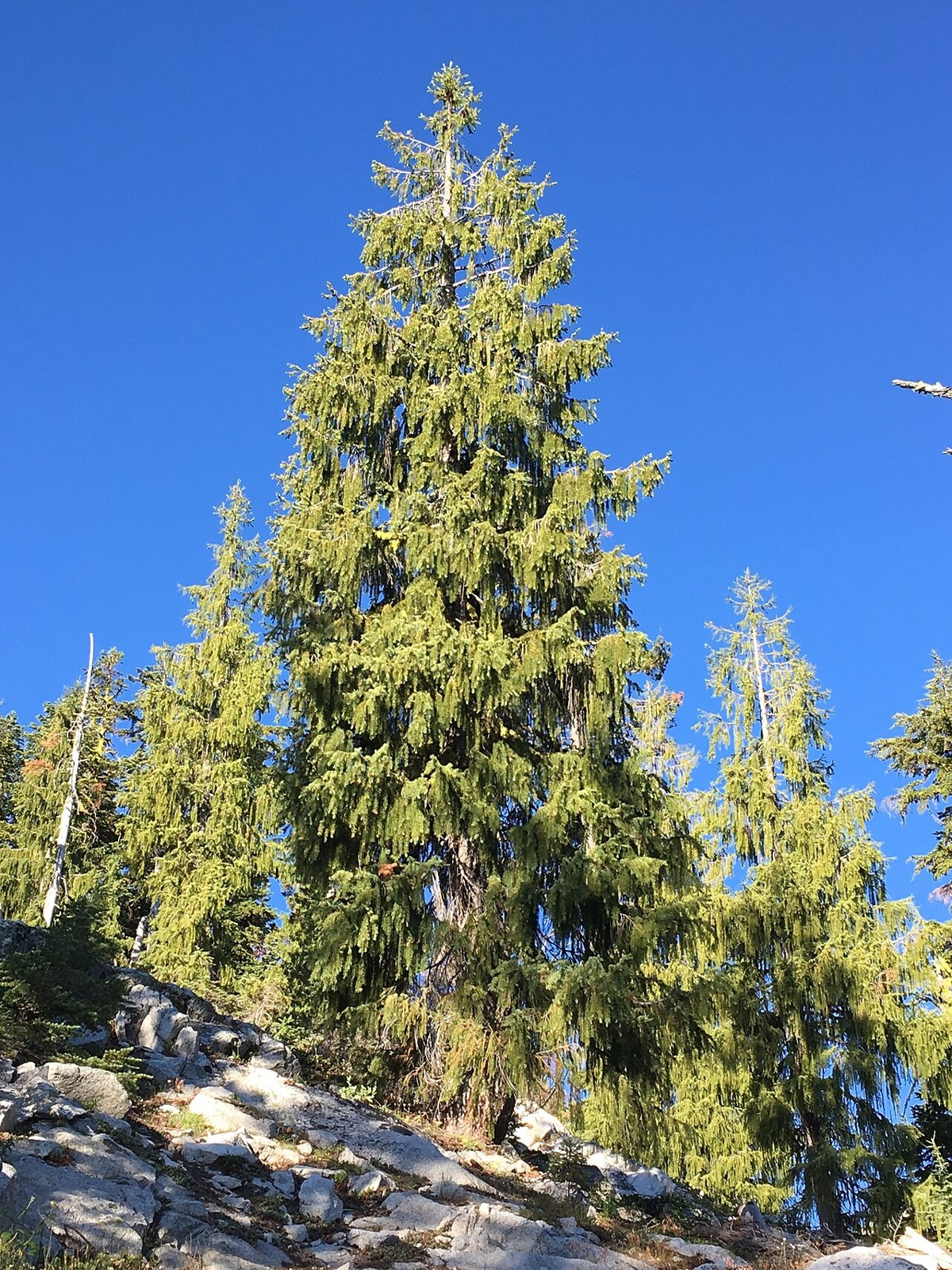
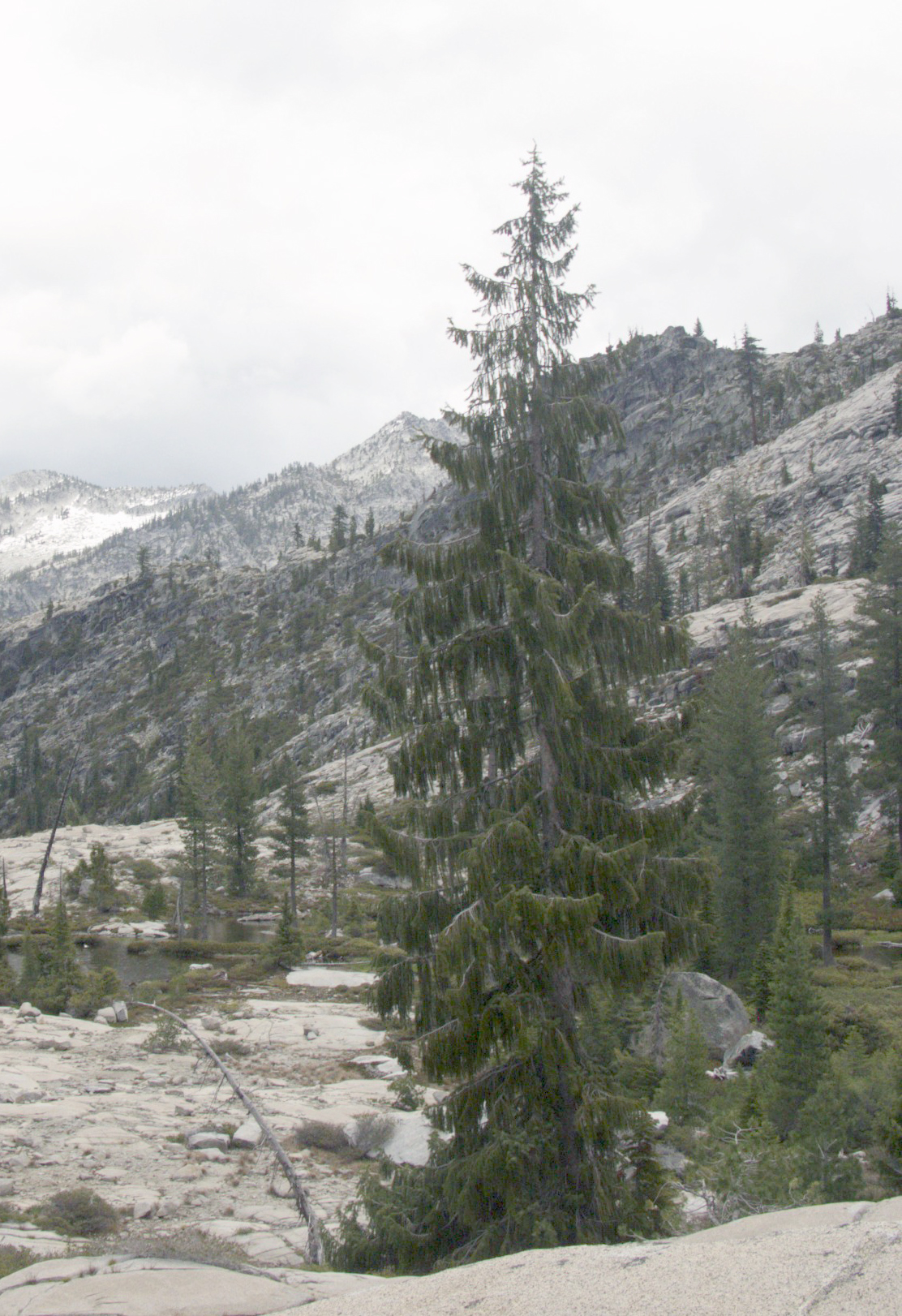
Picea breweriana, the Brewer spruce, is one of the rarest and most distinctive conifers in North America, confined to a small corner of the Klamath-Siskiyou Mountains of northern California and southwestern Oregon. It is instantly recognizable: from stiff, upswept branches, narrow curtains of foliage hang straight down, sometimes 6 feet or more, giving the tree a weeping, almost sorrowful silhouette unlike any other spruce in the world. Gardeners and conifer collectors prize it as a slow-growing specimen tree, though it is a demanding plant outside its cool, moist mountain habitat.
Brewer spruce was discovered on Mount Eddy in 1863 by botanist William Murray Canby and later named for the plant collector William Henry Brewer, who had explored the region with the California Geological Survey. It remains one of the most restricted conifers in the United States, growing in scattered, mostly small populations on rocky ridges and basins at mid to high elevation, often alongside other Klamath Mountains conifers found nowhere else together.
In cultivation, Brewer spruce is grown almost exclusively as a specimen or accent tree by collectors who can give it cool summers, consistent moisture and excellent drainage. It struggles in hot, humid, or dry climates and is rarely successful much outside the Pacific Northwest and similar maritime-influenced regions, but where it thrives, few conifers draw as much attention.
Identification
Brewer spruce is a medium to large evergreen conifer, typically 60 to 100 feet tall in the wild (occasionally more) with a narrow, spire-like crown. Its most striking feature is the foliage habit: the primary branches angle upward and outward from the trunk, but from each branch, slender secondary branchlets hang straight down in long, dense curtains, sometimes brushing the ground on lower limbs of old trees.
Bark & Form
The trunk is straight, tapering slowly, with thin, grayish to reddish-brown bark that breaks into small, loose scales with age. Young trees have a dense, narrowly conical shape; older trees develop the characteristic weeping, almost shaggy silhouette as the pendant branchlets lengthen over decades.
Needles
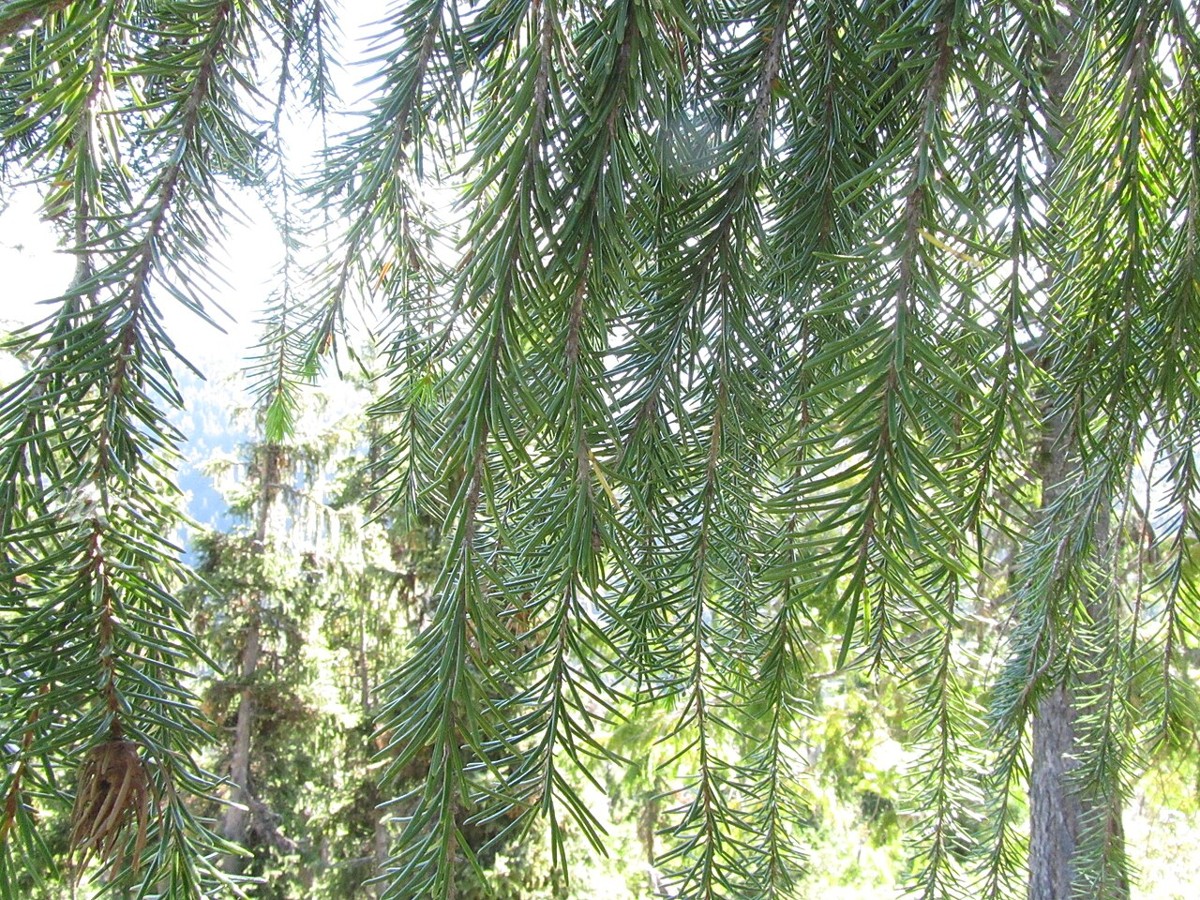
Needles are flattened, blunt-tipped, dark bluish-green to green, about 1 to 1.5 inches long, and unlike most spruces they are soft rather than sharply pointed, a trait that helps distinguish Brewer spruce from other conifers sharing its range. They are arranged densely and radially on the hanging branchlets, which is what produces the curtain effect.
Cones
Cones are cylindrical, 2.5 to 4.5 inches long, hanging downward from the upper branches. They start purplish before ripening to light brown, with thin, flexible scales. Cones mature and drop seed in a single season, in late summer and fall, and spent cones often remain visible on the tree through winter.
Quick Facts
| Scientific Name | Picea breweriana |
| Family | Pinaceae (Pine) |
| Plant Type | Evergreen coniferous tree |
| Mature Height | 60–100 ft in the wild; often 15–30 ft after decades in cultivation |
| Mature Spread | 15–25 ft, narrow and spire-like |
| Growth Rate | Slow |
| Sun Exposure | Full Sun to Part Shade |
| Water Needs | Average to moist; poor drought tolerance |
| Soil Type | Rocky, well-drained, often serpentine-influenced soils |
| Soil pH | Slightly acidic to neutral |
| Bloom Time | Late spring (cones, not showy flowers) |
| Flower Color | Not applicable (conifer) |
| Fall Color | None (evergreen) |
| Fruit | Cylindrical cones, 2.5–4.5 in, ripening late summer–fall |
| Deer Resistant | Yes |
| USDA Hardiness Zones | 5–7 |
Native Range
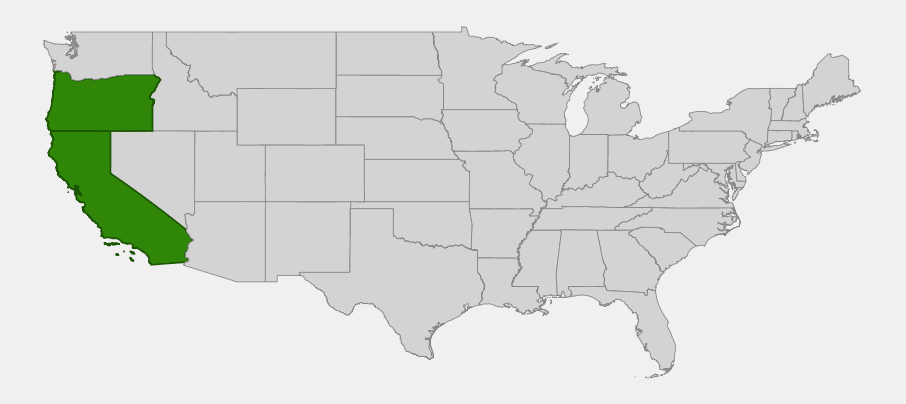
Brewer spruce has one of the smallest native ranges of any North American conifer. It is confined to the Klamath-Siskiyou Mountains, a rugged, botanically rich region straddling the California-Oregon border, where it grows on scattered peaks and ridges from the Marble Mountains and Trinity Alps north into the Siskiyou Mountains of southwestern Oregon.
Typical habitat is rocky, high-elevation terrain, usually between about 4,000 and 7,500 feet, on north-facing slopes, glacial basins and ridgelines where snow lingers late into summer. Soils are often thin and rocky, sometimes derived from serpentine rock, and the climate is cool with heavy winter snowpack and relatively dry summers softened by fog and cloud cover. Brewer spruce frequently grows with other Klamath region conifers such as subalpine fir, white fir and Douglas fir, in a region famous among botanists for its unusual concentration of conifer species.
Because its range is so limited and its populations scattered and often small, Brewer spruce is considered globally rare, though it is not federally listed. Most populations occur on National Forest land where they face few direct threats, but the species’ narrow habitat and slow reproduction make it a conservation concern that botanists continue to monitor.
📋 Regional plant lists featuring Brewer Spruce: California & Nevada · Western Oregon & Western Washington
Growing & Care Guide
Brewer spruce is a slow but rewarding specimen tree for gardeners in cool-summer climates who can offer it the conditions it needs. It is not a fast landscape filler; it is a long-term investment that rewards patience with a conifer unlike any other.
Light
In the garden, Brewer spruce does best in full sun to light shade, especially where summers are mild. In hotter inland gardens, afternoon shade helps prevent heat and moisture stress; in cooler, foggy coastal or mountain climates, full sun produces the densest, best-formed trees.
Soil & Water
Give it well-drained, rocky or gravelly soil; Brewer spruce does not tolerate heavy clay or waterlogged roots. Consistent moisture is important, especially while the tree is young, since it has poor drought tolerance compared with many western conifers. A cool root zone, helped by mulch, mimics the moist, shaded mountain soils it grows in naturally.
Planting Tips
Choose a site with cool summer temperatures and reliable moisture; Brewer spruce performs poorly in hot, humid, or consistently dry regions and is best suited to the Pacific Northwest, northern California and similar maritime or high-elevation climates. Plant young nursery stock in fall or early spring, and allow generous space, 15 to 20 feet or more, for the mature spread of the weeping crown.
Pruning & Maintenance
Little pruning is needed or wanted; the hanging branchlets are the plant’s main ornamental feature, and heavy pruning disrupts its natural form. Remove only dead or damaged branches. Established trees need minimal fertilizing; a light application of an acidifying conifer fertilizer in spring is enough on poor soils.
Propagation
Brewer spruce is propagated mainly from seed, which germinates slowly and sometimes unevenly, and from cuttings taken from vigorous young growth, though cutting-grown plants can be slower to develop a strong central leader. Grafted selections exist in specialty conifer nurseries for gardeners who want a more predictably shaped tree.
Landscape Uses
- Specimen conifer as a dramatic focal point where its weeping form can be seen from multiple angles
- Conifer collections and rock gardens in cool, well-drained sites
- Large-scale mountain or Pacific Northwest landscapes paired with white fir and subalpine fir
- Winter interest, since the pendant form and cones stand out against snow
- Wildlife plantings in large native-conifer gardens
Wildlife & Ecological Value
As a rare, localized conifer, Brewer spruce plays a quiet but notable role in the unique Klamath-Siskiyou forest ecosystem it inhabits.
For Pollinators
Like other spruces, Brewer spruce is wind-pollinated and does not attract pollinating insects, though its dense foliage can shelter insects that in turn support birds and other wildlife.
For Birds
The dense, overlapping curtains of foliage provide excellent cover and nesting sites for small forest birds, including chickadees, nuthatches and kinglets, which also glean insects from the needle-covered branchlets. Seed-eating birds such as crossbills can feed on the cones.
For Mammals
Douglas squirrels and chipmunks feed on and cache Brewer spruce seeds, and the sheltering branches provide cover for small mammals in the otherwise exposed, rocky high-elevation terrain where the species grows.
Ecosystem Role
Brewer spruce is one of several conifers that make the Klamath-Siskiyou region internationally notable for conifer diversity. Its presence on rocky, often serpentine-influenced slopes helps stabilize thin mountain soils, and its persistence in a narrow climatic niche makes it a useful indicator of the cool, moist microclimates that support the region’s broader botanical richness.
Cultural & Historical Uses
Brewer spruce has little recorded history of use by Indigenous peoples or settlers, largely because its remote, high-elevation range kept it apart from the areas of concentrated human activity. Unlike more widespread conifers, it was never an important timber or resource species.
Its primary historical significance is botanical. Discovered in 1863 and later named for William Henry Brewer, it became known to scientists and collectors as one of the most unusual spruces in the world, and 19th- and 20th-century botanists treated the Klamath-Siskiyou region, with Brewer spruce among its signature species, as a living laboratory of plant evolution and endemism.
Today the tree’s main human connection is horticultural. Conifer collectors and specialty nurseries around the world, especially in Britain and the Pacific Northwest, prize Brewer spruce for its singular weeping form, and mature specimens in botanic gardens, such as the Royal Botanic Garden Edinburgh, are often star attractions among conifer enthusiasts.
Frequently Asked Questions
Why does Brewer spruce have hanging branches?
The drooping secondary branchlets are a genetic trait unique among spruces, thought to help the tree shed heavy mountain snow loads without breaking limbs. The result is the long, curtain-like foliage that makes the species so distinctive.
Can I grow Brewer spruce outside the Pacific Northwest?
It is possible in other cool-summer, well-drained climates, but Brewer spruce performs poorly in hot, humid or consistently dry regions. It is best suited to maritime Pacific Northwest gardens, higher elevations, or similarly cool, moist climates.
Is Brewer spruce rare?
Yes. It has one of the smallest native ranges of any North American conifer, limited to the Klamath-Siskiyou Mountains of northern California and southwestern Oregon, though it is not federally listed as threatened or endangered.
How fast does Brewer spruce grow?
Very slowly, especially in its first years. A young tree may take a decade or more to reach modest size, though growth can pick up somewhat once the root system is established in good conditions.
Are the needles of Brewer spruce sharp like other spruces?
No. Unlike many spruces with stiff, prickly needles, Brewer spruce has comparatively soft, flattened needles, which makes the foliage pleasant to touch as well as distinctive to look at.

Looking for a nursery that carries Brewer Spruce?
Browse our native plant nursery directory: California · Oregon