California Gooseberry (Ribes californicum)
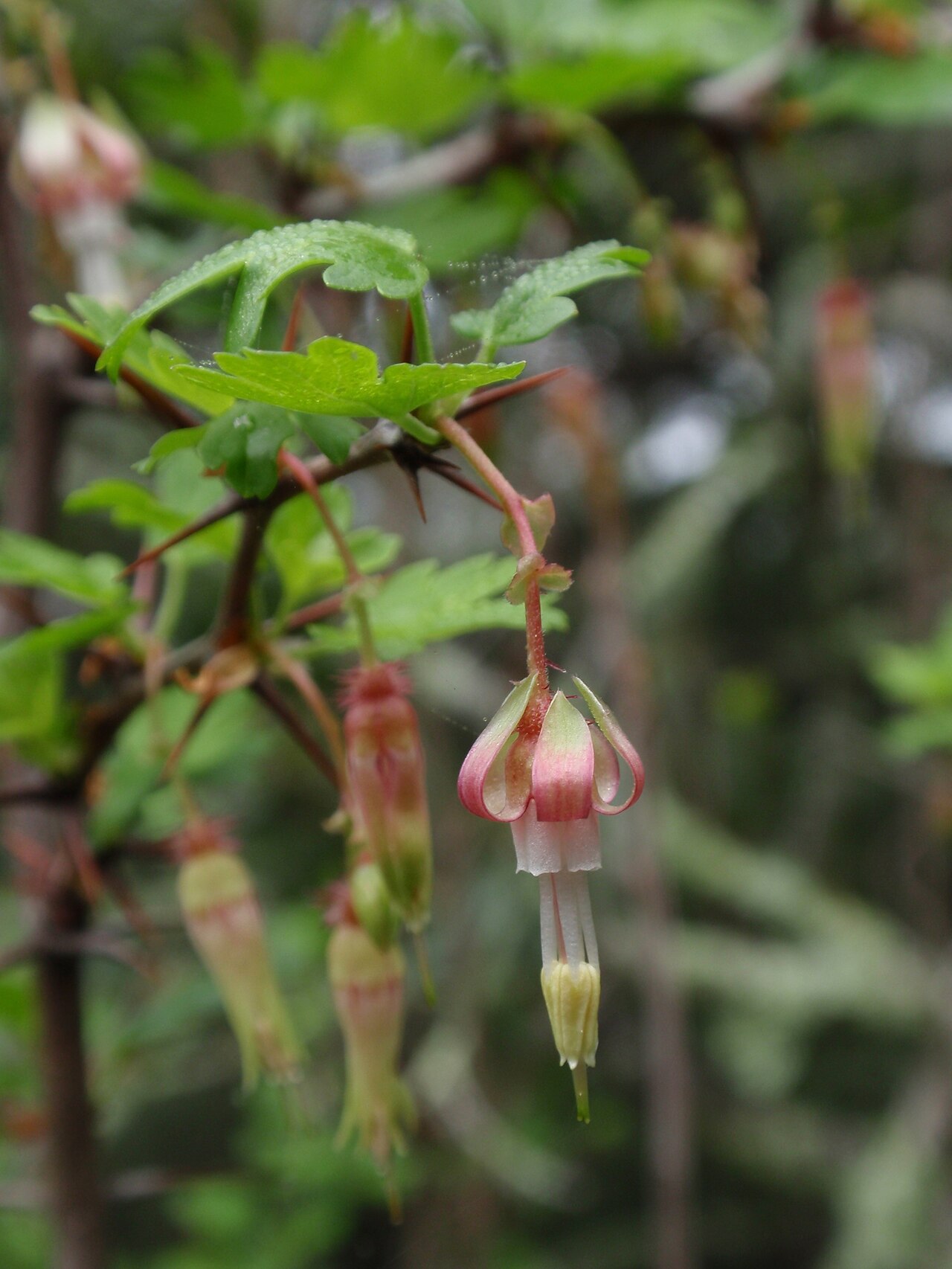
Ribes californicum, commonly called California gooseberry or hillside gooseberry, is a spiny deciduous shrub found only in California, where it grows scattered through the Coast Ranges and the mountains of the southern part of the state. It belongs to the gooseberry group within the genus Ribes (family Grossulariaceae), distinguished from the smooth-stemmed currants by the sharp spines that arm every node.
In the wild this is a plant of chaparral and oak woodland edges, usually found tucked under taller shrubs or trees where its roots stay a little cooler and shadier than the open hillside. It is not a showy plant from a distance — the flowers are small and hang downward, easy to miss unless you are looking closely — but up close the maroon-and-white, lantern-shaped blooms are one of the first signs of the gardening year in coastal and foothill California, often opening while most other natives are still dormant.
California gooseberry is a good choice for a dry-shade native garden, a restoration planting under oaks, or anywhere a thorny, wildlife-friendly thicket is welcome. It asks for very little once established, tolerates the dry summers that kill many garden shrubs, and rewards a closer look with flowers, fruit and structure that few other California natives offer in quite the same combination.
Identification
California gooseberry grows as an erect to spreading shrub, typically 3 to 6 feet tall and about as wide, with slender, arching branches. Two varieties are recognized: the typical variety found in the Coast Ranges from Ventura and Orange counties north into Mendocino County, and a separate variety restricted to the San Gabriel Mountains of southern California. Both share the same general look and care needs.
Bark & Stems
Every node along the stem bears a cluster of three stiff spines up to about half an inch long — the clearest field mark separating this true gooseberry from the spineless currants in the same genus. Young stems are slender and grayish brown; older wood is a bit shaggier but rarely thick enough to call a trunk. The spines make the shrub awkward to prune and a little unpleasant to brush against, but they also give small birds a safe place to nest and hide.
Leaves
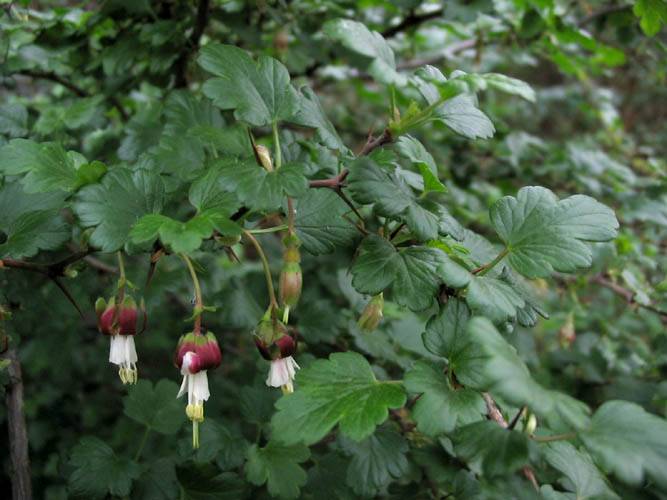
Leaves are small, usually 1 to 3 inches across, and divided into three to five shallow, rounded, toothed lobes — a shape gardeners will recognize as the classic “gooseberry leaf.” They are soft-textured and can be lightly hairy on both surfaces. Being deciduous, the shrub drops its leaves by late summer or fall as the dry season wears on and leafs out again with the first substantial rain.
Flowers & Fruit
Flowers appear singly or in loose clusters of two or three, hanging from short stalks in winter and early spring, often as early as December in mild years and continuing into March. Each flower has reflexed, deep maroon-red sepals that flare backward around a tubular, pale pink to white true corolla, giving the bloom a two-tone, almost fuchsia-like look. The nectar draws early-season bees and other insects at a time when few other flowers are open.
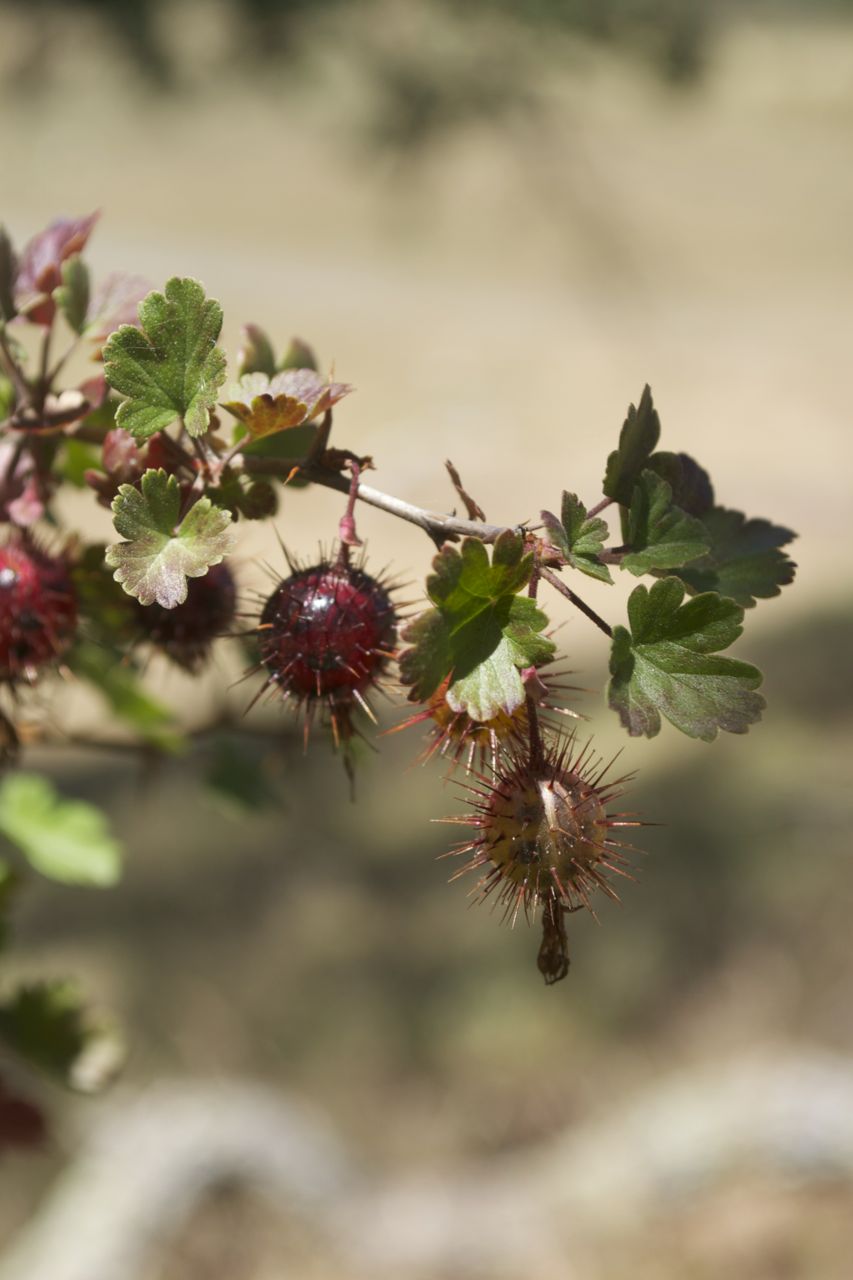
The fruit is a round berry about a third to half an inch across, densely covered in its own short spines, ripening from green to a deep wine red by late spring or early summer. The berries are reported as edible once the spines are rubbed or scorched off, though most gardeners simply leave them for wildlife rather than bother with the fiddly cleaning — there is no reason to count on them as a garden food crop.
Quick Facts
| Scientific Name | Ribes californicum |
| Family | Grossulariaceae (Currant/Gooseberry) |
| Plant Type | Deciduous spiny shrub |
| Mature Height | 3–6 ft |
| Mature Spread | 3–6 ft |
| Growth Rate | Moderate |
| Sun Exposure | Part Shade to Shade |
| Water Needs | Low once established; appreciates some summer shade |
| Soil Type | Sandy, loamy or clay; good drainage preferred |
| Soil pH | Adaptable; neutral to slightly acidic typical |
| Bloom Time | December – March |
| Flower Color | Maroon-red sepals, pale pink to white corolla |
| Fall Color | Yellowish before summer leaf drop |
| Fruit | Spiny red berries, reportedly edible once de-spined |
| Deer Resistant | Good (spiny stems discourage browsing) |
| USDA Hardiness Zones | 7–10 |
Native Range
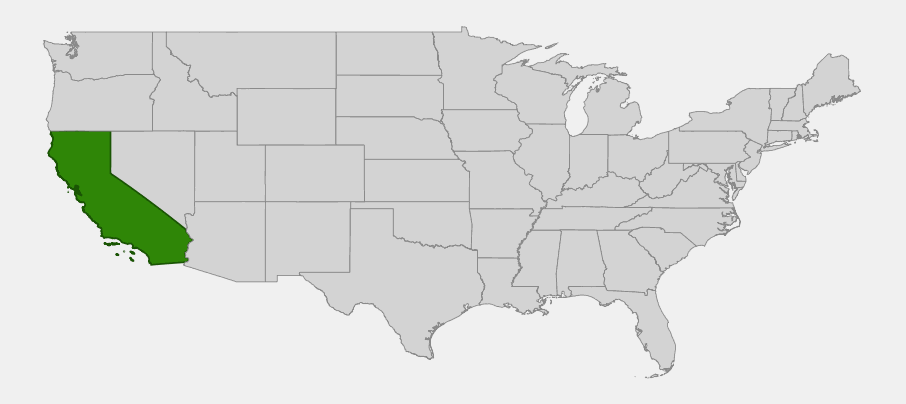
California gooseberry is a California endemic — it is not native to any other state. Within California it occurs in two separate groups: the widespread coastal variety runs through the Coast Ranges from Mendocino County south through the San Francisco Bay Area and central coast to Ventura and Orange counties, while a second, more localized variety is confined to the San Gabriel Mountains north of Los Angeles. It is not native east of the Sierra Nevada, in the Central Valley floor, or in the desert interior.
Across its range it grows on dry slopes and canyon edges in chaparral, mixed-evergreen forest and oak woodland, generally favoring some shade from taller shrubs or trees rather than open, sun-baked hillsides. Elevation ranges from near sea level to roughly 6,000 feet, so plants from the high end of the range tend to be hardier to cold than coastal-population stock.
Because this species is sometimes confused with other spiny California Ribes such as Sierra gooseberry (Ribes roezlii), gardeners sourcing seed or plants from a wild population should confirm the identification with a local botanist or native plant society chapter before assuming it is this species — the two overlap in parts of the southern Coast Ranges and Transverse Ranges.
📋 California gooseberry does not yet have a dedicated spot on one of our regional plant lists — browse our full native plant directory for more California natives.
Growing & Care Guide
Light
Give California gooseberry part shade to full shade for the best appearance, especially inland where summers are hot. Along the immediate coast it tolerates more sun if the soil never fully dries out, but plants pushed into full, reflected sun in a hot interior garden tend to look scorched and sparse by late summer.
Soil & Water
This shrub is not fussy about soil texture — it grows in sand, loam and clay in the wild — but it does want reasonable drainage and dislikes summer irrigation that keeps the root zone constantly wet. Water regularly through the first one to two summers to establish a deep root system, then taper off to occasional deep soaks or none at all, depending on your climate and companion planting. Overwatering mature plants is one of the more common ways gardeners lose this species to root rot.
Planting Tips
Plant in fall or winter so winter rains can help establish the root system before the first dry season. Because of the spines, site it away from paths, patios and anywhere small children or pets regularly brush past. A spot under an existing oak or large shrub, where it gets filtered light and leaf-litter mulch, mimics its natural habitat closely.
Pruning & Maintenance
Little pruning is needed or wanted. Thick gloves and long sleeves are essential for any pruning work given the spines. Remove only dead or crossing wood after the shrub has finished fruiting, and avoid heavy shearing, which ruins the naturally arching form and removes next year’s flowering wood.
Propagation
California gooseberry can be grown from seed, which usually needs a period of cold, moist stratification to mimic a winter outdoors before it will germinate, or from semi-hardwood cuttings taken in late summer. Named cultivars or wild-collected cuttings should be rooted under mist or in a humid propagation case for best results.
Landscape Uses
- Dry-shade understory planting beneath oaks and other established natives
- Wildlife hedgerow or barrier planting where the spines deter foot traffic
- Chaparral and woodland restoration projects
- Winter-interest garden for its unusually early bloom time
Wildlife & Ecological Value
For Pollinators
The winter and early-spring bloom time makes California gooseberry an important early nectar source for bees and other insects active during mild spells in the cool season, when few other California natives are flowering.
For Birds
Berries are eaten by a range of resident and migratory birds, and the dense, spiny structure offers safe nesting and roosting cover that predators and larger birds have a harder time reaching.
For Mammals
Small mammals use the spiny thickets for cover, and the berries are browsed by various wildlife, though the spines limit how much larger browsers such as deer will eat of the foliage itself.
Ecosystem Role
As an understory shrub in chaparral and oak woodland, California gooseberry helps fill the shrub layer beneath the tree canopy, adding structural diversity and an early-season food source to plant communities that are otherwise mostly dormant in winter.
Cultural & Historical Uses
California gooseberry has not been as widely documented in ethnobotanical literature as some of its showier relatives, and specific historical uses by California’s Indigenous peoples are not well recorded in accessible sources, so none are claimed here. What is clear is that spiny gooseberries of this kind were generally handled carefully and the berries, when gathered, required removing or burning off the spines before eating — a labor-intensive step that likely limited how often they were used as food compared to smoother-skinned fruits.
In more recent horticultural history, California gooseberry has found a niche among native-plant gardeners looking for winter-blooming, dry-shade shrubs, a combination that is harder to come by than it might seem. It remains a specialty item at native plant nurseries rather than a mainstream landscape shrub, prized more for its ecological role and unusual winter flowers than for any ornamental show from a distance.
Like every member of the genus Ribes, California gooseberry is a potential alternate host for white pine blister rust (Cronartium ribicola), the fungus that nearly wiped out American five-needle pines in the twentieth century. Historic eradication campaigns targeted Ribes broadly, but the federal blanket quarantine was lifted decades ago, and today’s state-level restrictions are aimed almost entirely at cultivated European black currant (Ribes nigrum) rather than western native species like this one. Still, gardeners in areas with susceptible white pines nearby, or anyone in a state that still regulates Ribes plantings, should check current state agriculture department rules before planting.
Frequently Asked Questions
Is California gooseberry the same as the gooseberries sold for fruit?
No. This is a wild California native grown mainly for habitat value and winter flowers, not a fruiting crop like the European gooseberry (Ribes uva-crispa) sold at nurseries for jam-making. The berries are small, very spiny, and not worth growing for food.
Will the spines hurt me or my pets?
The spines are sharp enough to scratch skin and can be uncomfortable for pets that push through the foliage, so it is best planted away from paths, play areas and places pets frequent. They are not toxic, just mechanically sharp.
Does California gooseberry need full shade?
Not necessarily full shade, but it performs best with at least part shade, especially away from the immediate coast. In hot inland gardens, full sun combined with limited summer water usually leads to a scorched, thin-looking plant.
Is California gooseberry considered a blister rust risk?
All Ribes species are biologically capable of hosting white pine blister rust, but current regulatory attention is focused on cultivated black currant, not western native species like this one. Check your state’s current nursery stock rules if you are unsure, particularly if you garden near susceptible five-needle pines.
How fast does it grow, and when does it flower?
Growth is moderate once established. Flowering starts unusually early for a California shrub, often from December into March, well before most other natives break dormancy, which makes it a useful early-season nectar source in a native winter garden.

Looking for a nursery that carries California Gooseberry?
Browse our native plant nursery directory: California