Carolina Lily (Lilium michauxii)
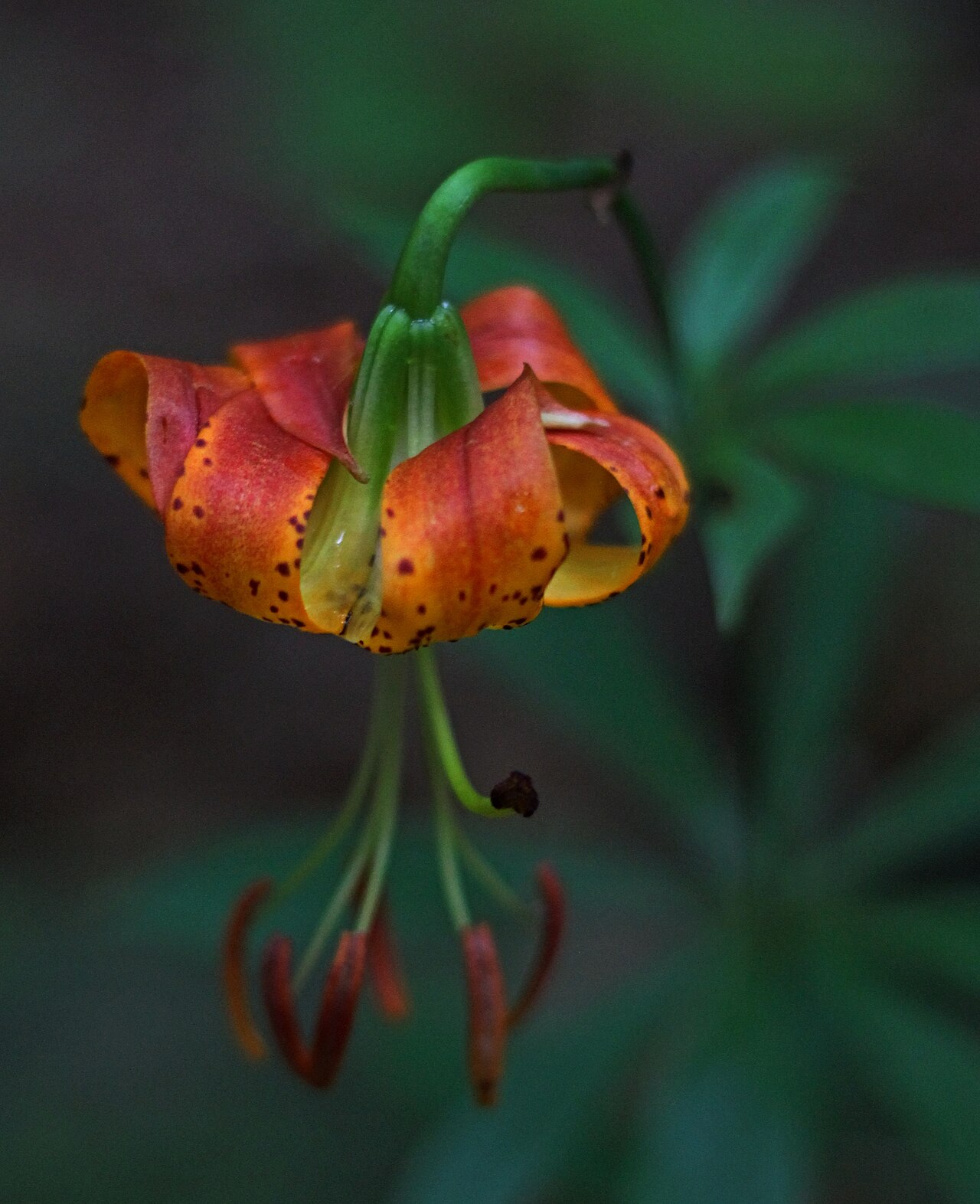
Lilium michauxii, the Carolina Lily, is a slender native wildflower of the southeastern United States and the official state wildflower of North Carolina. Unlike most of its lily relatives, which favor damp meadows and seepy roadsides, Carolina lily is a plant of dry, open woods — the sandy ridges, pine-oak slopes and rocky bluffs where water drains away quickly. There it sends up a single wiry stem topped by one to a handful of nodding, Turk’s-cap-style flowers in burnt orange and red, each petal curled sharply backward and dusted with dark maroon spots.
The plant is named for French botanist André Michaux, who explored the southern Appalachians in the late 1700s, and it is easy to mistake for its larger cousin, the turk’s-cap lily (Lilium superbum), which shares the same recurved shape but grows taller, carries more flowers per stem, and shows a bright green star at the base of each petal that Carolina lily lacks. Carolina lily’s leaves are another tell: they are arranged in tidy whorls around the stem, usually with one whorl near the middle and scattered single leaves above and below, rather than the many stacked whorls of turk’s-cap lily.
For a native-plant garden with well-drained, even lean soil, Carolina lily is a rewarding choice. It does not need the boggy conditions many lilies demand, it tolerates drought once established, and its late-summer flowers arrive when much of the woodland garden has already finished blooming. Because it is uncommon in cultivation and slow to establish from seed, gardeners should always buy nursery-propagated bulbs rather than wild-collected ones.
Identification
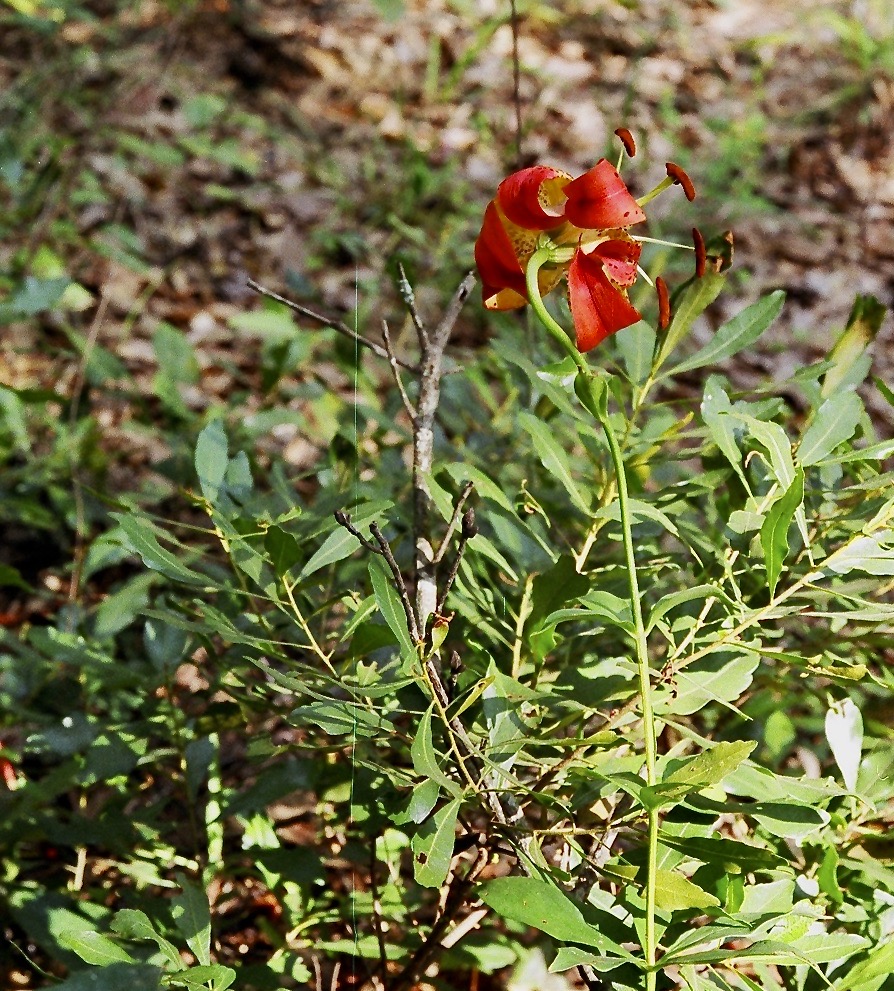
Carolina lily is an unbranched, herbaceous perennial that dies back to an underground bulb each winter and re-emerges in spring. A mature plant typically reaches 1 to 4 feet tall, occasionally taller in rich soil, with a single upright stem bearing whorled leaves below and one to six (rarely more) nodding flowers at the top.
Leaves
Leaves are lance-shaped to narrowly elliptical, 3 to 6 inches long, with smooth margins and a glossy dark green upper surface. Most are arranged in one or two whorls of 4 to 10 leaves partway up the stem, with a few additional leaves scattered singly above and below the whorls. This combination of whorled and scattered leaves helps separate Carolina lily from the more heavily whorled turk’s-cap lily and from the unwhorled Canada lily (Lilium canadense), which does not occur as far south.
Flowers
Each flower hangs face-down on a long, gently curved pedicel. The six tepals are orange to orange-red toward the tips and yellower toward the throat, strongly recurved so that their tips nearly touch the pedicel, and marked with scattered maroon to purple-brown spots concentrated near the base. Six long stamens with brick-red anthers dangle well below the petals, giving the open flower a graceful, spidery look. A sweet, mild fragrance is noticeable up close. Bloom time runs from mid-July into September, later than most eastern native lilies.
Fruit & Seeds
After pollination, the flower produces an upright, oblong seed capsule that dries and splits open in autumn, releasing flat, papery, wind-dispersed seeds. Like other native lilies, Carolina lily seedlings take several years to reach flowering size, forming a small bulb below ground before any top growth appears.
Quick Facts
| Scientific Name | Lilium michauxii |
| Family | Liliaceae (Lily) |
| Plant Type | Herbaceous bulb perennial |
| Mature Height | 1–4 ft |
| Mature Spread | 6–12 in (single stem, clumps slowly from offsets) |
| Growth Rate | Slow (several years from seed to bloom) |
| Sun Exposure | Full Sun to Part Shade |
| Water Needs | Average to dry; good drainage essential |
| Soil Type | Dry to average, well-drained sandy or rocky loam |
| Soil pH | Acidic, about 5.0–6.5 |
| Bloom Time | Mid-July – September |
| Flower Color | Orange-red with maroon spots |
| Fall Color | None (foliage withers after bloom) |
| Fruit | Upright capsule with flat, wind-dispersed seeds |
| Deer Resistant | No (deer and rabbits readily browse the buds) |
| USDA Hardiness Zones | 5–9 |
Native Range
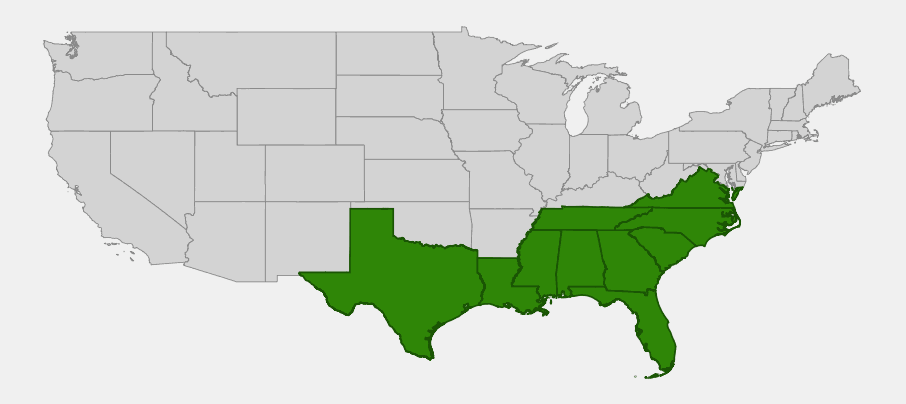
Carolina lily is native to the southeastern United States, from southern Virginia and eastern Tennessee south through the Carolinas, Georgia and the Florida Panhandle, and west through Alabama, Mississippi and Louisiana into eastern Texas. It is most frequent in the Piedmont and mountains, where it can be locally common in the right habitat, but it thins out and becomes scarce toward the edges of this range, including on the Atlantic and Gulf coastal plains.
Across this range the plant sticks to dry, well-drained ground: oak-hickory and oak-pine woodlands, sandy ridgetops, road banks and open rocky slopes, usually with light to moderate shade from a broken canopy. It is notably drought-tolerant for a lily, a trait tied to its upland habitat, and it often grows alongside other plants adapted to lean, acidic soils rather than the wet meadow or streamside species typical of most native lilies.
Because Carolina lily bulbs are slow to multiply and the plant has been collected from the wild for gardens in the past, populations can be locally vulnerable to disturbance, deer browsing and habitat loss. It is not federally listed, but several states track it as uncommon, so established garden populations grown from nursery stock are a meaningful way to take pressure off wild colonies.
📋 Regional plant lists featuring Carolina Lily: Maryland, Virginia & West Virginia · North Carolina & South Carolina · Georgia, Alabama & Mississippi · Arkansas, Louisiana, Eastern Oklahoma & Eastern Texas · Kentucky & Tennessee
Growing & Care Guide
Carolina lily is easier to please than many native lilies precisely because it does not want constant moisture. Give it the dry, open-woodland conditions it experiences in the wild and it will reward you with years of late-summer flowers.
Light
Plants grow and flower best with a half-day or more of sun, or dappled light under a thin, high canopy — conditions typical of its open oak-pine habitat. Full sun is tolerated if soil moisture is not excessive, but heavy, continuous shade leads to weak, leggy stems and few flowers.
Soil & Water
Good drainage is the single most important requirement. Plant bulbs in sandy or gravelly loam, or amend heavy clay generously with grit and organic matter, and avoid any spot where water stands after rain. Once established, Carolina lily tolerates real drought and generally needs no supplemental water beyond normal rainfall; overwatering, not underwatering, is what kills this species in gardens.
Planting Tips
Set bulbs 4 to 6 inches deep in fall, pointed end up, in a lean, well-drained bed. Because bulbs multiply slowly and seed-grown plants take several years to flower, start with nursery-propagated bulbs or container plants rather than seed if you want blooms sooner. Mark the planting spot, since the thin stem dies back completely each winter and is easy to disturb while gardening nearby in spring.
Pruning & Maintenance
Deadhead spent flowers if seed is not wanted, but let the foliage yellow and wither naturally before cutting it back, since the bulb is rebuilding its reserves for next year. Staking is rarely needed given the plant’s modest height. Watch for deer and rabbit browsing on emerging buds, which can eliminate a season’s bloom; a temporary cage around young plants solves the problem.
Propagation
Carolina lily can be grown from ripe seed sown in fall, though germination and growth to flowering size typically take three to five years. Established clumps occasionally produce small bulb offsets that can be separated and replanted in late summer dormancy. Because of this slow multiplication, buy nursery-propagated bulbs rather than removing any from wild populations.
Landscape Uses
- Dry woodland gardens under thin oak or pine canopy, where few other lilies thrive
- Native meadow or prairie-edge plantings on lean, well-drained soil
- Pollinator gardens, paired with other native lilies for a longer bloom sequence
- Rock gardens and sunny slopes where drainage is naturally sharp
- Naturalized plantings along dry road banks and woodland edges
- Cut flowers for a light, informal arrangement
Carolina lily is a good fit alongside other summer bloomers recommended in our roundups of perennial flowers for North Carolina, perennial flowers for Virginia and perennial flowers for Tennessee, where it adds height and a splash of late-season color to a bed of lower-growing natives.
Wildlife & Ecological Value
Carolina lily’s flowers are built for a daytime pollinator rather than the night-flying moths many other lilies rely on, which shapes its role in the summer woodland.
For Pollinators
The recurved, upward-facing anthers and strong fragrance attract large swallowtail butterflies, especially eastern tiger swallowtails and spicebush swallowtails, which can reach the nectar while hovering below the dangling flower. Bumblebees and other large native bees also visit for pollen and nectar, making Carolina lily a useful mid- to late-summer nectar source in a pollinator garden.
For Birds & Mammals
Few birds use the plant directly, but the open woodland habitat it favors supports a wide range of songbirds and small mammals. White-tailed deer and eastern cottontails readily browse the flower buds and young growth, which is one of the chief threats to wild populations and to garden plantings alike.
Ecosystem Role
As a long-lived, slow-spreading perennial of the oak-pine understory, Carolina lily is part of the diverse herbaceous layer that distinguishes healthy, fire-maintained southeastern woodlands from degraded ones. Its presence is often a sign of relatively undisturbed, well-drained forest soil.
Cultural & Historical Uses
Carolina lily carries the name of French botanist André Michaux, who traveled extensively through the southern Appalachians and Piedmont in the 1780s and 1790s cataloging the region’s flora for the French crown. The species was among the many showy natives that drew early botanical attention to the biodiversity of the southeastern uplands.
In 2003, North Carolina designated Carolina lily as the state’s official wildflower, recognizing a plant found in every region of the state except the immediate coastal plain. The honor reflects both its wide distribution within North Carolina and its standing as a distinctive, well-loved native bloom rather than any documented historical use as food or medicine.
Beyond its symbolic status, Carolina lily’s main human history is horticultural: nineteenth- and twentieth-century native-plant and wildflower nurseries in the Carolina mountains offered the bulbs for sale to gardeners seeking regional natives, a trade that continues today through specialty native-plant growers.
Frequently Asked Questions
How is Carolina lily different from turk’s-cap lily?
Turk’s-cap lily (Lilium superbum) grows taller, often 4 to 8 feet, carries more flowers per stem, and shows a distinct green star-shaped patch at the base of each petal that Carolina lily lacks. Carolina lily is also shorter overall and prefers drier soil, while turk’s-cap lily favors damp meadows and streamsides. For more help telling native lilies apart, see our guide to plants that look like lilies.
Does Carolina lily need wet soil like other native lilies?
No. Carolina lily is unusual among native lilies in preferring dry to average, well-drained soil typical of upland oak-pine woods. Planting it in consistently moist or boggy ground is one of the most common reasons gardeners lose this species.
Is Carolina lily hard to grow from seed?
It takes patience. Seedlings typically need three to five years to build a bulb large enough to flower, so most gardeners start with nursery-propagated bulbs or container-grown plants for faster results.
Why is Carolina lily North Carolina’s state wildflower?
North Carolina named Carolina lily its official state wildflower in 2003 because it occurs in every region of the state except the coast and is widely recognized as a distinctive native bloom of the state’s forests.
Will deer eat Carolina lily?
Yes, readily. Deer and rabbits browse the emerging buds and stems, which can prevent flowering entirely in high-deer areas. A temporary cage around young plants during bud formation helps protect the bloom.

Looking for a nursery that carries Carolina Lily?
Browse our native plant nursery directory: Virginia, South Carolina, Tennessee & Texas · North Carolina · Georgia & Florida · Alabama · Mississippi & Louisiana