Chaparral False Bindweed (Calystegia occidentalis)
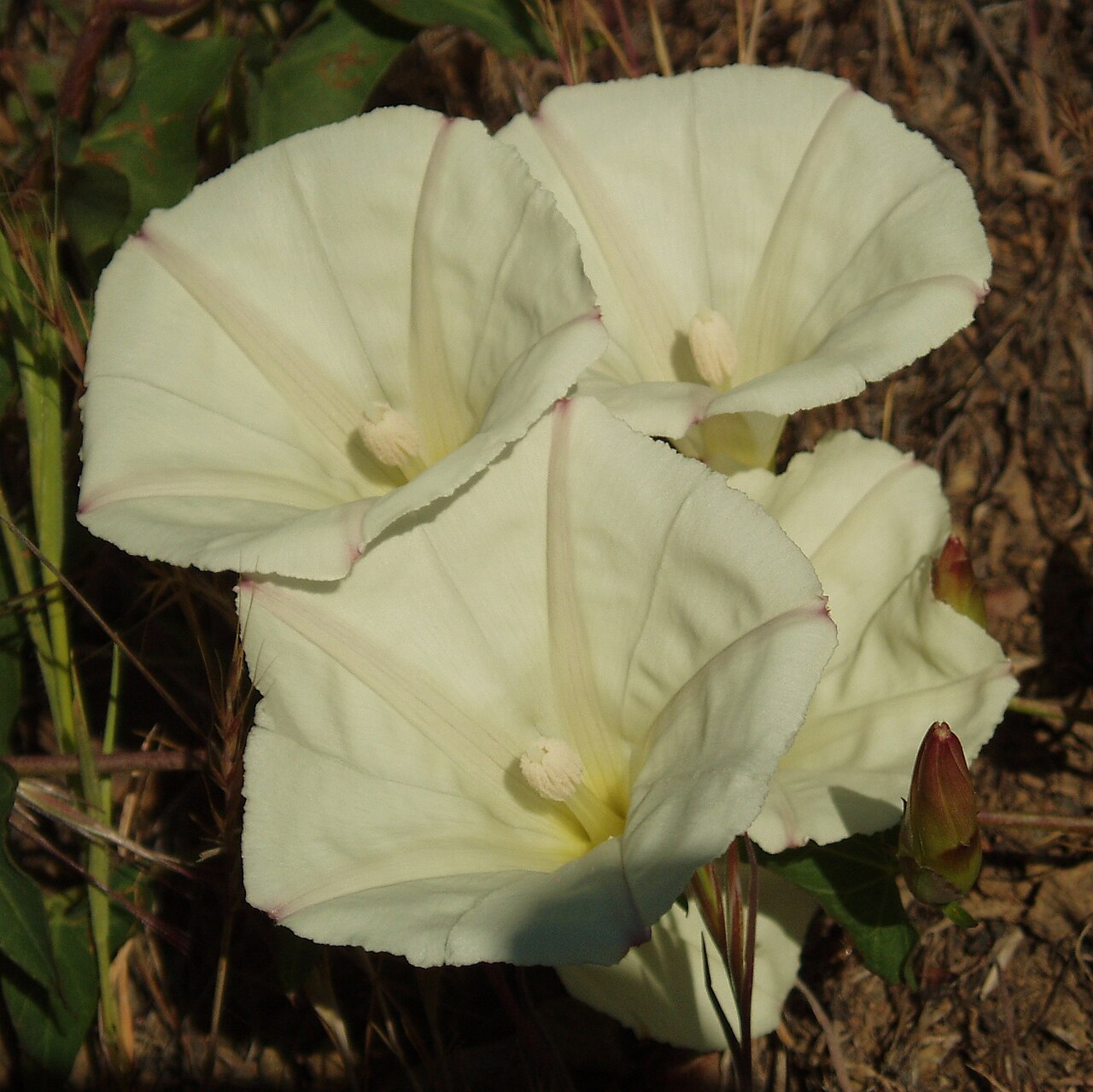
Calystegia occidentalis, commonly called Chaparral False Bindweed or Western Morning Glory, is a native perennial vine found on dry, sunny slopes through much of California and into southwestern Oregon. Unlike its weedy relative field bindweed, this is a well-behaved native member of the morning glory family (Convolvulaceae), scrambling modestly over rocks, shrubs, and grasses rather than smothering everything in sight. Its large, crepe-textured white to pale pink flowers open wide on summer mornings and are a familiar sight to anyone who hikes the foothills and chaparral of the Sierra Nevada, Coast Ranges, or Klamath-Siskiyou region.
The plant grows from a deep, woody rootstock that lets it vanish underground during the dry months and resprout each spring with new twining or trailing stems. Its arrow-shaped (hastate) leaves and funnel-form flowers are classic morning glory features, but the whole plant stays low and unobtrusive compared to garden morning glories, rarely climbing more than a few feet even when given something to scramble over. Where it grows wild, it is usually found threading through buckbrush, manzanita, or oak woodland edges rather than forming dense mats.
For California and southwestern Oregon gardeners restoring dry slopes, rock gardens, or foothill woodland edges, Chaparral False Bindweed offers a tough, deep-rooted native that needs no summer water once established and produces a long season of large, pale flowers that pollinators readily visit. It is not a plant for formal beds — its casual, twining habit belongs in wilder plantings — but it fills a niche that few other native perennials occupy as gracefully.
Identification
Chaparral False Bindweed is a herbaceous perennial with slender, twining to trailing stems that die back to a woody underground rootstock in the dry season and regrow each year. Stems are typically 1 to 3 feet long but can reach 6 feet where they find support, and the plant is often lightly hairy (pubescent), giving the foliage a soft, grayish cast in some populations (formerly separated as var. tomentella).
Leaves
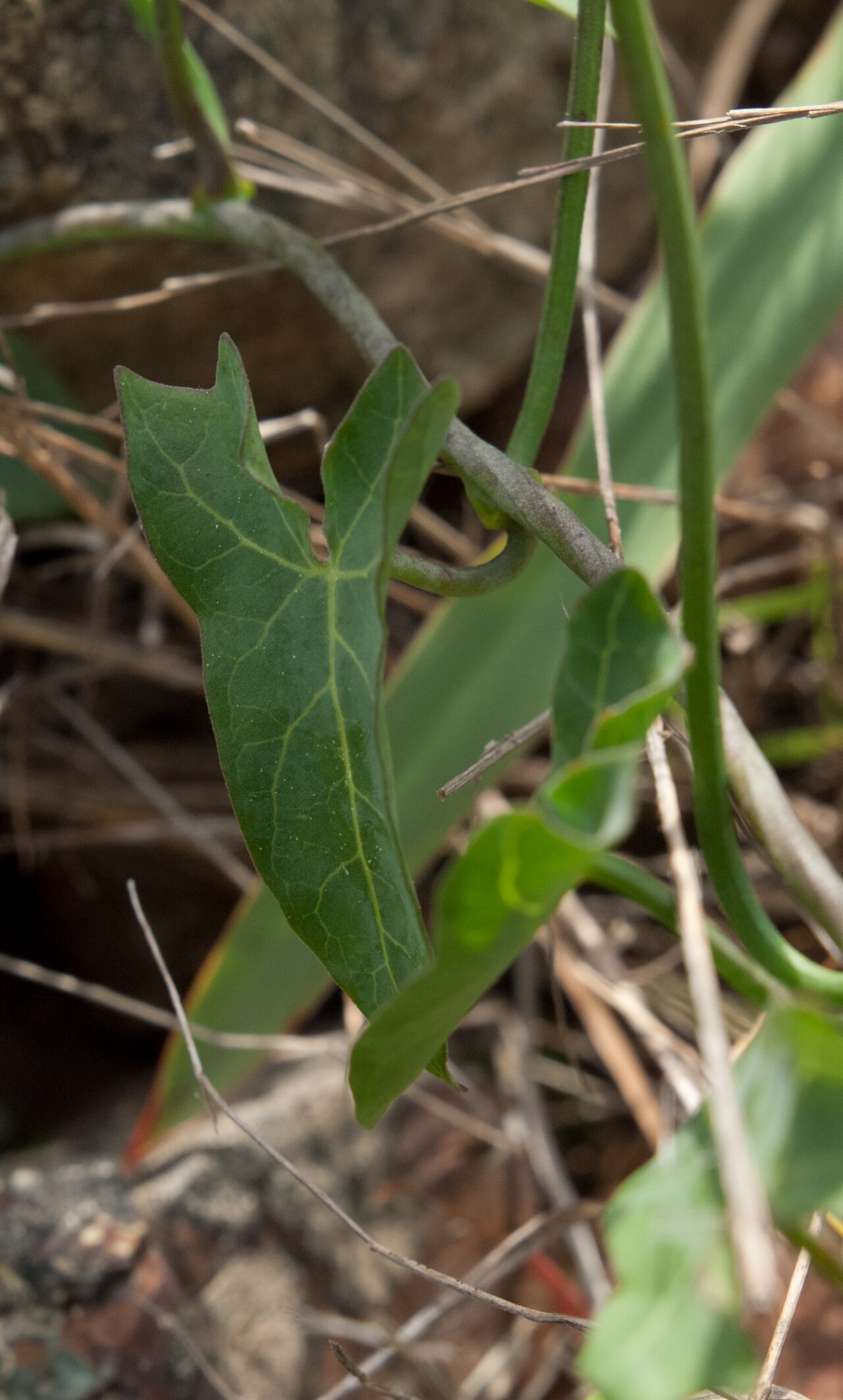
Leaves are alternate, 1 to 2½ inches long, and distinctly arrowhead- or halberd-shaped (hastate to sagittate), with two backward-pointing basal lobes — a reliable field mark that separates this species from the smaller, more rounded-leaved relatives in the genus. Leaf color ranges from medium to grayish green, and the leaf stalks (petioles) are often noticeably shorter than the blade.
Flowers
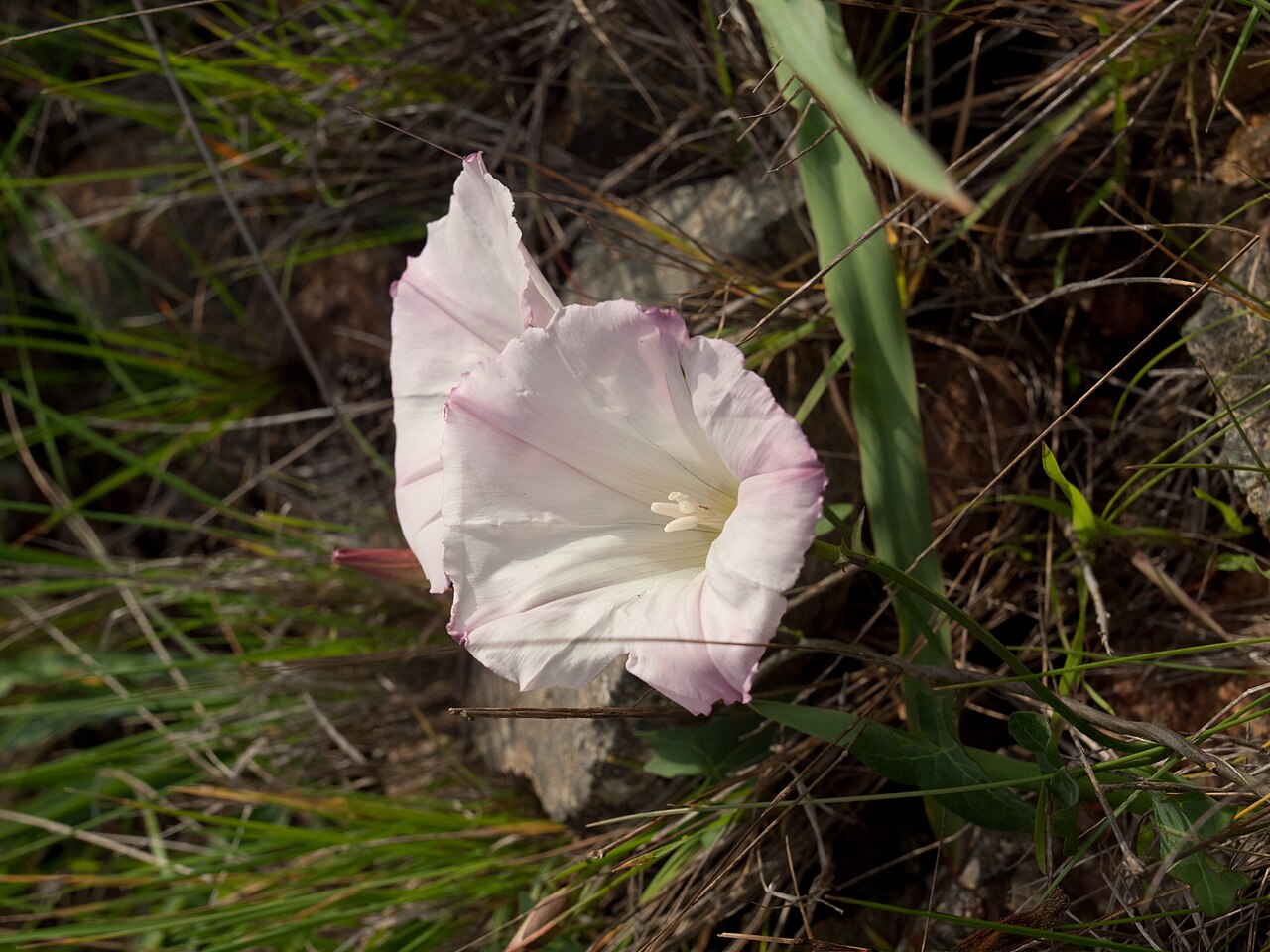
The flowers are the plant’s signature feature: large, funnel- or trumpet-shaped, 1½ to 2½ inches across, usually white but sometimes blushed with pale pink, each with five faint radiating seams marking the fused petal lobes. Flowers are borne singly on stalks from the leaf axils and are subtended by two bracts partway down the flower stalk, a detail that distinguishes true Calystegia from the weedy field bindweed (Convolvulus arvensis), whose bracts sit well below the flower. Blooms open in the morning and typically close by afternoon, especially in hot weather.
Fruit & Seeds
After flowering, the plant forms a small, rounded, papery capsule that dries and splits to release a few large, dark brown to black seeds. The capsules are inconspicuous and easy to miss among the foliage; most gardeners never notice seed set unless they look closely in late summer.
Quick Facts
| Scientific Name | Calystegia occidentalis |
| Family | Convolvulaceae (Morning Glory) |
| Plant Type | Perennial twining/trailing vine |
| Mature Height | Trailing/climbing stems 2–6 ft long |
| Mature Spread | 2–4 ft (dies back to rootstock each year) |
| Growth Rate | Moderate |
| Sun Exposure | Full Sun to Part Shade |
| Water Needs | Low; drought tolerant once established |
| Soil Type | Well-drained, rocky or gravelly; tolerates poor soils |
| Soil pH | Slightly acidic to neutral (6.0–7.5) |
| Bloom Time | April – July |
| Flower Color | White to pale pink |
| Fall Color | None (foliage dies back in late summer) |
| Fruit | Small papery capsule with a few dark seeds |
| Deer Resistant | Generally yes |
| USDA Hardiness Zones | 7–10 |
Native Range
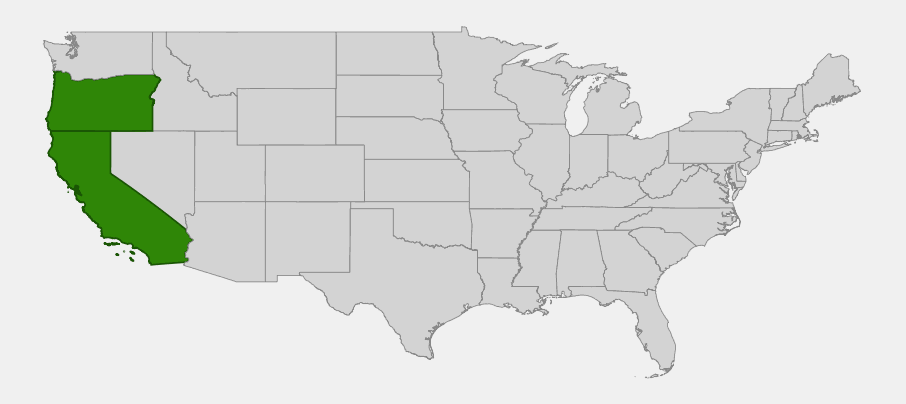
Chaparral False Bindweed is native to California, where it occurs widely from the Coast Ranges and Sierra Nevada foothills down into the Transverse and Peninsular Ranges of southern California, and it extends north into southwestern Oregon in the Klamath-Siskiyou region, including Jackson and Josephine counties. It is absent from the Central Valley floor, the immediate coast, and the deserts, favoring instead the dry foothill belt that rings the valley and the mountain slopes above it.
Typical habitat is open chaparral, foothill woodland, and yellow pine forest edges on slopes and ridges, usually below about 6,000 feet elevation. The species tolerates a range of parent materials but is often found on rocky, well-drained sites, including some serpentine-influenced soils. It grows alongside chamise, buckbrush, manzanita, interior live oak, and blue oak, twining loosely through these shrubs for support rather than climbing trees or structures.
This species should not be confused with the common roadside weed field bindweed (Convolvulus arvensis), an introduced Eurasian species that is invasive nationwide and is never appropriate to plant. Chaparral False Bindweed is well-behaved by comparison, spreading slowly from a single rootstock rather than running aggressively, and it is not listed as invasive anywhere in its native range.
📋 Regional plant lists featuring Chaparral False Bindweed: Western Oregon & Western Washington
Growing & Care Guide
Chaparral False Bindweed rewards gardeners who can offer it a dry, sunny spot and then leave it alone. It is one of those natives that resents pampering — rich soil and regular irrigation tend to shorten its life and invite rot in the thick rootstock.
Light
Give this vine full sun to light part shade. In its native chaparral it often grows in full exposure on open slopes, though it also threads through the dappled edges of oak woodland. More shade generally means fewer flowers and leggier growth.
Soil & Water
Well-drained, rocky, or gravelly soil is ideal; this is not a plant for heavy clay or soils that stay wet. Established plants need little to no supplemental water and are best left dry through summer, matching their natural dormancy cycle. Newly planted specimens benefit from occasional deep watering through their first year while the deep rootstock develops, after which irrigation should be tapered off sharply.
Planting Tips
Plant from containers in fall so roots can establish during the rainy season before the first dry summer. Give the rootstock room to grow undisturbed — this species dislikes transplanting once established — and provide something low for the stems to scramble over, such as rocks, a split-rail fence, or neighboring shrubs. It is not a vigorous enough climber to need a trellis.
Pruning & Maintenance
Little maintenance is needed. The top growth dies back naturally in late summer or fall and can be cut back or simply left to weather until new growth emerges the following spring. Avoid disturbing the root crown when clearing old stems.
Landscape Uses
Chaparral False Bindweed suits informal, water-wise plantings:
- Dry slope and bank plantings where its roots help stabilize loose soil
- Chaparral and foothill woodland restoration projects
- Rock gardens, scrambling over boulders and ledges
- Wildlife and pollinator gardens in its native range
- Low fences or split-rail borders as an informal, non-aggressive climber
Wildlife & Ecological Value
Though modest in stature, Chaparral False Bindweed plays a useful role for pollinators and other wildlife in the dry plant communities where it grows.
For Pollinators
The large, open flowers are visited by native bees, including digger bees and bumble bees, which can access the nectar and pollen easily thanks to the wide funnel shape. The relatively long bloom season provides a nectar source through the dry months when many other chaparral plants have already finished flowering.
For Birds
The foliage and tangled stems offer some cover for small birds foraging at ground level in chaparral and woodland-edge habitat, and the seeds are eaten in small amounts by sparrows and other seed-eating birds.
For Mammals
Browsing by deer and rabbits is generally light, which is part of why the species is considered relatively deer resistant; the tough, somewhat bitter foliage is not a preferred food source.
Ecosystem Role
As a deep-rooted perennial that resprouts after fire and drought, Chaparral False Bindweed helps stabilize soil on the dry slopes it occupies and contributes to the understory diversity of chaparral and foothill woodland, filling gaps between shrubs without competing aggressively for space or water.
Cultural & Historical Uses
Unlike some of its showier garden relatives, Chaparral False Bindweed has left little mark in the historical record of plant use. It was collected and described by botanists working through California’s chaparral flora in the nineteenth century, and the genus name Calystegia, from the Greek for “covering cup,” refers to the two bracts that enclose the base of the flower.
The species has no significant documented history of food or medicinal use among Indigenous peoples of California, likely because showier, more productive native plants were more commonly utilized for those purposes in the same chaparral and foothill habitats. Its primary historical value has been botanical and ecological rather than practical.
In recent decades, native plant gardeners and restoration practitioners have come to appreciate Chaparral False Bindweed as a useful, low-water component of chaparral and foothill woodland plantings, valued more for its ecological role and modest beauty than for any utilitarian history.
Frequently Asked Questions
Is Chaparral False Bindweed invasive like field bindweed?
No. Field bindweed (Convolvulus arvensis) is an introduced, aggressively spreading weed found throughout the country. Chaparral False Bindweed is a well-behaved California and Oregon native that spreads slowly from a single deep rootstock and is not considered invasive anywhere.
Will this vine take over my garden?
No. It is a modest climber, usually reaching only a few feet even with support, and it dies back each year to its rootstock rather than spreading by runners. It is far less vigorous than ornamental morning glories or bindweeds.
Does Chaparral False Bindweed need a trellis?
Not usually. In the wild it scrambles over rocks and low shrubs rather than climbing high, so a few nearby shrubs, rocks, or a low fence give it all the support it needs.
Why did my plant disappear in summer?
This is normal. The top growth dies back to the underground rootstock during the dry season and reliably resprouts with the fall and winter rains, so there is no need to replant.
Can I grow Chaparral False Bindweed outside California and Oregon?
It can be tried in other dry, Mediterranean-climate gardens with well-drained soil, but it is best suited to its native range and similar summer-dry climates; in regions with wet summers, the rootstock is prone to rot.

Looking for a nursery that carries Chaparral False Bindweed?
Browse our native plant nursery directory: California · Oregon