Checker Lily (Fritillaria affinis)
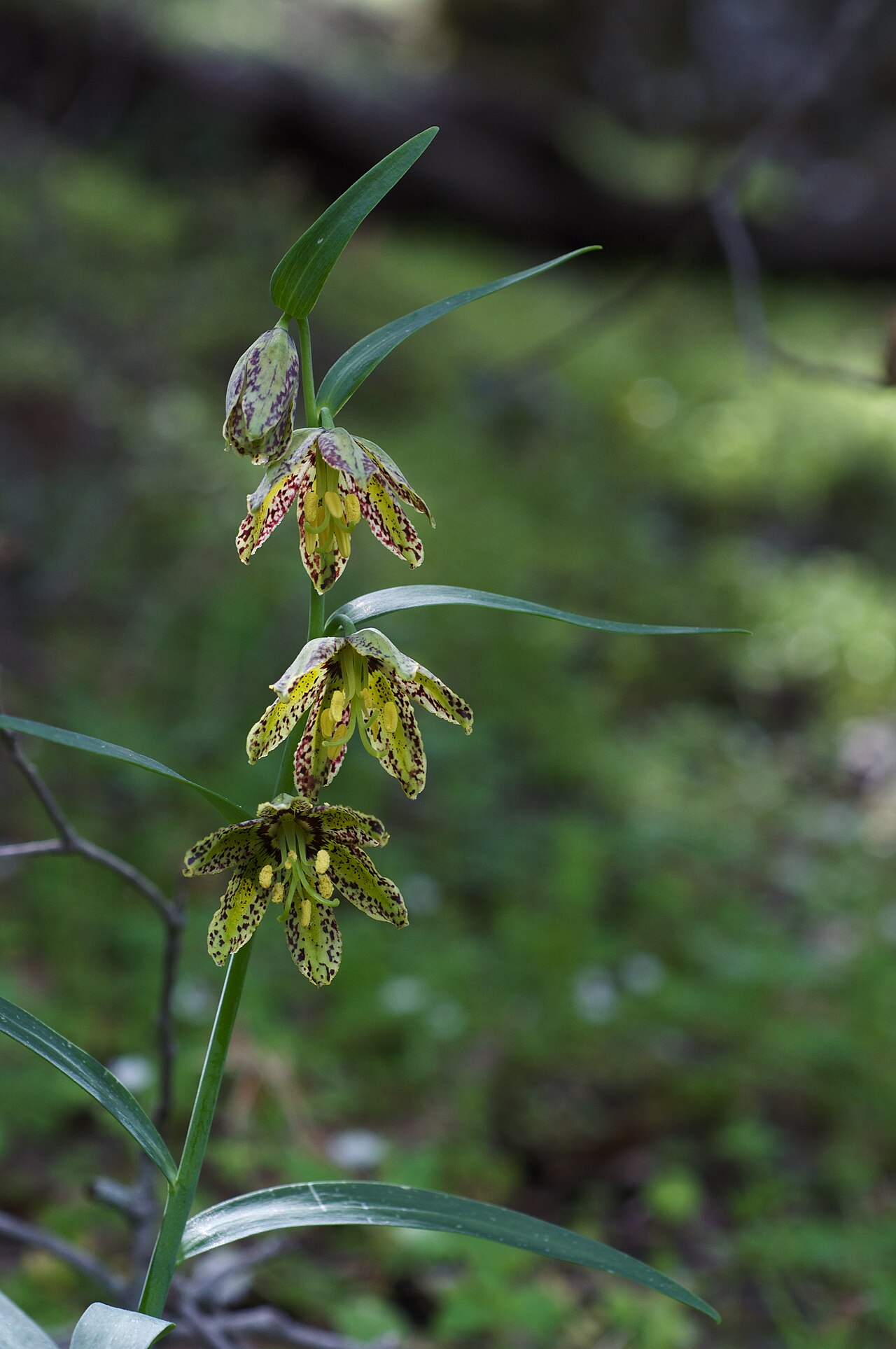
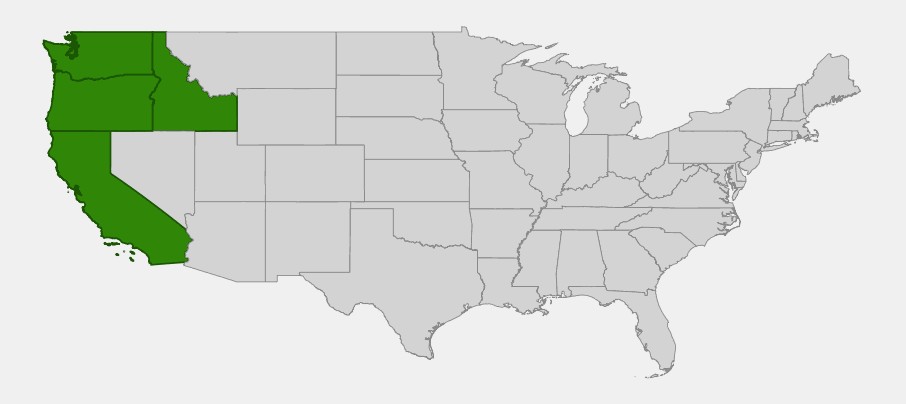
Fritillaria affinis, commonly called checker lily or mission bells, is a woodland bulb of the West Coast named for the mottled, checkerboard-like pattern of yellow-green and purple-brown on each nodding flower. It belongs to the lily family (Liliaceae) and is one of the more widespread native fritillaries in western North America, found from southwestern British Columbia south through Washington, Oregon, and California, with scattered populations reaching into the mountains of northern Idaho.
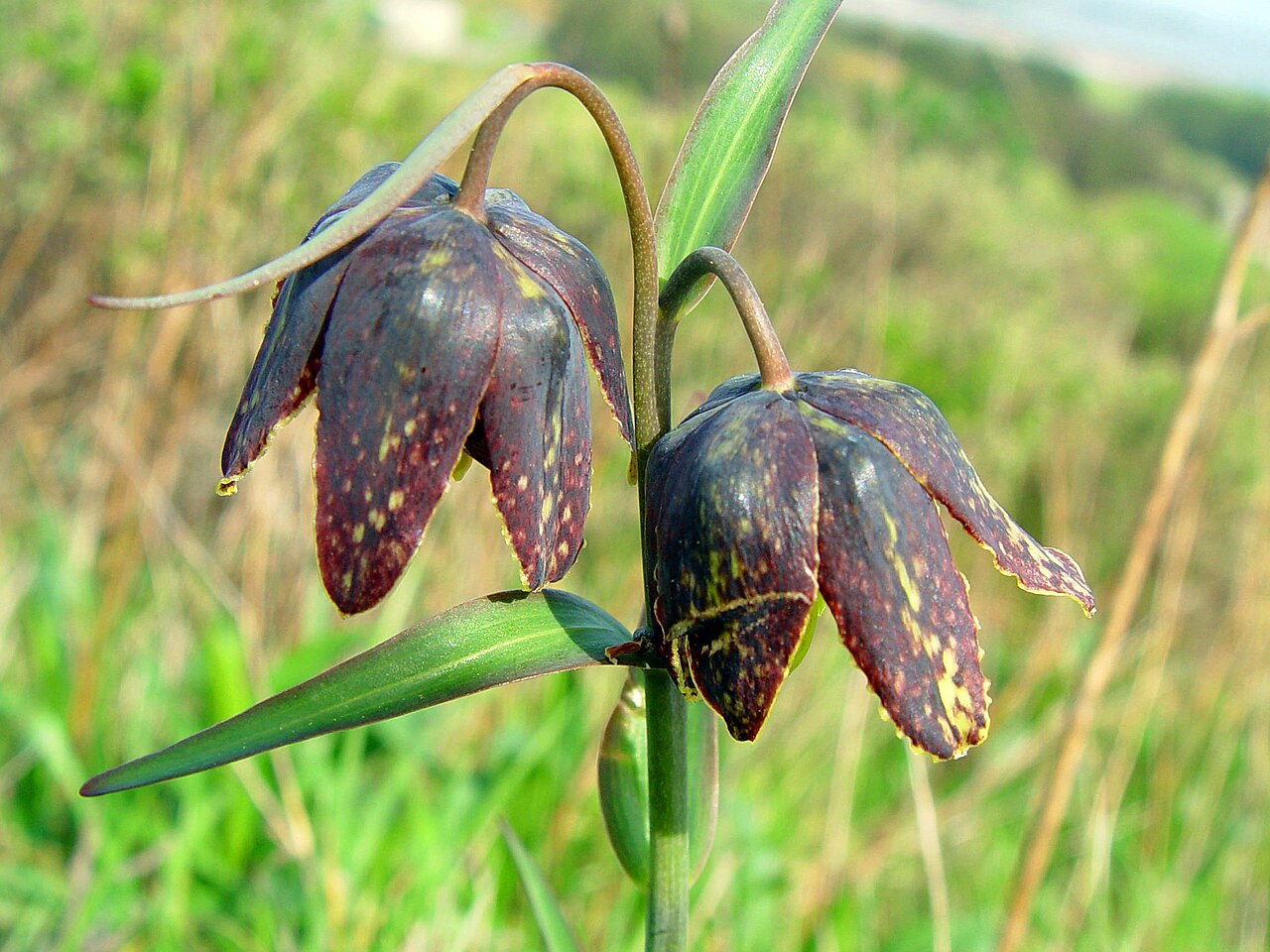
Checker lily grows from a small bulb made of thick, rice-like scales, pushing up a single leafy stem each spring that bends gracefully under the weight of one to several bell-shaped flowers hanging face-down. The nodding posture is typical of the genus Fritillaria and protects the pollen and nectar from rain while still allowing access to visiting insects from below. Flower color is notably variable across the species’ range, running from mostly greenish-yellow with fine brown mottling to flowers that are almost entirely deep maroon-purple, which is part of why it carries several overlapping common names, including spotted checker lily and mission bells.
In the wild, checker lily favors the dappled light of oak woodland, mixed conifer forest, and coastal scrub, often emerging through leaf litter in late winter. In the garden, it is a quietly beautiful addition to a shaded native woodland planting, more subtle than showier spring bulbs but a favorite of gardeners who appreciate its unusual coloring and form up close.
Identification
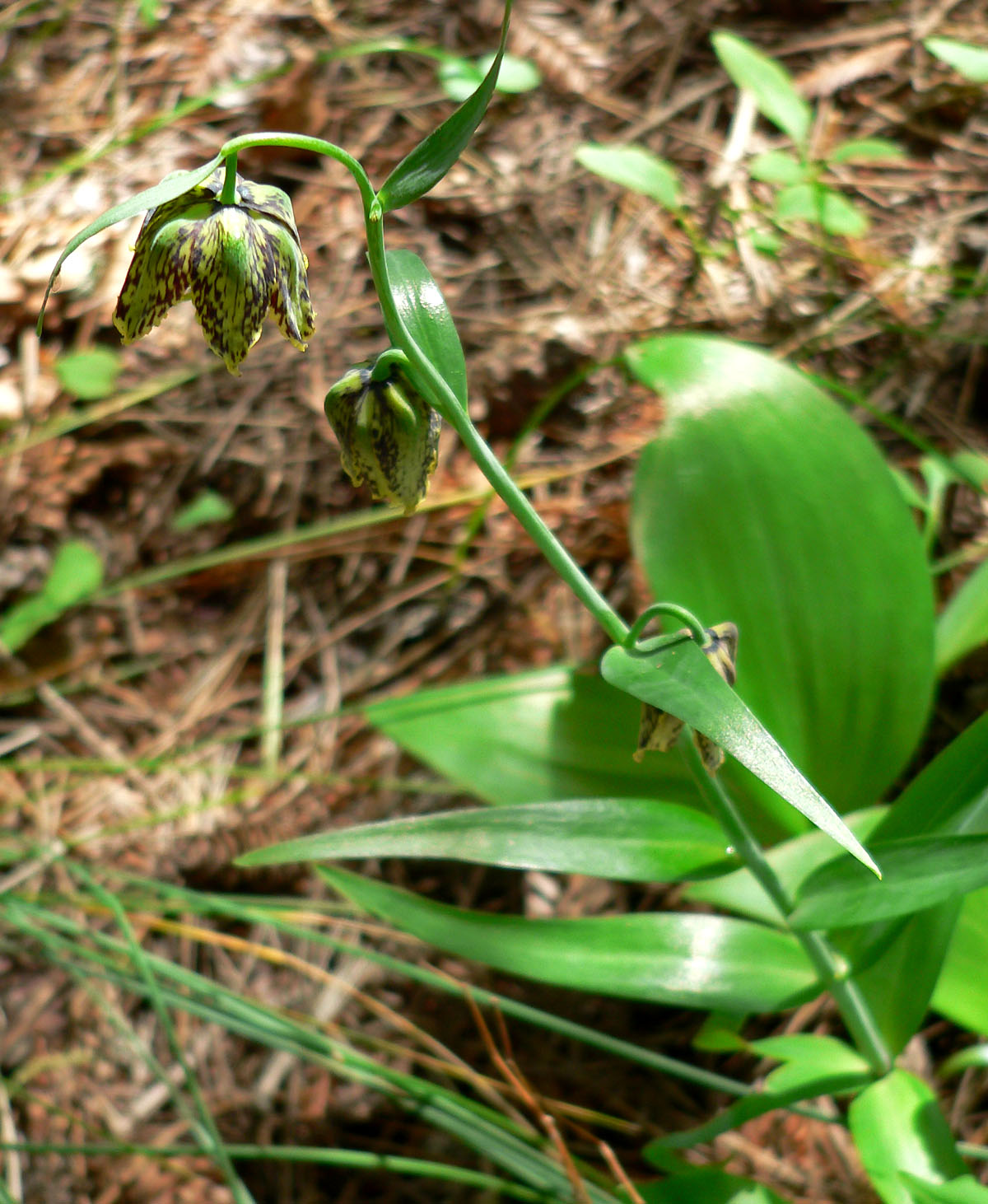
Checker lily is a perennial herb growing from a bulb of fleshy, rice-grain-like scales, typically reaching 8 to 24 inches tall, occasionally more in favorable sites. A single, leafy, unbranched stem rises each spring, bearing whorled or scattered narrow leaves along its length.
Flowers
The stem bears one to several (occasionally a dozen or more on robust plants) bell-shaped, nodding flowers, each about ¾ to 1½ inches long, hanging from slender stalks at the top of the stem. The six tepals are mottled in a checkered pattern of greenish-yellow and purplish-brown, though overall coloring is highly variable — some populations lean strongly yellow-green with fine brown speckling, others are almost solid deep maroon-purple with only a thin yellow margin. Inside, the flowers typically show a slightly glossy, nectar-producing surface near the base. Bloom time runs from February to May depending on elevation and latitude, with coastal and low-elevation populations flowering earliest.
Leaves & Stem
Leaves are lance-shaped to narrowly elliptic, 2 to 6 inches long, arranged in one or more whorls partway up the stem, with additional leaves scattered singly above. The stem itself is unbranched and leafy, quite different from the leafless flowering stalks of brodiaeas and other nearby bulb relatives.
Fruit
After flowering, each bloom develops into an upright, six-angled capsule that dries and splits to release flattened, papery seeds in summer. By the time the capsules mature, the foliage has usually yellowed and the plant is heading into summer dormancy.
Quick Facts
| Scientific Name | Fritillaria affinis |
| Family | Liliaceae (Lily) |
| Plant Type | Perennial bulb |
| Mature Height | 8–24 in (20–60 cm) |
| Growth Rate | Slow |
| Sun Exposure | Partial Shade to Shade |
| Water Needs | Moderate in season; dry in summer dormancy |
| Soil Type | Well-drained woodland loam, rich in organic matter |
| Soil pH | 6.0–7.0 (neutral) |
| Bloom Time | February – May |
| Flower Color | Mottled yellow-green to deep purple-brown |
| Dormancy | Summer and fall (bulb only) |
| Deer Resistant | Mostly yes; bulbs attract rodents |
| USDA Hardiness Zones | 6–9 |
Native Range
Checker lily is native along the West Coast from Washington south through Oregon and California, with disjunct populations extending east into the mountains of northern Idaho. Within this range it typically grows below about 6,500 feet elevation, most often in the partial shade of oak woodland, mixed evergreen and conifer forest, chaparral edges, and coastal scrub and grassland, usually on well-drained soils with some organic richness.
Checker lily should not be confused with a different plant sometimes also nicknamed “chocolate lily” — Fritillaria camschatcensis, native to the Pacific Northwest coast and Alaska, with darker, more uniformly chocolate-brown flowers and a very different native range (see Plant Native’s profile of Fritillaria camschatcensis). The two species overlap in parts of the Pacific Northwest but are distinct plants, and F. affinis is the one most often called “checker lily” or “mission bells” in California.
📋 Regional plant lists featuring checker lily: California & Nevada · Western Oregon & Western Washington · Idaho, Eastern Oregon & Eastern Washington
Growing & Care Guide
Checker lily is a quiet, long-lived addition to a shaded native woodland garden, rewarding a bit of patience with its uniquely patterned flowers each spring.
Light
Plant in partial shade to full shade, mimicking its native woodland understory habitat. Dappled light under deciduous trees or open conifer canopy works well; too much direct sun, especially in hot inland gardens, can stress the plant.
Soil & Water
Checker lily wants well-drained woodland soil with some organic richness — leaf litter and light mulch help replicate its natural forest-floor conditions. Keep soil lightly moist during the active growing season from late winter through spring, then allow it to dry out as the bulb goes dormant in summer.
Planting Tips
Plant bulbs in fall, 3 to 4 inches deep, in a shaded woodland bed. Because the bulb scales are somewhat fragile and rice-grain-like, handle bulbs gently and avoid letting them dry out completely before planting. Checker lily pairs naturally with other shade-tolerant West Coast natives such as trillium, western sword fern, and wild ginger.
Pests & Problems
Slugs and snails can damage emerging shoots in wet, shaded gardens. Gophers occasionally eat the bulbs. Otherwise the species is relatively trouble-free when given appropriate shade and drainage.
Landscape Uses
Checker lily is well suited to:
- Shaded woodland gardens under oaks or conifers
- Native plant collections focused on West Coast forest species
- Naturalized plantings among ferns and other shade perennials
- Restoration projects in oak woodland and mixed forest understory
Wildlife & Ecological Value
Checker lily contributes early-season nectar and pollen to forest-floor pollinators at a time of year when few other woodland flowers are blooming.
For Pollinators
The nodding, bell-shaped flowers are visited primarily by bees and flies able to approach from below, the typical pollination strategy for downward-facing Fritillaria flowers, which keeps pollen dry and accessible despite the plant’s often wet, shaded habitat. Flowering in late winter and early spring, checker lily provides nectar before the main spring wildflower bloom gets underway in open habitats.
For Mammals
Gophers and other burrowing rodents will eat the starchy bulb scales when they encounter them, a natural source of mortality in wild populations.
Ecosystem Role
As a spring-ephemeral-like geophyte of the shaded forest floor, checker lily is part of the understory plant community that completes its active growth before the forest canopy fully leafs out (in deciduous-influenced woodlands) or during the cooler, wetter part of the year in evergreen forest. Its presence is often used as an indicator of relatively undisturbed oak woodland and mixed forest understory.
Cultural & Historical Uses
The bulbs of checker lily, like those of several other western Fritillaria species, were historically gathered and eaten by Indigenous peoples across its range, typically dug after flowering and prepared by roasting or boiling. Because the plant is relatively slow to reproduce and its populations can be locally limited, most contemporary native-plant guidance discourages wild harvest; gardeners interested in growing checker lily should seek nursery-propagated bulbs rather than collecting from wild populations.
Frequently Asked Questions
Is checker lily the same as chocolate lily?
Not exactly — “chocolate lily” is also a common name for Fritillaria camschatcensis, a related but distinct species native to the Pacific Northwest coast and Alaska with more uniformly dark brown flowers. Fritillaria affinis, the subject of this page, is usually called checker lily, mission bells, or spotted checker lily, though it is sometimes informally called chocolate lily too, especially where the two overlap.
Why does my checker lily have different-colored flowers than ones I’ve seen elsewhere?
Flower color in this species is naturally very variable, ranging from mostly yellow-green with fine brown mottling to nearly solid deep maroon-purple, even within a single population. This is a normal feature of the species, not a sign of a different plant or a growing problem.
Can checker lily grow in full sun?
It prefers partial to full shade and generally performs poorly in hot, full-sun conditions, especially away from the cooler coastal parts of its range. Give it a woodland setting for best results.
Is checker lily difficult to grow?
It is not difficult once given appropriate shade, drainage, and a dry summer dormancy, but it is slower growing and less showy from a distance than many sun-loving native bulbs, making it better suited to a dedicated woodland garden than a bright perennial border.
Do checker lily bulbs need to be lifted and stored?
No — in the garden, bulbs can be left in the ground year-round as long as the site provides the dry summer dormancy and good drainage the species needs; lifting is unnecessary and risks damaging the fragile, rice-grain-like scales.

Looking for a nursery that carries checker lily?
Browse our native plant nursery directory: California · Oregon · Washington · Idaho