Cherry Laurel (Prunus caroliniana)
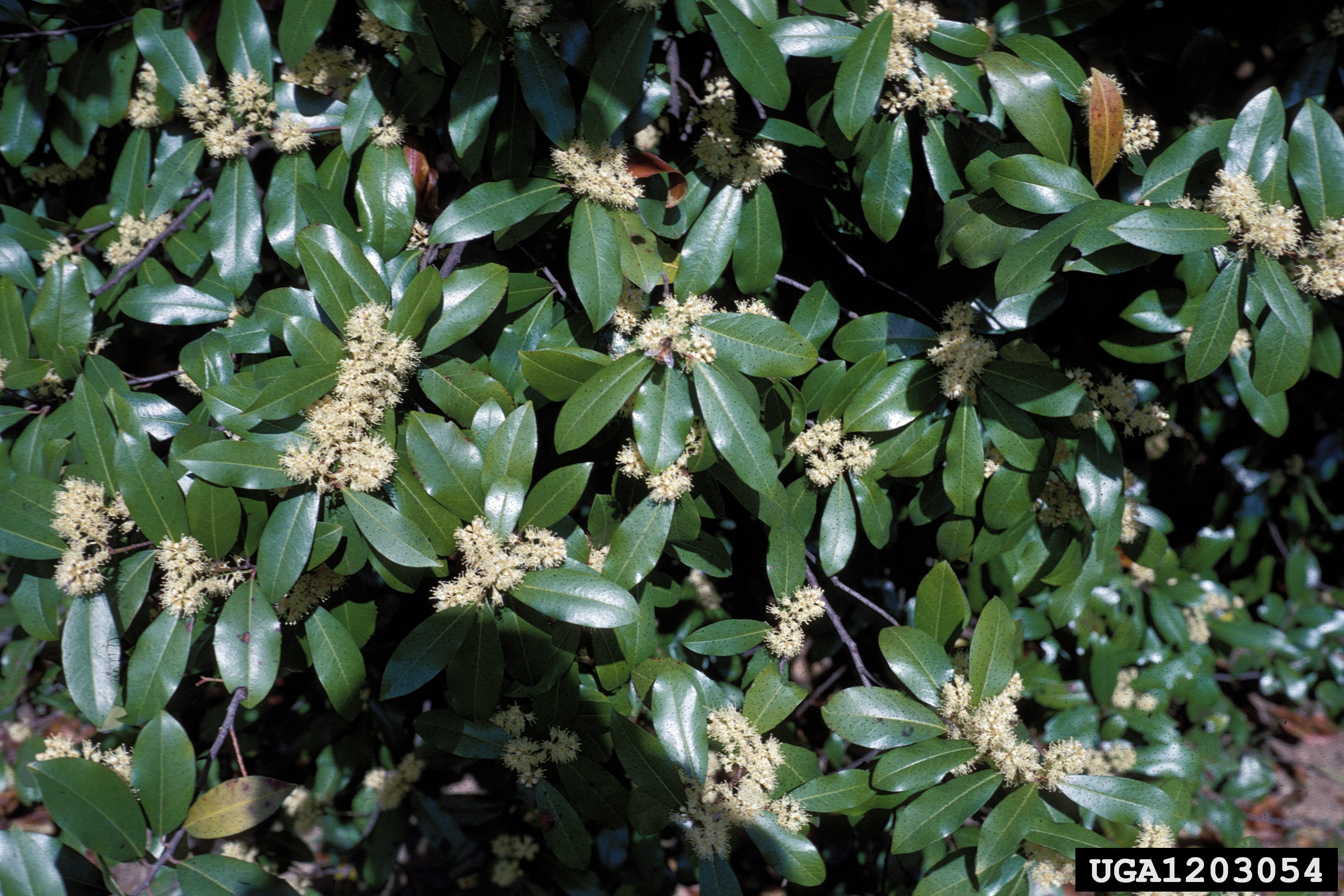
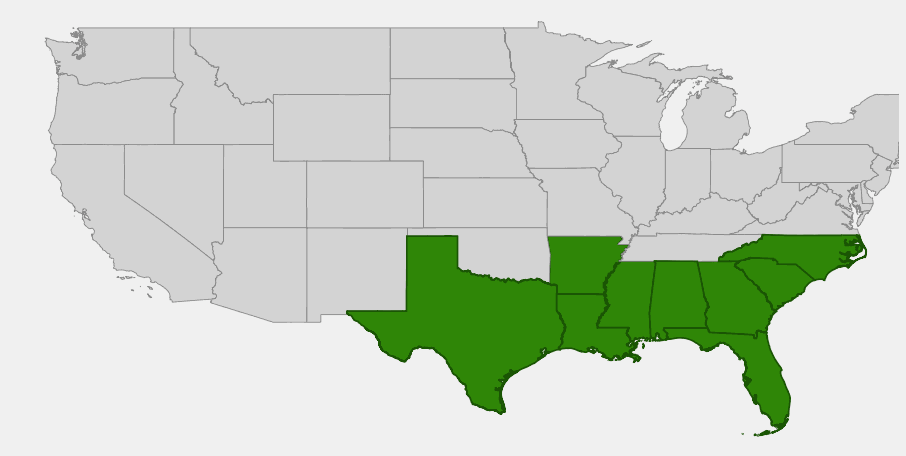
Prunus caroliniana, commonly known as Cherry Laurel or Carolina Laurelcherry, is a handsome native evergreen tree or large shrub of the American South, belonging to the Rosaceae (rose) family. Its range spans the coastal plain from North Carolina south through Florida and west to Texas, where it grows in a variety of upland habitats including hammocks, forest margins, and roadsides. With its dense, lustrous dark-green foliage, fragrant white spring flowers, and persistent black fruits, Cherry Laurel is simultaneously one of the most visually striking and ecologically valuable native trees of the region.
Growing 20 to 30 feet tall at maturity — occasionally taller — Cherry Laurel develops into a broad, pyramidal or rounded crown with densely clothed branches. The tree is notably fast-growing for a native species, making it one of the best choices for quickly establishing screening, windbreaks, or wildlife habitat in southeastern landscapes. The flowers, appearing in showy racemes in late winter and early spring, are a critical nectar source for early-season native bees and other pollinators before many other plants have come into bloom. The subsequent black fruits are eagerly consumed by birds and small mammals.
Despite its considerable landscape value, Cherry Laurel is somewhat underutilized in native plant landscaping, partly because the non-native English Laurel (Prunus laurocerasus) has long been the default choice for screens and hedges in the Southeast. The native Cherry Laurel outperforms its European counterpart in wildlife value while being far better adapted to local soils and climate. For gardeners committed to ecological landscaping in the Southeast, Cherry Laurel is a plant that earns its place in nearly every design.
Identification
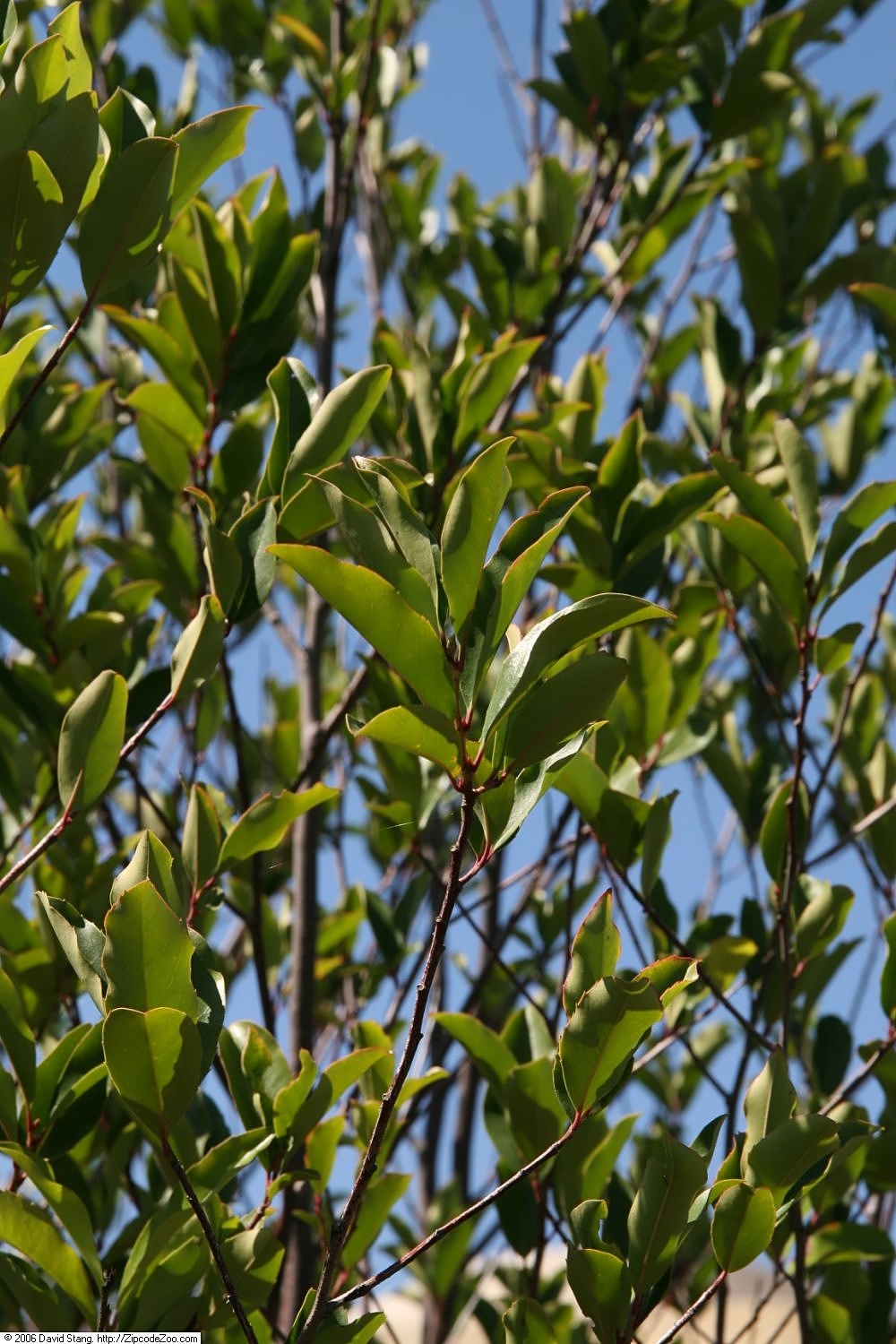
Cherry Laurel typically grows as a medium to large evergreen tree, reaching 20 to 30 feet in cultivation and occasionally 40 feet in the wild. Young trees tend to be narrowly pyramidal; older specimens develop broader, more rounded crowns. The tree’s most immediately recognizable feature is its glossy, dark-green, evergreen leaves — lance-shaped and finely serrate, they give the whole tree a lustrous, polished appearance year-round.
Bark & Stems
The bark of young branches is reddish to grayish-brown, smooth, and marked with distinctive lenticels (pores). On older trunks, bark becomes grayish-brown and develops shallow furrows. The inner bark has a characteristic bitter-almond scent when cut — a hallmark of the Prunus genus, caused by prussic acid (cyanide) compounds in the tissue. This scent is strong enough to be detected by breaking a young twig.
Leaves
The leaves are alternate, simple, evergreen, and 2 to 4 inches long, with a lance-shaped to elliptic form. Their most notable quality is their exceptional glossiness — the upper surface is a rich, deep green and highly reflective, while the underside is paler and matte. Leaf margins are finely and shallowly serrate (toothed). At the base of each leaf blade, one or two small glands are typically present on the petiole — a characteristic of the Prunus genus. The leaves contain prussic acid and are toxic if consumed in large quantities.
Flowers & Fruit
The flowers are small, creamy-white, and five-petaled, borne in dense, showy cylindrical racemes 2 to 3 inches long that emerge from leaf axils in late winter to early spring (February–April). The fragrance is sweet and noticeable, especially on warm days. The fruit is a small drupe, ¼ to ⅓ inch long, ripening from green through red to glossy black by fall. The clusters of black fruits persist into winter and are consumed by many bird species. The fruit pulp and especially the seeds contain toxic prussic acid compounds and should not be eaten by humans.
Quick Facts
| Scientific Name | Prunus caroliniana |
| Family | Rosaceae (Rose) |
| Plant Type | Evergreen Tree / Large Shrub |
| Mature Height | 30 ft |
| Sun Exposure | Full Sun to Part Shade |
| Water Needs | Low (Drought Tolerant) |
| Bloom Time | February – April |
| Flower Color | White |
| USDA Hardiness Zones | 7–10 |
Native Range
Cherry Laurel is native to the coastal plain of the southeastern United States, ranging from North Carolina south through South Carolina, Georgia, Florida, and westward along the Gulf Coast through Alabama, Mississippi, Louisiana, and into East Texas. It also extends slightly inland in some parts of its range, particularly in Georgia and the Carolinas, where it grows along river bluffs, forest margins, and the edges of bottomland forests. The species reaches its greatest abundance in Florida and the Gulf Coast states.
In its natural habitat, Cherry Laurel is a plant of maritime forests, coastal hammocks, bluff forests, and the edges of bottomland hardwood communities. It frequently grows alongside live oak (Quercus virginiana), Southern magnolia (Magnolia grandiflora), American holly (Ilex opaca), yaupon (Ilex vomitoria), and wax myrtle (Morella cerifera). It is a strong competitor in disturbed sites and is often among the first woody plants to colonize forest edges, old fields, and roadsides within its range.
Cherry Laurel’s drought tolerance, evergreen nature, and rapid growth rate — unusual among native trees — give it a competitive edge in sunny, dry upland sites. However, it also succeeds in partial shade and accepts a wide range of soil types. This broad ecological tolerance explains both its natural abundance and its success as a landscape plant throughout the Southeast.
📋 Regional plant lists featuring Cherry Laurel: Alabama, Georgia & Mississippi
Growing & Care Guide
Cherry Laurel is one of the easiest native trees to grow in the Southeast. Once established, it is drought-tolerant, pest-resistant, and largely self-sufficient. Its fast growth rate means it establishes privacy screening or wildlife habitat far more quickly than most native trees.
Light
Cherry Laurel grows best in full sun, where it develops its densest, most attractive form with abundant flowering. It also tolerates partial shade well, though it grows more openly and flowers somewhat less profusely in shadier conditions. In deep shade, growth slows and the plant becomes sparse. For screen plantings, full sun is strongly preferred.
Soil & Water
Cherry Laurel is exceptionally adaptable in terms of soil. It grows in sandy, loamy, or clay soils across a wide pH range — slightly acidic to neutral or even mildly alkaline. Its drought tolerance is one of its defining characteristics; established plants survive extended dry periods without supplemental irrigation in most of the Southeast. Young plants should be watered regularly during the first two growing seasons. Avoid poorly drained soils, where it may develop root rot.
Planting Tips
Plant in fall or early spring. Container-grown specimens are widely available and transplant easily. Space plants 8–15 feet apart for screens and hedges; give individual specimens 15–20 feet to develop their full natural form. Growth can be rapid — expect 2–4 feet per year under favorable conditions — so plan for mature size when selecting a planting site. The roots do not typically cause problems with foundations or pavement.
Pruning & Maintenance
Cherry Laurel tolerates heavy pruning and shearing, making it excellent for formal hedges. However, to maximize wildlife value and natural beauty, allow it to develop its natural pyramidal to rounded form with minimal pruning. If size control is needed, prune in late winter before flowering. The plant recovers vigorously from severe pruning. Maintenance needs are minimal — Cherry Laurel is naturally disease-resistant and requires little care once established.
Landscape Uses
- Privacy screens and windbreaks — one of the fastest-growing native evergreen trees for this purpose
- Wildlife gardens — fruits support dozens of bird species, flowers feed early pollinators
- Coastal landscapes — tolerates salt spray and coastal conditions
- Formal hedges — tolerates shearing for a tidy, structured appearance
- Specimen tree for large residential or commercial properties
- Street tree and urban planting in appropriate USDA zones
Wildlife & Ecological Value
Cherry Laurel is a significant wildlife plant that contributes to the southeastern food web across multiple seasons. Its dense evergreen canopy, winter fruits, and early spring flowers make it valuable in ways that few other native trees can match.
For Birds
The black fruits are eaten by numerous bird species including American Robin, Northern Mockingbird, Gray Catbird, Cedar Waxwing, Eastern Bluebird, Yellow-rumped Warbler, and many others. The dense evergreen canopy provides roosting, nesting, and thermal cover year-round — extremely valuable during cold winter months and spring nesting season. The White-eyed Vireo is particularly associated with dense shrubby Cherry Laurel growth as a nesting habitat.
For Mammals
White-tailed deer browse the foliage when other food is scarce. Raccoons, opossums, and foxes consume the fruits. Squirrels occasionally take fruit. The dense evergreen thickets created by multiple cherry laurel plants provide year-round thermal cover and escape habitat for cottontail rabbits and other small mammals.
For Pollinators
Cherry Laurel’s early bloom time — February to April — makes it exceptionally valuable for early-season pollinators. Native bees, honeybees, and a variety of small beneficial insects visit the flowers for nectar and pollen at a time when few other food sources are available. The fragrant flowers may also attract early-emerging butterflies and moths on warm late-winter days.
Ecosystem Role
Cherry Laurel plays an important structural role in coastal and piedmont forest edges, providing dense evergreen cover that creates a distinct mid-story layer in the forest. As a fast-growing colonizer of disturbed sites, it facilitates forest succession by rapidly providing cover and food resources that attract birds and mammals, which in turn disperse seeds of other native plants. Its tolerance of a wide range of conditions makes it a resilient component of southeastern forest ecosystems.
Cultural & Historical Uses
Cherry Laurel has a rich history of use by Indigenous peoples of the Southeast. Various tribes used preparations from the leaves and bark for medicinal purposes, primarily exploiting the prussic acid (cyanide) compounds present throughout the plant. Small amounts of the compound, properly prepared, were used as sedatives, analgesics, and treatments for respiratory conditions — practices that required careful knowledge of proper dosage and preparation to avoid poisoning. The wood was occasionally used for tool handles and other small implements.
Early European settlers and naturalists were struck by the beauty of Cherry Laurel and its resemblance to Old World laurel species. William Bartram, the 18th-century naturalist who traveled extensively through the Southeast, noted Cherry Laurel in his writings and described groves of the trees as among the most beautiful he encountered. By the 19th century, Cherry Laurel was being exported to Europe as an ornamental plant, where it became valued for its resemblance to the true laurel (Laurus nobilis) of ancient Greece and Rome.
In the American South, Cherry Laurel has long been a staple of traditional landscape design. Before the widespread availability of exotic evergreens, native Cherry Laurel provided the dense, attractive screening and foundation planting that many landscapes required. Today, with the growing awareness of native plant landscaping and the ecological value of native species, Cherry Laurel is enjoying renewed appreciation both for its beauty and its contributions to wildlife.
Frequently Asked Questions
Is Cherry Laurel the same as English Laurel?
No. English Laurel is Prunus laurocerasus, native to southwestern Asia and southeastern Europe. Cherry Laurel (Prunus caroliniana) is the native North American species. Both are evergreen members of the Prunus genus with similar appearances, but the native Cherry Laurel is better adapted to southeastern US conditions and far superior in wildlife value.
Are Cherry Laurel berries poisonous?
The berries contain prussic acid (hydrogen cyanide) compounds and are toxic to humans in significant quantities. Birds and some mammals can eat them safely. Do not consume the berries or the leaves. The plant should not be considered safe for browsing by livestock either, particularly in quantity.
How fast does Cherry Laurel grow?
Cherry Laurel is one of the fastest-growing native trees of the Southeast, typically adding 2–4 feet per year under favorable conditions. This makes it an excellent choice for quickly establishing screening, windbreaks, or wildlife hedges.
Will Cherry Laurel self-seed in my yard?
Yes — birds distribute the seeds widely, and Cherry Laurel can self-seed prolifically in favorable conditions. In areas where it is native, this is generally beneficial as it contributes to natural forest succession. In areas well outside its native range, it can become weedy; always check local invasive species lists before planting.
Can Cherry Laurel be used as a hedge?
Absolutely — it is one of the best native choices for a dense, fast-growing evergreen hedge in the Southeast. It tolerates heavy shearing and recovers quickly from pruning. For a more natural, wildlife-friendly hedge, allow it to grow with minimal shearing.

Looking for a nursery that carries Cherry Laurel?
Browse our native plant nursery directory: Alabama · Georgia · Mississippi