Coastal Sage Scrub Oak (Quercus dumosa)
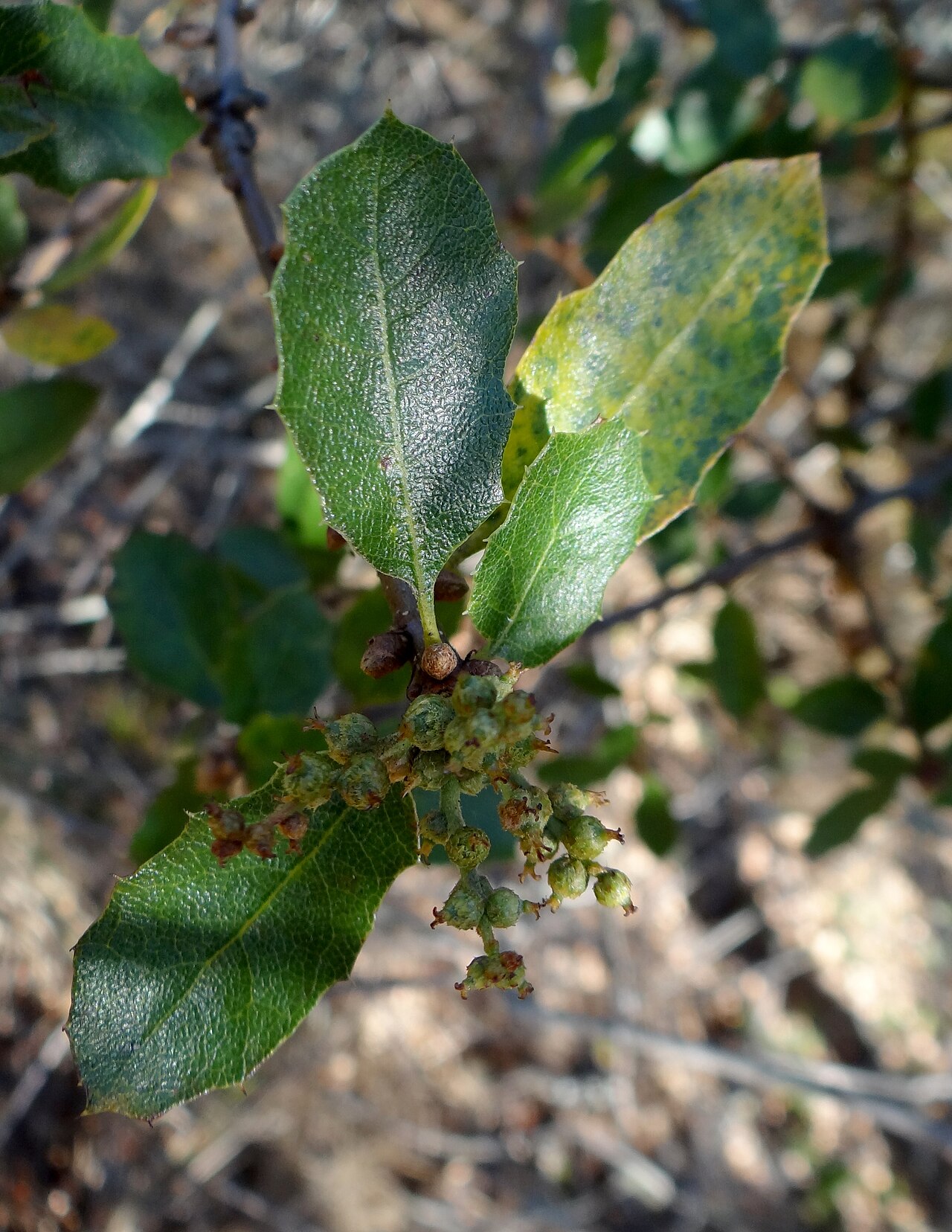
Quercus dumosa, known as Coastal Sage Scrub Oak or Nuttall’s Scrub Oak, is one of the rarest and most narrowly distributed oaks in California. A member of the Fagaceae (beech family), it grows as a low, dense, evergreen shrub tucked into sandy coastal terraces and bluffs within sight — and often within smell — of the Pacific Ocean, in a handful of disjunct populations from Santa Barbara County south through Orange and San Diego counties into northern Baja California.
For most of the 20th century, this species was confused with the much more common and widespread Quercus berberidifolia of inland chaparral, and many older field guides and nursery labels still use “scrub oak” or “Quercus dumosa” loosely to mean that other, common plant. Botanists have since clarified that true coastal Quercus dumosa is a distinct, narrow coastal endemic — and one that has lost the great majority of its original habitat to coastal development, making it a genuine conservation concern rather than just a landscaping curiosity.
Where it survives, Coastal Sage Scrub Oak is a tough, drought-adapted, wind-sculpted shrub 3 to 10 feet tall, holly-like in its spiny leaves and valuable to wildlife for its reliable acorn crops. It deserves a place in coastal Southern California native gardens both for its toughness and because every planting helps conserve a genuinely threatened California plant.
Identification
Coastal Sage Scrub Oak grows as a dense, rounded, evergreen shrub, typically 3 to 10 feet (1–3 m) tall and often wider than tall, rarely approaching small-tree stature. Its low, spreading, often wind-pruned form reflects its exposed coastal bluff and sandy terrace habitat.
Bark & Stems
Young twigs are slender, gray to grayish-brown, and often finely hairy; older branches develop smooth to slightly scaly gray bark. Growth is dense and twiggy, with branches often arching to the ground, giving mature shrubs a tight, impenetrable form.
Leaves
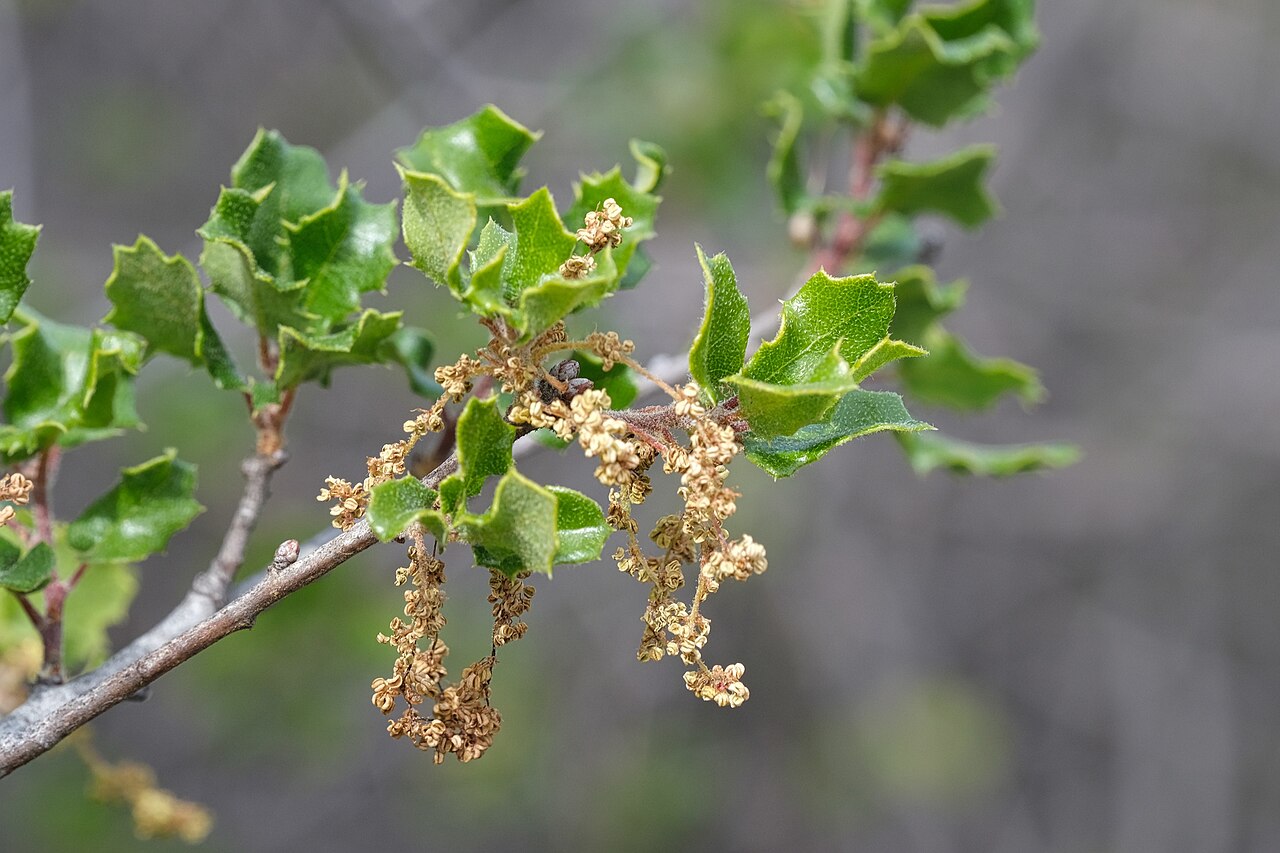
Leaves are evergreen, alternate, oval to oblong, ¾ to 1½ inches (2–4 cm) long, with 4 to 8 sharp, spine-tipped teeth along each margin — a holly-like look that is the quickest way to recognize any scrub oak at a glance. The upper surface is glossy dark green and often slightly convex or cupped; the underside is paler and may show fine hairs along the veins. Leaves persist year-round, dropping gradually rather than all at once.
Flowers
Like all oaks, Coastal Sage Scrub Oak is monoecious, with separate male and female flowers on the same plant. Male flowers hang in slender, drooping catkins 1 to 2 inches long in early spring, pale yellow-green and inconspicuous except for the dangling clusters they form at branch tips. Female flowers are tiny and easy to overlook, tucked close to the new growth.
Fruit & Seeds
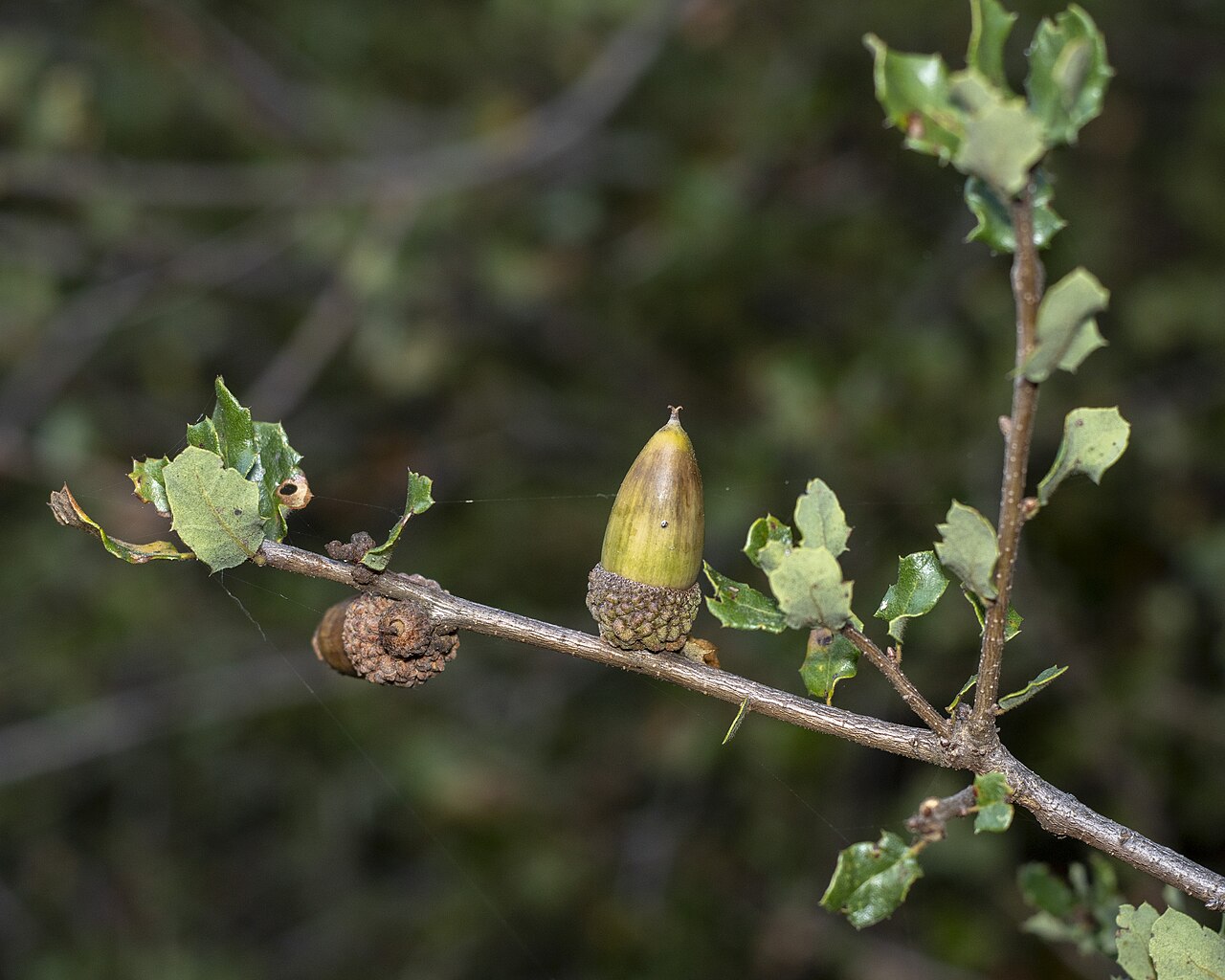
Acorns are solitary or paired, ½ to ¾ inch long, narrowly oval, maturing in a single season (unlike many oaks that take two years) with a shallow, scaly cap covering about a third of the nut. A notable trait of this species is that mature acorns often persist on the plant well after ripening rather than dropping immediately, making them a conspicuous and reliable late-season food source.
Quick Facts
| Scientific Name | Quercus dumosa |
| Family | Fagaceae (Beech) |
| Plant Type | Evergreen Shrub |
| Mature Height | 3–10 ft |
| Mature Spread | 5–12 ft |
| Growth Rate | Slow |
| Sun Exposure | Full Sun to Part Shade |
| Water Needs | Low (once established) |
| Soil Type | Sandy, sandstone-derived, well-drained |
| Soil pH | 6.0–7.5 |
| Bloom Time | March – April |
| Flower Color | Pale yellow-green catkins |
| Fall Color | Evergreen (no fall color change) |
| Fruit | Acorns, single-season, often persisting on the plant |
| Deer Resistant | Mostly (spiny leaves discourage browsing) |
| USDA Hardiness Zones | 9–10 |
Native Range
Coastal Sage Scrub Oak is one of the rarest oaks in California, known from a small number of disjunct populations from Santa Barbara County south through Ventura, Orange, and San Diego counties, and extending slightly into Baja California, Mexico, near Punta Colonet. It is restricted almost entirely to within a few miles of the coast, rarely found more than a short distance inland.
Within this narrow range it grows on sandy, often sandstone-derived soils of coastal terraces, bluffs, and mesas, usually in coastal sage scrub or the sandier edges of chaparral, below about 700 feet elevation. It associates with California sagebrush, laurel sumac, and other classic coastal sage scrub species, and in chaparral transition zones may grow alongside other scrub oaks and chamise.
Decades of coastal development across Southern California have destroyed most of this species’ original habitat, and surviving populations are small, fragmented, and often restricted to parks, reserves, and other protected open space. It is tracked as a species of conservation concern by the California Native Plant Society, and while it is not federally listed, its extremely limited and shrinking habitat makes wild collection or habitat disturbance a genuine conservation issue — never collect acorns, cuttings, or plants from wild populations.
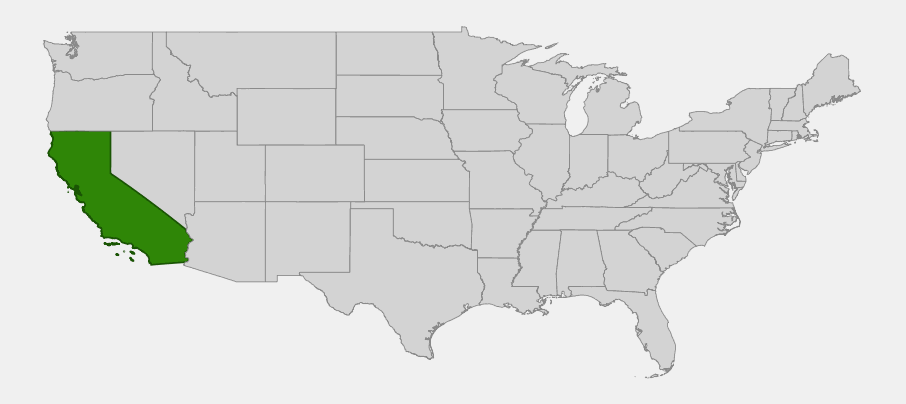
📋 Regional plant list featuring Coastal Sage Scrub Oak: California & Nevada
Growing & Care Guide
Coastal Sage Scrub Oak is slow but extremely tough once established, rewarding patience with a long-lived, nearly maintenance-free shrub well suited to coastal Southern California conditions.
Light
Grows best in full sun near the immediate coast, and tolerates part shade farther inland or in hotter microclimates. It does not need or particularly want rich, shaded woodland conditions.
Soil & Water
Requires sharply drained, sandy or sandy-loam soil and is intolerant of heavy clay or poor drainage, which can cause root rot. Like most California scrub oaks, it is markedly drought-tolerant once established and should receive little to no summer irrigation in a mature planting — overwatering is a far more common cause of failure than underwatering. Give young plants occasional deep watering through their first one to two summers to establish a deep root system, then taper off.
Planting Tips
Plant container-grown stock in fall, giving roots the cool, wet winter months to establish before summer drought arrives. Because the species is rare and slow-growing, source plants only from reputable native plant nurseries that propagate from cultivated stock — never from wild-collected material. Choose a well-drained, sunny coastal site; avoid low spots that collect winter water.
Pruning & Maintenance
Very little pruning is needed. Remove dead wood as needed and shape lightly if a more formal hedge form is wanted, though the naturally dense, rounded habit needs little intervention. Avoid heavy pruning, which the slow-growing species recovers from gradually.
Landscape Uses
Coastal Sage Scrub Oak fits naturally into coastal Southern California gardens:
- Low-water coastal native garden specimen or massed planting
- Wildlife hedge or informal screen — dense, spiny growth deters intruders and browsers alike
- Habitat restoration on sandy coastal terrace sites
- Conservation gardening — helps preserve a genuinely rare California native
- Low-maintenance foundation planting in coastal sage scrub-adjacent landscapes
Wildlife & Ecological Value
Despite its small stature and limited range, Coastal Sage Scrub Oak is an important wildlife resource within the already fragmented coastal sage scrub ecosystem it occupies.
For Birds
California scrub-jays, acorn woodpeckers, and towhees forage on and cache the acorns, and the dense, spiny foliage provides secure nesting and roosting cover for coastal scrub birds such as wrentits and California thrashers, species that depend heavily on structurally complex native shrubs.
For Mammals
Acorns are an important food source for California ground squirrels, woodrats, and other small mammals, and the tangled, spiny branches offer cover from predators. Larger mammals such as mule deer browse the foliage only lightly, since the spiny leaf margins discourage heavy grazing.
For Pollinators
Like other oaks, Coastal Sage Scrub Oak is primarily wind-pollinated, but its early-spring catkins still provide incidental pollen for some native bees, and the shrub’s leaves host the larvae of several native moth species.
Ecosystem Role
As one of the few woody, acorn-producing plants in the coastal sage scrub community, Coastal Sage Scrub Oak adds structural and nutritional diversity to an ecosystem otherwise dominated by soft-leaved subshrubs. Its persistence in small, isolated remnants makes every surviving stand ecologically significant for the wildlife that depends on it.
Cultural & Historical Uses
Indigenous peoples of coastal Southern California, including Chumash, Tongva, and Kumeyaay communities, gathered acorns from scrub oaks including Quercus dumosa as part of the broader California Indian acorn economy, leaching out the bitter tannins through careful processing before grinding the nuts into meal — a historical practice, not a casual modern use, since raw acorns are unpalatably bitter and must be properly leached.
The dense, spiny branches historically served practical purposes as natural barriers and brush fencing in traditional land use. Today, the species’ primary significance is conservation-focused: botanists and native plant advocates emphasize cultivated, nursery-grown Coastal Sage Scrub Oak as a way to support a genuinely rare California plant without further disturbing its few remaining wild populations.
No toxicity concerns are associated with the plant itself, though raw acorns, like those of all oaks, contain tannins that make them unpalatable and mildly irritating if eaten without processing.
Frequently Asked Questions
Is Coastal Sage Scrub Oak the same plant as California Scrub Oak?
No — they were long confused, but current botanical treatment recognizes Quercus dumosa (coastal, narrow range) as distinct from the much more common and widespread Quercus berberidifolia (California Scrub Oak) of inland chaparral. Many older references and some nursery tags still use the names interchangeably.
Is this oak endangered?
It is not federally listed, but it is tracked as a California Native Plant Society species of conservation concern due to severe habitat loss from coastal development. It is one of the rarest oaks in California, and wild populations should never be disturbed or collected from.
Can I grow Coastal Sage Scrub Oak away from the coast?
It can be grown inland with excellent drainage and reduced summer water, but it is best adapted to the mild, fog-influenced coastal climate of its native range and may struggle with extreme inland heat.
How fast does it grow?
Slowly — typical of many California native oaks — so plan for a long-term planting rather than quick results. The payoff is a long-lived, extremely low-maintenance shrub once established.
Do the acorns attract wildlife?
Yes — acorns persisting on the plant after ripening make this species a reliable late-season food source for scrub-jays, woodpeckers, and small mammals in the coastal sage scrub community.
For more on building a low-water coastal garden around tough natives like this one, see our guide to low-maintenance shrubs for California. Its dense, acorn-bearing structure also makes it a strong candidate for native hedgerows for birds, and it pairs naturally with the design principles in our best habitat gardens for wildlife guide.

Looking for a nursery that carries Coastal Sage Scrub Oak?
Browse our native plant nursery directory: California