Curly Mesquite (Hilaria belangeri)
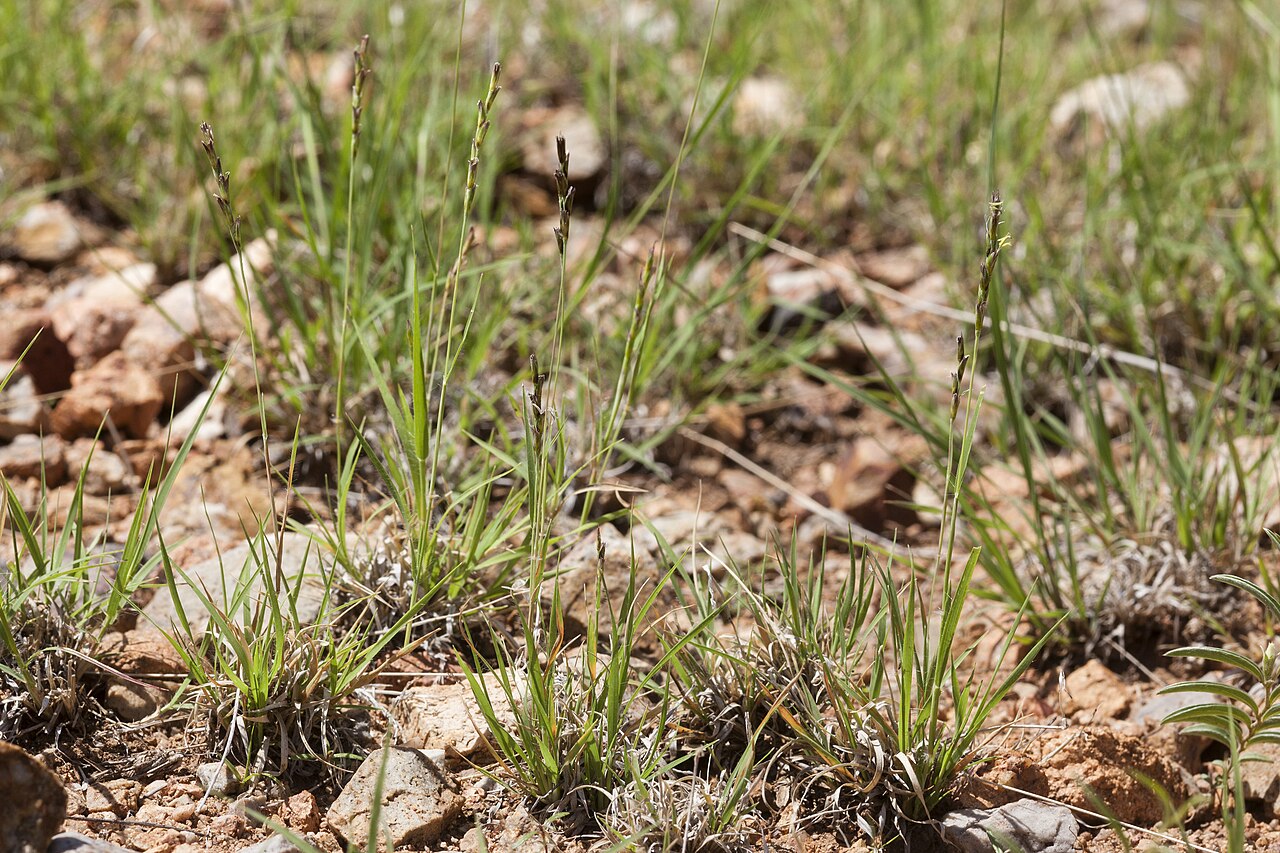
Curly mesquite is a grass, not a miniature mesquite tree. Hilaria belangeri forms a low, spreading layer of narrow leaves, with modest flower spikes rising above the foliage. It is one of the native grasses worth considering when an Arizona garden calls for an open shortgrass look rather than a tall ornamental clump. The regional table lists full sun, dry soil, and a 6-inch height, a useful description of its low vegetative layer.
Its runners can root and help adjacent plants knit together. That gives it potential as a naturalistic lawn alternative within its suitable range, but the result should not be judged against a permanently green, closely clipped conventional lawn. Drought and winter dormancy are part of its behavior. A gardener who accepts seasonal brown foliage has more freedom to reduce water than one who requires a uniform green surface every month.
Start with site fit and intended use. Curly mesquite can make sense in an open native planting, a lightly used lawn alternative, or a transition between paths and taller dryland plants. It is not an automatic substitute for every recreation lawn, shaded yard, or poorly drained depression. Test a small area under real site conditions before committing a whole garden to it.
Identification
Stems & Runners
Look for a low grass that sends stolons across the soil surface, with rooted growth developing along the runners. That spreading pattern distinguishes its landscape behavior from a strictly tufted bunchgrass. Keep a few runners visible while learning the plant; immediately burying every stem beneath mulch obscures a useful identification feature. Established patches can become denser as rooted nodes fill the spaces between the original plants.
Leaves
The leaves are narrow and grasslike, with parallel veins. During dormancy they can curl, contributing to the common name. A curled or dry-looking leaf must be interpreted in context: season, recent weather, rooting, and the condition of neighboring growth all matter. Do not identify a grass solely from a brown leaf. The whole plant and its flowering structures are much more useful when distinguishing it from other short grasses.
Flowers
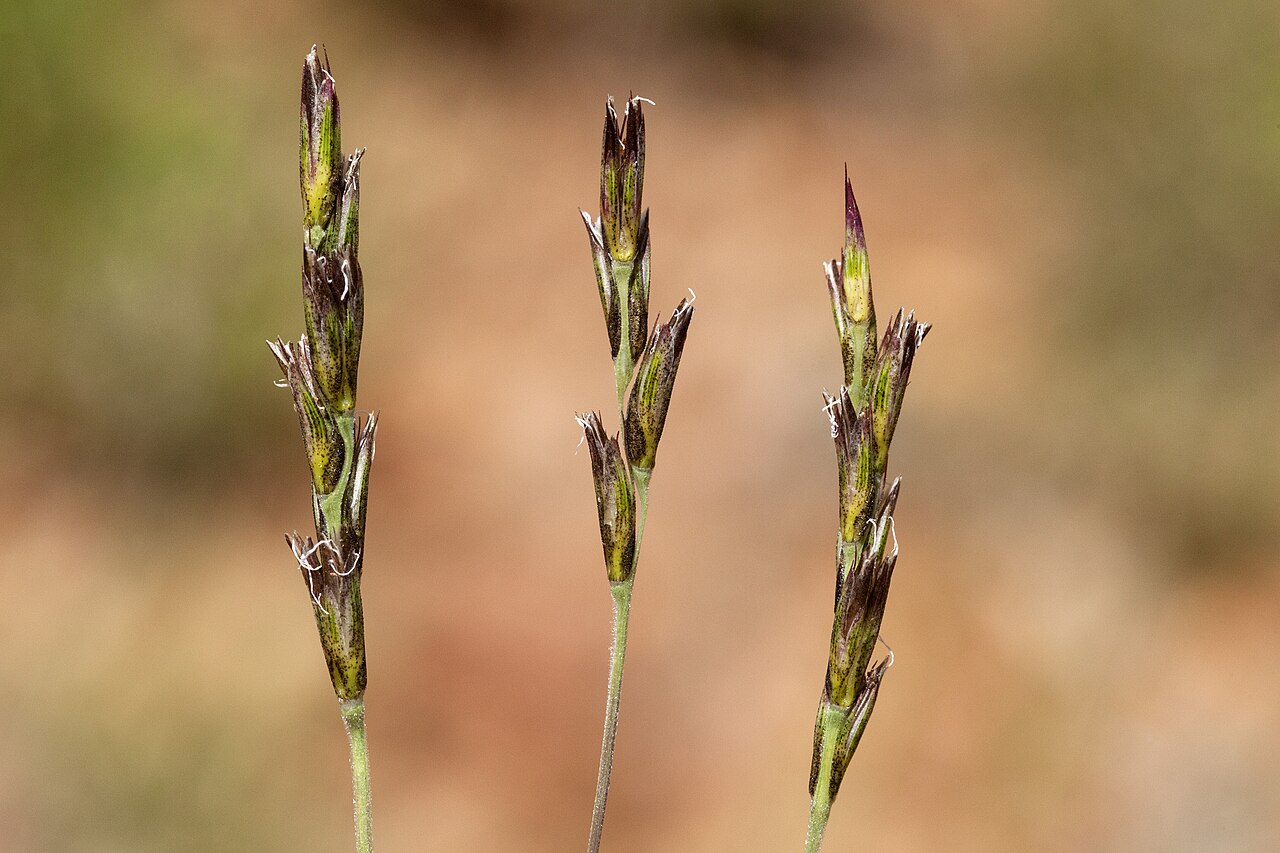
The flowering stems carry compact spikes with small florets rather than conspicuous petals. Close viewing reveals the structure that a distant lawn-scale view misses. Bloom is usually strongest in the warmer later part of the season, with local rainfall affecting timing. Leave some plants unmown if identification, seed production, or simply observing the grass’s seasonal cycle is important.
Fruit & Seeds
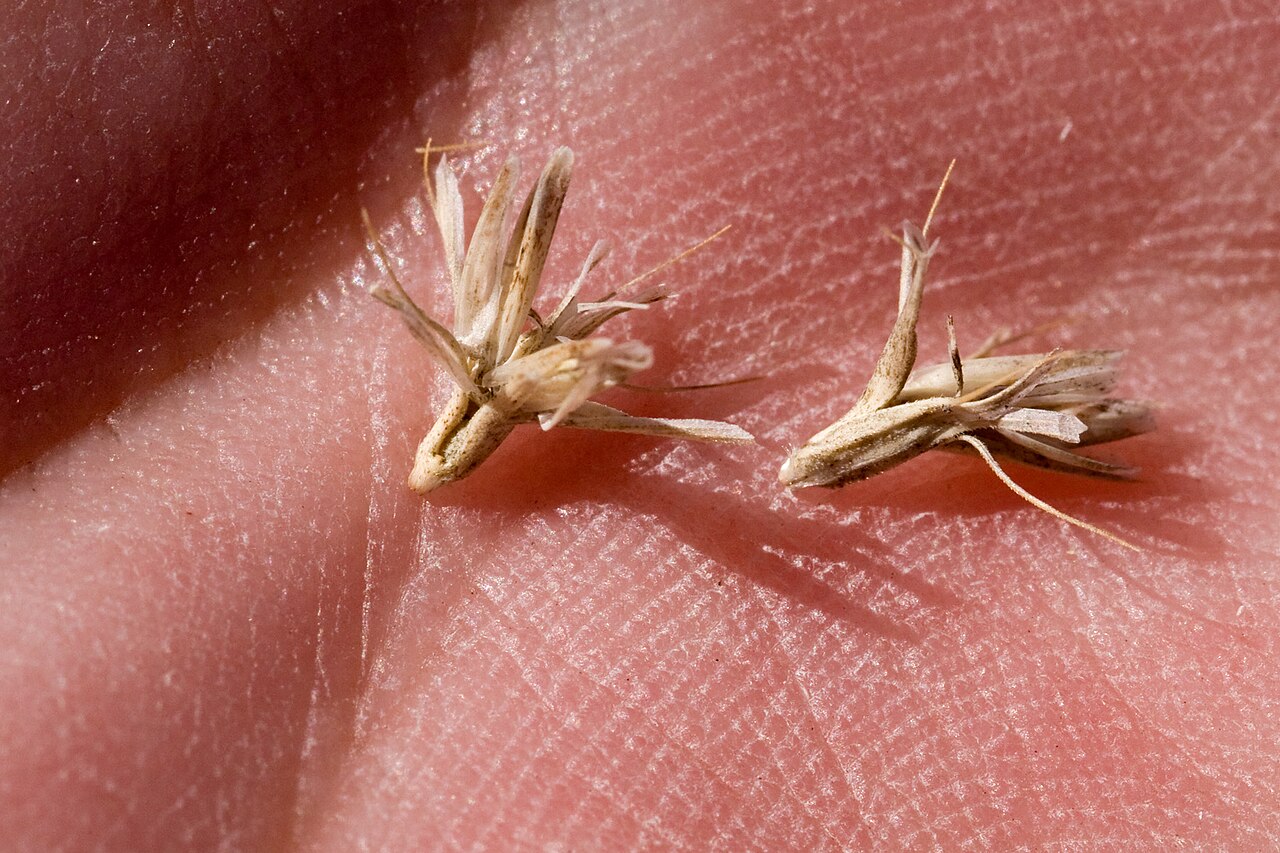
The fruits are dry grains typical of the grass family. The close-up photograph shows the small reproductive structures rather than an oversized ornamental seed head. Reliable identification matters when collecting or purchasing seed: a generic native lawn mix may include different species with different growth habits. Retain the supplier’s species list and provenance information so later management is based on what was actually planted.
Quick Facts
| Scientific Name | Hilaria belangeri |
| Family | Poaceae (grass family) |
| Plant Type | Warm-season perennial grass; stolon-forming |
| Mature Height | Low foliage around 6 inches; flowering stems may reach about 12 inches |
| Mature Spread | Spreads laterally by aboveground runners |
| Growth Rate | Seasonal; strongest under suitable warm growing conditions |
| Sun Exposure | Full sun |
| Water Needs | Low after establishment; dry soil |
| Soil Type | Well-drained clay loam, loam, sand, or caliche-derived soil |
| Soil pH | Adapted to regional mineral soils, including calcareous sites |
| Bloom Time | Usually late summer and fall; rain and temperature affect timing |
| Flower Color | Small, inconspicuous grass florets |
| Fall Color | Turns tan or brown with dormancy |
| Fruit | Dry grass grains (caryopses) |
| Deer Resistant | Moderate; not protected from all grazing |
| USDA Hardiness Zones | Use regionally tested stock and supplier guidance for winter limits |
Native Range
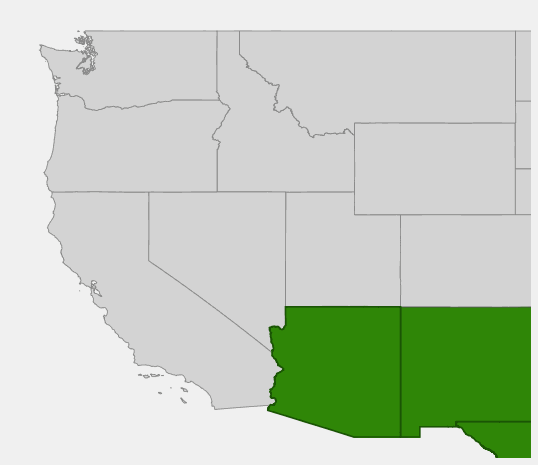
Both Kew’s Plants of the World Online and the Lady Bird Johnson Wildflower Center place the native U.S. range in Arizona, New Mexico, and Texas. The species also extends into Mexico. Only the three U.S. states are shaded on this map; it is not intended to depict the Mexican portion or to imply that every location inside a shaded state supports the species naturally.
The Wildflower Center describes dry shortgrass prairie and savanna settings, including caliche and well-drained clay sites. It notes that curly mesquite may grow with buffalograss and form dense cover by stolons. This ecological setting is more useful for choosing a garden location than assuming all native grasses want the same soil or rainfall pattern.
Arizona’s cold uplands and hot low-elevation gardens can impose very different stresses. Ask a regional grower about the origin of the stock and its performance near your elevation. A grass native in part of the state may still be a poor choice for a deeply shaded courtyard or a site that stays wet through cool weather. Match the provenance and microclimate before planning a large installation.
📋 Regional plant list: Arizona
Growing & Care Guide
Light
Provide full sun. In a lawn-alternative setting, evaluate shade from walls and trees through the growing season, not only during winter. A sparse strip beneath a tree may need a different plant community rather than more fertilizer or water. Keep tall companion plants far enough away that the low grass receives light at the soil surface, especially while new plugs are filling in.
Soil & Water
The species tolerates several soil textures when drainage is adequate, with clay loam a useful reference point from the Wildflower Center. Avoid interpreting clay tolerance as tolerance of prolonged saturation. Newly planted plugs need water to root into the surrounding soil; established plants can follow a substantially drier regime. Check moisture where roots actually are rather than judging only the dry appearance of the surface. Let the watering plan evolve as the planting establishes.
Planting Tips
Prepare the site by controlling competing weeds before installation. A low grass has limited ability to overtop vigorous weeds during its first growing season. Place propagated plugs at their existing depth, keep runners from being buried under heavy mulch, and water the root zone thoroughly. Choose spacing based on the nursery’s plant size and the desired establishment period rather than assuming rapid instant coverage. Leave paths or stepping stones for access so new plants are not repeatedly crushed while being tended.
Pruning & Maintenance
Decide whether the planting is a naturalistic grass patch or a regularly maintained lawn alternative. Those goals lead to different mowing expectations. Keep some flowering stems where possible and avoid cutting newly established plants so frequently that rooting is compromised. Dormant foliage need not be removed immediately just because it is brown. Assess local seasonal growth before cleanup, and use a conservative approach rather than scalping an uneven young stand.
Propagation
For a small garden, accurately labeled nursery plugs or divisions supplied by a knowledgeable grower provide a practical start. The plant’s stolon-forming habit explains how a patch expands, but an unrooted runner is not equivalent to an established transplant. Keep newly rooted material from drying abruptly. If purchasing seed, confirm the species and request sowing guidance for that particular lot; warm-season native grasses should not automatically be managed like a cool-season turf mix.
Planning for Dormancy
Expect a seasonal change in color. The Wildflower Center notes dormancy in winter and during extreme drought. A brown patch in an established stand is therefore a prompt to investigate, not immediate proof of death. Check whether crowns remain firm, whether recent weather explains the change, and whether new growth returns when conditions improve. Avoid watering solely to force color without considering the purpose of a low-water planting.
Managing Edges & Competition
Stolons are helpful inside the intended planting but can also cross a loose garden edge. Observe where they root before deciding whether a physical border is necessary. Remove unwanted young extensions while they are easy to handle, preserving the main stand. In mixed beds, give taller wildflowers their own space and prevent them from shading the entire grass layer. A diverse shortgrass planting still needs deliberate management while its component species establish.
Landscape Uses
- A seasonal native lawn alternative in sunny, locally suitable Arizona sites.
- A low grass layer in a dry native garden where runners can fill open spaces.
- Transitions along paths with room for a natural edge and occasional flowering stems.
- Small test plots for learning how native warm-season turf behaves under local rainfall.
- Mixed shortgrass plantings using locally appropriate companions with similar irrigation needs.
Wildlife & Ecological Value
For Pollinators
Grass flowers should not be advertised as the same nectar resource as a bed of showy wildflowers. Build a pollinator planting by combining the grass layer with locally native flowering plants, preserving enough sun and root space for both. Curly mesquite contributes structure and continuity at ground level while the flowers provide complementary resources.
For Birds
Retaining some flowering and fruiting stems allows more of the grass’s seasonal cycle to remain in the landscape. Avoid presenting it as a guaranteed major food source for any particular bird without local evidence. Combine low grasses with appropriate shrubs and other native plants to provide varied heights and cover. A lawn alternative becomes more useful when it is connected to a broader habitat rather than isolated as a single-species rectangle.
For Mammals
The Wildflower Center characterizes it as fair livestock forage and relatively limited wildlife forage, with moderate deer resistance. That is not a reason to ignore browsing or trampling in a new planting. Protect young plugs where animals repeatedly cross or graze them, and do not assume that a short stature makes the grass indestructible. Establishment and sustained recreational traffic are separate management questions.
Ecosystem Role
Stolon growth can add continuous living cover to open ground. That can be useful in a dry garden, but vegetation alone does not correct concentrated runoff or poor grading. Preserve infiltration, control weeds without routine broad chemical treatment, and keep the planting’s water regime aligned with its dry-site character. Seasonal dormancy is compatible with that ecological role even when the stand is not green.
Cultural & Historical Uses
The name curly mesquite connects the curling dormant leaves with the mesquite savanna landscapes in which the grass may occur. The word mesquite can otherwise be misleading, so use Hilaria belangeri when ordering stock. It is a member of the grass family, not a woody legume.
The Wildflower Center discusses curly mesquite alongside buffalograss and blue grama as a native grass with lawn potential. Those comparisons are useful starting points, not proof that the species are interchangeable. Texture, spreading behavior, local climate, and the gardener’s tolerance of seasonal dormancy all affect the final choice.
Its modern appeal is part of a larger shift from resource-intensive ornamental turf toward regionally appropriate ground layers. A successful planting makes the intended tradeoffs explicit: seasonal color changes, a less uniform texture, and space for flowering companions can be acceptable in exchange for a landscape better matched to its setting. Nursery-propagated material helps accomplish that without digging plants from wild grasslands.
Frequently Asked Questions
Is curly mesquite a tree?
No. Hilaria belangeri is a low perennial grass. Its common name reflects its curling leaves and association with mesquite landscapes, not a woody growth form.
Is it native to Arizona?
Yes. Kew and the Wildflower Center list Arizona, New Mexico, and Texas in its native U.S. range. Select material suited to the local elevation and climate.
Will it stay green all winter?
Do not plan on that. Winter dormancy and drought-related dormancy are normal parts of its behavior. An evergreen appearance is not the right standard for evaluating this native grass.
How tall does it get?
The Arizona table describes about 6 inches of low growth. Flowering stems may rise to roughly a foot, so leave some space for its seasonal form rather than treating 6 inches as a rigid maximum.
Can I immediately replace a heavily used lawn with it?
Test a small area first and clarify the intended level of use. Establishment, shade, traffic, drainage, and the desired appearance all matter. A native lawn alternative is not automatically equivalent to a conventional sports surface.
Sources & Further Reading
- Lady Bird Johnson Wildflower Center: curly mesquite grass
- Kew Plants of the World Online: Hilaria belangeri
- USDA PLANTS: Hilaria belangeri
Find Native Plants
Ask growers about nursery propagation and regional provenance. Browse our Arizona native plant nurseries directory for suppliers.