Desert Needlegrass (Pappostipa speciosa)
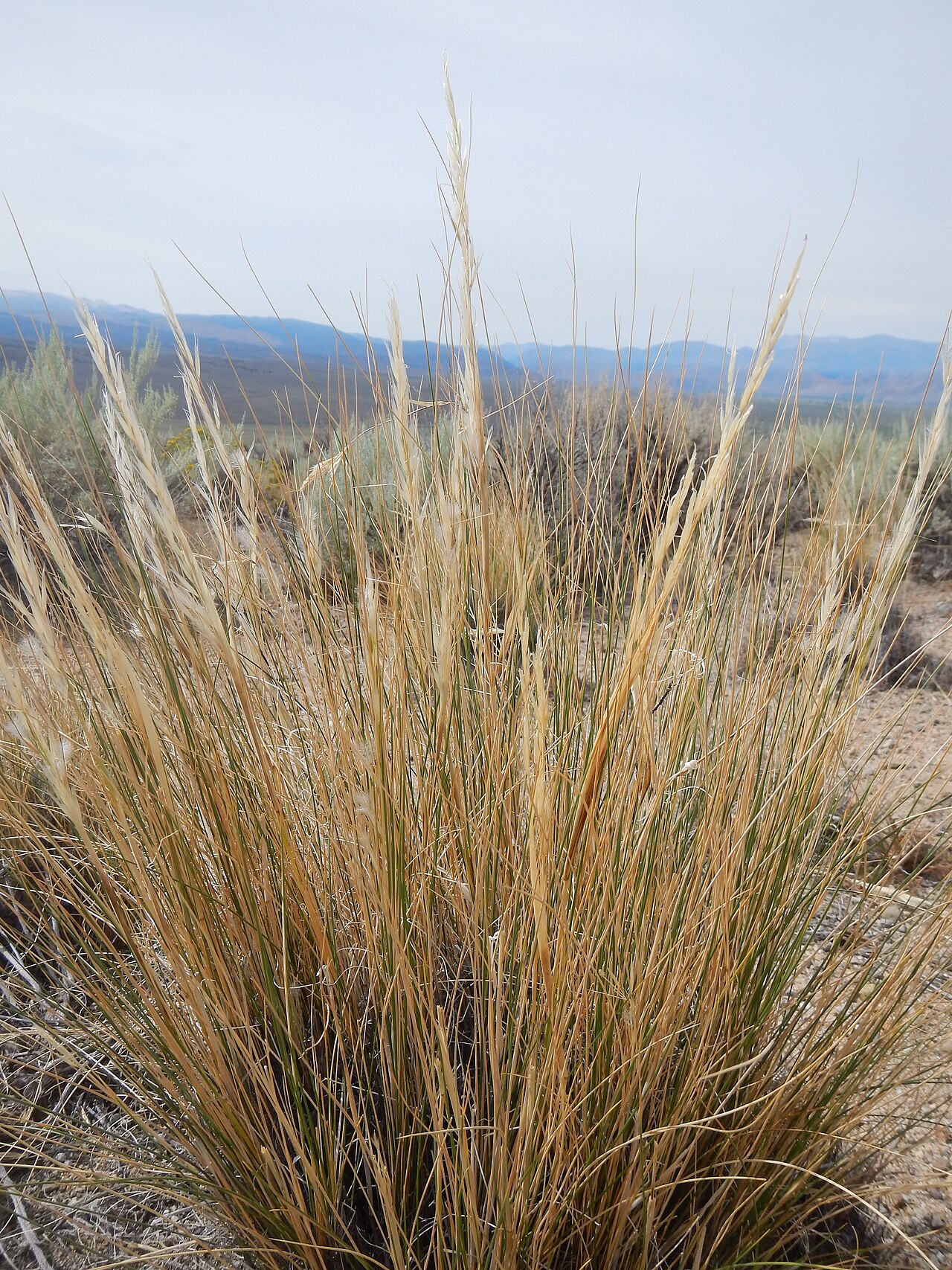
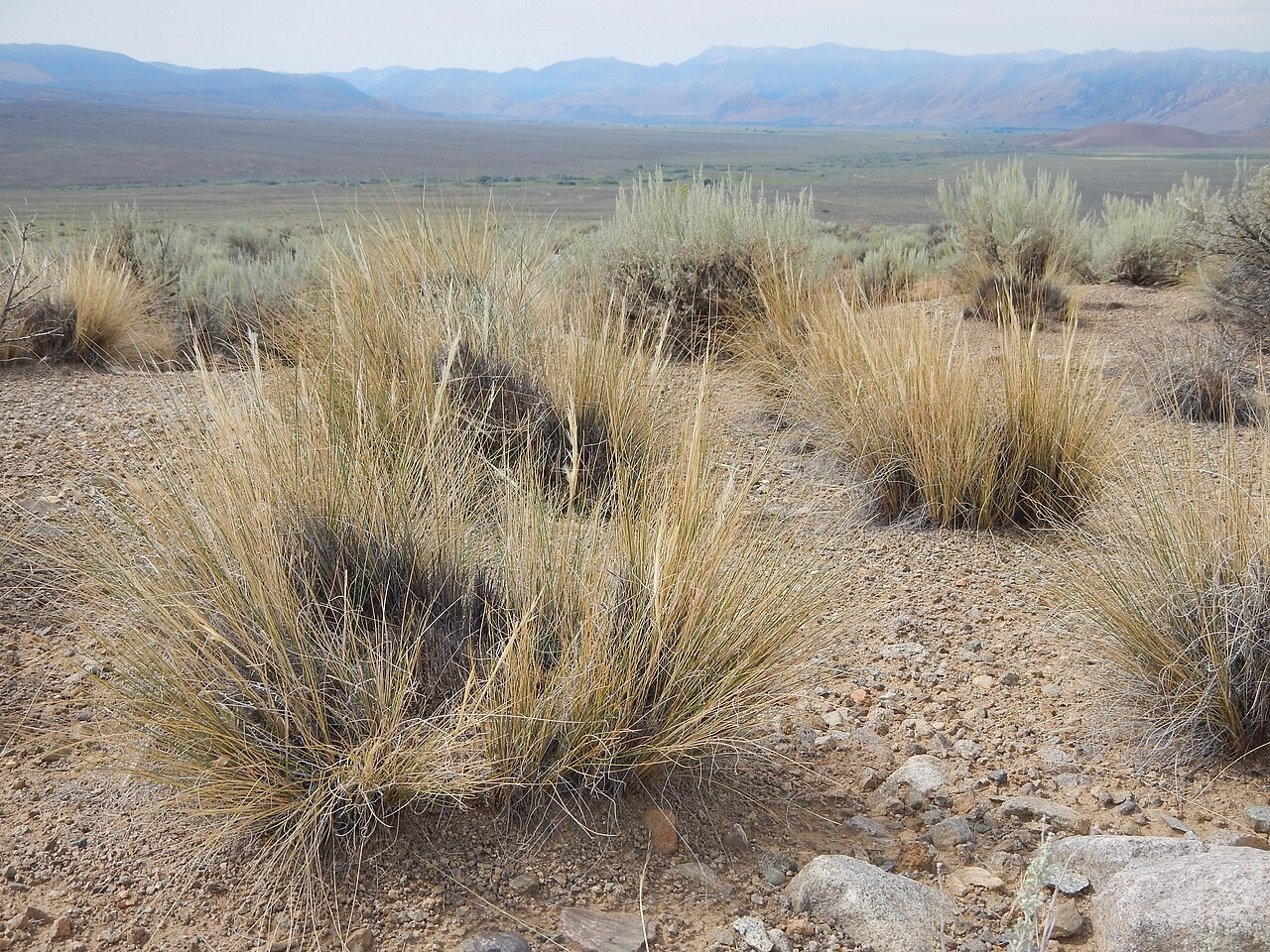
Desert needlegrass is a small western bunchgrass with an outsized visual presence. Fine leaves gather into a compact fountain, while pale flowering stems catch light above the clump. In a dry garden it contributes texture and movement without needing the constant irrigation that keeps conventional turf green. Its appearance belongs to open country: rocky slopes, desert washes, and sagebrush landscapes rather than lush borders or shaded woodland.
The accepted name used here is Pappostipa speciosa. Older floras, seed catalogs, and the USDA profile call the same species Achnatherum speciosum or Stipa speciosa. Those synonyms are important when shopping for nursery stock; they do not identify different garden plants. This grass must not be confused with Mexican feathergrass or with unrelated plants sold simply as needlegrass. Request a full scientific name and collection region when buying seed.
For gardeners in Utah and western Colorado, the essential question is site fit. A sunny, freely draining place with little summer irrigation is a better starting point than a fertile flowerbed. The established plant tolerates dryness, but a new transplant still needs enough moisture to make roots. Its sharp, awned seeds also deserve consideration near pet runs, livestock, and frequently used paths. Choose it for its authentic dryland character, not as a soft lawn substitute.
Identification
Growth Habit and Stems
Desert needlegrass is a perennial in the grass family, Poaceae, usually about 1–2 feet tall in the USDA description. Leaves and flowering stems rise from a persistent basal crown rather than from a mat of long, spreading runners. An older bunch may be wider and less evenly green than a nursery plug. Count that natural structure as part of its character rather than trying to force it into the uniform outline of a clipped ornamental.
Leaves
The narrow blades are commonly rolled inward, giving the foliage a wiry look. Inspect the plant at its base as well as at the flowering tips: the basal sheaths are hairy and the ligule is short. A photograph of a distant clump alone is not sufficient for a confident identification, because several desert grasses make similar tufts. The combination of leaf features and mature reproductive structures is much more useful.
Flowers and Seed Heads
The flowering cluster is a narrow, compact panicle, often about 4–6 inches long, with part of it still held within the upper leaf sheath. Rather than producing large colorful petals, it bears the tiny florets typical of wind-pollinated grasses. Flowering and seed production depend strongly on seasonal moisture. A dry year can bring a much smaller display than the same plant produces after favorable cool-season rainfall.
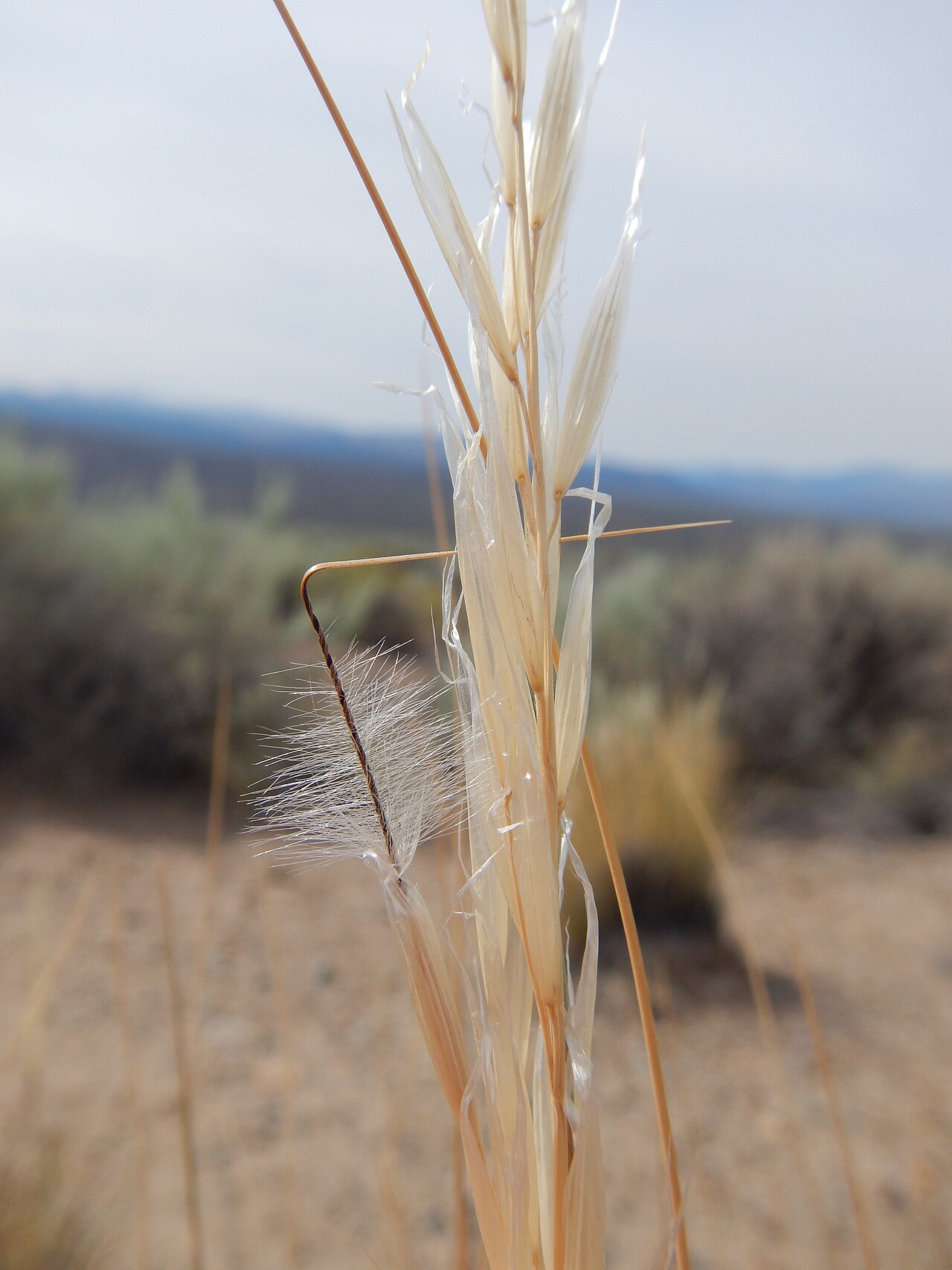
Awns and Mature Seeds
The awn is the long extension attached to the floret. In this species it bends and has conspicuous plumose hairs along its lower section; the close-up photograph illustrates that feature. Mature diaspores also have a sharp basal callus. Handle seed heads with gloves, and avoid brushing them onto clothing or a dog’s coat. An awn is an identification character and a dispersal device, not just decorative fluff.
Quick Facts
| Scientific Name | Pappostipa speciosa; synonyms Achnatherum speciosum, Stipa speciosa |
| Family | Poaceae — grass family |
| Plant Type | Native perennial, cool-season bunchgrass |
| Mature Height | Usually 12–24 inches (30–60 cm) |
| Mature Spread | Clumping; allow room around the crown rather than expecting a spreading turf |
| Growth Rate | Seasonal; strongest growth with cool-season moisture |
| Sun Exposure | Full sun |
| Water Needs | Low once established; good drought tolerance |
| Soil Type | Well-drained sandy, gravelly, or rocky mineral soil |
| Soil pH | Select locally adapted stock; no narrow universal pH prescription |
| Bloom Time | Spring to early summer, varying with elevation and rainfall |
| Flower Color | Inconspicuous; seed heads pale straw-colored at maturity |
| Fall Color | Tan to straw-colored; dormancy varies with weather |
| Fruit | Awned grass grain enclosed by floret structures |
| Deer Resistant | Not browse-proof; young growth is eaten by grazing wildlife |
| USDA Hardiness Zones | Use provenance and local climate, not a single species-wide zone promise |
Native Range
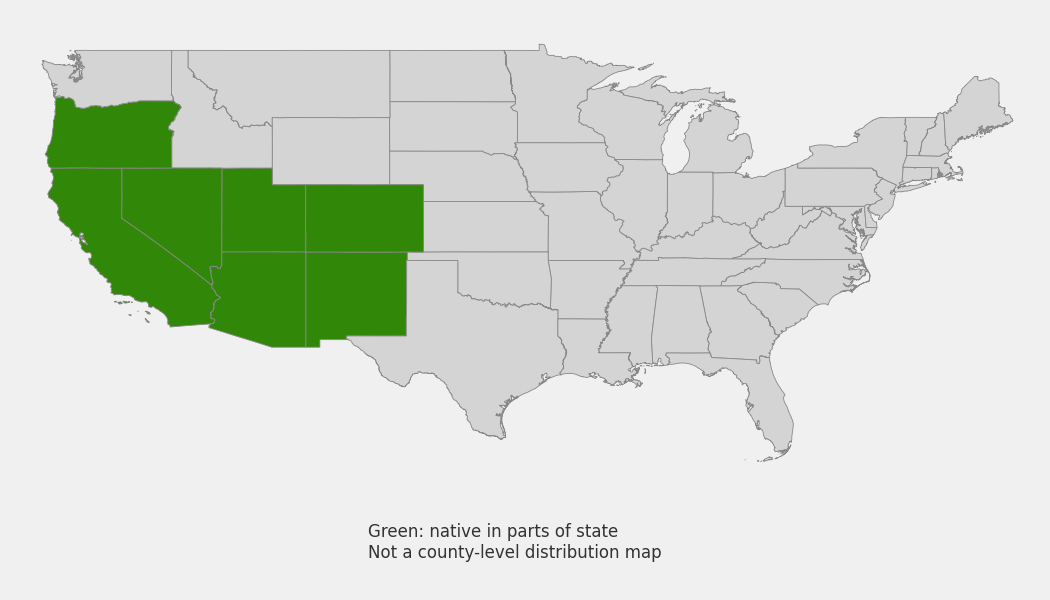
The North American native range covers the dry Southwest and adjacent western states. Kew and the USDA fact sheet list Arizona, California, Colorado, Nevada, New Mexico, Oregon, and Utah, with continuation into northwestern Mexico. The species also has native South American populations; a garden plant from that distant part of the range should not automatically be treated as locally appropriate western restoration stock.
Within Utah and Colorado the plant occupies selected dry habitats, not every county and not every elevation. Forest Service accounts describe coarse soils on rocky hillsides, alluvial fans, talus, and canyon ground. A broad state-level map can show that a species belongs to a state’s flora, but it cannot tell whether a cool mountain meadow or a shaded canyon seep is suitable for it.
The map follows the seven-state distribution in the USDA fact sheet and Kew treatment. An older Forest Service summary names a shorter set of states; that difference reflects the scope and age of the sources, not permission to fill the whole West with green. For a conservation planting, confirm a county record and use seed from an appropriate ecological setting. The USDA link below is a useful starting point for a more local check.
📋 Regional plant list: Utah and Western Colorado
Growing & Care Guide
Light
Give desert needlegrass an open exposure. Before planting, look at the site in both spring and summer: a bed that is sunny before deciduous trees leaf out may be too shaded during the grass’s active season. In a desert-style composition, place taller shrubs far enough away that their mature canopy does not cover the crown. Good air movement and sunlight are more useful here than a rich soil amendment.
Soil and Water
Drainage is the first requirement. Gravelly or sandy ground can suit this grass well, but adding a thin gravel mulch cannot correct a deeply waterlogged clay basin. Avoid locations receiving repeated lawn-sprinkler runoff. Water new plugs through their root zone when needed, then gradually lengthen the interval as roots establish. The goal is a plant supported by its site, not one maintained indefinitely by frequent shallow sprinkling.
Planting Tips
Use nursery-propagated plugs or legally collected, correctly identified seed. Plant at the original crown depth and keep heavy mulch away from the center. In regions with dependable cool-season moisture, establishment can be aligned with that moist period; in colder locations, seek local nursery advice on timing. Begin with a small trial where winter drainage or provenance is uncertain. Observe survival through a full seasonal cycle before expanding the planting.
Pruning and Maintenance
Do not shear the plant repeatedly like a hedge. Remove loose dead material when it is safe to work around the crown, taking care not to pull out living shoots. Retain attractive stems where seed is welcome; remove ripe heads before they shed if the site borders a pet route. A naturally tan summer clump is not necessarily dying. Check the crown and the pattern of seasonal growth before responding with extra water.
Propagation
Seed is the practical route for establishing a number of plants, but awns complicate handling and seed-lot quality varies. USDA reports that cool germination conditions performed well in a study; that experimental result is not a guarantee for every stored lot. Follow a native-seed supplier’s instructions for cleaning, sowing depth, and timing. New tillers enlarge a living bunch, but that does not mean a mature clump will tolerate rough splitting during drought.
Placement around Animals
Choose a position away from heavily used dog paths, bedding areas, and livestock concentration points. USDA specifically notes injury potential from the sharp mature seed structures. Young foliage may be grazed, and repeated close grazing or trampling can weaken a planting. Where pets share a small garden, a different local bunchgrass with less troublesome seed may be a more practical choice. This is a site-selection decision, not a reason to remove healthy wild plants.
Designing for the Seasons
Pair the grass with plants that accept the same low-irrigation regime. Give individual bunches visible space instead of burying them beneath sprawling companions. A few repeated groups can connect shrubs and rocks through the planting while still leaving room for small annual wildflowers. Expect the balance of green leaves and tan stems to shift from year to year. That variability reflects rainfall and is one of the pleasures of a dryland garden.
Landscape Uses
- A fine-textured accent in a locally appropriate dry garden
- Small bunches between widely spaced native shrubs
- Low-disturbance soil-cover projects guided by local restoration advice
- A teaching planting showing grass awns and seasonal drought response
Wildlife & Ecological Value
Pollinators
This is a wind-pollinated grass, not a nectar-rich flower. Include regionally native flowering forbs nearby if a primary goal is food for bees and butterflies. The grass can still contribute shelter and structural variety within that planting. Avoid treating all native plants as interchangeable pollinator resources: grasses and flowering herbs perform different jobs.
Birds
Bunches add cover near ground level, and mature grass communities provide places for small animals to move and forage. Specific seed consumption varies with bird species and site; this guide does not promise that a particular bird will use the planting. Leaving some undisturbed ground and nearby shrubs can be as important as selecting one named grass.
Mammals
Forest Service and USDA accounts recognize the forage value of young growth for grazing animals, including desert bighorn sheep. That does not make the plant browse-proof in a garden. Its usefulness as forage changes as the seed matures, when sharp structures make close contact less desirable. Protect newly established plants from heavy use until crowns and roots are secure.
Soil and Ecosystem Role
Persistent bunches interrupt bare ground and contribute living roots to dryland soils. They are one component of a functioning shrub-grass community, not a cure for active erosion on their own. Repair concentrated runoff and prevent repeated trampling before expecting plugs to stabilize a slope. Avoid disturbing biological soil crusts to install ornamental plants in intact natural habitat.
Cultural & Historical Uses
The sequence Stipa, Achnatherum, and Pappostipa records changes in botanical classification. Older names remain useful because much of the practical range-management literature was published under Achnatherum speciosum. Keeping those names together helps gardeners find evidence without accidentally treating synonymous records as different species.
Its documented human uses include rangeland forage and revegetation of suitable arid sites. Those uses depend on management: a species that tolerates dry conditions may still disappear under excessive grazing or trampling. A garden-scale planting is most informative when it demonstrates the same relationship between living cover, open soil, and careful disturbance.
No specific food preparation or medicinal recipe is recommended here. Common names can overlap among grasses, and the pointed mature seed structures are a practical reason for caution. Respect local collecting rules and obtain propagated material instead of digging plants from desert slopes. Photographs and careful observation provide a better introduction to wild populations than harvesting them.
Frequently Asked Questions
Is Stipa speciosa the same plant?
Yes. Stipa speciosa and Achnatherum speciosum are synonyms of Pappostipa speciosa in the Kew treatment used here. A seed label bearing one of these names still needs a provenance check; the name alone does not tell where the seed originated.
Why is my desert needlegrass turning straw-colored?
Dry-season dormancy and aging stems can produce a tan appearance. Check whether the change matches local weather and whether the crown remains sound. Do not automatically increase irrigation, especially if soil around the roots is already damp.
Can it replace a lawn?
No. It is a discrete bunchgrass, not a dense, regularly mown turf, and its mature awns make it a poor choice for barefoot play areas. Use it as part of a dryland planting where its natural spacing and seasonal seed heads are appropriate.
Does drought tolerance mean a new plug never needs water?
No. A plug has a small root volume and can dry before it establishes. Supply establishment water according to soil conditions and weather, then reduce the frequency as rooting improves. Persistent saturation is not an alternative to careful establishment.
Should it be planted beside a dog run?
Usually not. Mature seeds have sharp structures and can lodge in fur or cause injury. Keep it away from repeated animal traffic, or choose a different locally suitable grass for that particular space.
Sources & Further Reading
- USDA NRCS — Desert needlegrass fact sheet
- US Forest Service FEIS — Achnatherum speciosum
- Kew Plants of the World Online — Pappostipa speciosa
Find Native Plants
Ask growers about nursery propagation and regional provenance. Browse our UT native plant nurseries, CO native plant nurseries, AZ native plant nurseries, CA native plant nurseries directory for suppliers. Explore the native nursery finder.