
Devil’s Club (Oplopanax horridus)
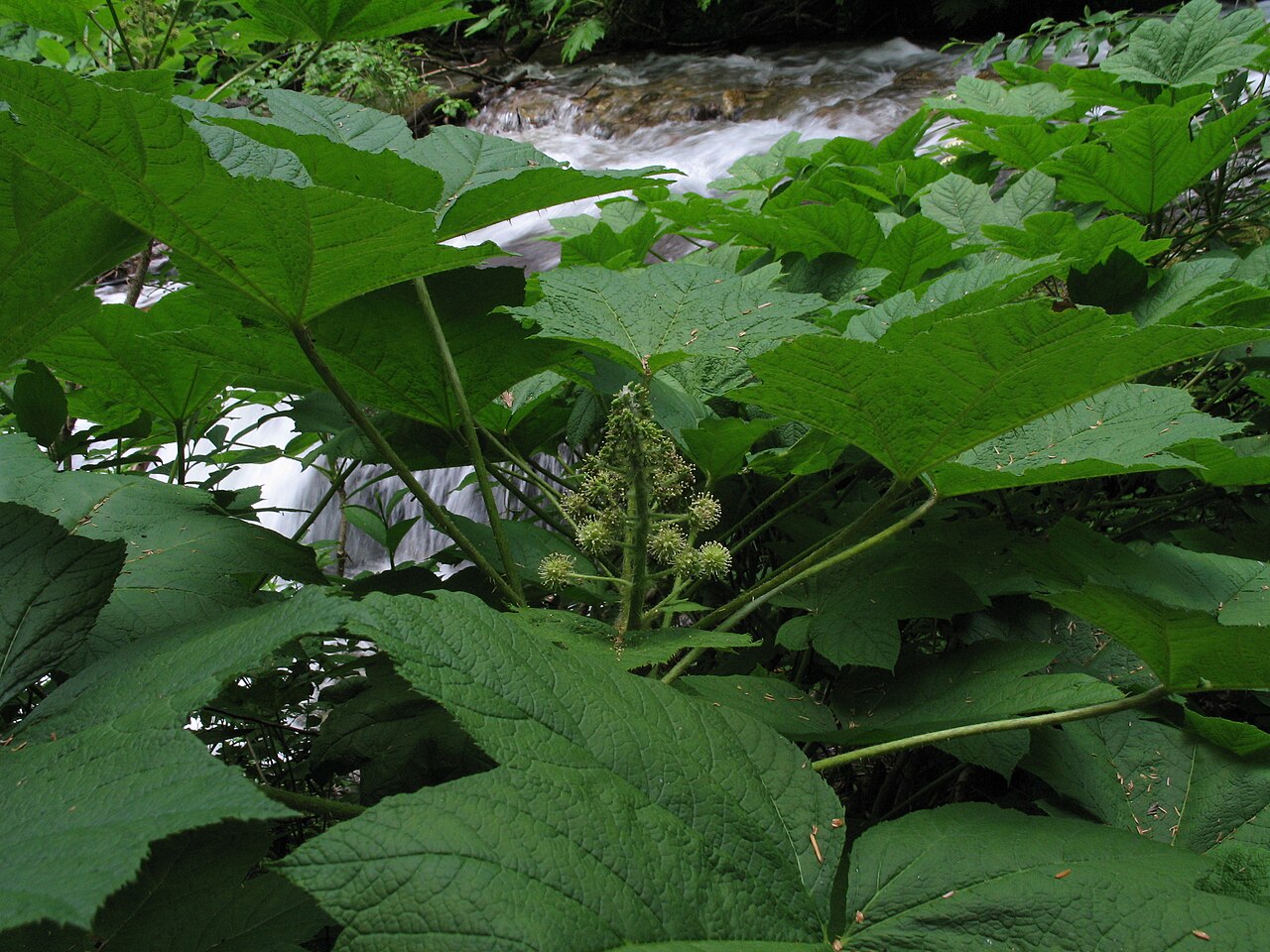
Oplopanax horridus, known as Devil’s Club (listed by USDA PLANTS as devilsclub), is a large deciduous shrub of the wet forests of northwestern North America and a member of the ginseng family (Araliaceae). It grows 3 to 10 feet tall, occasionally more, with thick, sparsely branched stems that are densely armed with sharp yellowish spines. At their tips it carries some of the largest leaves of any native shrub in the region: broad, maple-shaped blades often a foot or more across, with spines along their stalks and veins.
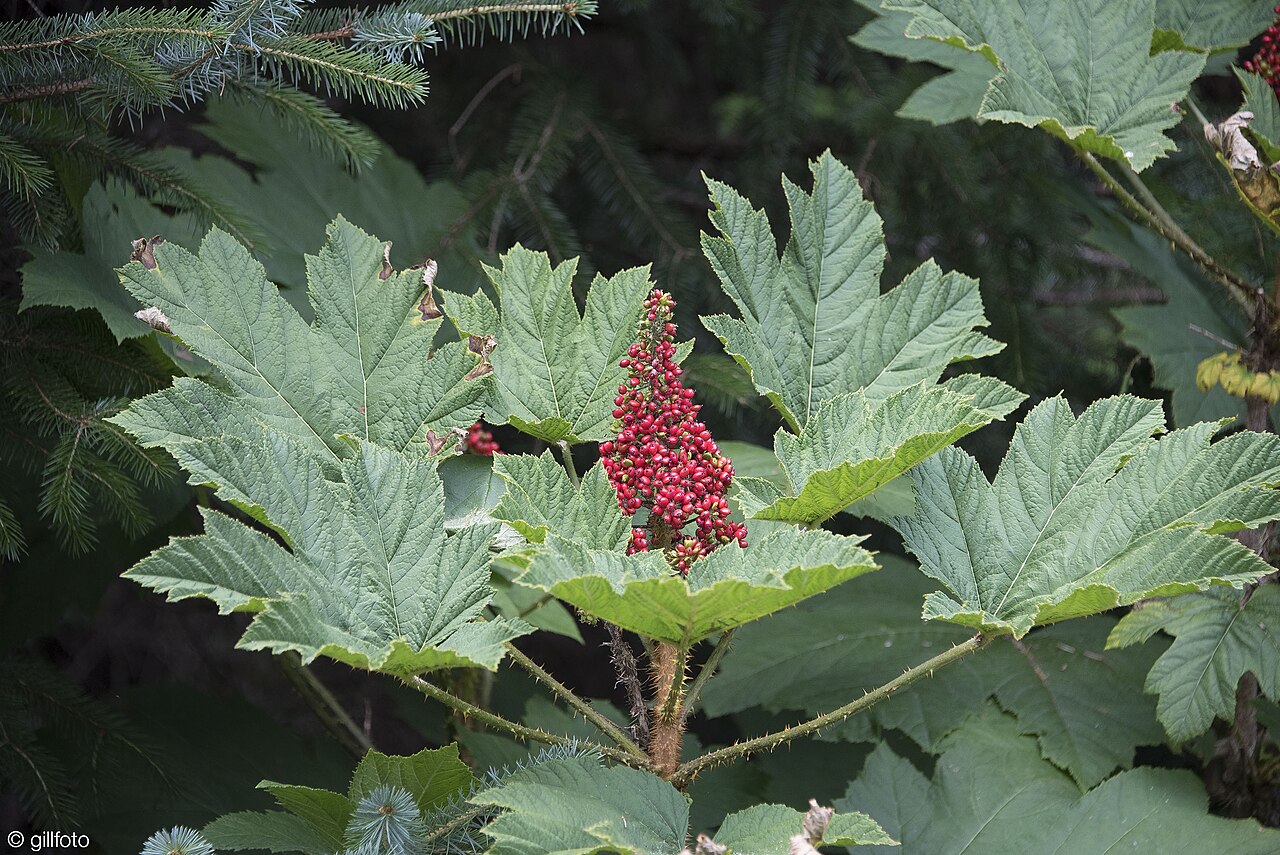
In early summer each stem holds a cone-shaped cluster of small greenish white flowers above its crown of leaves, and by late summer these become dense pyramids of glossy scarlet berries. With its tropical-looking foliage and bright fruit, devil’s club is one of the most striking plants of Pacific Northwest and Alaskan rainforests. It forms thickets in shaded seepage areas, along streams and in old-growth cedar and hemlock forests.
It is also one of the most culturally important plants of the region. For many Indigenous peoples of the Pacific Northwest and Alaska, devil’s club is a major medicine and a plant of spiritual protection. For hikers and foresters it is a formidable obstacle, as the common name and the species name horridus suggest. This guide covers identification, range, its rare place in shade gardens, its ecology and a clear safety note about its spines.
Identification
Devil’s club is unmistakable. No other native shrub in its range combines giant, maple-like leaves with stems covered in spines. Even in winter, the thick, spiny, leafless canes are easy to identify.
Stems & Spines
The stems are stout, up to about 1½ to 2 inches thick, pale brown and usually unbranched or sparsely branched. They often grow at an angle or sprawl along the ground and then curve upward, so a thicket can be a tangle of stems pointing in all directions. Every part of the stem is densely covered with stiff, needle-like yellowish spines up to about ½ inch long. Where sprawling stems touch moist ground they take root, so a single plant can spread into a large colony over time.
Leaves
The leaves are clustered near the tips of the stems on long stalks. Each is palmately lobed like a maple leaf, with five to nine pointed, toothed lobes, and typically 8 to 16 inches across; in deep, moist shade they can exceed 2 feet. The leaf stalks and the main veins on the underside bear small spines, and the upper surface often has scattered spines too. The leaves turn yellow in fall and drop early.
Flowers
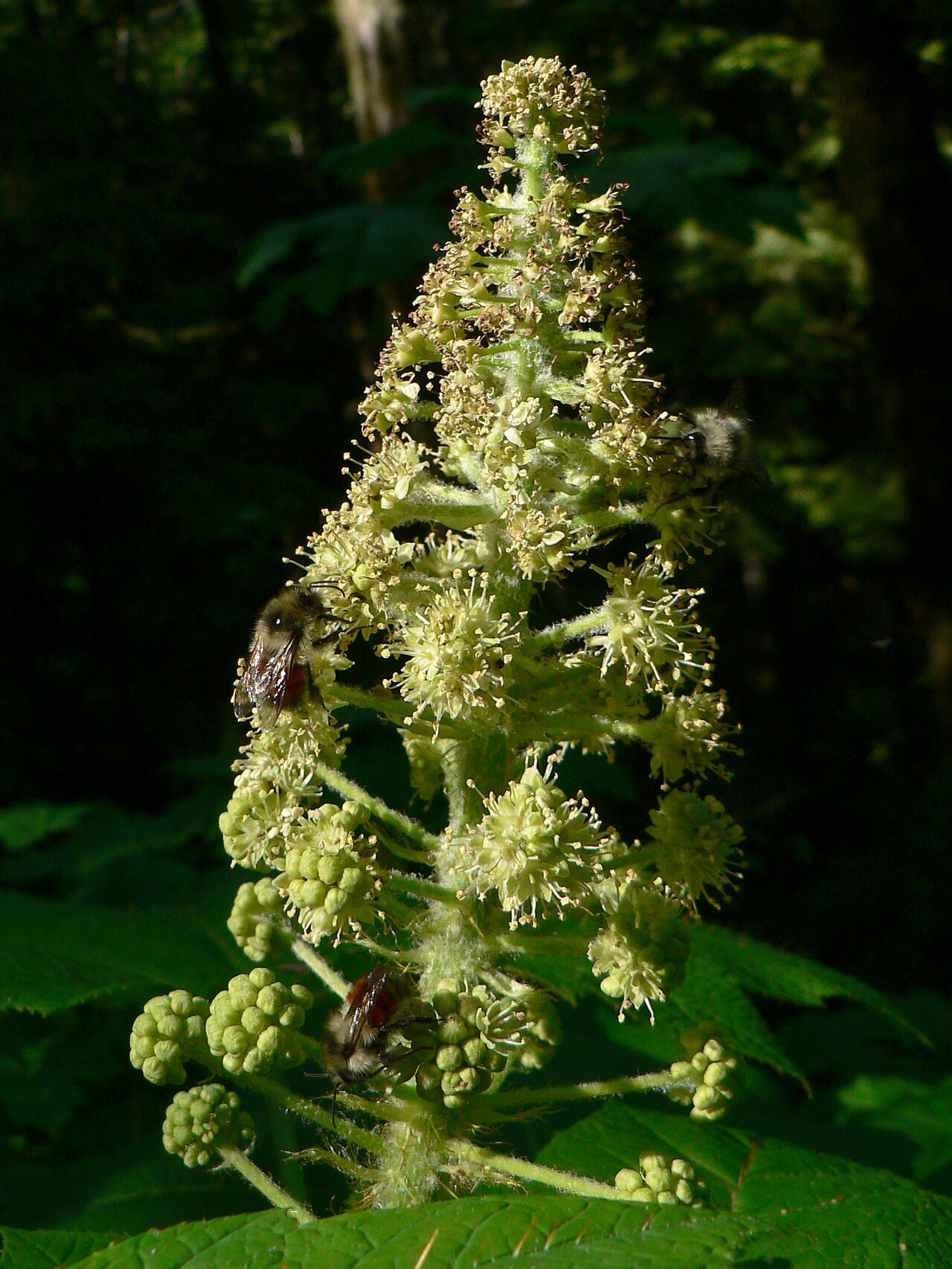
Flowers appear from about May to July, depending on elevation and latitude. They are small, about ¼ inch across, greenish white, with five petals and five stamens, and are grouped in many small, rounded umbels along a stout terminal stalk. The whole cluster is cone-shaped, 4 to 10 inches tall, and sits upright above the leaves.
Fruit
The fruits are flattened, shiny, bright red berries about ¼ inch across, each with two or three seeds. They ripen from late July to September in a dense cluster that stands out vividly against the green leaves. They are not considered edible for people.
Similar Species
Few plants could be confused with devil’s club. Thimbleberry (Rubus parviflorus) has similar maple-like leaves but no spines, white rose-like flowers and soft red fruit. Vine maple and other maples are trees or shrubs with opposite leaves and no spines. Bigleaf maple seedlings lack spines entirely.
Quick Facts
| Scientific Name | Oplopanax horridus (syn. Echinopanax horridus) |
| Family | Araliaceae (ginseng family) |
| Plant Type | Deciduous shrub with spiny stems; spreads by layering |
| Mature Height | 3–10 ft (occasionally to about 15 ft in sprawling thickets) |
| Mature Spread | 3–6 ft per plant; forms larger colonies over time |
| Growth Rate | Slow to moderate |
| Sun Exposure | Full shade to partial shade |
| Water Needs | High; soil must stay moist to wet |
| Soil Type | Rich, moist to wet organic soil, alluvium or seepy loam |
| Soil pH | About 5.0–7.0 |
| Bloom Time | May–July |
| Flower Color | Greenish white |
| Fall Color | Yellow, briefly before early leaf drop |
| Fruit | Pyramidal cluster of shiny bright red berries (not edible for people) |
| Deer Resistant | Yes; spines discourage browsing, though elk and deer may nibble young leaves |
| USDA Hardiness Zones | 4–8 |
Native Range
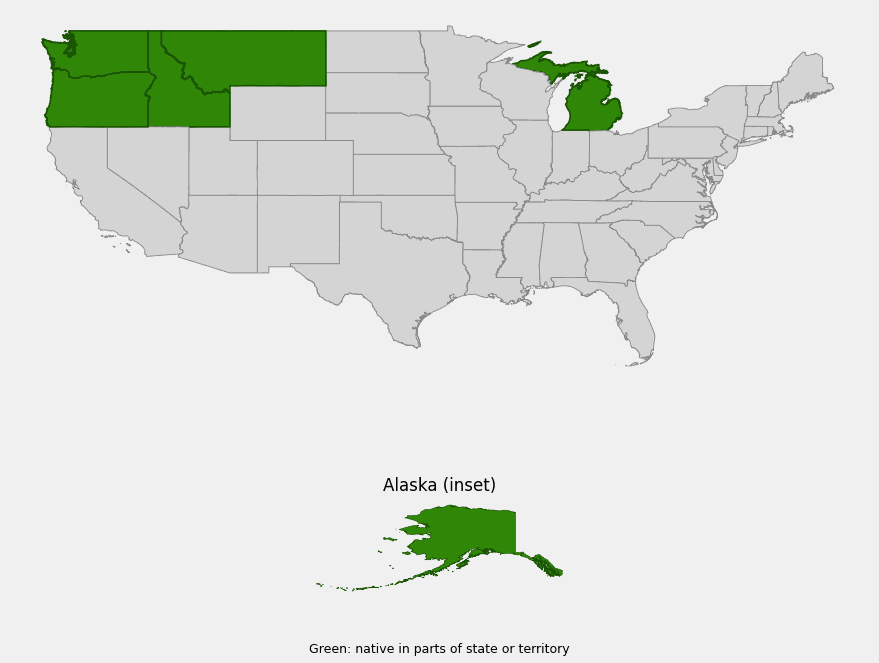
Devil’s club is native to the moist forests of northwestern North America. USDA PLANTS records it as native in Alaska, Washington, Oregon, Idaho, Montana and Michigan. In Canada it is common throughout British Columbia and also grows in western Alberta, the southern Yukon and a few islands in Lake Superior in Ontario. Its main range stretches from southern Alaska along the coast and the Cascades to Oregon, and inland through the wet interior cedar-hemlock forests of British Columbia, northern Idaho and northwestern Montana.
Its populations in the Great Lakes region are a remarkable disjunct, about 1,000 miles east of its main range. In the United States it grows only on Isle Royale and nearby islands in Lake Superior, Michigan, where it is rare and of conservation concern. Botanists interpret these populations as relicts left from a once wider range after the last glaciation, persisting in the cool, humid climate along the lake. The USDA PLANTS database also lists New York, but that record is not supported: NatureServe does not list the species for New York, and the only record is a single historical museum specimen without location data. This guide does not treat devil’s club as native there.
Within its range devil’s club favors shady, moist to wet sites: seepage slopes, stream and river banks, wet ravines, avalanche chutes and the understory of old-growth western redcedar, western hemlock and Sitka spruce forests. It ranges from sea level along the coast to subalpine forests at roughly 7,000 feet in the interior.
📋 Regional plant lists featuring Devil’s Club: Idaho, Eastern Oregon & Eastern Washington · Montana & Wyoming · Michigan, Wisconsin & Eastern Minnesota · Alaska
Growing & Care Guide
Devil’s club is a dramatic plant for large, shady, wet gardens in the Pacific Northwest and Alaska, but think carefully before planting it. Its spines make it a hazard near paths, play areas and anywhere people or pets move. It is slow to establish and needs consistently moist soil and shade. Buy nursery-propagated plants only and do not dig it from the wild. Wild harvesting for the herbal trade is already a concern in parts of its range.
Light
Plant it in full to partial shade. In the wild it grows under dense conifer canopy. Sun scorches the big leaves, and plants in bright sites grow stunted and yellowish unless the soil is very wet.
Soil & Water
Devil’s club needs rich, moist to wet soil high in organic matter, such as a seepy slope, a streambank or a low spot that stays damp all summer. It tolerates periodic flooding and saturated soils but not drought. In gardens outside the cool, humid Pacific Northwest and Alaska, it usually struggles.
Planting Tips
Site it well away from walkways, at the back of a woodland planting or along a stream, where its foliage can be admired at a distance. Plant container-grown stock in fall or early spring, water it thoroughly, and mulch with leaves or conifer duff. Allow plenty of room, since stems sprawl and root where they touch the ground.
Pruning & Maintenance
Little care is needed once established. If you must prune or remove stems, wear thick leather gloves, long sleeves and eye protection, and handle cuttings with tools, not hands. Dispose of cut stems where nobody will step on or brush against them.
Propagation
Devil’s club can be grown from seed, but seeds have complex dormancy and may need a warm period followed by a long cold period, with germination often taking two years. Stem cuttings and layered stems that have rooted where they touched the ground are easier ways to propagate it in a nursery setting.
Landscape Uses
- Large shade and woodland gardens: a bold, architectural foliage plant for the Pacific Northwest and Alaska
- Streambank and riparian plantings: for shaded, wet banks within its native range
- Barrier plantings: an impenetrable natural barrier in out-of-the-way wet woods
- Forest restoration: in moist conifer forest understories, using propagated stock
- Ethnobotanical gardens: to illustrate an important Indigenous medicinal plant, sited safely
Wildlife & Ecological Value
Devil’s club is a keystone of the wet forest understory. Its flowers feed insects, its berries feed bears and birds, and its thickets shelter wildlife along streams.
For Pollinators
The small greenish flowers produce nectar and pollen visited by many small insects, including flies, small bees, wasps and beetles. Flowering in early summer, devil’s club is an important food source in shady forests where few other plants bloom.
For Birds
Thrushes, including American robins and varied thrushes, and other fruit-eating birds eat the red berries and spread the seeds. The dense, spiny thickets offer protected nesting and foraging cover for small birds in moist forests.
For Mammals
Black bears and grizzly bears eat the berries in late summer. Elk and deer browse the leaves only lightly because of the spines, though they may nibble young growth. The spines protect thickets that serve as cover for small mammals along streams.
Ecosystem Role
Devil’s club is an indicator of moist, nutrient-rich forest sites with flowing groundwater. By spreading through layering it forms long-lived clonal patches, which help stabilize streambanks and seepage slopes. Its presence in old-growth forest understories reflects stable, shaded conditions, and it often declines after clearcutting.
Cultural & Historical Uses
Devil’s club is one of the most important medicinal and spiritual plants for many Indigenous peoples of the Pacific Northwest and Alaska, including Tlingit, Haida, Tsimshian, Nuxalk, Kwakwaka’wakw and Coast Salish peoples, as well as Interior peoples of British Columbia. The inner bark and roots have been used in many traditional remedies. The plant’s spines and power have long been associated with spiritual protection, and sticks were used as protective charms. It has also been used to make fishing lures, black face paint from charred stems, and deodorants.
The plant has drawn modern research interest, and devil’s club products are sold in the herbal trade. Many Indigenous communities and conservation groups are concerned that commercial harvest of the slow-growing roots could damage wild populations. It is not regulated for trade in most places, but harvesting is best left to those with traditional rights and knowledge.
Safety note: the spines of devil’s club break off easily in skin and can cause painful wounds that may become inflamed or infected. Some people have stronger reactions. Always wear heavy gloves and protective clothing when working near it, and keep it away from paths and play areas. The red berries are not considered edible for people. Do not use devil’s club as a home remedy without qualified guidance.
Frequently Asked Questions
Why is it called devil’s club?
Because its thick stems are covered with sharp spines, like a spiked club. The species name horridus means “bristly” or “prickly” in Latin, and the genus name Oplopanax combines the Greek hoplon (weapon) with Panax, the ginseng genus.
Are devil’s club spines dangerous?
They are not poisonous, but they break off easily in the skin and can cause painful, sometimes infected wounds. Wear heavy gloves and long sleeves around the plant, and remove spines promptly with tweezers.
Can I eat devil’s club berries?
No. The bright red berries are not considered edible for people, even though bears and birds eat them. Leave them for wildlife.
Is devil’s club native to Michigan?
Yes. It grows naturally on Isle Royale and nearby islands in Lake Superior, far east of its main range. These rare populations are thought to be relicts from the end of the last ice age and are protected within Isle Royale National Park.
Can I grow devil’s club in my garden?
Yes, if you have a large, shady, consistently moist site in a cool, humid climate such as the Pacific Northwest or southern Alaska. Use nursery-propagated plants and site it far from paths. It does poorly in hot, dry regions.

Looking for a nursery that carries Devil’s Club?
Browse our native plant nursery directory: Alaska · Idaho · Michigan & Montana · Oregon · Washington