
Dildo Cactus (Pilosocereus royenii)
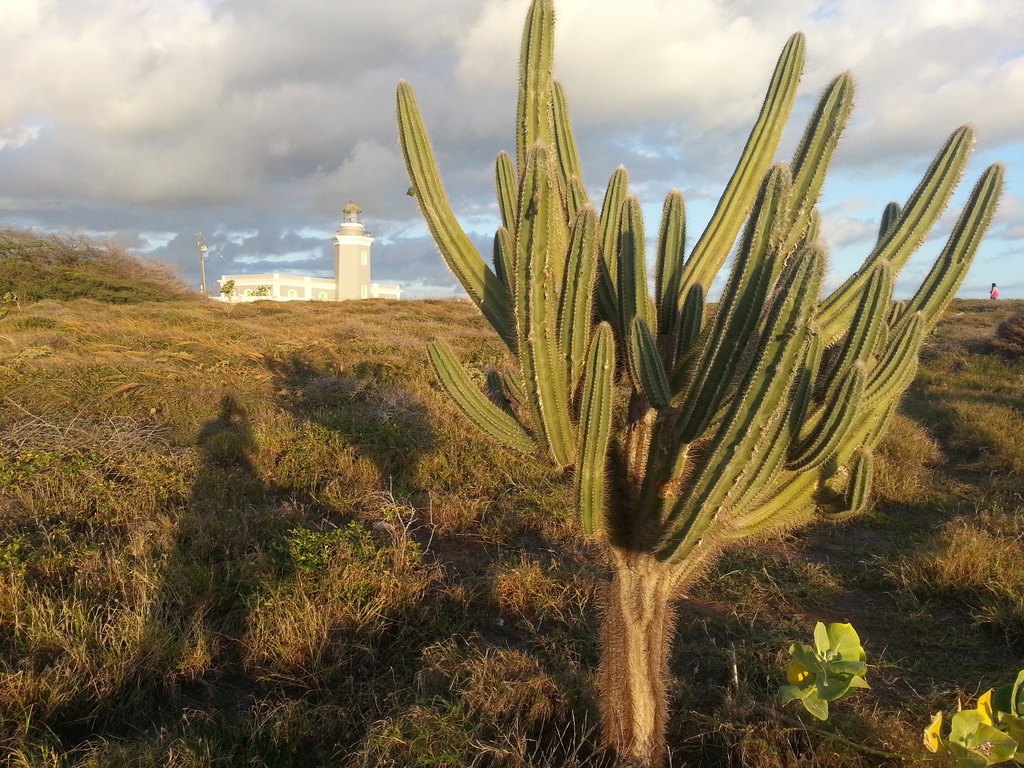
Pilosocereus royenii, the Dildo Cactus, is the tall columnar cactus of Puerto Rico’s dry coasts and hills. In Puerto Rico it is called sebucán, and the English name refers to its upright, finger-like stems. A mature plant is a blue-green candelabra 6 to 20 feet tall, ribbed, spiny, and crowned at flowering time with long white hairs. It is the signature plant of the Guánica dry forest, the cactus you see on headlands at Cabo Rojo, and a familiar silhouette on Mona, Desecheo, Vieques and Culebra.
This is a cactus of hot, bright, well-drained ground: limestone headlands, coastal scrub, rocky serpentine slopes and the thorny semi-deciduous forest of the southern coast. The Institute for Regional Conservation treats it as endemic to the Puerto Rico Platform, the shallow bank that carries Puerto Rico, Vieques, Culebra, Mona, Desecheo, Caja de Muertos and the Virgin Islands, and records it in the Guánica and Susúa state forests, Sierra Bermeja and Punta Guaniquilla, among other places. It is common and assessed as Least Concern, though like all cacti it is listed on CITES Appendix II.
In a garden it is dramatic, tough and almost free of maintenance: full sun, sharp drainage and nothing else. Its flowers open after dark and feed nectar-feeding bats and moths, and its magenta fruit feeds birds and bats, so a single plant does real work for wildlife in a dry coastal yard. This guide covers how to recognize it, where it grows in Puerto Rico, how to grow it from cuttings or seed, and the taxonomy behind its several names.
Identification
Puerto Rico has several native cacti, but only a few grow into tall columns. Dildo cactus is the common one: upright, branched from near the base, blue-green when young, with white hair and long spines along the ribs. The tiny black seeds, red fruit and night-blooming flowers finish the identification.
Growth Form
Dildo cactus grows as a branched, tree-like succulent, most often 6 to 20 feet tall, occasionally taller on sheltered sites. Older plants develop a short, woody, gray trunk and a crown of upright branches that gives the whole plant the look of a candelabra. Young plants are a single unbranched column. Stems are typically 2 to 4 inches thick, and the plant is shallowly rooted, relying on a wide, fine root system to catch brief rain.
Stems & Spines
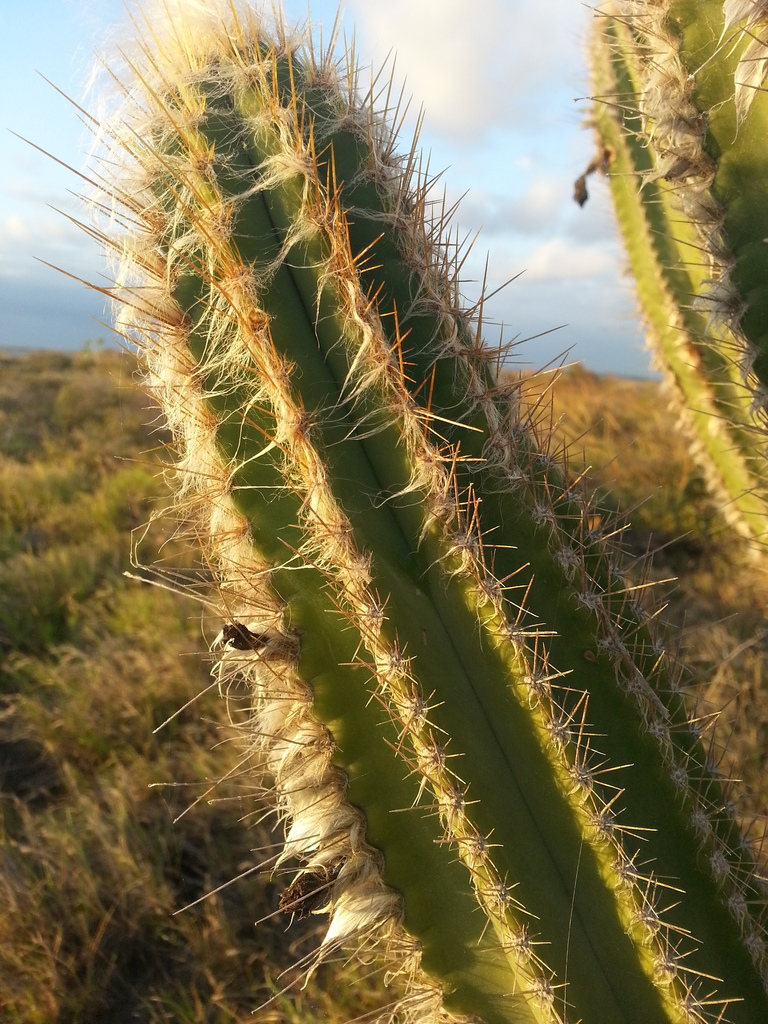
The stems carry about 7 to 11 broad ribs and are waxy blue-green, aging to dull gray-green. Along the ribs, the areoles bear stiff yellowish to brown spines, the longest up to about 2½ inches, together with soft white hairs that can be well over an inch long. Hair is sparse on ordinary stems but builds up densely near the tips of branches that are ready to flower, which is the feature the genus name describes: Pilosocereus means “hairy cereus.”
Flowers
Flowers open at night. Each is a stout, funnel-shaped tube about 2 to 3 inches long, with thick, waxy outer segments in pale green to pink and paler inner segments, opening to a bowl of stamens. They emerge from the hairy areoles near the branch tips, usually a few at a time over a long season, and they close during the following morning. Flowering happens mainly in the spring and summer but can occur in most months.
Fruit & Seeds
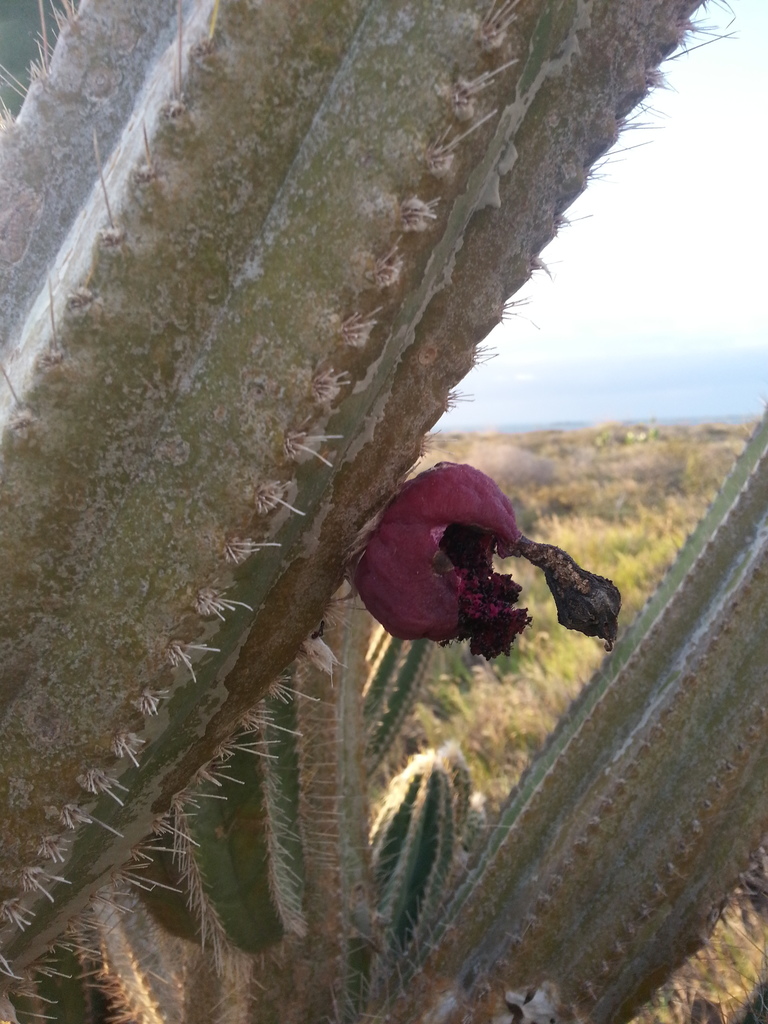
The fruit is a smooth, rounded, spineless berry one to two inches across that ripens from green to deep magenta or purplish red. When ripe it splits along one side on the plant, exposing a mass of juicy, dark red pulp packed with very small, shiny black seeds. The withered flower often stays attached at the tip. Fruit can be found at almost any time of year on a large plant.
Similar Species
The other tall cactus likely to be confused with it in Puerto Rico is the slender, fiercely spiny Leptocereus quadricostatus and other native columnar cacti of the southwest, which lack the long white hairs. Smaller native cacti such as Melocactus, with its woolly flowering cap, and the prickly pears (Opuntia) are not similar in form.
Quick Facts
| Scientific Name | Pilosocereus royenii (L.) Byles & Rowley (syn. Cephalocereus royenii, Cereus royenii; Puerto Rican plants treated by recent authors as Pilosocereus armatus) |
| Family | Cactaceae (cactus family) |
| Plant Type | Evergreen columnar succulent; tree-like cactus |
| Mature Height | 6–20 ft |
| Mature Spread | 3–8 ft |
| Growth Rate | Moderate for a cactus; a few inches of stem a year |
| Sun Exposure | Full sun |
| Water Needs | Very low; drought tolerant |
| Soil Type | Sharply drained sand, gravel, limestone rubble or rocky soils |
| Soil pH | Adaptable; common on alkaline limestone |
| Bloom Time | Mainly spring and summer; flowers open at night |
| Flower Color | Pale green to pink outside, whitish within |
| Fall Color | None; evergreen succulent |
| Fruit | Magenta berry 1–2 in, splitting to show dark red pulp |
| Deer Resistant | Not applicable in Puerto Rico; spines deter most browsing |
| USDA Hardiness Zones | 10–11 |
Native Range
USDA PLANTS lists Pilosocereus royenii (symbol PIRO6) as native to Puerto Rico and the U.S. Virgin Islands; it is not native to any state in the continental United States. The Institute for Regional Conservation describes it as endemic to the Puerto Rico Platform, the shallow bank that links Puerto Rico with Vieques, Culebra, Mona, Desecheo, Caja de Muertos and the Virgin Islands. The Smithsonian’s Flora of the West Indies also records plants under this name through the Lesser Antilles and parts of the Greater Antilles, a wider sense of the name that recent revisions have narrowed.
Within Puerto Rico it is a plant of hot, dry, low elevations. The Institute for Regional Conservation maps it in the northern coastal lowlands around Fajardo, the eastern coast at Ceiba, the southern coastal lowlands at Ponce and Caja de Muertos, and the southwestern coastal lowlands at Cabo Rojo, as well as Vieques, Culebra, Mona and Desecheo. It is present in the Guánica State Forest, the Susúa State Forest, Sierra Bermeja, Punta Guaniquilla and the Jobos Bay reserve. It grows from sea level up into the dry foothills, on limestone headlands, coastal scrub, rocky slopes and the edges of salt flats.
Taxonomy has moved under this plant. Plants of the World Online no longer accepts Pilosocereus royenii as applied in the old broad sense and places the Puerto Rican and Virgin Islands populations in Pilosocereus armatus, following the revision of Caribbean Pilosocereus published in 2019 and the new combination made in 2021. USDA PLANTS and the Puerto Rico native plant list still use P. royenii, and that is the name used on this page; a plant labeled P. armatus at a Puerto Rican nursery is the same cactus. On PlantNative it is listed for Puerto Rico only.
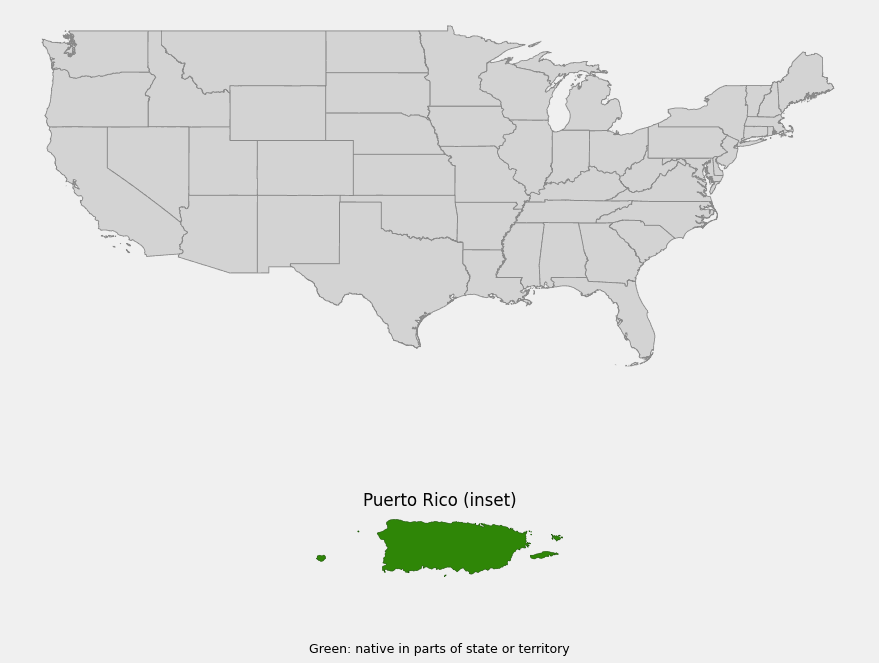
📋 Regional plant lists featuring Dildo Cactus: Puerto Rico
Growing & Care Guide
Dildo cactus is as easy as a plant gets in the right place: hot, sunny and dry, with soil that never stays wet. It is best used as a specimen or in a cactus and succulent bed, where its height and spines are an asset and nobody will brush past it.
Light
Full sun, all day. It grows in the most exposed places in the Puerto Rican landscape, on bare limestone and open scrub, and it tolerates reflected heat from walls and paving. Plants in shade grow thin, lean toward the light and rarely flower.
Soil & Water
Drainage is everything. Sand, gravel, limestone rubble and shallow rocky soils all suit it, and in a container it needs a gritty cactus mix with ample drainage holes. Established plants need no irrigation in Puerto Rico; rain is enough, and too much water in heavy soil causes soft rot at the base. If you water a container plant, soak it and then let it dry out completely.
Planting Tips
Plant at the start of the dry season rather than the wet season so cut roots and bruises can heal. Dig a wide, shallow hole, set the plant at the depth it grew before, and backfill with coarse, free-draining material. Handle large stems with folded cardboard or carpet strips and a helper, and stake a tall cutting until it anchors. Keep it well away from paths, doorways and places where children play.
Pruning & Maintenance
Almost none. Remove damaged branches with a clean saw and let the cut dry; do not seal it. Plants knocked over by storms usually re-root where they lie, or can be re-set and staked. Watch for cochineal scale, the white cottony insect on the stem surface, which can be washed off with a strong jet of water. Do not fertilize; lush growth is weak growth in a cactus.
Propagation
Both cuttings and seed work. For cuttings, remove a branch at a rib joint, let the cut face callus in a dry, shaded place for one to three weeks until it is hard, then set it a few inches deep in gritty mix and keep it barely moist until roots form. For seed, scoop the pulp from a ripe fruit, wash the tiny black seeds, and sow them on the surface of a sandy mix kept warm and lightly moist; seedlings appear within a few weeks but take years to reach any size. Always use nursery plants or cuttings offered by their owner rather than taking material from wild populations.
Landscape Uses
- Dry coastal gardens: a sculptural native for salt-swept, sandy or rocky sites
- Cactus and succulent beds: height and structure above low succulents and groundcovers
- Wildlife gardens: night flowers for bats and moths, fruit for birds
- Barrier and boundary plantings: a spiny, impenetrable column along a property line
- Containers and rooftops: slow, shallow-rooted and happy in full sun and heat
Wildlife & Ecological Value
Columnar cacti are keystone plants in Caribbean dry forest. In a landscape where flowering and fruiting are tightly tied to the rains, a mature dildo cactus offers nectar at night and sweet, water-rich fruit at almost any time of year.
For Pollinators
The flowers have the classic signature of bat pollination: they open after dark, they are stout and strongly built with a wide mouth and plenty of nectar, and they are dull-colored rather than showy. Nectar-feeding bats are the principal pollinators of Pilosocereus in the Caribbean, and hawkmoths also visit the open flowers at night. Bees and other insects work the flowers that are still open in the first hours after dawn and collect the abundant pollen.
For Birds
The magenta fruit splits open on the plant and is taken readily by birds, which scatter the tiny seeds. In dry coastal scrub the fruit is a dependable source of moisture as well as food. The stout branches and spines also give small birds protected nest and perch sites, and cavities in old stems are used by lizards and invertebrates.
For Mammals
Fruit bats feed on the ripe pulp and are probably the main long-distance seed dispersers, carrying seeds between headlands and offshore islands. Puerto Rico’s native land mammals are all bats, and both nectar-feeding and fruit-eating species use this cactus at different stages of its cycle.
Ecosystem Role
In the Guánica dry forest and on coastal limestone, dildo cactus is a structural element of the vegetation, providing shade and a nurse site where seedlings of dry-forest trees and shrubs can establish. Fallen stems hold moisture as they decay and support a specialized community of insects.
Cultural & Historical Uses
In Puerto Rico this cactus is known as sebucán, a name also used in the Spanish-speaking Caribbean for the long woven press used to squeeze grated cassava. The English name dildo, has long been applied to columnar cacti in the English-speaking West Indies and refers to their upright, cylindrical stems. USDA PLANTS lists the species under the name Royen’s tree cactus, after the Dutch botanist Adriaan van Royen, whom Linnaeus honored when he described the plant as Cactus royenii in 1753.
Traditional uses across the dry Caribbean are practical. The ripe fruit is edible, sweet and intensely colored, and has been eaten fresh. The light, perforated woody skeleton left when a stem decays has long been collected for craft work and rustic furniture, and columnar cacti have been planted as living fences and property markers in dry country. In Puerto Rico the plant is also a landscape symbol of the south coast: it appears in paintings, photographs and tourist images of Guánica, Cabo Rojo and Mona.
Conservation is less about rarity than about trade and habitat. The IUCN assesses the species as Least Concern, but every member of the cactus family is listed on CITES Appendix II, so international movement of plants and seed is regulated. The bigger pressure in Puerto Rico is coastal development in the dry southwest, where its habitat is also habitat for rarer plants and animals. Buy nursery plants or take a cutting with permission; do not dig wild plants, which rarely survive the move and leave a gap that takes decades to fill.
Frequently Asked Questions
Why is it called dildo cactus?
The name has been used for tall columnar cacti throughout the English-speaking Caribbean for centuries and comes from an old English word for a cylindrical pin or peg. In Puerto Rico the usual name is sebucán, and USDA uses Royen’s tree cactus.
Is Pilosocereus royenii the same as Pilosocereus armatus?
For Puerto Rico, yes. Recent work on Caribbean Pilosocereus concluded that the name P. royenii cannot be applied with certainty and placed the Puerto Rican and Virgin Islands plants in P. armatus. USDA PLANTS and the Puerto Rico native plant list still use P. royenii, so you will see both names for the same cactus.
Can you eat the fruit?
The ripe magenta fruit has sweet, dark red pulp and is edible, eaten fresh like other cactus fruit. Handle it carefully, because the skin and surrounding areoles carry spines and fine hairs, and leave plenty on the plant for birds and bats.
How fast does it grow, and how big will it get?
Expect a few inches of new stem a year once it is settled, with most garden plants reaching 6 to 15 feet over many years and old wild plants reaching about 20 feet. It branches with age into a candelabra shape.
How do I start a new plant from a cutting?
Cut a branch at a joint, stand it in a dry, shaded, airy place for one to three weeks until the cut is hard and dry, then plant it a few inches deep in gritty soil. Water sparingly until it roots, usually within a couple of months in warm weather. Never take cuttings from wild plants without the landowner’s permission.

Looking for a nursery that carries Dildo Cactus?
Our nursery directory does not yet include Puerto Rico. Browse the native plant nursery directory by state: Alabama–Arkansas · California · Colorado–Hawaii · Idaho–Kansas · Kentucky–Montana · Nebraska–Oklahoma · Oregon · Pennsylvania–Virginia · Washington · West Virginia–Wyoming