
Puerto Rico Applecactus (Harrisia portoricensis)
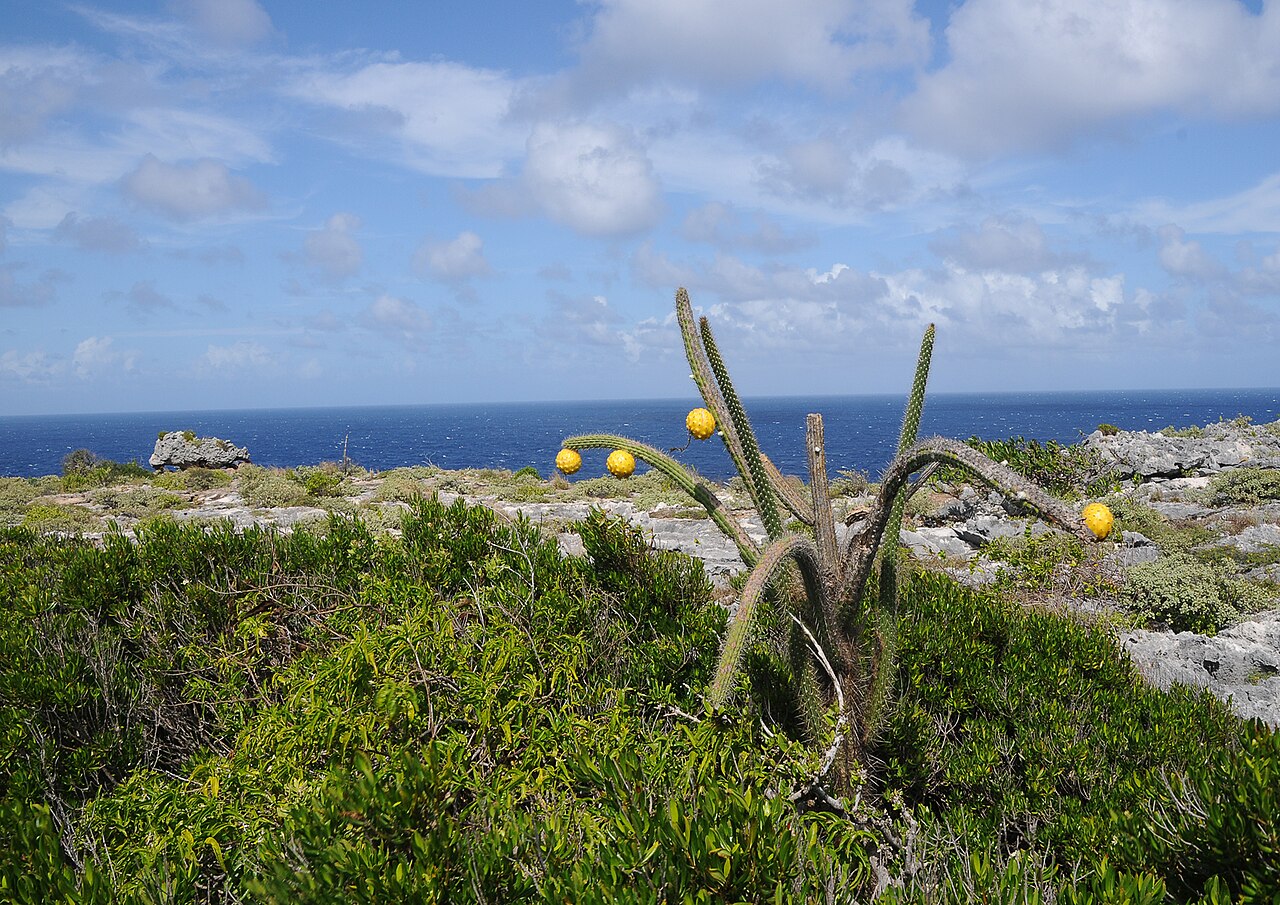
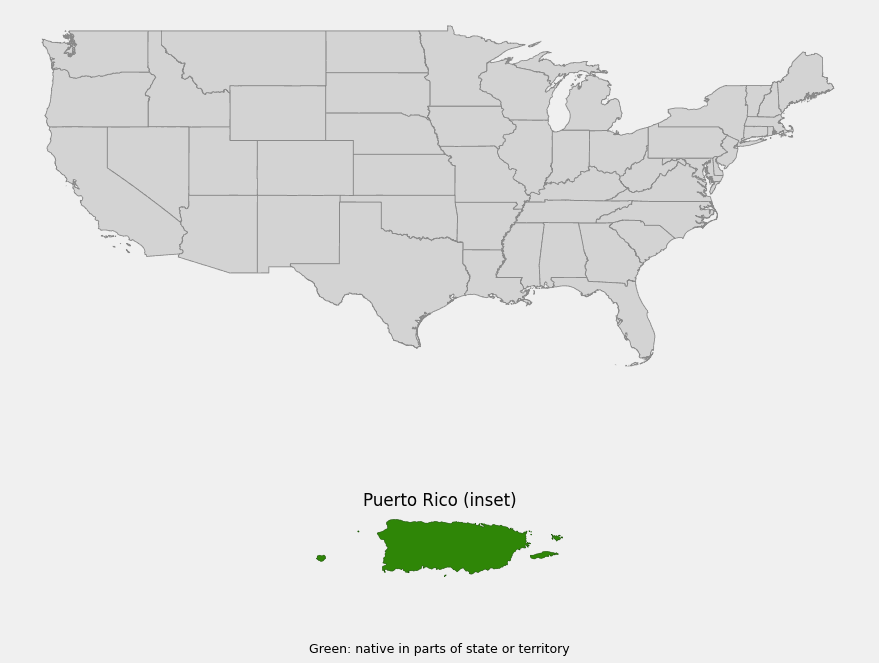
Harrisia portoricensis, the Puerto Rico Applecactus, is known in Puerto Rico as higo chumbo. It is a slender, upright columnar cactus found nowhere else in the world: the Smithsonian’s Flora of the West Indies lists it as endemic to Puerto Rico, on the offshore islands of Mona, Monito and Desecheo. USDA PLANTS lists it as native to Puerto Rico under the common name Puerto Rico applecactus.
Higo chumbo is federally listed as threatened under the U.S. Endangered Species Act. The U.S. Fish and Wildlife Service listed it in 1990, when it was known only from those three small islands. It was first described in 1908 from plants collected near Ponce on the main island, but that population has since disappeared. The largest remaining population, on Mona Island, was estimated at about 59,000 plants in 2009, while Monito held about 148 plants and Desecheo fewer than ten.
With its night-opening flowers and round yellow “apples,” higo chumbo is a striking symbol of Puerto Rico’s dry offshore islands. It is rarely available to gardeners. If you ever grow one, buy only nursery-propagated plants from a reputable source, and never collect plants, cuttings, fruit or seed from the wild. All of its native sites are protected refuges and reserves.
Identification
Higo chumbo is easy to recognize where it grows: tall, thin, few-branched cactus stems rising out of dense dry scrub, with spiny ribs and, in season, round yellow fruits the size of a small apple. It is the only Harrisia native to Puerto Rico.
Form & Stems
This is an upright cactus with only a few branches, usually 6.5 to 10 feet (2–3 m) tall. The stems are slender, only 1 to 1.5 inches (3–4 cm) thick, and have about eleven rounded ribs separated by shallow furrows. In the wild the stems often lean on or grow up through surrounding shrubs.
Spines
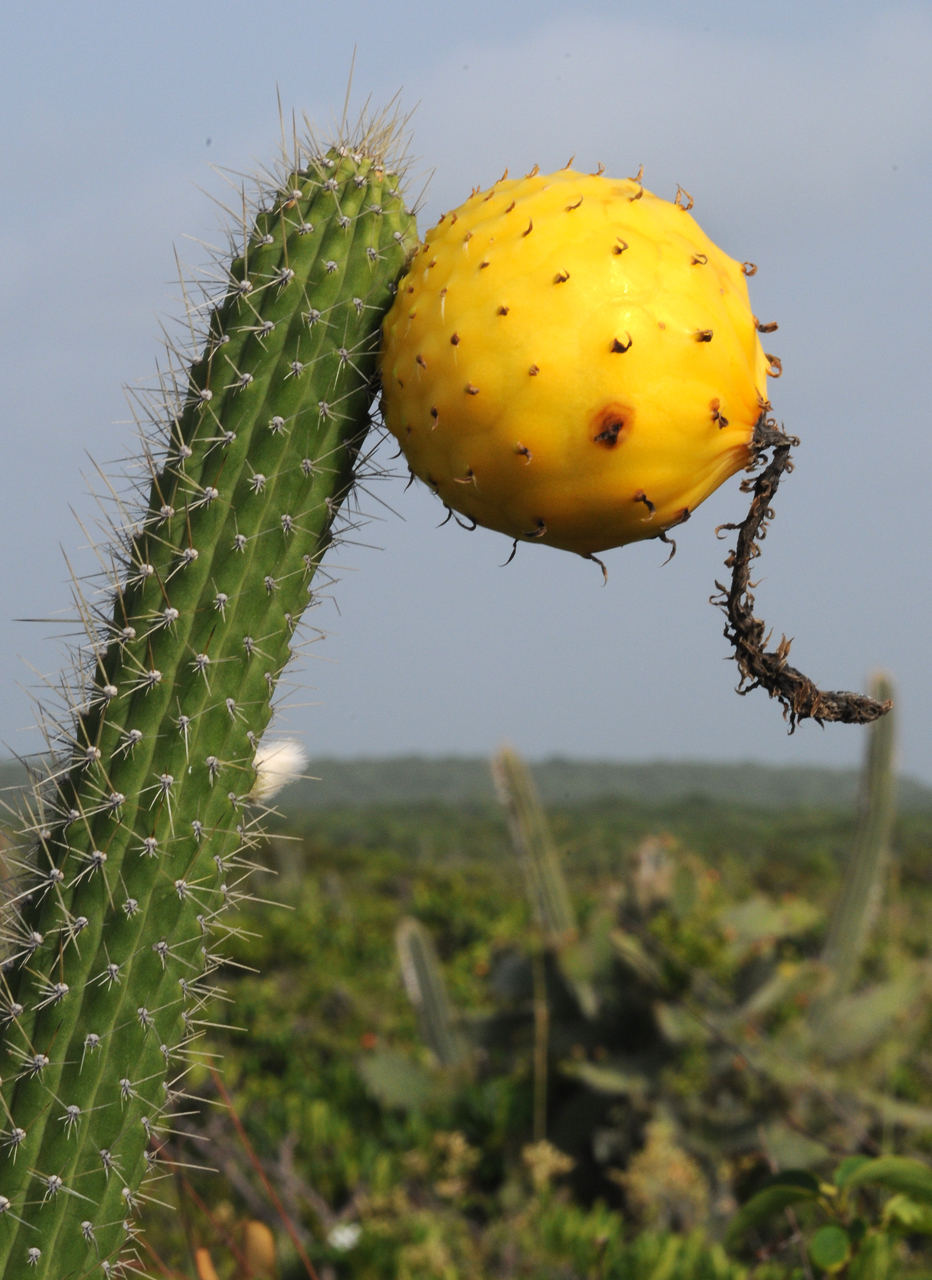
Each areole along the ribs carries a cluster of 13 to 17 grayish-white spines with darker tips, each about 0.8 to 1.2 inches (2–3 cm) long. The spines give the stems a bristly, pale look from a distance.
Flowers
Like other members of its genus, higo chumbo has large, white, funnel-shaped flowers that open at night. They can be up to about 6 inches (15 cm) long. Each flower lasts a single night. Plants may bloom at any time of year, but the peak is usually from May to July, and buds often wait for weeks and then open after a heavy rain.
Fruit
The fruits are round to egg-shaped and bright yellow when ripe, about 1.5 to 2.5 inches (4–6 cm) across, with scattered tufts of spines. They give the plant its common names: “applecactus” in English and “higo chumbo” (a name for prickly fruit) in Spanish. Each fruit holds many small seeds.
Quick Facts
| Scientific Name | Harrisia portoricensis Britton |
| Family | Cactaceae (cactus family) |
| Plant Type | Columnar cactus (shrub-like) |
| Mature Height | 6.5–10 ft |
| Mature Spread | Narrow; a few slender stems 1–1.5 in thick |
| Growth Rate | Slow |
| Sun Exposure | Full sun to partial shade; seedlings need shade |
| Water Needs | Low; very drought tolerant |
| Soil Type | Thin, rocky limestone soils; must drain freely |
| Soil pH | Neutral to alkaline (limestone) |
| Bloom Time | Year-round; peak May–July |
| Flower Color | White; opens at night |
| Fall Color | None; evergreen stems |
| Fruit | Round yellow “apple,” 1.5–2.5 in across, with many small seeds |
| Deer Resistant | Not rated (no deer in Puerto Rico); damaged by feral goats and pigs |
| USDA Hardiness Zones | Frost-free tropics only (about zones 10b–12) |
Native Range
Puerto Rico applecactus is endemic to Puerto Rico. USDA PLANTS lists it as native in Puerto Rico, and the Smithsonian’s Flora of the West Indies records it on Mona, Monito and Desecheo, three small, dry islands in the Mona Passage between Puerto Rico and Hispaniola. It grows in scrubland on exposed limestone from sea level to about 500 feet (150 m).
Mona Island holds by far the largest population. There, higo chumbo is most common in the open Cactus Forest but also grows in the island’s plateau forest, depression forest, cliffside forest and plateau shrub forest. Monito, a tiny cliff-ringed islet next to Mona, supports about 148 adult plants. On Desecheo, an estimated 550 plants in 1994 had fallen to about nine by 2003, after years of damage from introduced goats and monkeys, hurricanes and drought.
The species was first collected in the Las Cucharas area west of Ponce on the main island, but that population was lost to development. To bring it back, the U.S. Fish and Wildlife Service and its partners have planted higo chumbo at the Cabo Rojo National Wildlife Refuge, Caja de Muertos Natural Reserve off Ponce and, in 2009, 25 plants at Los Morillos in the Boquerón Commonwealth Forest. The recovery plan also names the Guánica dry forest as a possible site for new populations.
📋 Regional plant lists featuring Puerto Rico Applecactus: Puerto Rico
Growing & Care Guide
Higo chumbo is a plant for conservation collections, botanical gardens and dry-forest restoration rather than an ordinary garden plant, and it is seldom sold. If you do obtain a nursery-propagated plant, treat it like other tropical columnar cacti: lots of light, sharp drainage and very little water. Never take plants, cuttings, fruit or seed from wild populations; all are protected.
Light
Mature plants grow in full sun to light shade among dry scrub. Young plants are different: field studies on Mona found that seeds sown in open, sunny spots did not germinate, while seedlings survived best in the shade of native shrubs such as Croton discolor and Reynosa uncinata, which act as “nurse plants.”
Soil & Water
In the wild higo chumbo grows on thin, rocky soil over limestone in one of the driest parts of Puerto Rico. Plant it in very fast-draining, gravelly or rocky soil and water only during long dry spells after it is established. Wet, poorly drained soil will rot the stems.
Planting Tips
Buy only nursery-propagated plants with documentation of their origin, and check whether any permits are required. Good sites are sunny, dry rock gardens or restoration plantings in the dry southwest of Puerto Rico. Because its slender stems lean on their neighbors, it looks natural growing up through low native shrubs.
Pruning & Maintenance
No pruning is needed. Remove broken or rotting stems. Check plants for the Harrisia cactus mealybug (Hypogeococcus pungens), an introduced South American pest that causes twisted, deformed growth and is considered a major threat to the species. Do not move cactus plants or cuttings between islands, which can spread this pest.
Propagation
Propagation is best left to conservation nurseries. In one study, stem cuttings collected in the field did not survive in a greenhouse. On Mona, seeds that had passed through pearly-eyed thrashers germinated, while seeds from other birds’ droppings did not. Seedlings need shade and protection while they establish.
Landscape Uses
- Conservation plantings: helps the recovery of a federally threatened cactus found only in Puerto Rico
- Dry-forest restoration: fits coastal dry scrub on limestone, under nurse shrubs
- Botanical collections: a rare endemic for public gardens and teaching collections
- Rock and cactus gardens: for frost-free, very dry, fast-draining sites
- Wildlife food: its yellow fruits are eaten by native birds
Wildlife & Ecological Value
Higo chumbo is part of the unusual dry-forest community of Mona, Monito and Desecheo, islands that are managed as nature reserves and wildlife refuges.
For Pollinators
The large white flowers open at night. On Mona, researchers watching 38 plants for more than 300 hours recorded only five brief visits, all by the tetrio sphinx moth (Pseudosphinx tetrio), whose tongue is too short to be an effective pollinator. Most seeds are produced by self-pollination, which researchers think is aided by wind.
For Birds
Birds eat the ripe yellow fruits. On Mona, only seeds that had passed through the pearly-eyed thrasher (Margarops fuscatus) germinated in a study; seeds from the droppings of the Greater Antillean grackle and the endangered yellow-shouldered blackbird did not. The thrasher appears to be its main seed disperser.
For Mammals
No native mammals are known to depend on higo chumbo. Introduced feral goats and pigs on Mona, and goats and monkeys on Desecheo, have damaged or eaten the plants.
Ecosystem Role
Higo chumbo is a characteristic plant of Mona’s Cactus Forest, where it grows among native shrubs that shelter its seedlings. It belongs to the same dry, rocky coastal plant community as other Puerto Rican cacti such as the Turk’s cap cactus. Its fruits feed birds, which in turn spread its seeds to new sheltered spots.
Cultural & Historical Uses
The genus Harrisia honors William Harris, superintendent of public gardens and plantations in Jamaica. Nathaniel Lord Britton of the New York Botanical Garden described Harrisia portoricensis in 1908; the species name means “of Puerto Rico.” Ignatz Urban later placed it in Cereus as Cereus portoricensis, a name now treated as a synonym.
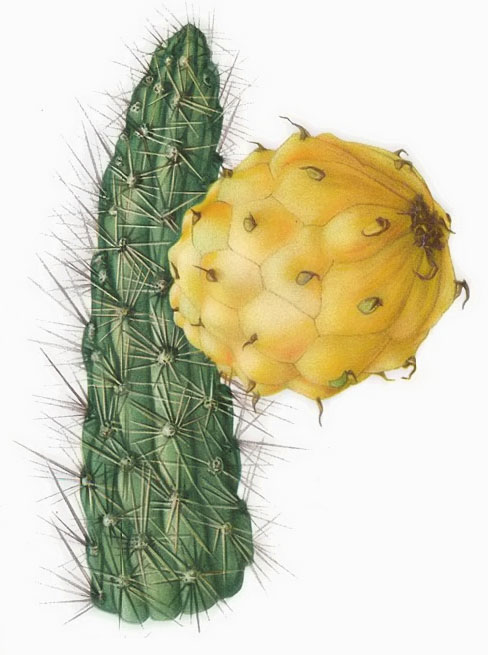
The Spanish name higo chumbo is used across the Spanish-speaking world for spiny cactus fruits, especially prickly pears. In Puerto Rico it refers to this cactus. Its fruit was painted by botanical artist Mary Emily Eaton for Britton and Rose’s classic four-volume work The Cactaceae, shown above.
Higo chumbo was listed as threatened by the U.S. Fish and Wildlife Service in 1990 and a recovery plan was approved in 1996. Since then, feral goats were removed from Desecheo, and the Service, the Puerto Rico Department of Natural and Environmental Resources and the University of Puerto Rico have begun returning the species to protected sites on and near the main island.
Frequently Asked Questions
Is the Puerto Rico applecactus endangered?
It is federally listed as threatened under the U.S. Endangered Species Act (since 1990). It survives naturally only on Mona, Monito and Desecheo islands, and the Desecheo population has nearly disappeared. Introduced pests such as the Harrisia cactus mealybug are a major threat.
What does “higo chumbo” mean?
It is a Spanish name for spiny cactus fruit, often prickly pears. In Puerto Rico it is the common name of Harrisia portoricensis, whose round yellow fruits look like small apples, hence “applecactus” in English.
Can I grow higo chumbo?
Only from nursery-propagated plants, which are seldom available. It needs a frost-free, very dry, sunny site with sharp drainage, and young plants need some shade. Never collect plants, cuttings, fruit or seed from the wild.
When does it flower?
It can flower any time of year, but mostly from May to July. The white flowers open at night, often after heavy rain, and each lasts only one night.
What other native plants grow in Puerto Rico’s dry forests?
Good companions in dry, sunny plantings include Turk’s cap cactus (melocactus), gumbo limbo (almácigo) and lignum vitae (guayacán).

Looking for a nursery that carries Puerto Rico Applecactus?
Our nursery directory does not yet include Puerto Rico. Browse the native plant nursery directory by state: Alabama–Arkansas · California · Colorado–Hawaii · Idaho–Kansas · Kentucky–Montana · Nebraska–Oklahoma · Oregon · Pennsylvania–Virginia · Washington · West Virginia–Wyoming