
Lignum Vitae (Guaiacum officinale)
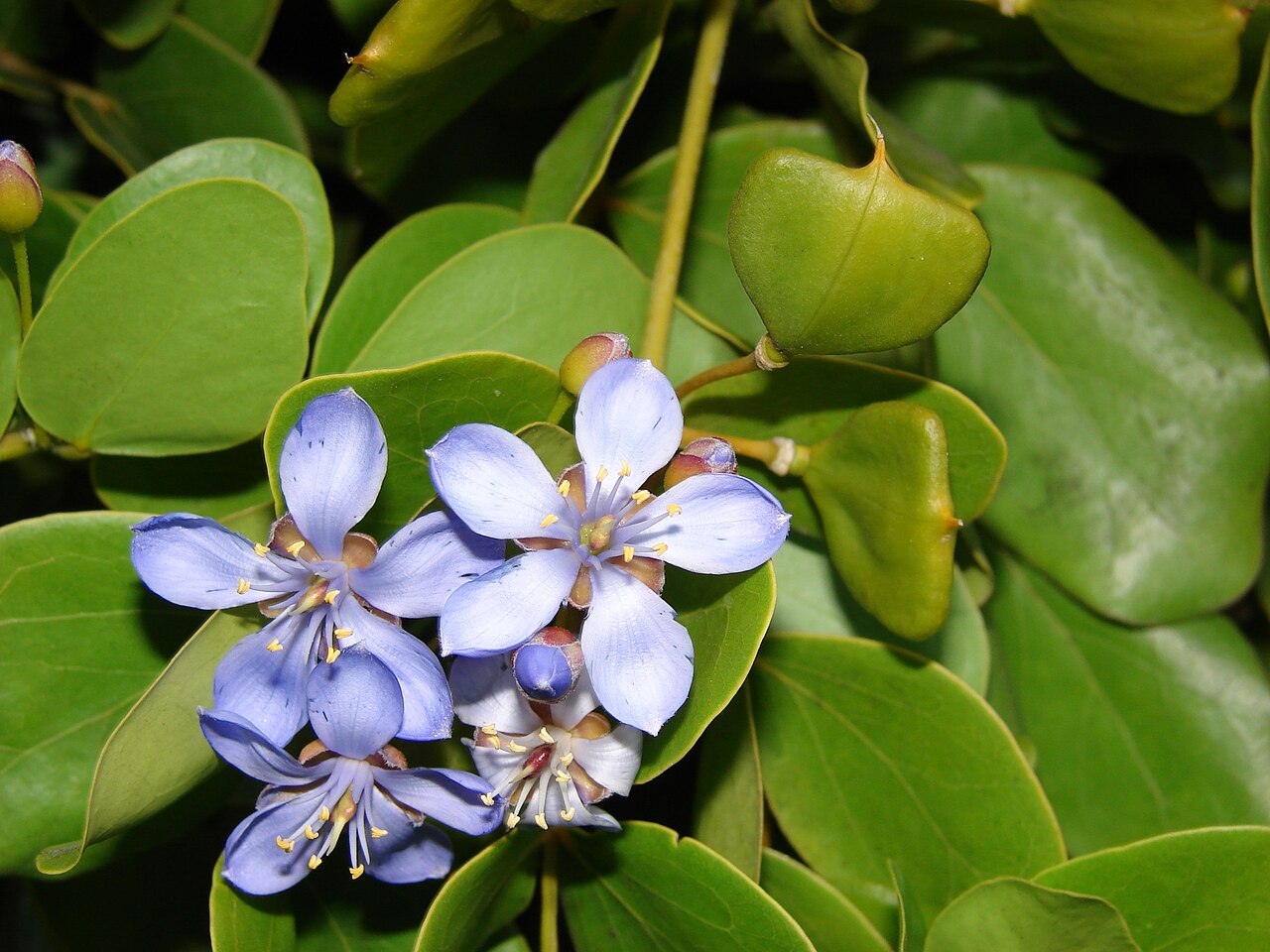
Guaiacum officinale, known as Lignum Vitae, roughbark lignum vitae, and in Puerto Rico as guayacán or guayaco, is a slow-growing evergreen tree of dry Caribbean coasts. It is famous for its wood, one of the hardest and heaviest in the world, and for its clusters of sky-blue flowers that are followed by bright orange-yellow fruit. It belongs to the caltrop family (Zygophyllaceae).
There are two “true” lignum vitae trees, and both are native to Puerto Rico. This page covers Guaiacum officinale, the species of the Caribbean islands and northern South America and the national flower of Jamaica. The other, Lignum Vitae (Guaiacum sanctum), also called holywood lignum vitae, is the species native to the Florida Keys. The easiest way to tell them apart is by the leaves and fruit: G. officinale has only two or three pairs of broad, rounded leaflets and flattened, heart-shaped fruit, while G. sanctum has more pairs of smaller, often pointed leaflets and a fruit with four or five angled lobes.
Lignum vitae is an excellent small tree for hot, dry, sunny and coastal gardens in Puerto Rico, where it tolerates drought, wind and salt spray. Because it has been heavily cut for its wood and resin, international trade in it is regulated, and planting it from nursery-grown stock helps keep the species in the landscape.
Identification
Lignum vitae is a dense, rounded tree with fine, glossy foliage. Its flowers and fruit are distinctive, and the leaflet count separates it from its Florida relative.
Form & Bark
It grows slowly into a small tree, usually 15 to 30 feet tall and occasionally to about 33 feet, with a short, often crooked or leaning trunk and a dense, rounded crown. The bark is fairly smooth and mottled in shades of gray, green and brown, flaking in small patches. Large old trees develop big surface roots on shallow or compacted soil. The tallest known tree in Puerto Rico is about 38 feet tall with a trunk 30 inches thick, and trees that size are probably more than 200 years old.
Leaves
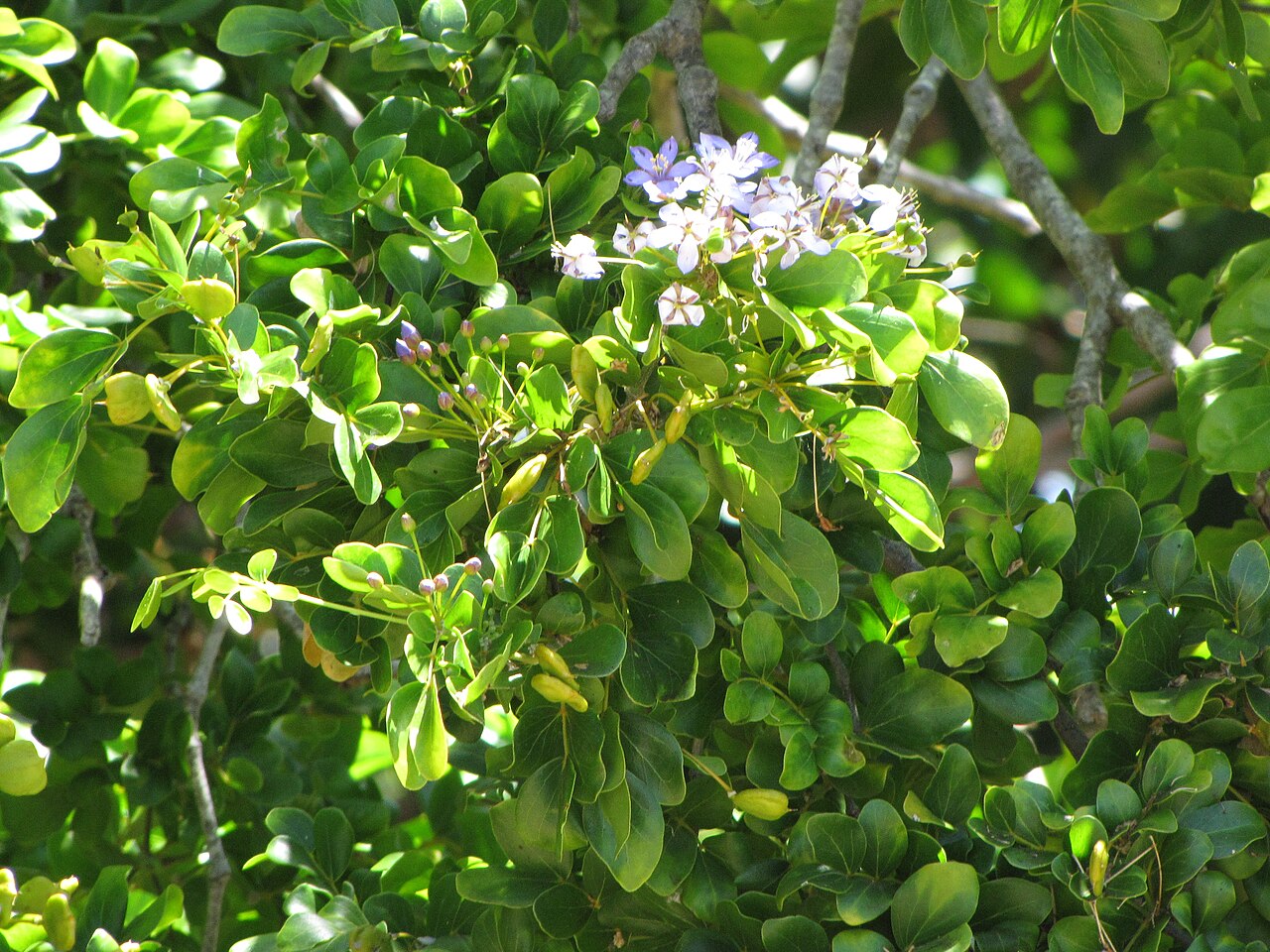
The leaves are opposite and pinnately compound, with usually two or three pairs of leaflets and no leaflet at the tip. Each leaflet is broadly oval to nearly round, about 1 to 1½ inches long, leathery, shiny and dark green. The tree is essentially evergreen, though it may drop some leaves in a long dry season.
Flowers
Slightly fragrant flowers appear in umbrella-like clusters near the branch tips, at any time from spring to fall, and a tree stays covered in bloom for about a month. Each flower is about ½ to ¾ inch across with five spreading petals and ten yellow-tipped stamens. They range from pale blue to violet-blue and fade paler with age, so a tree in bloom shows a mix of blues.
Fruit & Seeds
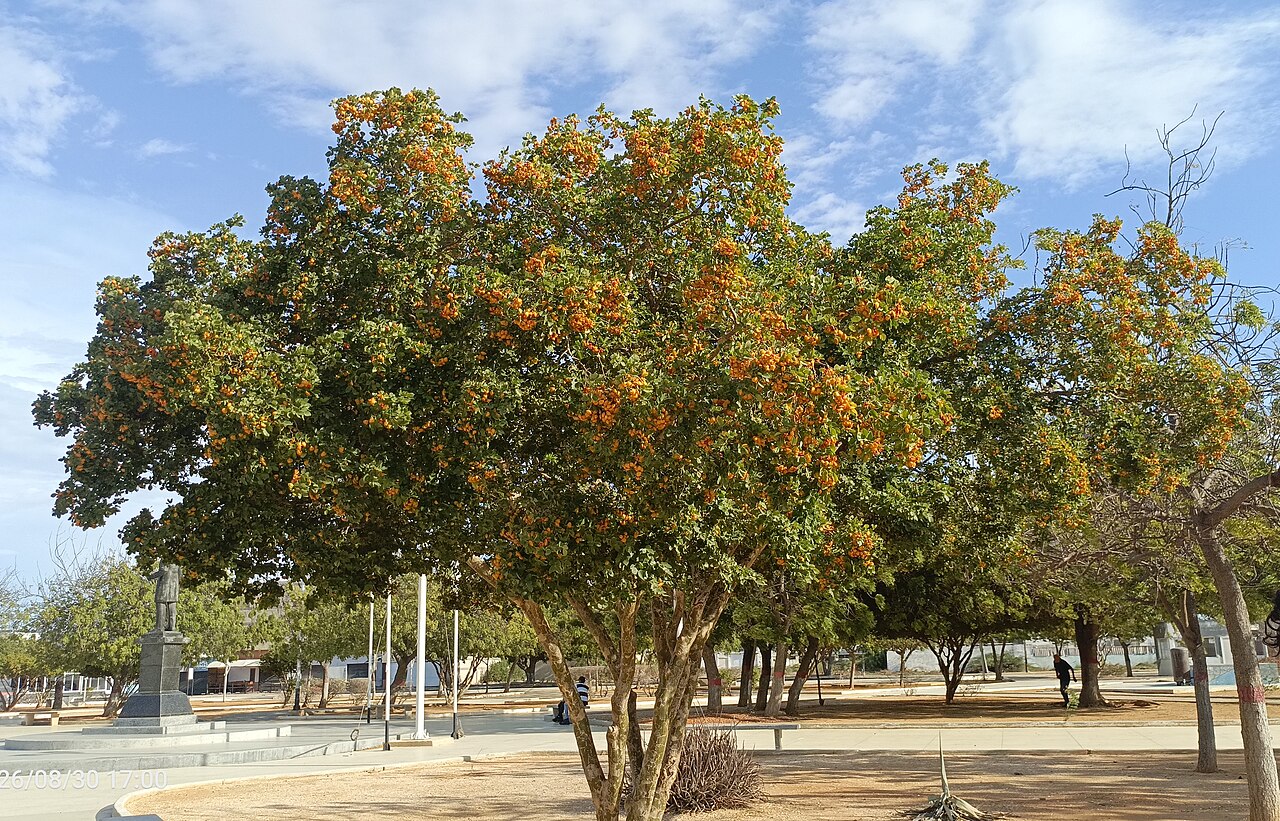
The fruit is a flattened, heart-shaped capsule, usually with two lobes, about ½ to ¾ inch across. It has two cells and usually two seeds. It turns from green to orange or orange-brown when ripe and splits open to show black seeds, each wrapped in a fleshy red covering (aril). Heavily fruiting trees look as if they were in a second bloom.
Quick Facts
| Scientific Name | Guaiacum officinale L. |
| Family | Zygophyllaceae (caltrop family) |
| Plant Type | Slow-growing evergreen tree |
| Mature Height | 15–30 ft (rarely to about 33 ft) |
| Mature Spread | 15–25 ft |
| Growth Rate | Slow |
| Sun Exposure | Full sun |
| Water Needs | Low; very drought tolerant once established |
| Soil Type | Well-drained sandy, rocky or limestone soils |
| Soil pH | Acid to alkaline (about 5.0–8.5) |
| Bloom Time | Spring to fall; each tree blooms for about a month |
| Flower Color | Pale blue to violet-blue |
| Fall Color | None; evergreen |
| Fruit | Flattened, heart-shaped orange capsule; usually 2 black seeds with red arils |
| Deer Resistant | Not a concern in Puerto Rico, which has no native deer |
| USDA Hardiness Zones | 10b–12; frost-sensitive |
Native Range
Lignum vitae is native to the Caribbean and the northern coast of South America: the southern Bahamas, the Greater Antilles including Puerto Rico, most of the Lesser Antilles, Aruba, Bonaire, Curaçao and Tobago, and Panama, Colombia and Venezuela. Development, cutting and fire have made it nearly extinct on several islands of the Lesser Antilles. USDA PLANTS lists it as native in Puerto Rico and the U.S. Virgin Islands.
In Puerto Rico it belongs to the dry, sunny lowlands, especially the coastal dry forest of the south and southwest, where rainfall is only about 30 to 40 inches a year. Because it grows so slowly, it survives mainly on poor, rocky sites with thin soil over limestone, where competition is low, though it also grows on serpentine. It ranges from near sea level up dry hills to about 1,000 to 1,300 feet. It shares these habitats with Guaiacum sanctum. Because both species have been cut for their wood for centuries, wild lignum vitae trees are uncommon today, and most of the trees people see are planted in parks, plazas and gardens.
USDA PLANTS also flags the species as native in the lower 48 states, but the native lignum vitae of the Florida Keys is Guaiacum sanctum. In Florida, G. officinale is known mainly as a planted ornamental, and this page is limited to Puerto Rico.
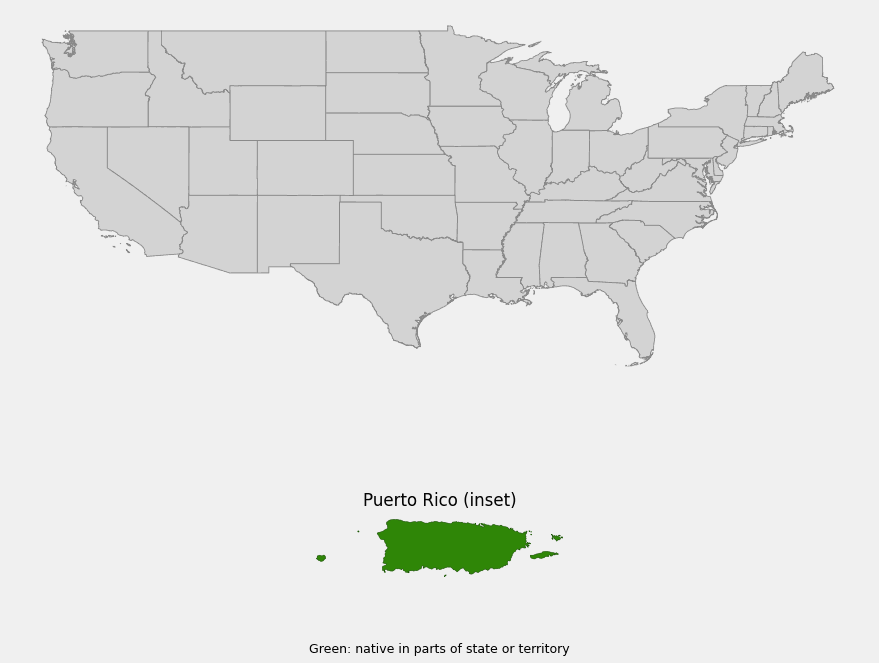
📋 Regional plant lists featuring Lignum Vitae: Puerto Rico
Growing & Care Guide
Lignum vitae asks for little once it is established: sun, good drainage and patience. Its slow growth is the main drawback, but it means a planted tree stays a manageable size for many years.
Light
Plant in full sun. Trees in shade grow even more slowly, become sparse and flower poorly.
Soil & Water
Any well-drained soil works, including sand, rocky fill and limestone. Avoid poorly drained or regularly flooded sites, where the roots can rot. Water regularly for the first year to establish the tree. After that it is very drought tolerant and handles salt spray and wind, which makes it a good choice for coastal yards.
Planting Tips
Plant at the start of the rainy season so the young tree gets steady moisture while its roots spread. Buy a well-rooted container plant from a nursery; seedlings grow very slowly, so a larger nursery tree gives a quicker effect. In Puerto Rican trials, seedlings did well when planted under the light shade of a thin nurse canopy and kept free of weeds. Allow at least 15 feet from walls and other trees for the crown to develop.
Pruning & Maintenance
Little pruning is needed. Remove dead or crossing branches and, if you want a single trunk, lightly train young trees by removing competing leaders. Avoid heavy fertilizing. Scale insects and caterpillars occasionally feed on the leaves but seldom do lasting harm.
Propagation
Grow it from fresh seed after removing the fruit pulp and red aril; stored seed starts losing viability after about a month. Germination of Puerto Rican seed is slow and erratic, with some seeds sprouting in the first month and many more over the following months, so keep seed trays for most of a year. Seedlings may be only 8 inches tall after two years, and container plants transplant far better than bare-root plants or direct seeding. Cuttings do not root, but young trees resprout if cut.
Landscape Uses
- Small specimen tree: for patios, entrances and small yards, where its blue flowers and orange fruit can be seen up close
- Coastal and xeriscape gardens: tolerates drought, wind and salt spray
- Street and plaza tree: its compact, dense crown gives shade without outgrowing small spaces
- Dry forest restoration: in coastal dry forest areas of southern and southwestern Puerto Rico, using nursery-propagated plants
- Bee and bird gardens: flowers attract bees, and the red-coated seeds are eaten by birds
Wildlife & Ecological Value
Lignum vitae offers both nectar and fruit, and its dense evergreen crown provides cover in the open, dry habitats where shade is scarce.
For Pollinators
The blue flowers attract bees and other small insects. Trees often flower heavily for several weeks, providing a reliable nectar source in dry coastal areas.
For Birds
When the fruit splits, the black seeds with their bright red arils are eaten by birds, which help disperse them. The thick crown provides nesting cover for small birds.
For Mammals
Lignum vitae has little direct value for Puerto Rico’s native mammals, which are bats, but it adds shade and cover to the dry forest community.
Ecosystem Role
As a slow-growing, long-lived tree, it is a lasting part of the coastal dry forest canopy. It is a host plant for some sulphur butterflies (Kricogonia), whose caterpillars feed on Guaiacum leaves.
Cultural & Historical Uses
Lignum vitae, Latin for “wood of life,” got its name from the medicinal use of its resin. In the early 1500s Spanish ships carried the wood from the Caribbean to Europe, where it was used as a treatment for syphilis and other ailments. The resin, called guaiac, is still used today in a laboratory test (the guaiac test) for hidden blood in stool.
The wood is extremely hard, dense and rich in natural oils, which make it self-lubricating. It was used for ship pulleys (block sheaves), propeller shaft bearings in early steamships and submarines, mallets, police truncheons and lawn bowling balls. Centuries of heavy cutting reduced wild populations, and all Guaiacum species are now listed in Appendix II of CITES, which regulates international trade in the wood and resin.
The flower of Guaiacum officinale is the national flower of Jamaica. In Puerto Rico it is called guayacán, a name shared with Guaiacum sanctum; both are treasured as ornamental trees and as reminders of the island’s dry forest heritage.
Frequently Asked Questions
How is this lignum vitae different from the one in Florida?
The Florida Keys species is Guaiacum sanctum. Guaiacum officinale has only two or three pairs of broad, rounded leaflets and flattened, heart-shaped two-lobed fruit. G. sanctum usually has more pairs of narrower, often pointed leaflets and a four- or five-lobed fruit. Both are native to Puerto Rico.
How fast does lignum vitae grow?
Very slowly. In a Puerto Rican plantation on thin soil over limestone, trees were only 6 to 10 feet tall after 7 years and 10 to 15 feet after 15 years.
Is lignum vitae drought and salt tolerant?
Yes. Once established it handles long dry spells, wind and salt spray, which makes it ideal for coastal and dry gardens in Puerto Rico.
Is lignum vitae endangered?
It is not listed under the U.S. Endangered Species Act, but heavy cutting has reduced wild populations, and all Guaiacum species are in CITES Appendix II, which controls international trade. Buy nursery-grown trees rather than collecting from the wild.
Why is it called lignum vitae?
The name means “wood of life” in Latin and refers to the resin, which was used as a medicine in Europe after the wood began arriving from the Caribbean in the 1500s.

Looking for a nursery that carries Lignum Vitae?
Our nursery directory does not yet include Puerto Rico. Browse the native plant nursery directory by state: Alabama–Arkansas · California · Colorado–Hawaii · Idaho–Kansas · Kentucky–Montana · Nebraska–Oklahoma · Oregon · Pennsylvania–Virginia · Washington · West Virginia–Wyoming