
Wallflower Orchid (Tetramicra canaliculata)
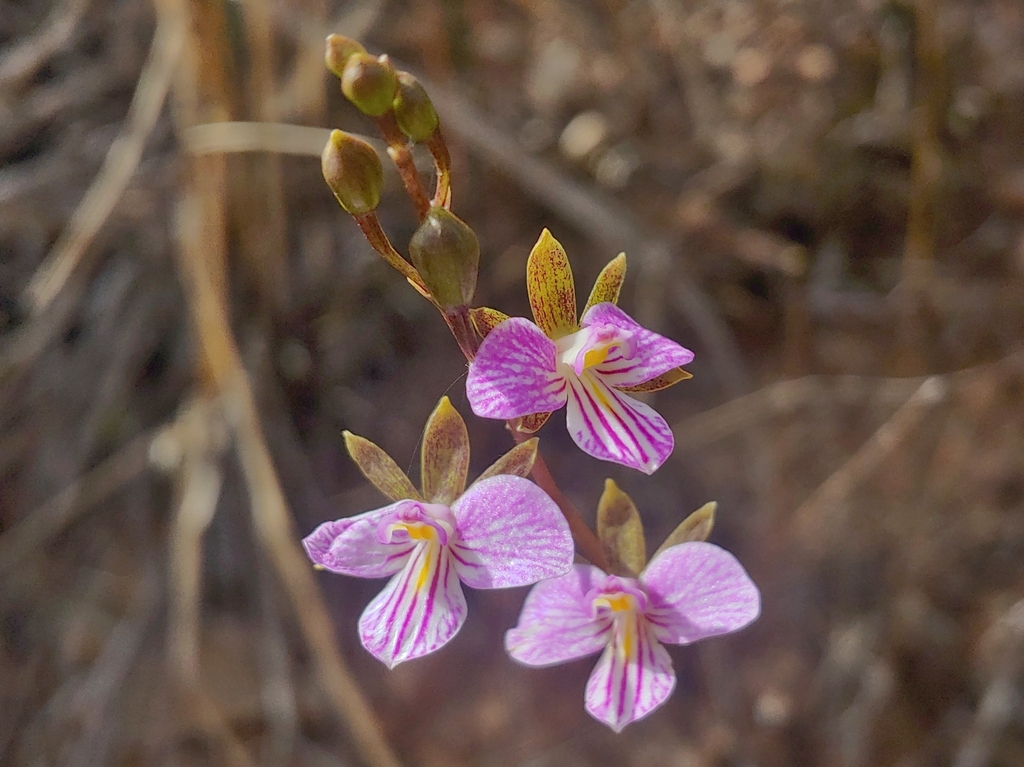
Tetramicra canaliculata, the Wallflower Orchid (USDA PLANTS name: serpentine wallflower orchid), is a small, sun-loving orchid of the West Indies. Instead of perching in the canopy like many tropical orchids, it usually grows on the ground or on rock, in open, dry, often rocky or sandy places. For most of the year it is little more than a tuft of stiff, grooved, rush-like leaves. When it blooms, a slender wiry stalk rises well above the foliage and opens a few surprisingly showy flowers, pale pink to lilac, with a broad lip striped in magenta around a yellow throat.
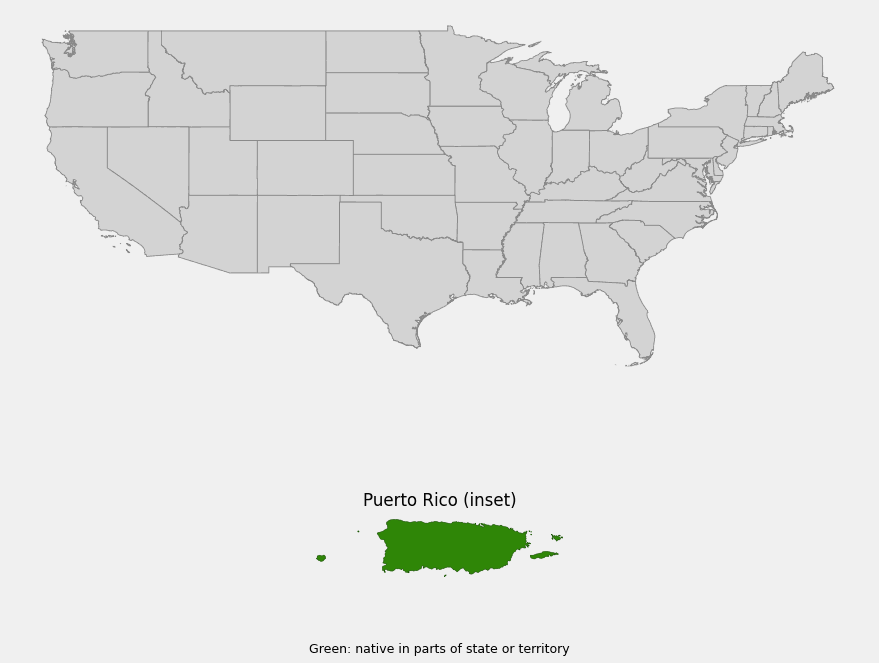
USDA PLANTS lists the species as native in Puerto Rico and the U.S. Virgin Islands, and nowhere else in the United States. The Institute for Regional Conservation’s Puerto Rico database records it as native and present on the island, growing on the ground, on limestone and on serpentine, from the lowlands up into middle elevations. Its full range, according to the Smithsonian’s Flora of the West Indies, runs through the Lesser Antilles and the Virgin Islands to Puerto Rico and Hispaniola. The plant was long known under the synonym Tetramicra elegans, a name still common in older books and orchid catalogs.
This guide covers how to recognize wallflower orchid, where it grows in Puerto Rico, why it is better admired in the wild than dug for the garden, and what its unusual lifestyle tells us about the dry, open habitats of the Caribbean.
Identification
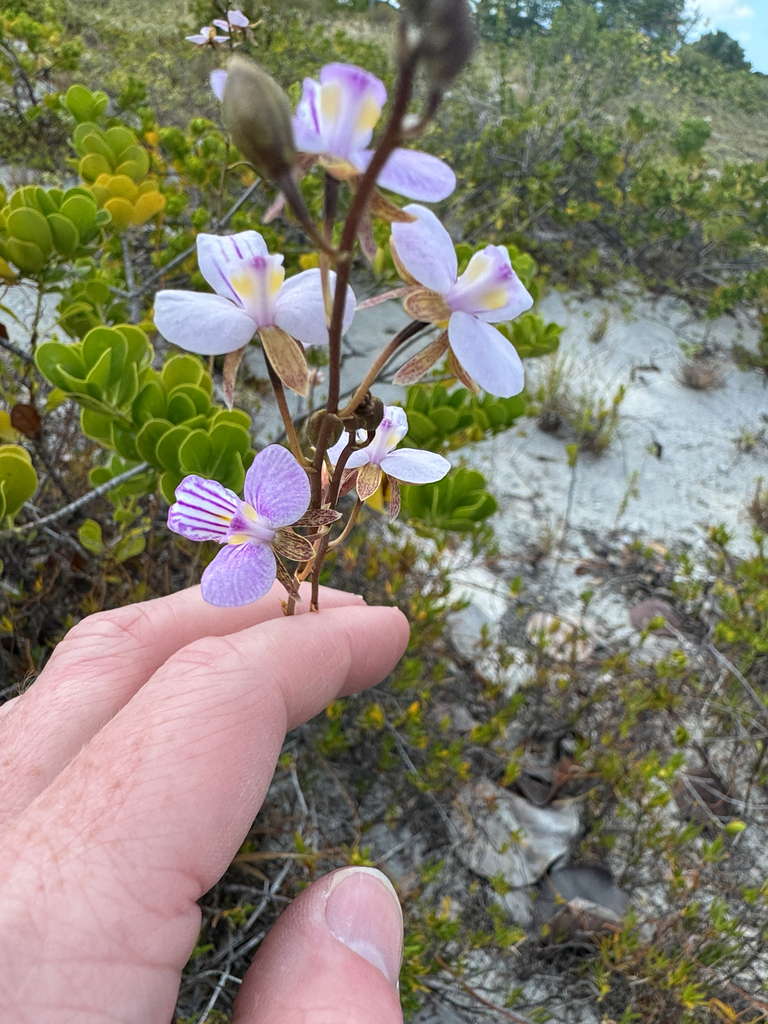
Wallflower orchid is easy to identify in bloom and easy to miss out of bloom. Look for a low clump of narrow, fleshy, channeled leaves in a dry, sunny spot, and in season a thin, branching or unbranched flower stalk carrying a few flat, pink-lilac flowers with a striped lip.
Growth Habit
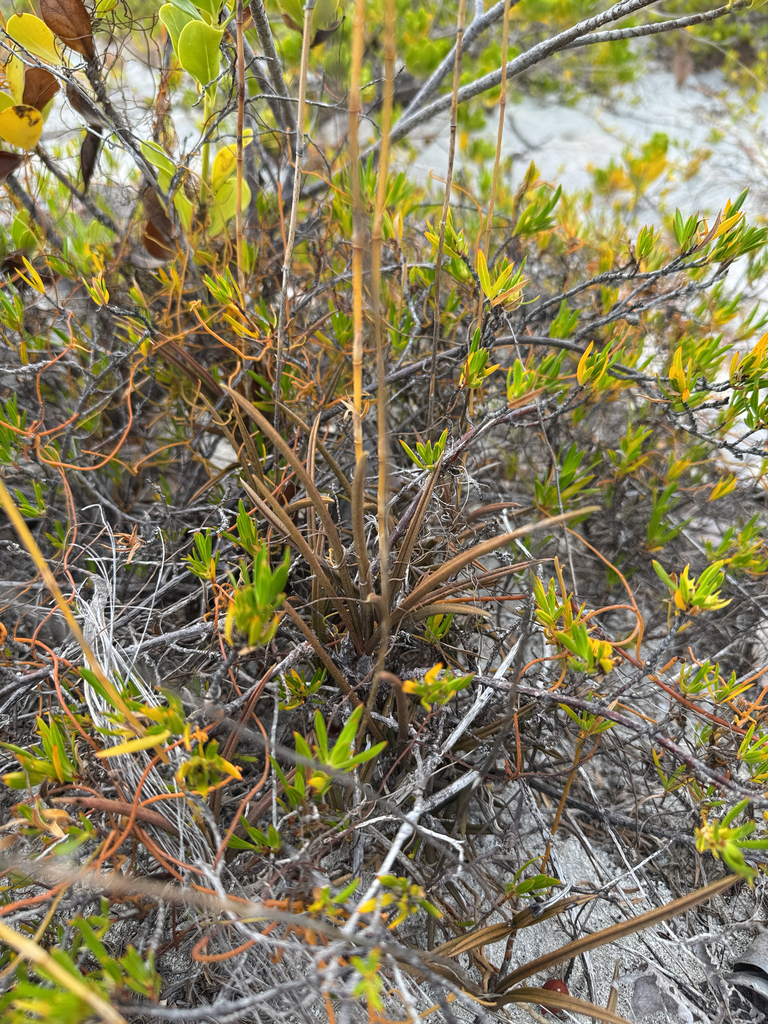
This is a small perennial herb that grows mostly on the ground or on rock (terrestrial or lithophytic) rather than on trees. It has no swollen pseudobulbs. Short, stick-like stems are wrapped at the base in overlapping papery sheaths and grow from creeping rhizomes, so an established plant can form a loose colony of several leafy shoots.
Leaves
Each shoot carries about two to five leaves arranged in two ranks like a small fan. They are stiff, fleshy and narrow, nearly round in cross-section but with a groove running along the upper side. That groove gives the species its name: canaliculata means “channeled”. The leaves are only a few inches long and look more like a rush or a small succulent than a typical orchid, an adaptation to sun and drought.
Flowers
The flower stalk is long and wiry, up to about two feet (70 cm) tall, with a few small sheaths and bracts. Near the top it carries a short raceme of up to about eight flowers, which open in succession with a few open at once. Each flower is about 1 inch (2.5 cm) across. The narrow sepals are greenish to bronze, often flushed pink, while the broader petals and the large, flat, three-lobed lip are white to pale pink or lilac, with dark magenta stripes and a yellow center on the lip. The flowers are described as slightly fragrant. Inside, each flower carries eight pollen masses (pollinia), four large and four small, a feature that distinguishes the genus.
Fruit & Seeds
Pollinated flowers develop into small, ribbed capsules that split when ripe to release thousands of dust-fine seeds. Like all orchid seeds, they have almost no food reserves and need to meet a suitable soil fungus to germinate and grow, one reason wild orchid populations recover slowly once disturbed.
Quick Facts
| Scientific Name | Tetramicra canaliculata (Aubl.) Urb. |
| Family | Orchidaceae (orchid family) |
| Plant Type | Perennial terrestrial or rock-dwelling orchid |
| Mature Height | Leaves a few inches; flower stalk up to about 2 ft |
| Mature Spread | A few inches per shoot; slowly forms small clumps |
| Growth Rate | Slow |
| Sun Exposure | Full sun to light shade |
| Water Needs | Low; adapted to seasonally dry, fast-draining sites |
| Soil Type | Thin, rocky or sandy, very well-drained soil; limestone and serpentine |
| Soil pH | Varies with substrate; grows on both limestone and serpentine |
| Bloom Time | Mainly late spring and summer |
| Flower Color | Pale pink to lilac with magenta-striped lip and yellow throat |
| Fall Color | None; evergreen |
| Fruit | Small ribbed capsule with dust-like seeds |
| Deer Resistant | Not applicable in Puerto Rico; no deer browse |
| USDA Hardiness Zones | 12–13 (frost-free tropics only) |
Native Range
Wallflower orchid is a Caribbean species. The Smithsonian’s Flora of the West Indies describes it as endemic to the West Indies, recorded from the Lesser Antilles (including Anguilla, Antigua, Barbados, Barbuda, Martinique and St. Eustatius), the Virgin Islands (Anegada, St. Croix, St. John, St. Thomas and Virgin Gorda), Puerto Rico and Hispaniola. Some sources extend it to Trinidad, the Guianas (where it was first described) and the Bahamas. Within the United States, USDA PLANTS lists it as native only in Puerto Rico and the U.S. Virgin Islands.
In Puerto Rico, the Institute for Regional Conservation records it as a native, present species that grows on the ground, on limestone and on serpentine substrates, at low and middle elevations up to roughly 1,000 meters. That fits the descriptions in orchid references of a sun-loving plant of lowland scrub and rocky hillsides. The USDA common name, serpentine wallflower orchid, reflects its ability to grow on serpentine, the nutrient-poor, metal-rich rock found in parts of western and central Puerto Rico. In general it is a plant of open, dry, well-lit ground rather than shaded rainforest.
What about Florida? Some references, including Wikipedia, list Florida in the range, but those reports have been challenged; the Atlas of Florida Plants does not include the species, and USDA PLANTS does not list it for any mainland state. PlantNative therefore treats it as a Puerto Rico and Virgin Islands native only.
📋 Regional plant lists featuring Wallflower Orchid: Puerto Rico
Growing & Care Guide
Wallflower orchid is rarely offered for sale and is not an easy garden plant. Like many terrestrial orchids, it depends on soil fungi and on very specific conditions of light, drainage and seasonal drought. The best way to enjoy it is to see it in the wild, leave it in place, and protect the dry, open habitats where it grows. The notes below are for gardeners and growers who obtain legally, nursery-propagated plants.
Light
Give it bright light, ideally full sun for much of the day or very bright filtered light. In the wild it grows in open scrub and on exposed rock, and in shade it weakens and stops flowering.
Soil & Water
Grow it in a very fast-draining, mineral mix, such as coarse sand, gravel and broken limestone with a little leaf litter, or on a rock or slab. Water when the medium has dried, more freely during warm, wet months and sparingly in the dry season. Soggy, organic soil will rot the roots quickly.
Planting Tips
Never dig plants from the wild. Wild-collected orchids rarely survive transplanting because they leave their fungal partners behind, and collection damages the small populations that remain. If you acquire a plant, set it at the same depth it was growing, in a warm, frost-free, sunny spot with good air movement, such as a rock garden or a raised bed of sand and stone.
Pruning & Maintenance
Little care is needed. Remove spent flower stalks once they dry, or leave them to ripen seed. Keep taller plants and weeds from shading the clump, and avoid disturbing the roots and rhizomes once established.
Propagation
Established clumps can be divided carefully, keeping several shoots and their roots together in each piece. Seed is dust-like and, like other orchid seed, needs a symbiotic fungus or laboratory flask culture to germinate. Raising orchids from seed is best left to specialist growers and conservation labs.
Landscape Uses
- Habitat conservation: a showy indicator of intact dry scrub and rocky ground
- Rock gardens (specialist): nursery-propagated plants on stone or sand in full sun
- Orchid collections: a sun-loving, drought-adapted Caribbean species
- Nature watching: a rewarding find on walks through open dry habitats
Wildlife & Ecological Value
Wallflower orchid is a small part of the rich community of plants that grow on thin, dry, sunny ground in Puerto Rico and the Lesser Antilles, habitats that are easily lost to development, grazing and fire.
For Pollinators
Its open, colorful, striped flowers are typical of orchids pollinated by bees, which follow the stripes toward the yellow center of the lip. The specific pollinators of this species are not well documented, and like many orchids it may offer little or no nectar reward, relying on attractive color and scent instead.
For Birds
The plant is not a food source for birds. Its fine seeds are carried by wind rather than eaten and dispersed by animals.
For Mammals
It has no known importance as food for mammals. Grazing livestock and trampling can damage plants in the open places where they grow.
Ecosystem Role
Like all orchids, wallflower orchid lives in close partnership with soil fungi, which supply young seedlings with nutrients before they can feed themselves. Its presence is a sign of an open, little-disturbed dry habitat with a healthy soil fungal community. The thick, grooved leaves are an adaptation to bright sun and long dry seasons, and the creeping rhizomes help it hold on in thin soil between rocks.
Cultural & Historical Uses
The species was first described in 1775 by the French botanist Jean Baptiste Christophe Fusée Aublet, as Limodorum canaliculatum, in his flora of French Guiana. Over the next century it was moved through several genera, including Cymbidium, Epidendrum, Brassavola and Bletia, before Ignatz Urban settled it in Tetramicra in 1918. It is the type species of the genus.
A version of the plant appeared as Brassavola elegans in Curtis’s Botanical Magazine in 1831, and for much of the twentieth century it was known as Tetramicra elegans. The genus name combines Greek words for “four” and “small”, referring to the pollen masses: the flowers carry eight pollinia, four large and four small.
In Florida, the species became something of a botanical mystery. It was reported from southern Florida in the past, but botanists have questioned those records, and current references such as the Atlas of Florida Plants and USDA PLANTS do not list it for the state. Today it is a Caribbean orchid, and in the United States a plant of Puerto Rico and the Virgin Islands.
Frequently Asked Questions
Is wallflower orchid native to Puerto Rico?
Yes. USDA PLANTS lists Tetramicra canaliculata as native in Puerto Rico and the U.S. Virgin Islands, and the Smithsonian’s Flora of the West Indies and the Institute for Regional Conservation both record it as native in Puerto Rico.
Can I dig one up for my garden?
No. Wild orchids rarely survive transplanting because they depend on soil fungi, and collecting harms the small native populations. Enjoy it where it grows and only buy plants that are clearly nursery-propagated.
Does it grow on trees?
Mostly no. Unlike many Caribbean orchids, wallflower orchid usually grows on the ground or on rock, in open, dry, sunny places, although some references note it can occasionally grow on trees.
Why is it called “serpentine” wallflower orchid?
USDA PLANTS uses that name, and the Institute for Regional Conservation records the species on serpentine substrates in Puerto Rico. Serpentine soils are thin, low in nutrients and high in certain metals, and support a specialized flora.
Are there related native orchids on the mainland?
Yes, several showy ground orchids are native to the southeastern United States, including pinepink (Bletia purpurea), which also grows in Puerto Rico, and grass pink (Calopogon tuberosus).

Looking for a nursery that carries Wallflower Orchid?
Our nursery directory does not yet include Puerto Rico. Browse the native plant nursery directory by state: Alabama–Arkansas · California · Colorado–Hawaii · Idaho–Kansas · Kentucky–Montana · Nebraska–Oklahoma · Oregon · Pennsylvania–Virginia · Washington · West Virginia–Wyoming