
Trumpet Tree (Cecropia schreberiana)
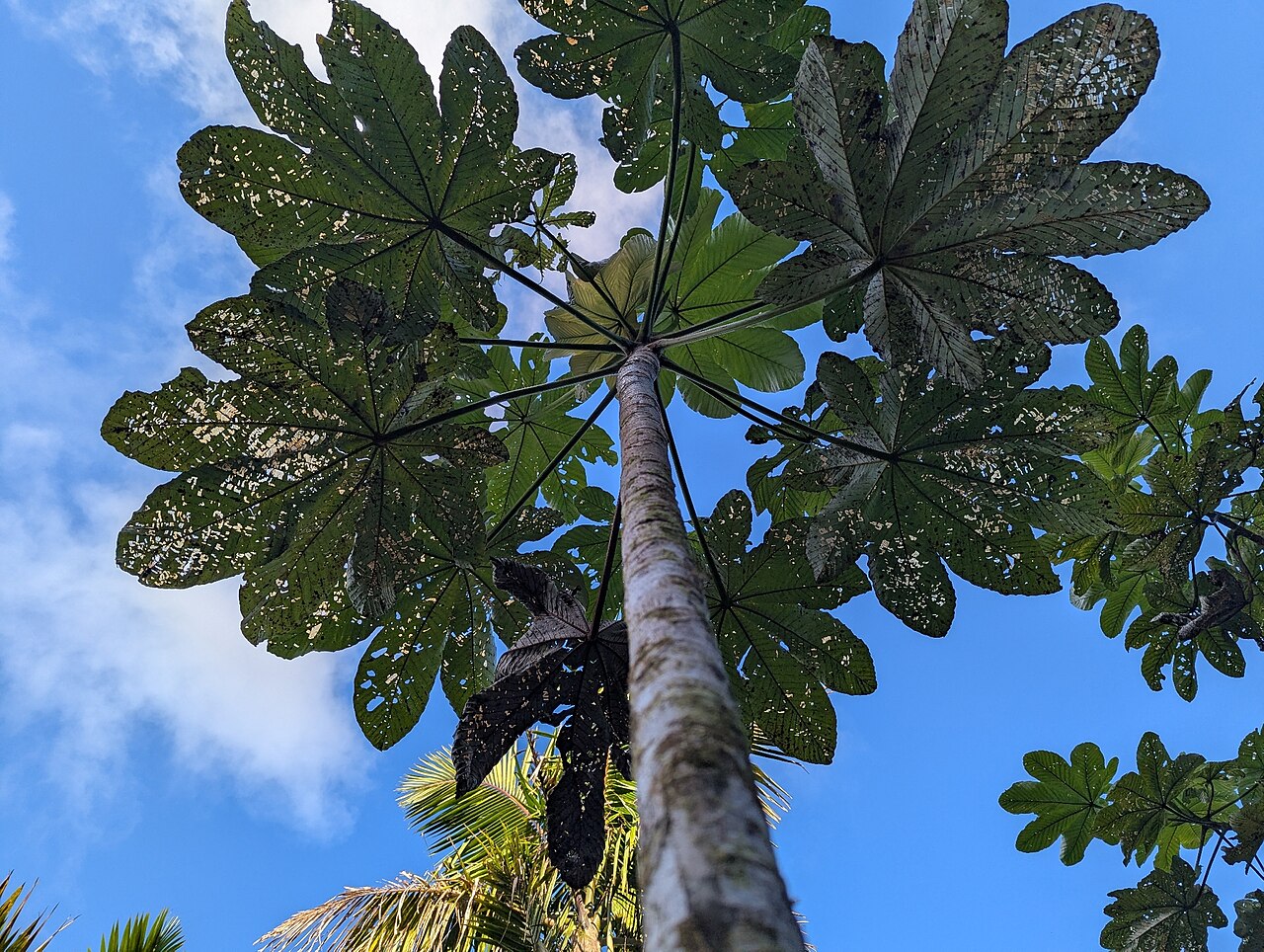
Cecropia schreberiana, the Trumpet Tree or pumpwood, called yagrumo hembra in Puerto Rico, is one of the most recognizable trees of the island’s moist and wet forests. It has a tall, slender, pale gray trunk marked with rings, a few candelabra-like branches, and enormous umbrella-shaped leaves that are dark green above and silvery white beneath. When the wind turns the leaves over, whole hillsides flash silver.
Trumpet tree is a pioneer, a fast-growing tree that colonizes openings in the forest. It is among the first trees to appear after landslides, road cuts, abandoned farms and hurricanes, and in the years after major storms it has dominated large areas of El Yunque and the Luquillo Mountains. It belongs to the family Urticaceae, the nettle family (sometimes placed in its own family, Cecropiaceae), and was long treated in Puerto Rican floras as Cecropia peltata.
This is not a typical garden tree. It grows very fast, has weak, hollow stems and drops huge leaves, and it is relatively short-lived, with an estimated life span of about 30 years. Where there is room, though, it is valuable for restoring forest on cleared land, feeding fruit-eating birds and bats, and quickly shading out weeds so that slower forest trees can establish.
Identification
No other native Puerto Rican tree has leaves quite like trumpet tree. Its relative, yagrumo macho (Schefflera morototoni), also has white-backed leaves, but they are compound, with separate leaflets, rather than a single lobed blade.
Form & Trunk
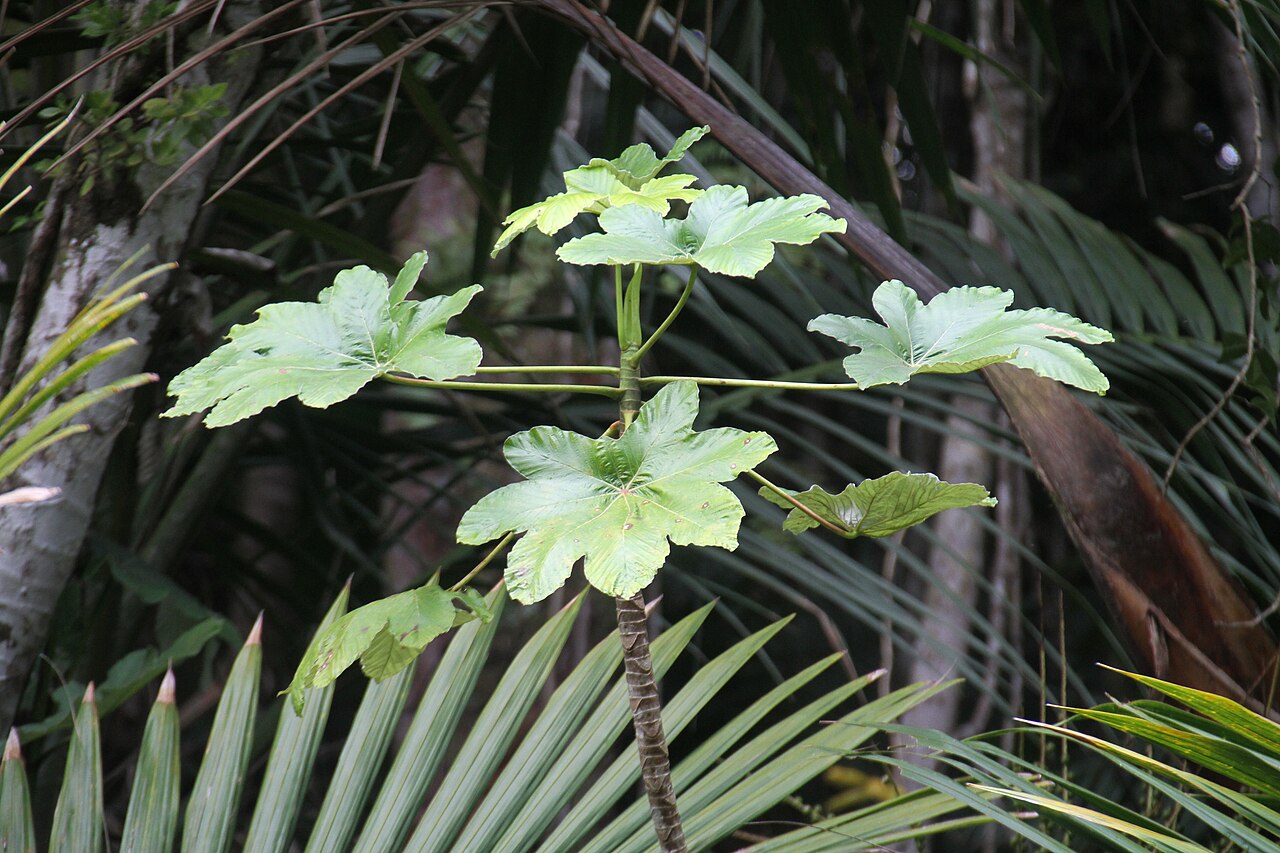
Trumpet tree usually grows 30 to 60 feet tall, sometimes to about 80 feet, with a straight trunk and a sparse, open crown of a few upturned branches. The bark is smooth, light gray, and ringed with scars left by fallen leaves and their sheathing stipules. The trunk and branches are hollow between their joints, with thin cross-walls, which is the source of the name trumpet tree. Damaged stems ooze a watery sap that darkens on exposure.
Leaves
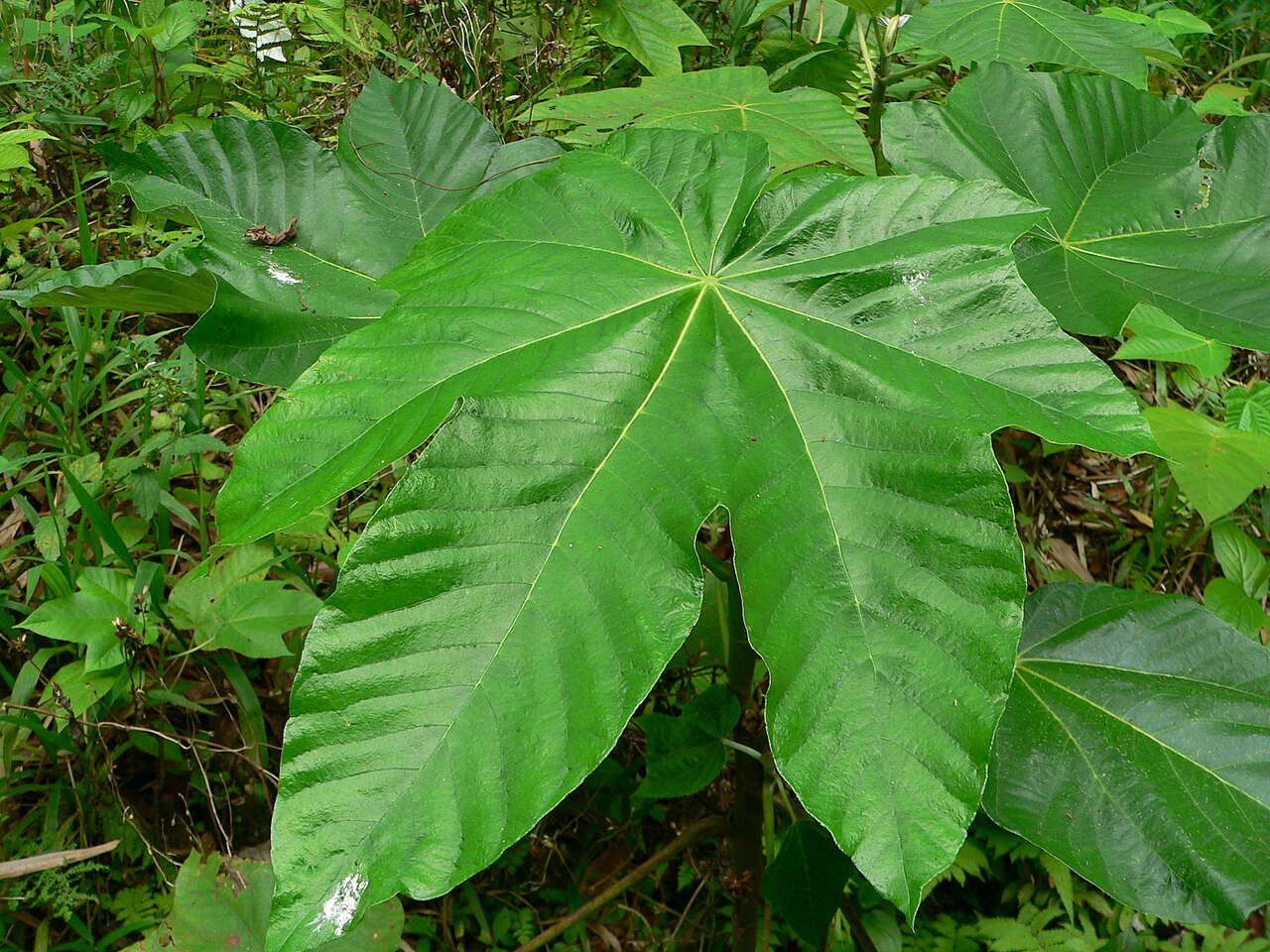
The leaves are alternate and clustered at the ends of the branches. Each is roughly round in outline, up to about 20 inches across, and divided into 7 to 11 deep, broad lobes. The long leaf stalk attaches to the underside of the blade near its center (peltate), so the leaf spreads like an umbrella. The upper surface is dark green and rough, and the underside is covered with dense white woolly hairs. Large new leaves are protected by a pink to reddish stipule sheath that falls as the leaf opens.
Flowers
Trumpet tree is dioecious: male and female flowers grow on separate trees. Both kinds are tiny, about 1/16 inch long, and packed into slender, finger-like spikes that hang in clusters from the leaf axils. Male spikes are shorter and more numerous. The flowers are wind-pollinated and have no petals. Trees can flower and fruit in any month, with a peak from January to March, the driest season in Puerto Rico.
Fruit & Seeds
On female trees, the spikes ripen into soft, fleshy, greenish, finger-shaped fruit clusters about 2 to 4 inches long, packed with tiny seeds. Birds and bats eat them and scatter the seeds widely; the seeds pass through their digestive systems unharmed. Seeds need full sun to germinate, so those that land under a closed canopy wait in the soil until an opening lets in light. They survive only a few months in forest soil, so the seed bank depends on a constant new supply from fruiting trees.
Quick Facts
| Scientific Name | Cecropia schreberiana Miq. (formerly treated in Puerto Rico as C. peltata) |
| Family | Urticaceae (nettle family; sometimes Cecropiaceae) |
| Plant Type | Fast-growing pioneer tree; evergreen |
| Mature Height | 30–60 ft (occasionally to about 80 ft) |
| Mature Spread | 15–30 ft |
| Growth Rate | Very fast |
| Sun Exposure | Full sun |
| Water Needs | Moderate to high; best in areas with year-round rain |
| Soil Type | Most soils, including disturbed clay and landslide scars; needs good drainage |
| Soil pH | Acid to neutral (about 4.5–7.0) |
| Bloom Time | Year-round; peak January–March in Puerto Rico |
| Flower Color | Greenish to cream; tiny flowers in finger-like spikes |
| Fall Color | None; evergreen, but old leaves turn brown and fall throughout the year |
| Fruit | Fleshy, finger-shaped green spikes with tiny seeds (female trees) |
| Deer Resistant | Not a concern in Puerto Rico, which has no native deer |
| USDA Hardiness Zones | 10b–12; frost-sensitive |
Native Range
Trumpet tree is native to the West Indies and northern South America. In the Caribbean it grows in Hispaniola, Puerto Rico (including Vieques), the U.S. and British Virgin Islands and through the Lesser Antilles to Grenada and Barbados. USDA PLANTS lists it as native in Puerto Rico and the U.S. Virgin Islands.
In Puerto Rico it is common in moist and wet forests from the coastal lowlands into the mountains: the northern karst hills, the Cordillera Central and especially El Yunque and the Luquillo Mountains, where it grows on slopes and ridges into the lower montane forest. Its range extends from about 160 feet (50 m) up to the elfin cloud forest on the highest peaks, about 4,300 feet (1,300 m), where it grows as a short, gnarled tree. It is rare or absent in the dry south and southwest. Wherever the forest canopy is opened by hurricanes, landslides, road building or clearing, it springs up from seed stored in the soil.
Studies in the Luquillo Experimental Forest after Hurricane Hugo in 1989, and after later storms, recorded large flushes of trumpet tree seedlings in storm gaps. These dense stands dominate for a decade or two and then gradually give way to slower-growing, longer-lived forest trees.
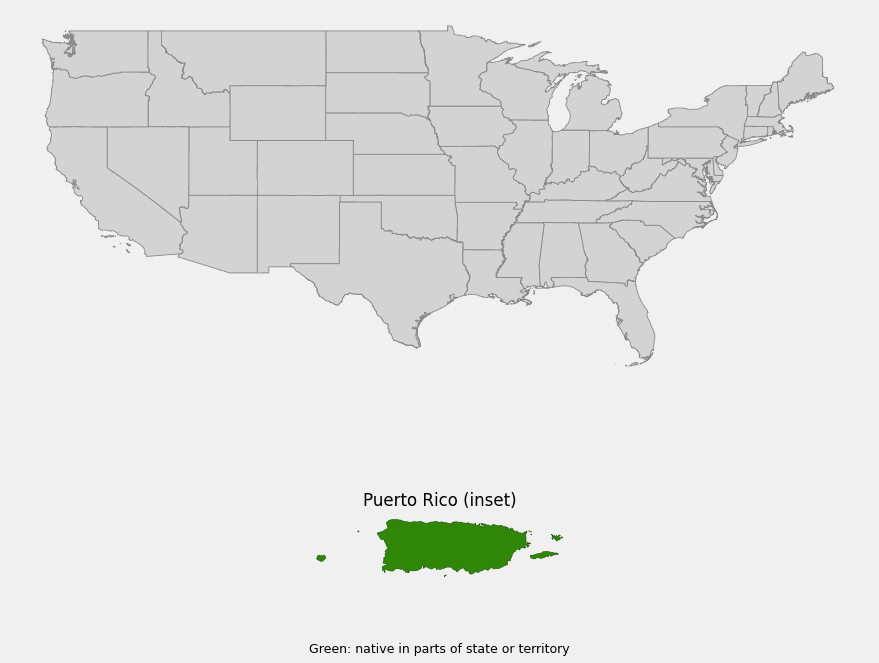
📋 Regional plant lists featuring Trumpet Tree: Puerto Rico
Growing & Care Guide
Trumpet tree is easy to grow in moist, frost-free places, but it is better suited to reforestation sites, large properties and forest edges than to small yards.
Light
Give it full sun. It is a light-demanding pioneer and does not grow well under a closed canopy.
Soil & Water
It tolerates poor, compacted and eroded soils, which is why it colonizes landslides and road cuts, but it grows fastest in moist, well-drained soil with regular rainfall. It is not suited to the dry south coast without irrigation.
Planting Tips
Plant away from buildings, roofs, driveways and power lines, because the large leaves fall throughout the year and the hollow, brittle branches can break in storms. In reforestation, mix it with slower-growing native trees: trumpet tree provides quick shade that helps suppress grasses, and the other trees take over as it ages.
Pruning & Maintenance
Pruning is rarely useful because the tree branches sparingly. Remove broken branches after storms. Fallen leaves are bulky and slow to break down on pavement, so plan for leaf cleanup near paths.
Propagation
Grow from seed. Mash ripe fruit spikes, rinse out the tiny seeds and sow them on the surface of moist potting mix in bright light; they need light to germinate. Seedlings grow rapidly and can be planted out within a few months.
Landscape Uses
- Reforestation: a fast nurse tree for restoring moist and wet forest on cleared or degraded land
- Erosion control: quickly stabilizes landslide scars, road cuts and steep slopes
- Wildlife plantings: its fruit is eaten by many birds and fruit bats
- Large properties and parks: a striking tropical silhouette where there is space for leaf drop
- Forest edges and buffers: to quickly shade out invasive grasses along streams and trails
Wildlife & Ecological Value
Trumpet tree is one of the most important wildlife food trees of Puerto Rico’s wet forests, and its rapid growth is central to how those forests recover from disturbance.
For Pollinators
The flowers are wind-pollinated and offer no nectar, so trumpet tree is of little value to pollinators. Its importance to wildlife lies in its fruit.
For Birds
At least 15 species of birds and bats have been recorded eating the ripe fruit in Puerto Rico. Among the most frequent visitors are the bananaquit, pearly-eyed thrasher, red-legged thrush and Puerto Rican spindalis (reina mora). Because fruit ripens over much of the year, trumpet trees are a dependable food source after hurricanes, when many other trees have lost their flowers and fruit.
For Mammals
Fruit-eating bats feed on the ripe fruit and pass the seeds unharmed, often far from the parent tree. The Jamaican fruit bat is one of the most frequently recorded visitors to trumpet trees in Puerto Rico.
Ecosystem Role
Trumpet tree builds the first canopy in forest gaps, shading out grasses and creating conditions in which shade-tolerant trees can grow. Its leaves decompose quickly and return nutrients to the soil. On the mainland of tropical America, many Cecropia species house colonies of aggressive Azteca ants in their hollow stems. Puerto Rico lacks those ants, and the island’s trumpet trees have no resident ant colonies, a difference studied by the ecologist Daniel Janzen in the 1970s.
Cultural & Historical Uses
In Puerto Rico the tree is known as yagrumo or yagrumo hembra (“female yagrumo”), distinguishing it from yagrumo macho, Schefflera morototoni. Its silvery leaf undersides, flashing on windy hillsides, make it one of the most familiar sights of the Puerto Rican countryside.
The wood is very light, only slightly heavier than balsa. In Puerto Rico it has been used to make the cuatro puertorriqueño, the island’s traditional ten-string guitar-like instrument, as well as crates, matchsticks, packing material and lightweight building boards. Hollow branches were split for gutters and troughs, and whole branches served as floats. Leaves and sap appear in traditional Caribbean folk medicine, including teas for colds and high blood pressure. These uses are traditional and not a substitute for medical advice.
For scientists, trumpet tree is one of the best-studied trees in the Caribbean. Its rapid response to hurricanes and landslides in the Luquillo Experimental Forest, one of the longest-running tropical forest research sites in the world, has made it a model for understanding how tropical forests recover from disturbance.
Frequently Asked Questions
What is the difference between yagrumo hembra and yagrumo macho?
Yagrumo hembra is trumpet tree (Cecropia schreberiana), with single, deeply lobed umbrella-shaped leaves. Yagrumo macho (Schefflera morototoni) is an unrelated tree with compound leaves made of separate leaflets. Both have pale undersides.
Why do trumpet trees appear after hurricanes?
Their tiny seeds lie dormant in the forest soil until a hurricane or landslide opens the canopy. Light and warmth trigger germination, and the seedlings grow several feet a year, quickly filling the gap.
Is trumpet tree a good yard tree?
Usually not for small yards. It grows very fast, has brittle hollow branches and drops large leaves all year. It is better for reforestation, large properties and forest edges.
Is trumpet tree invasive?
Not in Puerto Rico, where it is native. It has been introduced to some Pacific and African islands and parts of Asia, where it can spread aggressively, so it should not be planted outside its native range.
Do all trumpet trees produce fruit?
No. Male and female flowers grow on separate trees, and only female trees produce the finger-like fruit clusters.

Looking for a nursery that carries Trumpet Tree?
Our nursery directory does not yet include Puerto Rico. Browse the native plant nursery directory by state: Alabama–Arkansas · California · Colorado–Hawaii · Idaho–Kansas · Kentucky–Montana · Nebraska–Oklahoma · Oregon · Pennsylvania–Virginia · Washington · West Virginia–Wyoming