
Knotted Spikerush (Eleocharis interstincta)
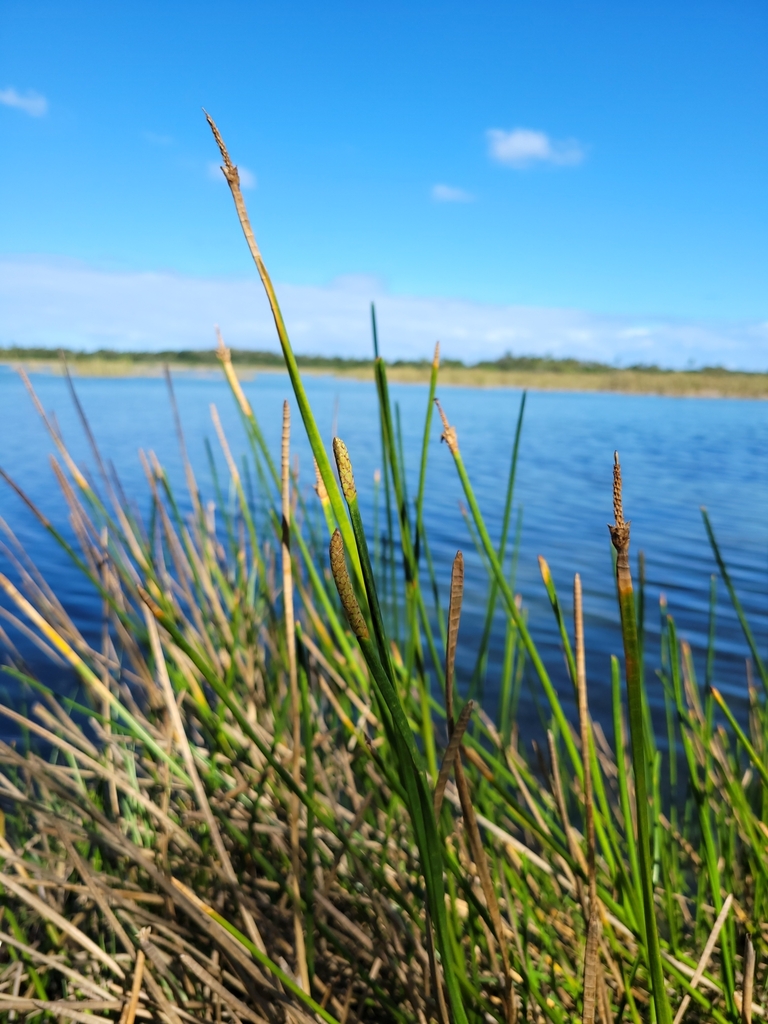
Eleocharis interstincta, the Knotted Spikerush, is a tall, rush-like sedge of marshes, ponds and lagoon edges in the American tropics and subtropics. USDA PLANTS also calls it knotted spikerush, and in Puerto Rico it shares the names junco, junco de ciénaga (“marsh rush”) and junco de espiga (“spike rush”) with similar plants. It has no real leaves to speak of: the plant is a dense colony of smooth, round, bright green stems, up to about 3 feet tall, each ending in a single cigar-shaped spikelet. The name “knotted” comes from the stems themselves, which are hollow and divided inside by thin cross-walls that can be felt as faint ridges when you run a stem between your fingers.
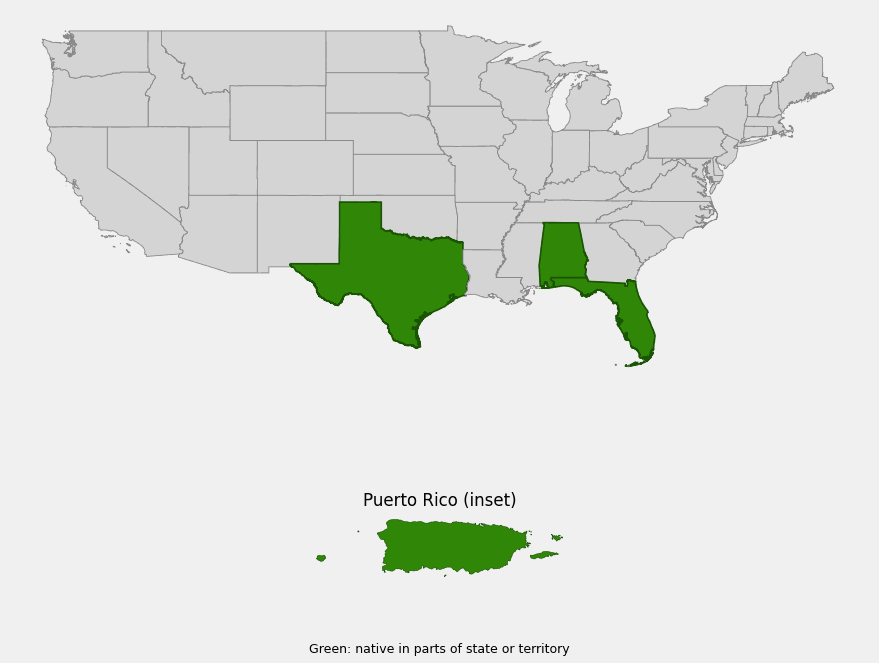
USDA PLANTS lists knotted spikerush as native in Puerto Rico, the U.S. Virgin Islands and the lower 48 states, where it grows wild in Florida, Alabama and Texas. In Puerto Rico, the Institute for Regional Conservation records it in El Yunque National Forest and the Río Abajo State Forest, and it also grows in coastal lagoons and marshes on the north coast. Beyond the United States it ranges through the West Indies, Mexico and Central America to South America.
This guide covers how to recognize knotted spikerush, where it grows, how to use it in ponds, rain gardens and wetland restorations, and its value to wetland wildlife.
Identification
Spikerushes (Eleocharis) are sedges with leafless stems and a single spikelet at the tip of each stem. Knotted spikerush is one of the largest, and its hollow, cross-partitioned stems are the key to identifying it.
Stems
The stems (culms) are round, smooth, spongy-hollow and up to about 3 feet tall, often as thick as a pencil or more. Inside, they are divided at regular intervals by thin transverse partitions (septa). Held up to the light or pressed between the fingers, the stems show faint cross-bands, the “knots” of the common name. The leaves are reduced to papery sheaths at the base of each stem.
Spikelets
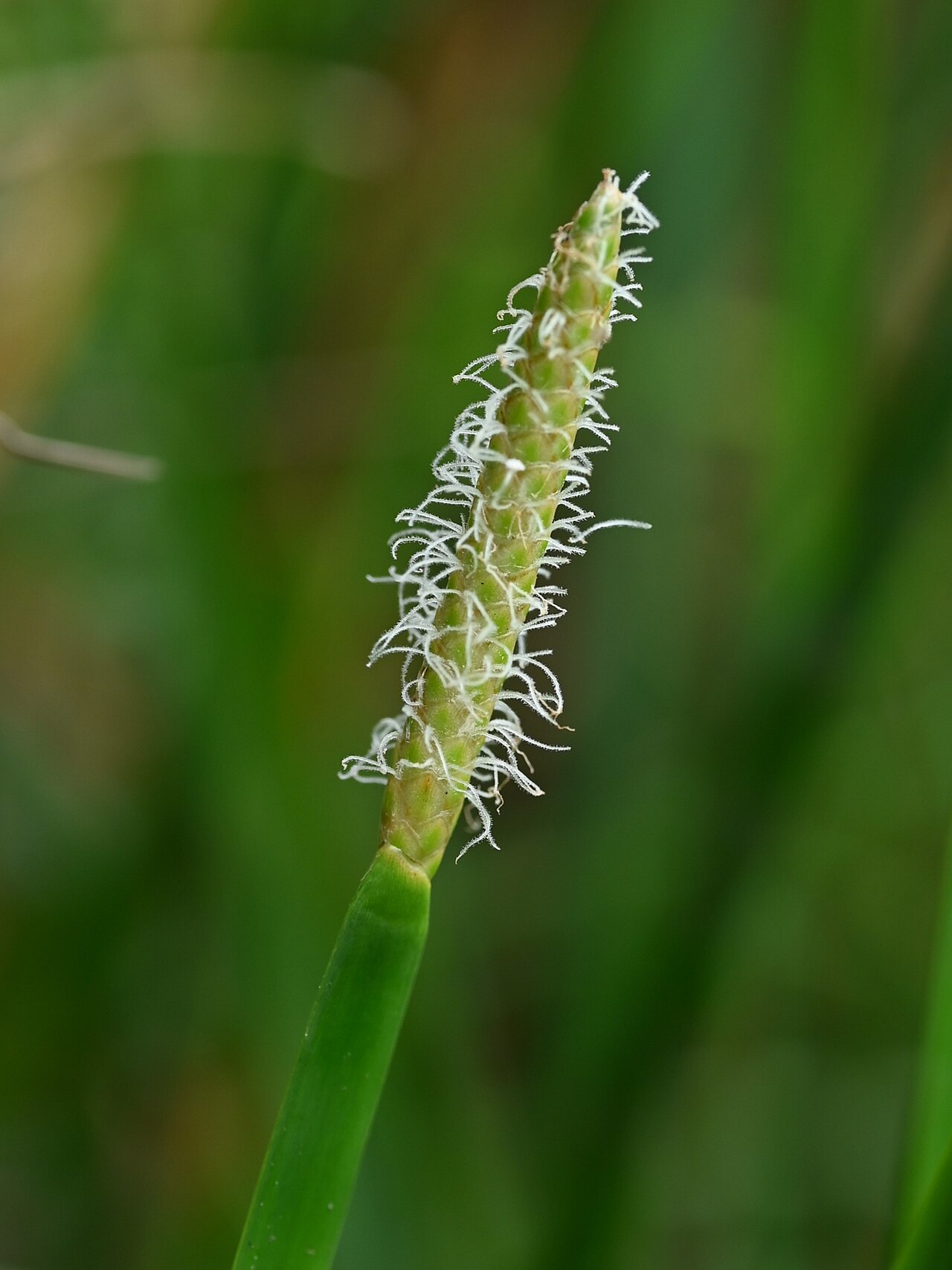
Each stem ends in one narrow, cylindrical spikelet, often an inch or more long and roughly the same thickness as the stem, so it looks like a continuation of the stem rather than a separate head. It is green at first, then turns straw-colored to brown. In flower, it bristles with white, feathery stigmas. The Lady Bird Johnson Wildflower Center notes that the spikerush flowers have no petals or sepals; its records show fruiting from late spring into winter.
Fruit
The fruits are tiny, one-seeded achenes, yellow, brown or gray, each topped by a small cap (tubercle) at the tip. As in other spikerushes, the shape of this cap and of the achene, seen under a hand lens, is important for confirming the species.
Similar Species
Several other large spikerushes also have cross-partitioned stems, including jointed spikerush (Eleocharis equisetoides) and Gulf Coast spikerush (E. cellulosa). Squarestem spikerush (E. quadrangulata) is easy to tell apart by its four-sided stems. Confirming knotted spikerush among its look-alikes usually requires mature fruit.
Quick Facts
| Scientific Name | Eleocharis interstincta (Vahl) Roem. & Schult. |
| Family | Cyperaceae (sedge family) |
| Plant Type | Rhizomatous perennial sedge (emergent wetland plant) |
| Mature Height | 2–3 ft |
| Mature Spread | Spreads by rhizomes to form colonies |
| Growth Rate | Moderate |
| Sun Exposure | Full sun to light shade |
| Water Needs | Very high; saturated soil or shallow standing water |
| Soil Type | Wet mud, muck or sand; tolerates limestone |
| Soil pH | Acidic to alkaline |
| Bloom Time | Late spring to winter; much of the year in the tropics |
| Flower Color | Inconspicuous; brown spikelets with white stigmas |
| Fall Color | None; stems brown at the tips with age |
| Fruit | Tiny yellow, brown or gray achene |
| Deer Resistant | Generally yes |
| USDA Hardiness Zones | 8–11; also frost-free Puerto Rico |
Native Range
Knotted spikerush is a plant of the warm Americas. The Institute for Regional Conservation describes its native range as the West Indies (Lesser Antilles, Greater Antilles and Bahamas), the southeastern United States, Mexico, Central America and South America. USDA PLANTS lists it as native in Puerto Rico, the U.S. Virgin Islands and the lower 48 states, with records from Alabama, Florida and Texas. The Atlas of Florida Plants records it as native in 23 Florida counties, and it is classed as an obligate wetland plant, one that almost always grows in wetlands.
In Puerto Rico it is native and present, with records in El Yunque National Forest and the Río Abajo State Forest in the northern karst region, and observations from coastal lagoons on the north coast such as those near Vega Baja. It grows in freshwater marshes, ponds, lagoon margins, ditches and wet depressions, usually in standing water or saturated soil, from the lowlands upward.
On the mainland, Texas herbarium records range from the Rio Grande Valley and the spring-fed creeks of the Edwards Plateau and Del Rio area to Padre Island and the Pineywoods of East Texas. In Alabama it is known from the Mobile area on the Gulf Coast. Throughout its range, it is a plant of permanently or seasonally flooded, sunny wetlands.
📋 Regional plant lists featuring Knotted Spikerush: Puerto Rico · North & South Florida · Alabama, Georgia & Mississippi · Arkansas, Louisiana, Eastern Oklahoma & Eastern Texas · South & West Texas
Growing & Care Guide
Knotted spikerush is a good choice for the wet margins of ponds, stormwater basins and wetland gardens in frost-free or mild-winter climates. It needs constant moisture and sun.
Light
Plant it in full sun or light shade. In heavy shade it thins out.
Soil & Water
Grow it in wet mud or in shallow standing water, from saturated soil to a few inches deep. It tolerates sandy, mucky and limestone-based soils. It does not tolerate drying out for long, so it is unsuitable for ordinary garden beds.
Planting Tips
Set plugs or divisions 1 to 2 feet apart along a pond edge or in a wet basin, at or just below the water line. In a container water garden, plant in a pot of heavy soil sunk so that the soil surface sits under 1 to 4 inches of water.
Pruning & Maintenance
Little maintenance is needed. Cut back old, brown stems if they look untidy. Because it spreads by rhizomes, plant it where a spreading colony is welcome, or grow it in a pot in small ponds.
Propagation
The easiest method is to divide rhizomes from an established clump. Seed can be sown on wet, constantly moist soil, but division is quicker and more reliable.
Landscape Uses
- Pond and lagoon edges: a fine-textured vertical accent in shallow water
- Stormwater basins and swales: tolerates standing water
- Wetland restoration: native emergent cover for marshes
- Water gardens: grow in a submerged pot in small ponds
- Puerto Rico wetland gardens: pairs with other native marsh plants
Wildlife & Ecological Value
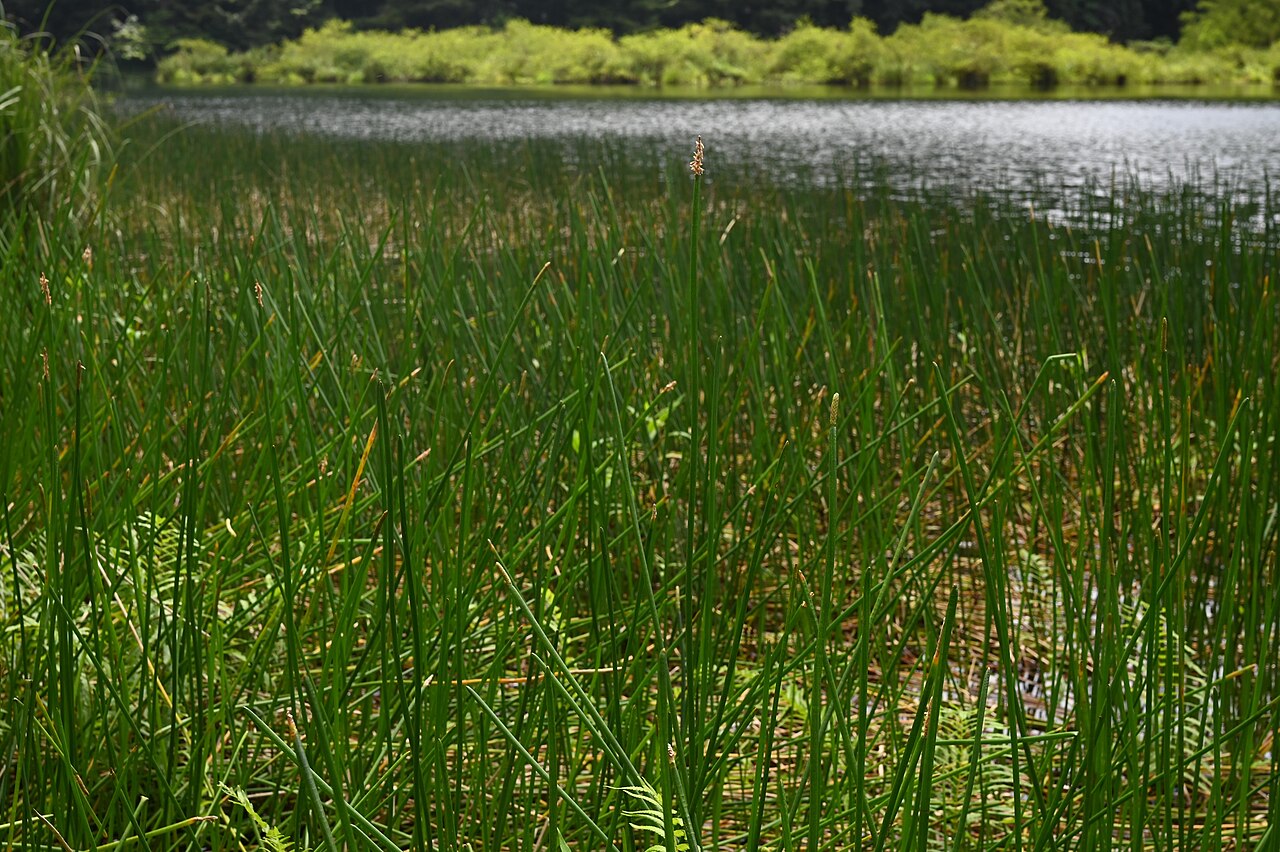
Emergent sedges like knotted spikerush form the backbone of many freshwater marshes, providing food and shelter for wetland wildlife.
For Pollinators
Spikerushes are wind-pollinated and offer little to pollinating insects. Dragonflies and damselflies often perch on the upright stems, and some lay eggs on or in emergent plants.
For Birds
Seeds of spikerushes are eaten by ducks and other waterbirds, and dense stands give cover to rails, herons and other marsh birds that hunt among the stems.
For Mammals
It has little direct value for mammals but forms part of the marsh habitat used by many wetland animals.
Ecosystem Role
Dense colonies of knotted spikerush slow moving water, trap sediment and help hold soft shorelines. The submerged stems provide surfaces for algae and small invertebrates, shelter for small fish, frogs and aquatic insects, and places for snails to lay eggs above the waterline.
Cultural & Historical Uses
The Danish botanist Martin Vahl described this plant in 1805 as Scirpus interstinctus, placing it with the bulrushes; it was moved to Eleocharis by Johann Jacob Roemer and Josef August Schultes in 1817. The species name interstinctus means “partitioned” or “marked off”, describing the cross-walls inside the stems. Eleocharis comes from Greek words meaning “marsh grace”.
In Spanish-speaking parts of the Caribbean, the general name junco is applied to many rushes, sedges and spikerushes with round, leafless stems. Knotted spikerush is one of the plants known in Puerto Rico as junco, junco de ciénaga and junco de espiga.
Rush-like plants such as spikerushes have long been used in many tropical regions for mats, baskets and thatch. Today, knotted spikerush is valued mainly as a native plant for wetland restoration and stormwater basins in Florida and the Caribbean.
Frequently Asked Questions
Is knotted spikerush native to Puerto Rico?
Yes. USDA PLANTS lists Eleocharis interstincta as native in Puerto Rico, where it is called junco, junco de ciénaga or junco de espiga, and the Institute for Regional Conservation records it in El Yunque and Río Abajo.
Why is it called “knotted”?
The stems are hollow and divided inside by thin cross-walls. These partitions show as faint bands or ridges on the outside, which look and feel like small knots.
Can knotted spikerush grow in a regular garden bed?
No. It is an obligate wetland plant and needs saturated soil or shallow standing water. Use it at pond edges, in water gardens or in wet stormwater areas.
Does it spread aggressively?
It spreads by rhizomes and can form dense colonies in shallow water, which is desirable in marsh restorations. In small ponds, grow it in a submerged pot to keep it contained.
What native plants grow well with it?
In Florida and Puerto Rico it grows naturally with other marsh plants such as sawgrass (Cladium jamaicense). On the mainland, common spikerush (E. palustris) is a related native for cooler regions.

Looking for a nursery that carries Knotted Spikerush?
Our nursery directory does not yet include Puerto Rico. Browse the native plant nursery directory by state: Alabama–Arkansas · California · Colorado–Hawaii · Idaho–Kansas · Kentucky–Montana · Nebraska–Oklahoma · Oregon · Pennsylvania–Virginia · Washington · West Virginia–Wyoming