
Drooping Juniper (Juniperus flaccida)
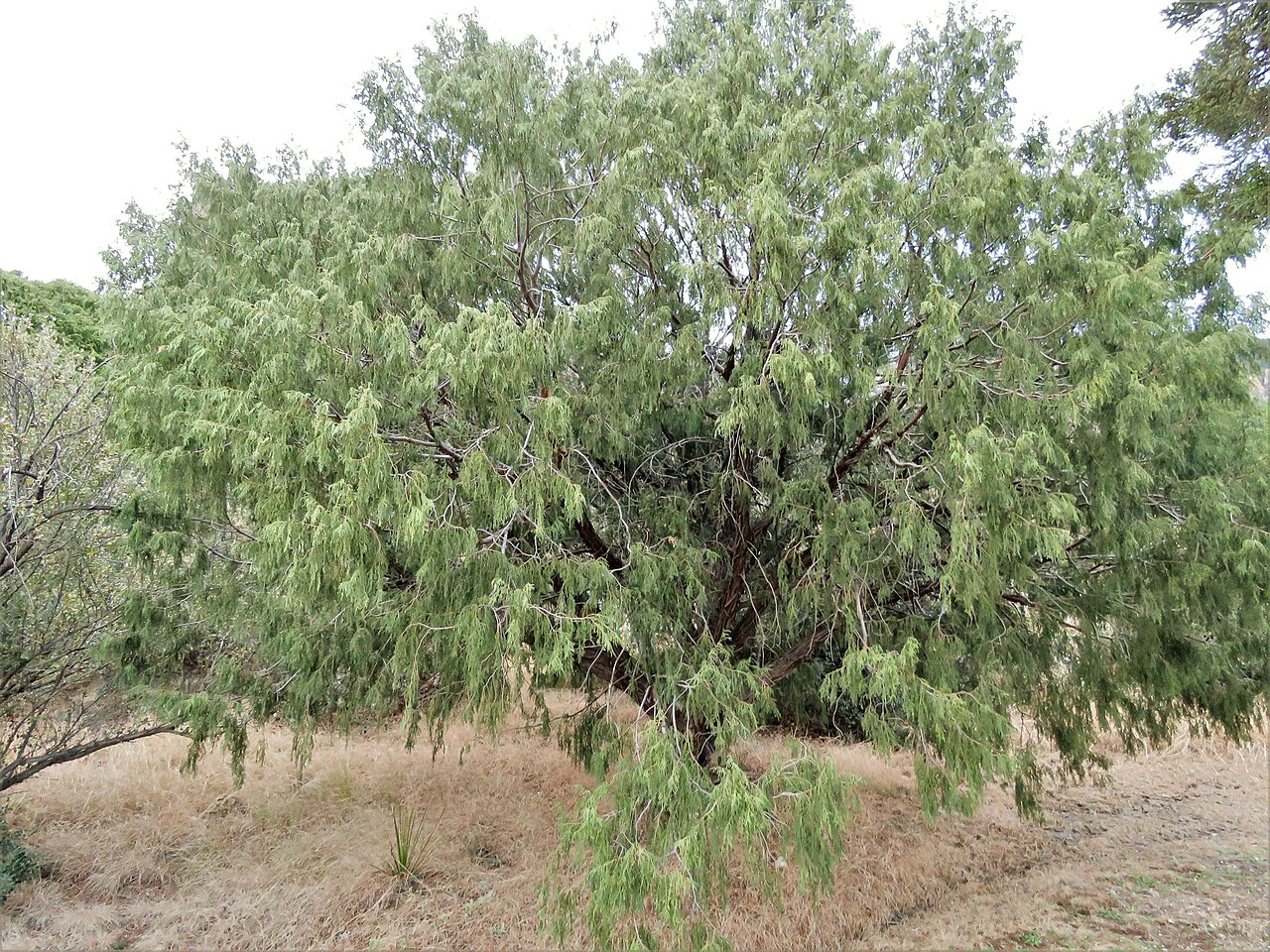
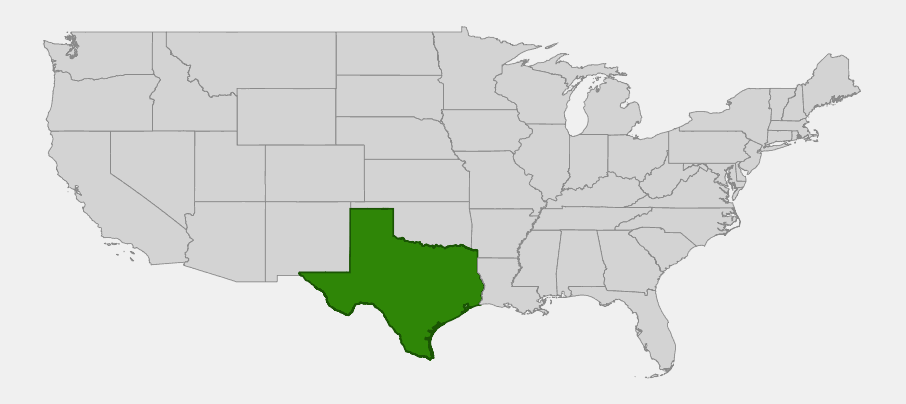
Juniperus flaccida, commonly called Drooping Juniper or Weeping Juniper, is one of the rarest native trees in the United States — not because it is endangered across its range, but because its entire U.S. population is confined to a single mountain range: the Chisos Mountains of Big Bend National Park in Brewster County, Texas. Everywhere else, Drooping Juniper is a tree of the mountains of central and northern Mexico, reaching south as far as Oaxaca.
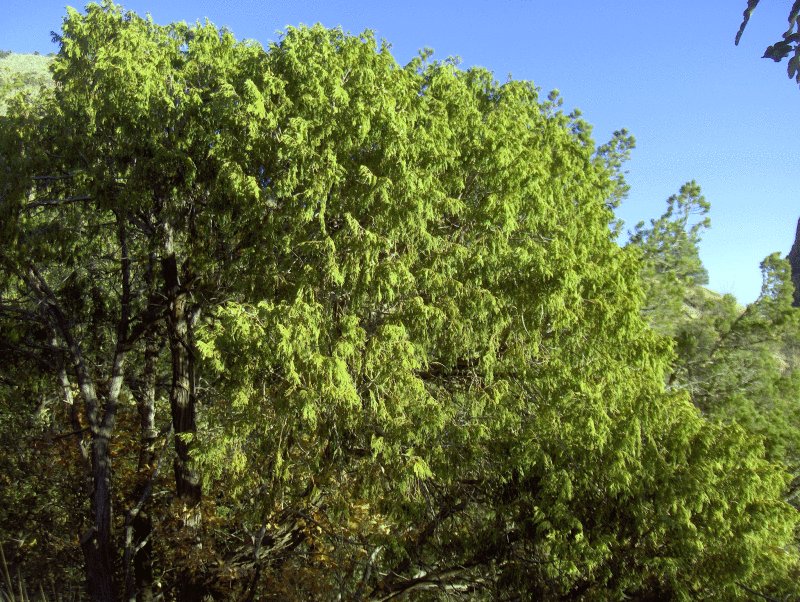
What makes this juniper instantly recognizable, even at a distance, is its growth habit. Drooping Juniper is the only juniper native to North America with strongly pendulous, weeping branches, often arranged in flattened, cascading sprays that give the tree a graceful, almost willow-like silhouette entirely unlike the stiff, upright form of most junipers. Combined with shaggy, stringy bark and relatively large, many-seeded cones, it is one of the most distinctive conifers a hiker can encounter in the Chisos high country.
Because its only U.S. population lies entirely within a national park, Drooping Juniper is not a tree most people will ever plant — collecting plant material from Big Bend National Park is illegal, and nursery stock is essentially unavailable in the United States. Its value here is almost entirely as a wild, protected rarity and a reminder of how many more widespread Mexican tree species reach the U.S. only at the very edge of their range in these isolated “sky island” mountains.
Identification
Drooping Juniper grows as a large shrub or small to medium tree, typically 16 to 33 feet tall and occasionally reaching 50 feet in favorable sites in Mexico. Its crown is broad and irregular, built from long, gracefully drooping branches that set it apart from every other juniper native to North America.
Bark & Stems
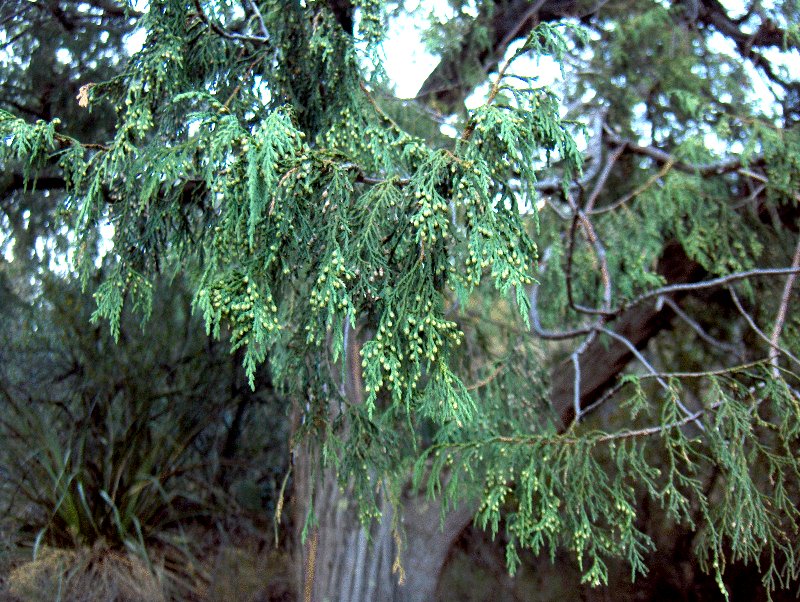
The bark is brown, thin, and fissures into long, stringy vertical strips, a texture shared with many junipers but especially pronounced here. Young shoots are slender, roughly 1 millimeter in diameter, and arranged in flattened, pendulous sprays that droop noticeably from the branch — the single most useful field mark for the species.
Leaves
Mature leaves are small, scale-like, and tightly appressed to the twig in opposite pairs, each about 2 to 4 millimeters long (slightly longer on vigorous leading shoots). Only young seedlings produce the sharper, needle-like juvenile foliage typical of many junipers; mature foliage is uniformly scale-like, giving the drooping sprays a soft, feathery texture.
Cones
Like all junipers, Drooping Juniper is dioecious, with separate male and female trees. Small male cones, 3 to 5 millimeters long, shed pollen in spring. Female trees produce berry-like seed cones 8 to 20 millimeters across that ripen from green to reddish-brown over about 18 months. These cones are notable for containing 6 to 12 seeds each — more seeds per cone than any other juniper species — a detail botanists use to help distinguish it from superficially similar junipers.
Quick Facts
| Scientific Name | Juniperus flaccida |
| Family | Cupressaceae (Cypress) |
| Plant Type | Evergreen coniferous tree / large shrub |
| Mature Height | 16–33 ft, rarely to 50 ft |
| Mature Spread | 15–25 ft, broad weeping canopy |
| Growth Rate | Slow |
| Sun Exposure | Full sun |
| Water Needs | Low; high drought tolerance |
| Soil Type | Dry, rocky, well-drained mountain soils, often igneous |
| Soil pH | Neutral to slightly alkaline |
| Bloom Time | Spring (wind-pollinated, inconspicuous) |
| Flower Color | N/A (separate male and female cones) |
| Fall Color | Evergreen; no fall color change |
| Fruit | Berry-like cones, 8–20 mm, green ripening reddish-brown; 6–12 seeds each |
| Deer Resistant | Yes, generally |
| USDA Hardiness Zones | 8–9 |
Native Range
Drooping Juniper is overwhelmingly a Mexican species, ranging through the mountains of central and northern Mexico from the vicinity of Oaxaca north to the U.S. border. In the United States, it occurs in exactly one location: the Chisos Mountains within Big Bend National Park, Brewster County, Texas — nowhere else in the country does this species grow natively.
Within its range, Drooping Juniper grows at moderate to fairly high elevations, roughly 2,600 to 8,500 feet, on dry, rocky mountain slopes and canyon walls, typically on igneous substrates. In the Chisos Mountains it occupies high-elevation woodland alongside other Mexican-affinity species that reach their only U.S. populations in this same sky-island range, including Texas madrone, Mexican pinyon, and alligator juniper.
Because Drooping Juniper’s entire U.S. range lies within a national park, it is legally protected from collection, and its rarity in the United States has nothing to do with population decline — it is classified as a species of Least Concern globally — but everything to do with the Chisos Mountains being the northernmost outpost of its naturally Mexican range.
📋 Regional plant lists featuring Drooping Juniper: Texas (South/West/Central)
Growing & Care Guide
Because Drooping Juniper’s only U.S. population grows wild and protected inside Big Bend National Park, this is not a species most readers will be able to plant. Collecting seed, cuttings, or whole plants from the park is illegal, and the species is not meaningfully available through the U.S. nursery trade. The notes below describe its natural requirements for reference and for anyone encountering cultivated specimens grown from legally sourced Mexican stock.
Light
In the wild, Drooping Juniper grows in full sun on open, rocky mountain slopes, consistent with its drought-hardy, sun-loving habit.
Soil & Water
This species is adapted to dry, rocky, well-drained mountain soils, often derived from igneous rock, with a neutral to slightly alkaline pH. It shows the same low-water, high drought tolerance typical of junipers native to the arid Southwest and northern Mexico, needing little water once established in soils with good drainage.
Conservation Note
Because its entire U.S. distribution lies within a single national park population, readers should never attempt to collect seed, cuttings, or whole plants of Drooping Juniper from the wild. If you encounter this species while hiking in the Chisos Mountains, photograph and enjoy it in place; any cultivated specimens available outside Mexico come from legally propagated nursery stock, not wild collection.
Landscape Uses
Where legally propagated stock is available (chiefly in Mexico, and only rarely in U.S. specialty conifer collections), Drooping Juniper’s uses include:
- Specimen tree prized for its unique weeping, cascading branch structure — a character shared with few other conifer trees
- Dry-climate windbreak or screen in regions with a similar climate to its native range, alongside other tough evergreens discussed in our guide to evergreens for windbreaks
- Drought-tolerant botanical and conifer collections, where its rarity and unusual form make it a conversation piece
Wildlife & Ecological Value
Within the high-elevation woodland of the Chisos Mountains, Drooping Juniper contributes to one of the most biologically distinctive habitats in Texas, shared with several other species found nowhere else in the United States.
For Birds
Like other junipers, the berry-like seed cones provide food for a range of birds, including species associated with Chisos Mountains woodland such as Mexican jays and various thrushes that pass through during migration or breeding season. The dense, drooping foliage also offers cover and nesting structure.
For Mammals
Small mammals feed on juniper “berries” and help disperse seeds, while the woodland the species helps form provides habitat structure used by Chisos Mountains wildlife, including white-tailed deer and the endemic Carmen Mountains white-tailed deer subspecies found in this same sky-island range.
Ecosystem Role
As part of the high-elevation woodland community of the Chisos Mountains, Drooping Juniper is one thread in an unusual ecological tapestry where Mexican mountain flora reaches its only U.S. foothold. Its presence, alongside Texas madrone, Mexican pinyon, and the Chisos oaks, helps define a habitat type found nowhere else in the country, which is part of why Big Bend National Park draws botanists and birders from across the continent.
Cultural & Historical Uses
Across its much larger Mexican range, Drooping Juniper and related junipers have traditionally been used by rural communities for fence posts, fuelwood, and small construction timber, much as other junipers are used throughout the arid Southwest and northern Mexico. Its wood, aromatic and naturally decay-resistant like that of many junipers, has served these practical purposes in the mountain communities where it grows.
In the United States, Drooping Juniper has no commercial history, since its sole population has always existed in rugged, remote terrain that became part of Big Bend National Park in 1944, protecting it from any harvest. Today its significance here is almost entirely as a botanical curiosity and a highlight for hikers exploring the Chisos high country — one of relatively few places in the U.S. where a visitor can see a juniper with a true weeping, cascading form growing wild.
For gardeners drawn to its unusual silhouette, legally propagated Drooping Juniper occasionally appears in specialty conifer collections; as with any rare or protected native, the responsible approach is always to seek out nursery-propagated stock rather than ever attempting wild collection, a principle worth keeping in mind generally when building a drought-tolerant native landscape.
Frequently Asked Questions
Where can I see Drooping Juniper in the wild in the United States?
Its only wild U.S. population grows in the Chisos Mountains of Big Bend National Park, Brewster County, Texas. It does not occur naturally anywhere else in the country.
Is Drooping Juniper endangered?
Globally it is classified as Least Concern, since it is common across a large range in Mexico. In the United States, however, it is extremely rare and geographically limited to a single protected mountain range, and it is illegal to collect from Big Bend National Park.
What makes Drooping Juniper different from other junipers?
It is the only juniper native to North America with strongly pendulous, weeping branches, often arranged in flattened, cascading sprays. Its cones also hold more seeds (6 to 12) than any other juniper species.
Can I buy Drooping Juniper at a nursery?
It is essentially unavailable in the mainstream U.S. nursery trade. Occasionally specialty conifer collectors offer legally propagated stock, but you should never collect seed or plants from Big Bend National Park, where the species is protected.
How big does Drooping Juniper get?
Typically 16 to 33 feet tall with a broad, weeping canopy, though trees in favorable sites in Mexico can occasionally reach 50 feet.

Looking for a nursery that carries native Texas conifers?
Browse our native plant nursery directory: Texas

