
Florida Tickseed (Coreopsis floridana)
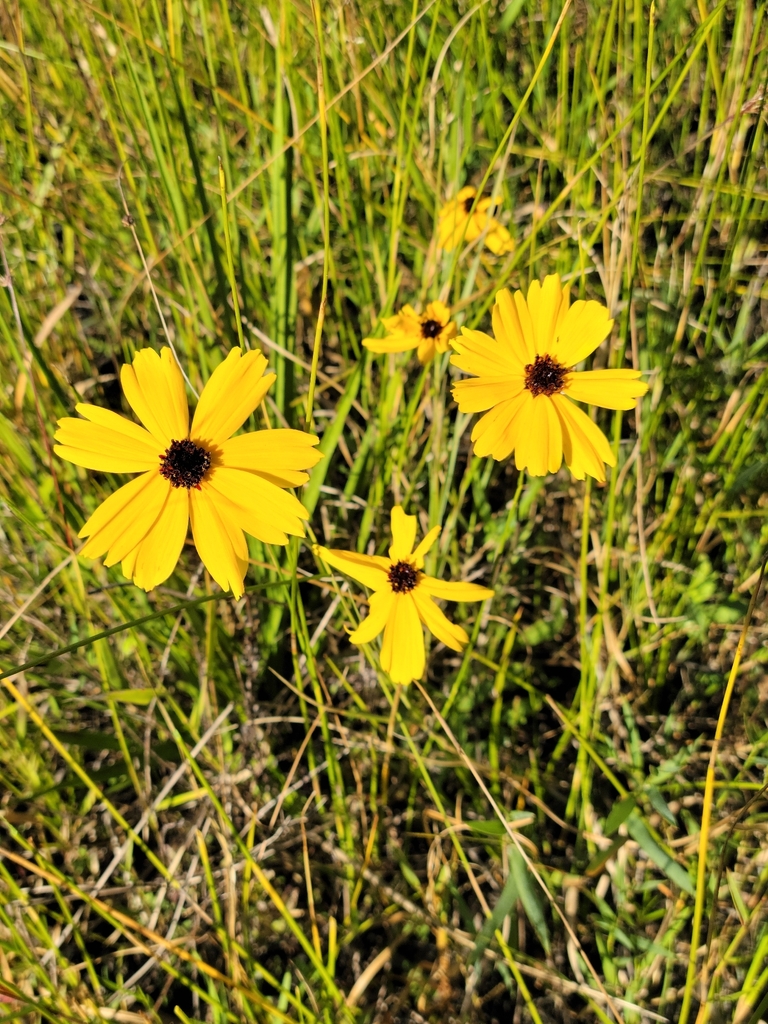
Coreopsis floridana, or Florida Tickseed, is a wetland wildflower found in the wild only in Florida. It is one of roughly a dozen Coreopsis species native to the state – a genus Florida named as its state wildflower – and it is the one that saves its display for the end of the year. While most tickseeds have finished by midsummer, Florida tickseed opens its big golden heads from about September into December, and sometimes later, over wet flatwoods, marsh edges and roadside ditches.
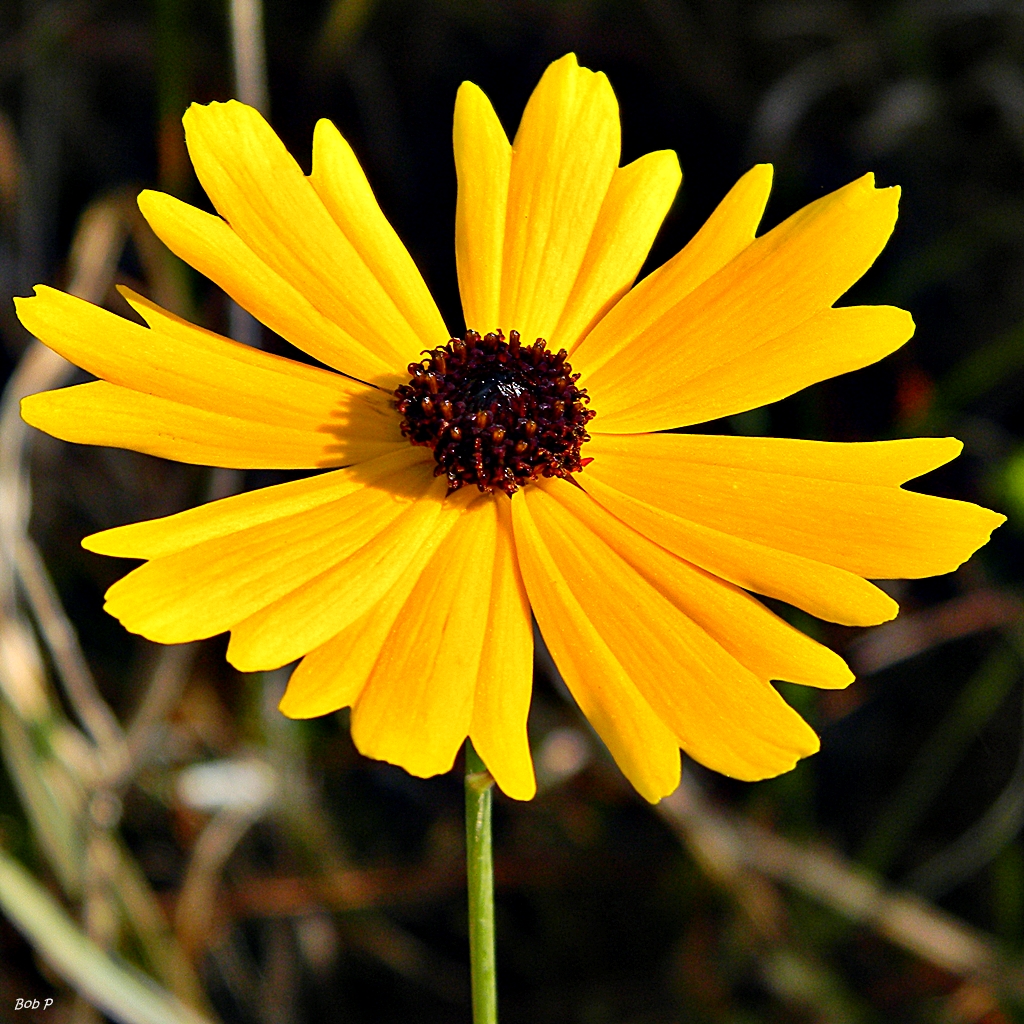
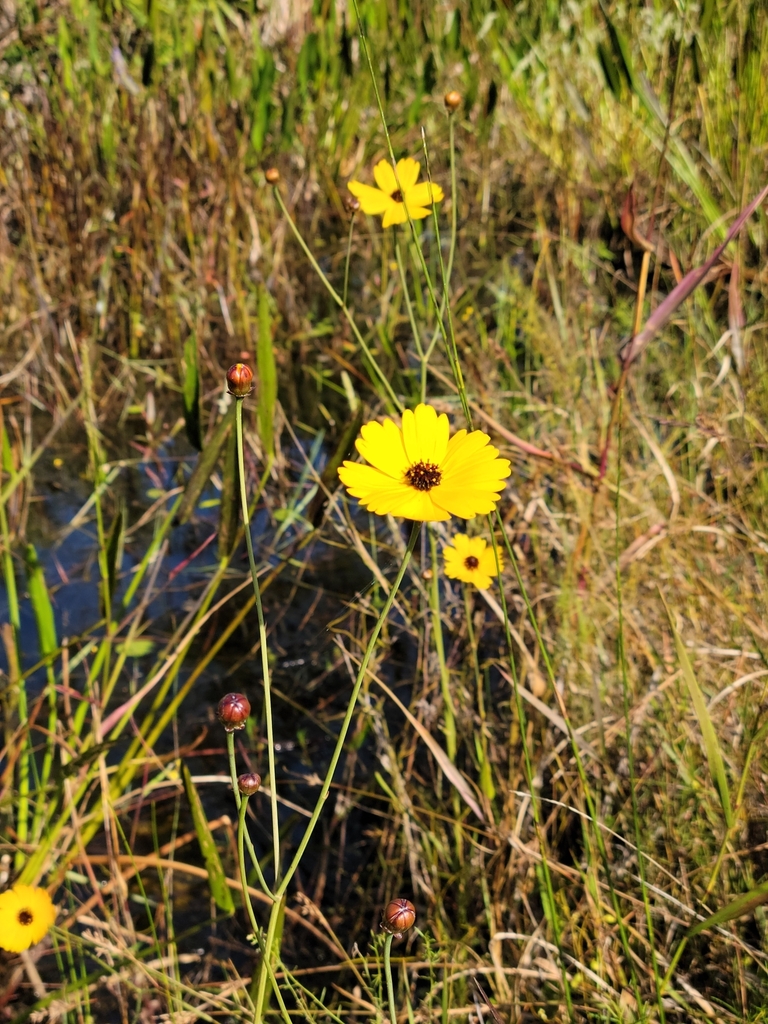
The plant is tall and sparse: a tuft of narrow basal leaves sends up slender, nearly leafless stalks to roughly 28 inches, occasionally taller, each ending in a single flower head up to about 2½ inches across. The rays are deep golden yellow and notched at the tips; the disk is a dark maroon-brown that makes the yellow look brighter. Seen from a distance in a wet prairie, the heads appear to float above the grass on invisible stems.
Florida tickseed is an obligate wetland species, rated OBL on the national wetland plant list, so it belongs in the wettest part of a garden rather than a typical sunny border. For gardeners with a pond edge, a rain garden, a seasonally flooded swale or simply a container with no drainage hole, it is one of the best late-season nectar plants Florida has.
Identification
Florida has many yellow tickseeds, and several share the same wet habitats, so identification comes down to the bracts under the flower head, the leaves, and the time of year. Florida tickseed blooms when almost everything else in the genus has stopped.
Habit & Stems
The plant grows from a perennial crown, often short-lived, producing a basal rosette or tuft of leaves and one to several upright flowering stalks. Stalks are slender, green, smooth or nearly so, usually branching only near the top, and typically reach about 2 to 2½ feet; vigorous plants in rich marsh edges may be taller. They carry few leaves, so the plant reads as a bare stem with a flower at the top.
Leaves
Leaves are alternate, elliptic to spatulate, with smooth (entire) margins and a blunt or rounded tip. The largest are clustered near the base; those on the stem are reduced in size and become narrow and bract-like toward the flower. Leaf surfaces may be smooth or finely hairy. Unlike several garden coreopsis species, the leaves are not divided or lobed.
Flowers
Each head sits singly at the tip of a long stalk. Eight or so golden-yellow ray florets, notched or shallowly lobed at the tip, surround a dense button of dark brown to maroon disk florets. Two rows of bracts support the head: the outer bracts are short, broadly triangular (deltoid) and light green with reddish-purple stripes, while the inner bracts are nearly colorless with many fine reddish lines. Bloom runs mainly from September through December, sometimes continuing into winter or appearing sporadically at other seasons.
Fruit & Seeds
The fruit is a small, flat, dry achene (technically a cypsela), dark brown and narrowly winged. The genus name comes from the Greek koris, “bug,” and opsis, “view,” because the seeds were thought to look like ticks – the source of the common name tickseed. Heads dry to a dark brown button that holds seed for weeks, long after the petals have dropped.
Similar Species
Coastalplain tickseed (Coreopsis gladiata) is nearly identical and grows in the same kind of wet ground; the two are separated by their bracts, which on coastalplain tickseed are longer and lance-shaped rather than short and triangular. Some botanists treat Florida tickseed as part of a broadly defined C. gladiata, but USDA PLANTS and the Atlas of Florida Plants both recognize it as its own species. Leavenworth’s tickseed (C. leavenworthii), Florida’s most common roadside coreopsis, has much smaller heads and blooms through the warm season. For other members of the genus, see Tickseed.
Quick Facts
| Scientific Name | Coreopsis floridana E.B. Sm. (treated by some authors within C. gladiata) |
| Family | Asteraceae (aster, composite or daisy family) |
| Plant Type | Herbaceous perennial wildflower, often short-lived |
| Mature Height | 2–3 ft in flower (about 28 in typical) |
| Mature Spread | About 1 ft per plant; forms loose colonies from seed |
| Growth Rate | Moderate to fast |
| Sun Exposure | Full sun |
| Water Needs | High; moist to seasonally flooded soil, no drought tolerance |
| Soil Type | Moist to wet sand, peaty sand and mucky soils; seasonally inundated |
| Soil pH | About 4.5–6.5 (acid flatwoods and marsh soils) |
| Bloom Time | September–December, occasionally into winter |
| Flower Color | Golden-yellow rays with a dark maroon-brown disk |
| Fall Color | None; stems die back and the plant is winter dormant |
| Fruit | Small flat achene (cypsela) in a dark brown seed head |
| Deer Resistant | Moderately; not a preferred browse |
| USDA Hardiness Zones | 8b–10b |
Native Range
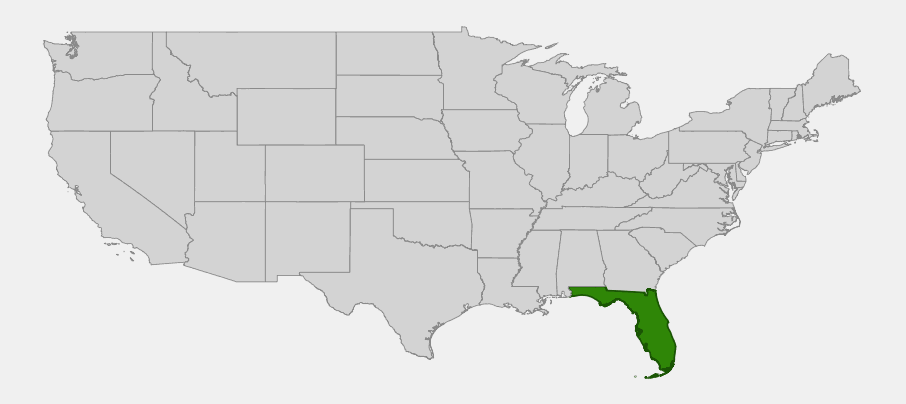
Florida tickseed is endemic to Florida. USDA PLANTS and the Lady Bird Johnson Wildflower Center record it from Florida alone, and the Atlas of Florida Plants lists it as native and endemic, with the type specimen collected in Dixie County in 1974 and described by E.B. Smith in 1976. It does not occur naturally in Georgia, Alabama or anywhere else, and there are no Canadian or Mexican populations.
Within the state it occurs nearly throughout, from the Florida Panhandle south through the peninsula, and it is most common in central and south Florida. Habitat is consistently wet and sunny: mesic to wet pine flatwoods, wet prairies, depression marshes and cypress swamp edges, herbaceous seepage slopes, and the kind of damp roadside ditches that mimic all of those. It is rated OBL (obligate wetland) on the national wetland plant list, meaning it is almost always found in wetlands.
The nearly identical coastalplain tickseed (C. gladiata) has a far wider coastal plain range from eastern Texas to Virginia and overlaps with Florida tickseed in the state. That overlap is the main reason records outside Florida attributed to “Florida tickseed” should be treated with caution; the two are distinguished by bract shape, not by geography alone.
📋 Regional plant lists featuring Florida Tickseed: North & South Florida
Growing & Care Guide
Florida tickseed is easy to grow in the right spot and impossible in the wrong one. It needs sun and consistently moist to wet soil; it has no drought tolerance and no salt tolerance. Plant it where water collects rather than where it drains, and it will largely look after itself, reseeding into the damp ground around it.
Light
Full sun. These are plants of open, treeless wetlands and sunny flatwoods, and they flower poorly under a canopy. Light afternoon shade is tolerated in the hottest sites, but sun produces the stronger stems and heavier bloom.
Soil & Water
Give it moist to wet, seasonally inundated sandy or peaty soil that stays damp through the growing season. Pond and lake margins, rain gardens, swales and the low end of a yard all work. A container with poor drainage – or no drainage hole at all – is a reliable way to grow it in a dry landscape. Soil should be acid and not especially rich; heavy fertilizer produces floppy stems. The plant will not tolerate drought or brackish water.
Planting Tips
Plant in spring or early summer, before the rainy season, so roots are established by the fall bloom. Space plants about a foot apart and let them colonize; because the stems are so narrow, a drift of a dozen plants reads far better than a single specimen. Set them among low sedges, grasses or other wetland wildflowers that can hold the slender stalks upright.
Pruning & Maintenance
Deadheading is not necessary and removing the seed heads costs you both the seedlings and the finches. After bloom, let the stalks dry and cut them back in late winter before new growth starts. Keep aggressive wetland grasses and cattails from closing over the planting. In wild habitats, periodic fire keeps the wet prairies open; in a garden, selective weeding does the same job.
Propagation
Seed is the practical method. Collect dried heads in late fall or winter and sow on the surface of moist soil – the seed needs light and damp ground to germinate – or simply let the plants self-sow where the ground stays wet. Established clumps can be divided in spring. Plants are occasionally available from Florida native plant nurseries, which is the simplest source for gardeners who do not want to wait on seed.
Landscape Uses
- Rain gardens and swales: one of the best choices for ground that floods after storms and stays damp for weeks
- Pond and lake margins: thrives in the saturated soil at the water’s edge in full sun
- Butterfly and pollinator gardens: supplies nectar in fall and early winter when little else is blooming
- Wet meadow and flatwoods restoration: a natural component of wet prairies and mesic to wet pine flatwoods within its Florida range
- Containers without drainage: a tub kept filled with wet soil makes a practical home for it in a dry yard
Wildlife & Ecological Value
Fall is a thin season for nectar in Florida wetlands, and Florida tickseed arrives precisely then. Its flat, open heads are accessible to almost every insect, and its seed ripens into the winter months.
For Pollinators
The open, shallow flower heads suit a wide range of visitors: butterflies and skippers, native bees including sweat bees and bumble bees, syrphid flies, soldier beetles and wasps. Because it blooms from September into December, it helps bridge the gap between the last of the summer wildflowers and the winter bloom of coastal and south Florida natives, and it is especially useful to late-flying butterflies and to migrating monarchs moving down the peninsula.
For Birds
The small dry achenes are eaten by seed-feeding songbirds. Goldfinches and sparrows work tickseed heads in the colder months, and leaving the dried stalks standing through winter is the simplest way to make that food available.
For Mammals
Of modest value. Small mammals take some seed, and the plant is not a preferred browse for deer, though young growth is occasionally nipped.
Ecosystem Role
Florida tickseed is an indicator of healthy, sunny, seasonally flooded ground. It appears in abundance in wet flatwoods and wet prairies that still flood on their natural schedule and stay open, and it disappears as those sites are drained, shaded by woody growth after decades without fire, or filled. Its tolerance for damp roadside ditches means it also survives in the wet margins of a developed landscape, where it keeps a scrap of wet prairie flora alive.
Cultural & Historical Uses
Florida tickseed is a recently named plant. E.B. Smith described it in the journal Sida in 1976, based on a specimen he collected northwest of Shamrock in Dixie County in 1974. Before that it was folded into the broader coastalplain tickseed, Coreopsis gladiata, and some botanists still treat it that way. USDA PLANTS and the Atlas of Florida Plants both keep it as a separate species, which is the treatment followed here.
The genus as a whole has unusual official standing in Florida. In 1991 the state designated Coreopsis – the whole genus, not a single species – as the Florida state wildflower, which means Florida tickseed is one of a dozen or so native species covered by that designation. Sales of the state’s wildflower license plate fund native wildflower planting and research along Florida roadsides, the same damp ditches where this species often grows.
There is little recorded traditional use of this particular tickseed. Other members of the genus were used by Native American and settler communities to make yellow, orange and reddish dyes from the flower heads, and tickseeds generally have long been gathered as cut flowers. Today Florida tickseed is valued mostly by native plant gardeners and roadside wildflower programs for its late bloom.
Frequently Asked Questions
When does Florida tickseed bloom?
Mainly from September through December, and sometimes into the winter. That late season is its distinguishing feature in the garden; most other tickseeds have finished flowering by midsummer.
How is it different from coastalplain tickseed?
The two look nearly identical. The reliable difference is in the bracts beneath the flower head: Florida tickseed has short, broadly triangular outer bracts, while coastalplain tickseed (C. gladiata) has longer, lance-shaped bracts. Some botanists combine the two species.
Can I grow it in a normal garden bed?
Only if that bed stays moist. It is an obligate wetland plant with no drought tolerance, so a rain garden, pond edge, swale or undrained container is a much better home than a standard raised bed.
Is it hard to find for sale?
It turns up occasionally at Florida native plant nurseries rather than in general garden centers. Seed is easy to collect from dried heads in late fall, and the plants self-sow freely in wet ground.
Should I cut it back after flowering?
Leave the seed heads standing. They feed goldfinches and sparrows through the winter and reseed the planting; cut the dried stalks back in late winter before new growth begins.

Looking for a nursery that carries Florida Tickseed?
Browse our native plant nursery directory: Florida