
Coastal Mock Vervain (Glandularia maritima)
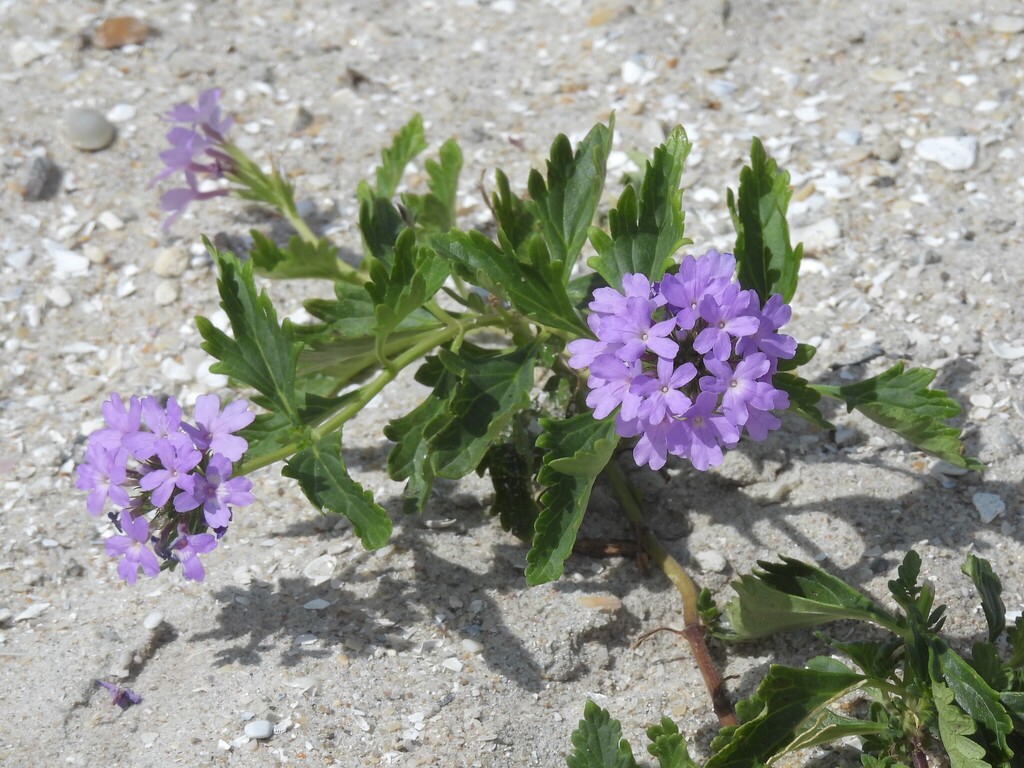
Glandularia maritima, known as Coastal Mock Vervain and widely sold as beach verbena or coastal vervain, is a low, sprawling wildflower found growing wild nowhere in the world except Florida. It belongs to the verbena family (Verbenaceae), and it does what the best dune plants do: it hugs the ground, roots as it travels, and covers hot bare sand with dark green foliage and flat clusters of lavender to rose-purple flowers. Individual plants stay only 4 to 12 inches tall, but their trailing stems can run 2 or 3 feet in every direction.
The flowers appear in nearly every month of the year in Florida, with the heaviest flushes in spring and summer, and they draw a steady stream of butterflies. Gulf fritillaries, long-tailed skippers, hawkmoths, miner bees and long-tongued bees all work the clusters. For a plant that asks for nothing more than sun and sand, it carries a lot of pollinator traffic.
Coastal mock vervain is also a species in trouble. It is listed as endangered by the State of Florida, and the Atlas of Florida Plants records it as a native Florida endemic with that state listing. Its home ground – the open coastal strand of the peninsula’s east coast – is exactly the land that has been built on, armored, and overrun with Brazilian pepper. That makes the gardener’s role straightforward: plant it, but always from nursery-grown stock, never from a wild population.
Identification
Several mock vervains grow in Florida, and a few non-native verbenas have escaped into the same open sandy sites, so it is worth learning this one carefully. Coastal mock vervain is recognized by its prostrate habit, its broad, coarsely toothed and lobed leaves, and its compact flat-topped flower clusters held just above the foliage.
Habit & Stems
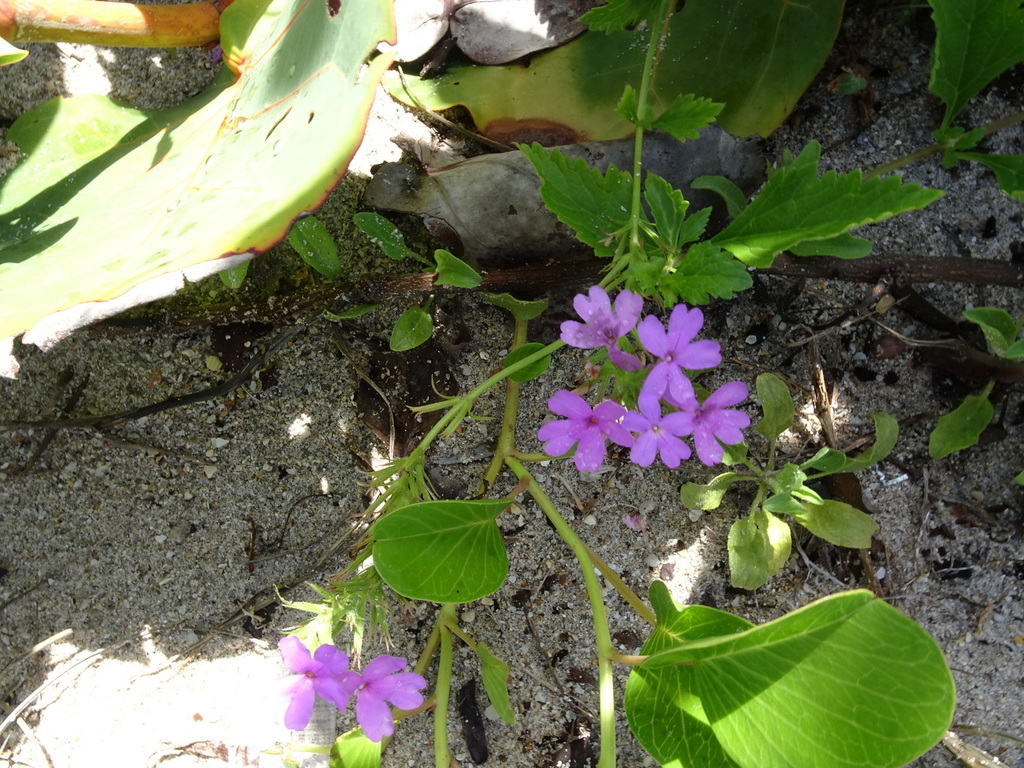
The plant forms a low, spreading mat rather than an upright clump. Stems are four-angled, finely hairy, often purplish, and subprostrate – they run along the surface of the sand and send down roots at the nodes, so a single plant slowly becomes a patch. Stems may reach about 3 feet long, but the leafy growth usually stands only 4 to 12 inches high. It is a short-lived perennial, generally vigorous for a few years and then replaced by seedlings or by rooted layers of itself.
Leaves
Leaves are opposite, dark green and somewhat glossy, ovate to rhombic in outline, and conspicuously toothed to deeply lobed along the margins. They are thick enough to handle salt wind and full sun, and they are noticeably broader than the finely dissected leaves of moss verbena (Glandularia pulchella), a widespread non-native that turns up in the same kinds of disturbed sandy ground.
Flowers
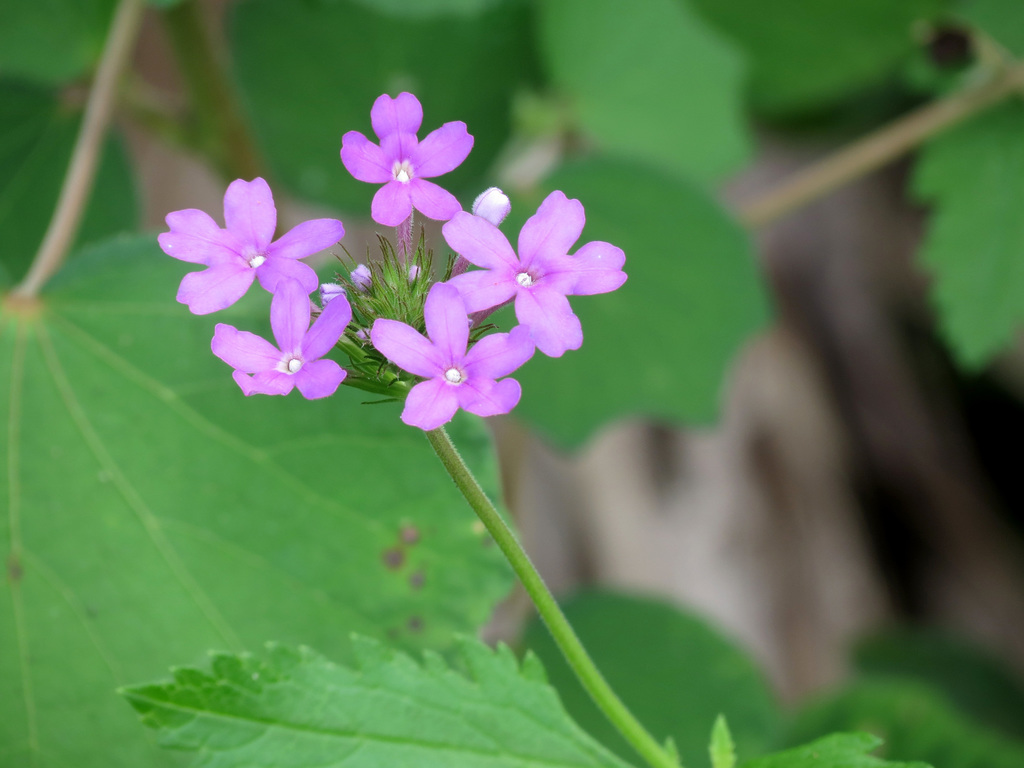
Flowers are borne in flat-topped terminal clusters, a few dozen to a cluster, opening from the outside of the head inward. Each flower is a slender tube about half an inch long that flares into five notched lobes, pale lavender to deep rose-purple with a whitish throat. The green calyx is narrow, ribbed and bristly-hairy. Bloom can occur in any month in Florida, with the strongest display in spring and summer; in frost-free coastal sites the plant is effectively evergreen and ever-blooming.
Fruit & Seeds
The fruit is inconspicuous: a dry schizocarp that separates into four narrow, hard nutlets, each holding one seed. There is no fleshy fruit and no showy seed head. Seeds drop near the parent plant, and in open sand they germinate readily, which is why wild colonies often appear as loose drifts rather than single plants.
Similar Species
Rose Vervain (Glandularia canadensis) is a close relative of the inland Southeast with larger rose-pink to magenta flowers and more deeply cut leaves; it is not a coastal strand plant. Moss verbena, with finely divided, almost ferny leaves, is non-native. Any verbena offered for sale in Florida should be checked against the scientific name, because the garden trade sells many non-native verbenas and hybrids under similar common names.
Quick Facts
| Scientific Name | Glandularia maritima (syn. Verbena maritima) |
| Family | Verbenaceae (verbena or vervain family) |
| Plant Type | Herbaceous, short-lived perennial groundcover |
| Mature Height | 4–12 in; trailing stems to about 3 ft long |
| Mature Spread | 2 ft or more; stems root at the nodes and form patches |
| Growth Rate | Fast |
| Sun Exposure | Full sun |
| Water Needs | Low; drought tolerant once established and intolerant of overwatering |
| Soil Type | Dry, sharply drained sand, shell or limestone soils, low in nutrients |
| Soil pH | About 6.0–8.0 (acid coastal sands to alkaline shell and limestone) |
| Bloom Time | Year-round in Florida; heaviest in spring and summer |
| Flower Color | Lavender to rose-purple with a pale throat |
| Fall Color | None; foliage stays green year-round in frost-free areas |
| Fruit | Inconspicuous dry schizocarp splitting into four nutlets |
| Deer Resistant | Generally; vervains are seldom preferred browse |
| USDA Hardiness Zones | 9–11 (its native frost-free and near-frost-free coastal range) |
Native Range
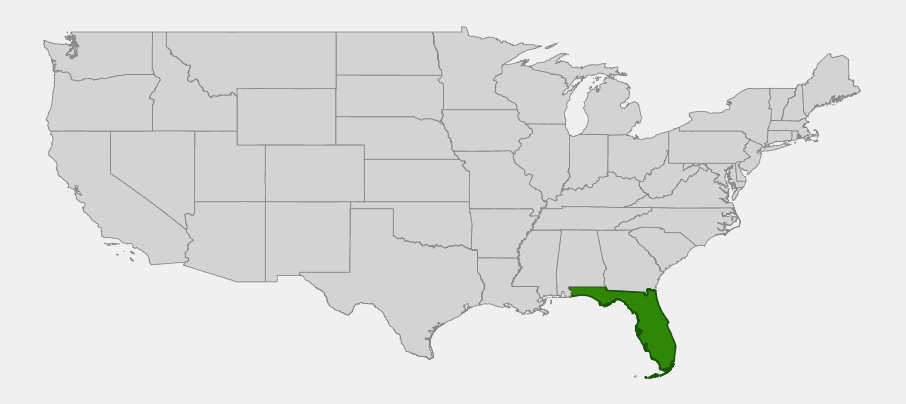
Coastal mock vervain is endemic to Florida. USDA PLANTS and the Lady Bird Johnson Wildflower Center list it for Florida alone, and the Atlas of Florida Plants classes it as native, endemic and state-listed endangered. There are no wild populations in any other state, in Canada, or in Mexico.
Within Florida the species belongs to the east coast of the peninsula. The Institute for Regional Conservation maps it from Miami-Dade County north along the coast to St. Johns County, with additional records in Collier and Hendry counties and an old report from the Monroe County Keys; the Florida Wildflower Foundation also includes Levy County on the Gulf side. Its core habitat is the coastal strand: the open, sunny, shell-and-sand zone just behind the dunes. Inland, scattered populations occur in pine rocklands and mesic flatwoods in Miami-Dade and Collier counties.
This is a small range in a heavily developed part of the country, and most of it sits on land that is beachfront property. Much of the historic coastal strand has been built on or has been taken over by Brazilian pepper and other invasive shrubs, which shade out a plant that cannot tolerate competition. The Institute for Regional Conservation treats it as a good candidate for replanting in coastal strand after exotic plants are cleared.
📋 Regional plant lists featuring Coastal Mock Vervain: North & South Florida
Growing & Care Guide
Coastal mock vervain is one of the easiest Florida natives to grow if you can give it the two things it insists on: full sun and sand that drains instantly. It fails in rich, moist, heavily mulched beds. Because it is state-listed as endangered, buy nursery-grown plants from a Florida native plant nursery and never dig or collect from wild populations; propagated plants establish faster anyway, and wild colonies are small enough that collecting does real damage.
Light
Full sun, all day. This is a plant of open sand with nothing overhead. In part shade it stretches, flowers sparsely, and is quickly crowded out by whatever is growing with it.
Soil & Water
Give it dry, sharply drained, nutrient-poor soil: beach sand, shelly sand, sandy loam, or the thin soils over limestone in south Florida. It tolerates both acid sand and alkaline shell. Water new plants until they root in, then stop. Established plants need no supplemental irrigation and resent it; overwatering and rich soil are the usual causes of death in cultivation. It handles salt wind well but does not tolerate standing salt or brackish flooding.
Planting Tips
Plant in the cooler months or at the start of the summer rains, and space plants 18 to 24 inches apart so the stems can run and knit together. Set the crown level with the surrounding sand, not in a depression that holds water. Skip the compost and the thick mulch; a thin layer of coarse sand or shell is better than bark, which holds moisture around the stems. It makes a good edge or container plant where drainage is guaranteed.
Pruning & Maintenance
Very little is needed. Trim back stems that wander out of bounds, and shear lightly if the mat gets thin and woody in the center to encourage fresh growth. Do not fertilize. Because plants are short-lived, let some seed ripen and fall so that the patch renews itself; the simplest maintenance plan is to leave bare sand between plants where seedlings can come up.
Propagation
Cuttings are the standard method and root easily, even without mist, which is how most nursery stock is produced. Plants can also be divided by lifting rooted sections where stems have layered at the nodes, and they grow from seed collected after the flower clusters dry. Keep the species pure where you can: verbenas hybridize readily, so planting the species native to your area helps protect the genetic identity of nearby wild populations.
Landscape Uses
- Coastal groundcover: a low, salt-wind-tolerant mat for sunny beachfront and near-coastal landscapes
- Butterfly and pollinator gardens: a long-blooming nectar source that flowers in almost every month
- Rock, shell and gravel gardens: thrives in the lean, fast-draining conditions those gardens provide
- Containers and raised planters: trails over the edge and tolerates the dry, hot conditions of a sunny patio
- Coastal strand restoration: used in replanting open coastal uplands after Brazilian pepper and other invasive plants are removed
Wildlife & Ecological Value
On a stretch of Florida coast where most of the ground cover is either bare sand or invasive shrubs, a patch of flowering coastal mock vervain is a concentrated nectar station, working through most of the year rather than for a few weeks.
For Pollinators
The flat-topped clusters make an ideal landing platform, and the narrow floral tubes suit insects with long tongues. Documented visitors include gulf fritillaries, long-tailed skippers and other butterflies, hawkmoths, miner bees and long-tongued bees such as bumble bees and orchid bees. Because bloom continues through the winter months in south Florida, the plant helps carry pollinators through the season when little else in the coastal strand is flowering.
For Birds
The plant offers no fruit or large seed crop for birds. Its value to them is indirect: a healthy mat of low vegetation supports insects, and insects feed the migrating songbirds that funnel down the Florida coast each spring and fall.
For Mammals
Of little direct importance. The foliage is not a favored browse, and the plant produces no significant seed or fruit crop for mammals.
Ecosystem Role
Coastal mock vervain is a stabilizer and a colonizer. Its rooting stems bind loose sand, and it moves quickly into open ground after storms or after invasive shrubs are cleared, holding that ground against erosion until other natives return. Its state endangered listing reflects how little intact coastal strand is left in peninsular Florida, and restoration crews use it as one of the first plants back in after Brazilian pepper removal.
Cultural & Historical Uses
The botanist John Kunkel Small described this plant as Verbena maritima in 1905, from a collection made between Cutler and Longview Camp in what is now Miami-Dade County. He later transferred it to the genus Glandularia in his 1933 Manual of the Southeastern Flora. The species name maritima simply means “of the sea,” and the older name Verbena maritima still circulates in the nursery trade as a horticultural synonym.
The USDA common name is coastal mock vervain, but Florida gardeners and native plant nurseries far more often call it beach verbena, and “coastal vervain” is used as well – the same plant under three names. The “mock” in mock vervain distinguishes the genus Glandularia from true vervains in the genus Verbena, which the species was once lumped with.
Its listing as a state endangered species has shaped how it is handled. Florida native plant nurseries propagate it from cuttings and sell it widely, especially in central Florida, which means gardeners can grow it without touching a wild population. Planting nursery-grown stock in coastal yards and restoration sites is one of the few practical ways a home gardener can give habitat back to a species that has lost most of its range to development.
Frequently Asked Questions
Is coastal mock vervain the same plant as beach verbena?
Yes. Glandularia maritima is sold as beach verbena and is also called coastal vervain; coastal mock vervain is the USDA common name. Its older scientific name, Verbena maritima, is still used in the nursery trade.
Can I grow it outside Florida?
It is hardy only in roughly zones 9 to 11 and needs fast-draining, sandy soil, so it is a Florida plant in practice. Outside its native range it is best treated as a container or seasonal plant, and gardeners elsewhere are better served by a mock vervain native to their own region.
Is it legal to collect it from the wild?
It is listed as endangered by the State of Florida, and digging plants from wild populations is both damaging and restricted. Buy nursery-propagated plants instead; they are widely available from Florida native plant nurseries and establish more reliably than collected ones.
Why is my plant dying in a well-watered bed?
Almost certainly too much water, too much shade, or soil that is too rich. Coastal mock vervain evolved on bare, sun-baked sand. Give it full sun, lean sandy soil, no fertilizer and no routine irrigation once it is rooted in.
How long does a plant live?
It is a short-lived perennial, usually vigorous for a few years. Stems root as they spread, and seedlings come up in open sand, so a planting renews itself if you leave a little bare ground and do not mulch heavily.

Looking for a nursery that carries Coastal Mock Vervain?
Browse our native plant nursery directory: Florida