
Swamp Lily (Crinum americanum)
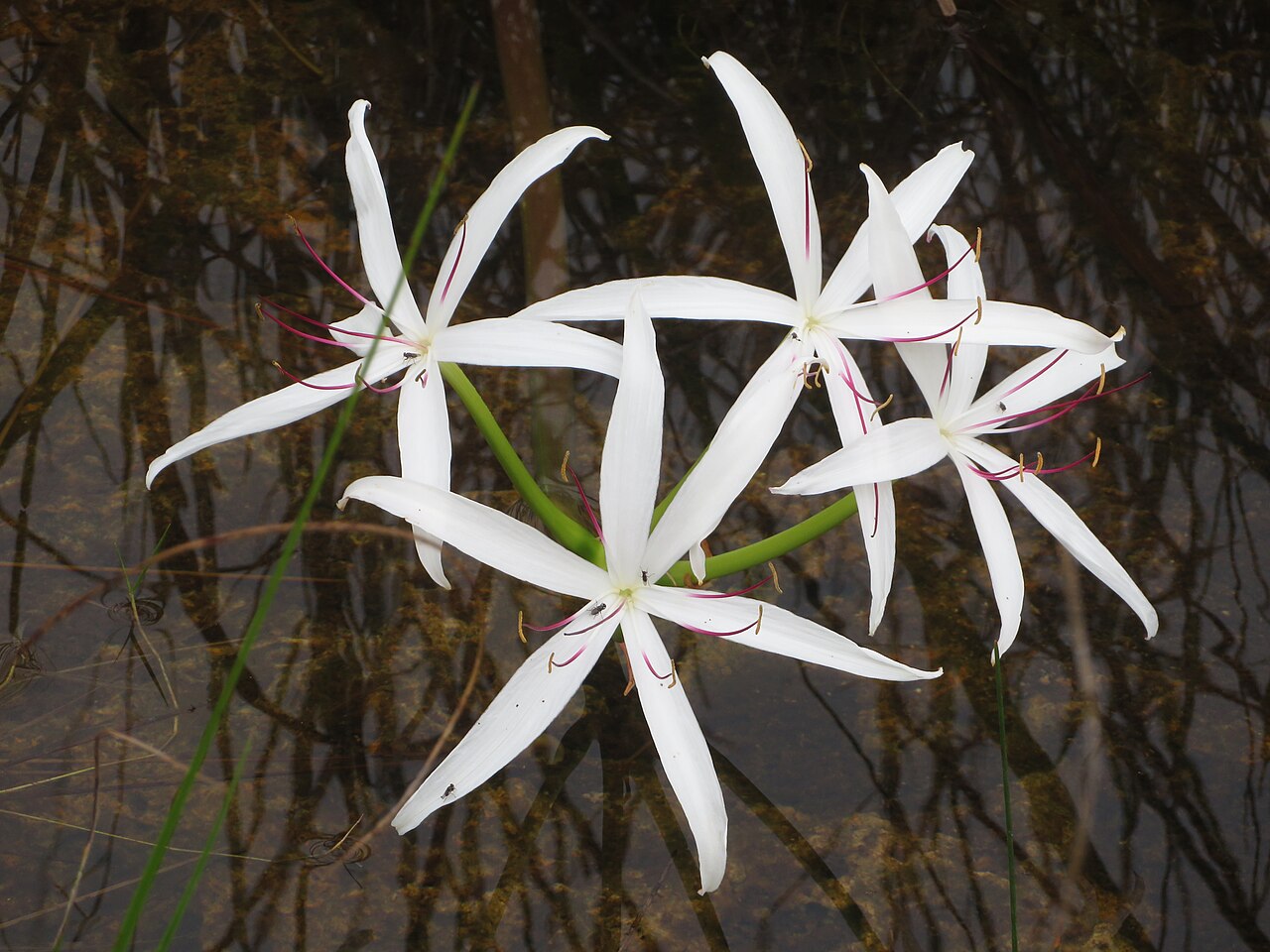
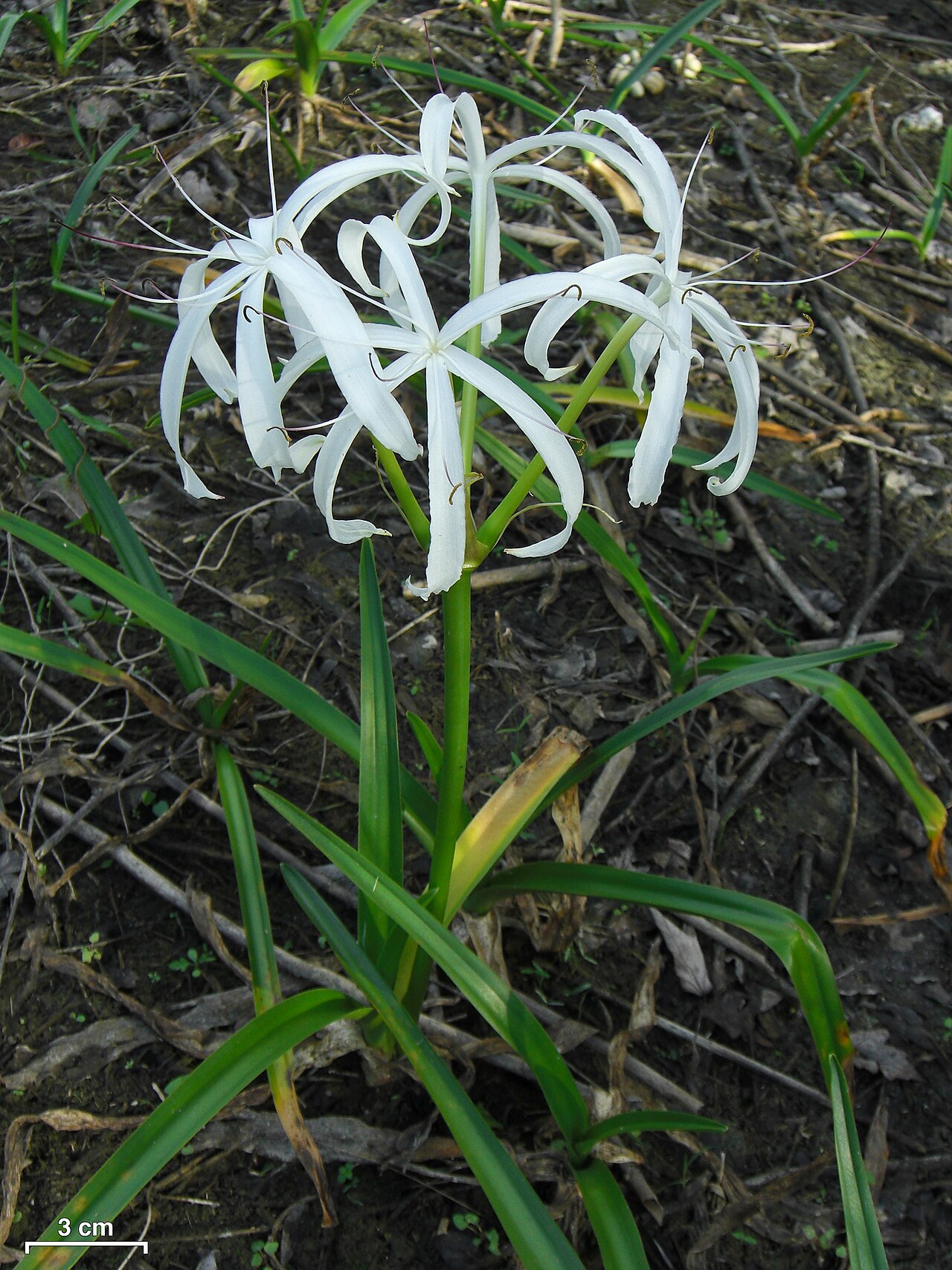
Crinum americanum, known as Swamp Lily, string lily, southern swamp crinum, or seven sisters (the name USDA PLANTS uses), is the native crinum of the southeastern United States. It is a bulb of freshwater marshes, cypress swamps, sloughs and the muddy edges of lakes, ponds and ditches. From a clump of long, strap-shaped leaves it raises a thick stalk 2 to 3 feet tall topped with a cluster of two to six large, spidery, fragrant white flowers, each with long, purple-red stamens that spread like the ribs of an umbrella.
It belongs to the amaryllis family (Amaryllidaceae), alongside daffodils, rain lilies and the native spider lilies (Hymenocallis). Like many of its relatives it contains toxic alkaloids, so it should not be eaten by people, pets or livestock. Wildlife sees it differently. In the Everglades, white-tailed deer eat so much swamp lily that it has been measured as a major part of their diet, and its leaves are a favorite of eastern lubber grasshoppers and spanish moth caterpillars.
Swamp lily is one of the easiest and most rewarding native plants for a pond edge, water garden or wet ditch in the Deep South. It spreads by stolons into small colonies, takes sun or shade, and flowers from early summer into fall. This guide covers how to recognize it, where it grows, how to grow it, and its role in southern wetlands.
Identification
In flower, swamp lily is hard to mistake for anything but a crinum or a spider lily. Out of flower it is a clump of glossy, strap-like leaves that could pass for a large iris or a daylily standing in the water.
Bulb & Growth Habit
Each plant grows from a bulb buried in wet muck or sand. The bulbs send out stolons (underground runners) that produce new bulbs nearby, so plants usually grow in small clumps or loose colonies rather than singly. The plant stays evergreen in mild climates. Where frost reaches it, the leaves freeze back to the water level in winter but green up again quickly.
Leaves
The leaves grow directly from the bulb in a loose rosette. They are long, flat and strap-shaped, about 2 to 4 feet long and 2 to 3 inches wide, bright green and somewhat fleshy. They can stand upright or arch outward and float on the water.
Flowers
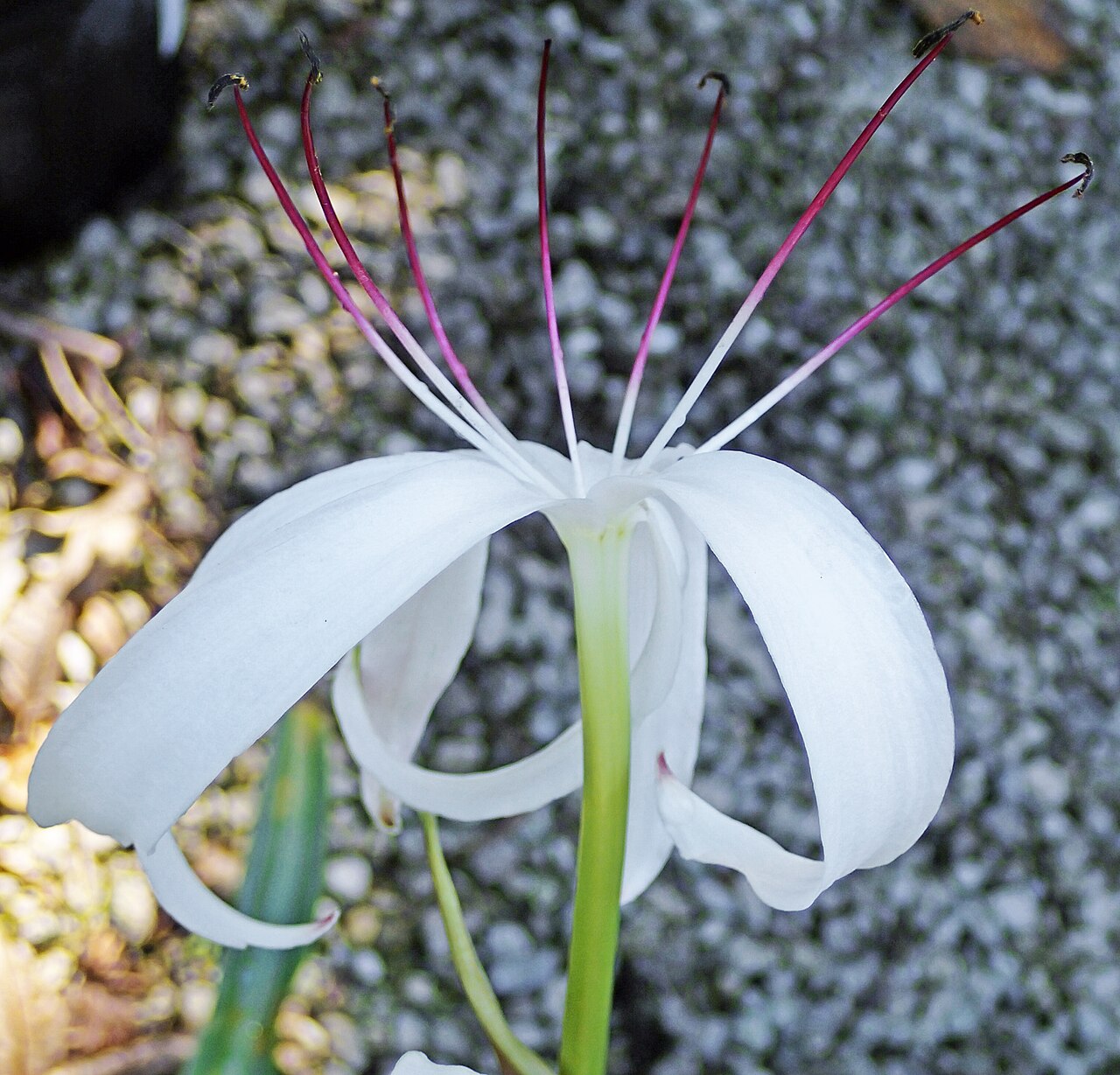
The flowering stalk is stout, about an inch thick and 2 to 3 feet tall, and carries an umbel of two to six flowers at the top. Each flower has a long, slender green tube several inches long that opens into six narrow, white tepals (the three sepals and three petals look alike). The tepals are 3 to 4 inches long and about ½ inch wide, and they curve back as the flower ages, giving it a loose, spidery look. They are sometimes tinged or striped with pink. Six long stamens with purple-red upper filaments and dark anthers spread outward from the center. The flowers are sweetly fragrant.
Swamp lily flowers mainly from June into November, with scattered flowers into winter in Florida. The native spider lilies (Hymenocallis) look similar, but their stamens are joined at the base by a white, cup-shaped membrane. Swamp lily has no cup, so its stamens stand free.
Fruit & Seeds
After flowering, the base of each flower swells into a rounded green capsule containing a few large, fleshy seeds. Crinum seeds have no dormancy and often start to sprout soon after they ripen. They can float, which helps them spread along waterways.
Quick Facts
| Scientific Name | Crinum americanum (syn. C. floridanum, C. strictum) |
| Family | Amaryllidaceae (amaryllis family) |
| Plant Type | Bulbous herbaceous perennial; emergent wetland plant |
| Mature Height | 2–3 ft in flower; leaves 2–4 ft long |
| Mature Spread | 2–3 ft per clump; slowly spreads by stolons |
| Growth Rate | Moderate |
| Sun Exposure | Full sun to shade |
| Water Needs | High; wet soil to shallow standing water |
| Soil Type | Wet, rich soils: sand, loam, clay or muck |
| Soil pH | Acidic to alkaline; tolerates calcareous soils |
| Bloom Time | June–November; occasionally into winter in Florida |
| Flower Color | White, sometimes tinged pink; purple-red stamens |
| Fall Color | None; evergreen in mild areas, freezes back in cold winters |
| Fruit | Rounded green capsule with a few large, fleshy seeds |
| Deer Resistant | No; deer browse it heavily in parts of Florida |
| USDA Hardiness Zones | 8–11 |
Native Range
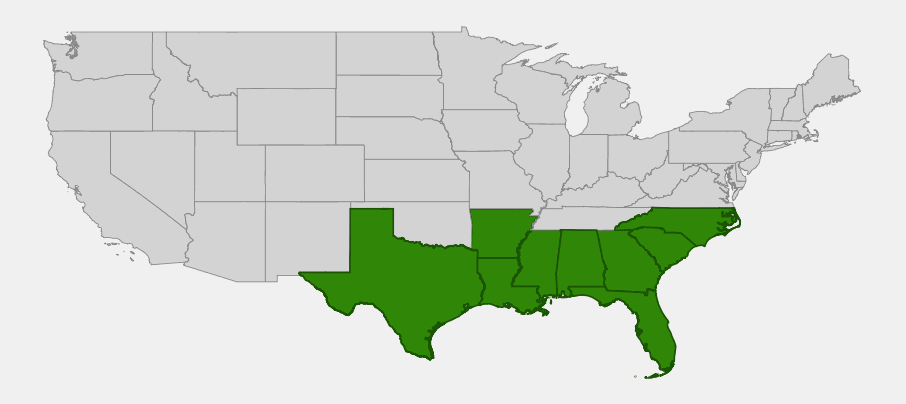
Swamp lily is native to the coastal plain of the southeastern United States. USDA PLANTS and the Lady Bird Johnson Wildflower Center record it from North Carolina, South Carolina, Georgia, Florida, Alabama, Mississippi, Louisiana, Arkansas and Texas. The Flora of the Southeastern United States places its northern limit in southeastern North Carolina. In Texas it grows in the southeast, along the upper Gulf Coast. Beyond the United States it is native to Mexico, Cuba, Jamaica and the Cayman Islands.
It is most common in Florida, where it grows from the northern counties south through the Everglades and Big Cypress Swamp, and NatureServe ranks it apparently secure there. Along the Gulf Coast it is a familiar plant of Louisiana and Mississippi marshes and swamps. Elsewhere it is scattered and more local. At the northern edge of its range in North Carolina it is uncommon, and NatureServe lists it as critically imperiled in Georgia, so wild plants should be left where they grow.
Throughout its range it is a plant of fresh water. It grows in marshes, wet prairies and sloughs, cypress and hardwood swamps, the shallow edges of lakes, ponds and rivers, and roadside ditches that hold water for much of the year.
📋 Regional plant lists featuring Swamp Lily: North & South Florida · Alabama, Georgia & Mississippi · North & South Carolina · Arkansas, Louisiana, Eastern Oklahoma & Eastern Texas
Growing & Care Guide
Swamp lily is a forgiving plant. Give it wet soil and warm summers and it will flower for years with almost no care. It is widely available from native plant and aquatic nurseries in the Southeast, so there is no reason to dig plants from the wild.
Light
Swamp lily is not fussy about light. It flowers well in full sun and will still bloom in deep shade, which makes it useful under cypress, at the shady edge of a pond, or in a wooded swale. In full sun the clumps are more compact. In shade the leaves grow longer and more arching.
Soil & Water
Grow it in soil that stays wet: the margin of a pond or lake, a water garden, a bog, a rain garden basin or a ditch. It does well in saturated soil or in shallow standing water a few inches deep, and it can also be grown in a pot set in a water feature. It accepts sand, loam, clay or muck, acidic or calcareous, and prefers soil rich in organic matter. It can survive in a regularly watered garden bed, but it flowers best with constant moisture.
Planting Tips
Plant bulbs or potted plants in spring or summer, setting the neck of the bulb at or just below the soil surface. Space them about 2 feet apart so the clumps have room to spread. In a pond, plant it in a container of heavy soil or directly in the muddy shelf at the edge. Because all parts of the plant are toxic, keep it away from areas where dogs or children might chew on the leaves or dig the bulbs.
Pruning & Maintenance
Remove spent flower stalks and yellowed leaves as needed. In zone 8, cold snaps may kill the leaves back to the water line, so cut away the damaged foliage after the cold passes. New leaves soon emerge. Check the leaves in summer for lubber grasshoppers and the black-and-white-banded caterpillars of the spanish moth, and hand-pick them if they do serious damage.
Propagation
Swamp lily is easy to propagate. Divide clumps, or separate the offset bulbs that form along the stolons, any time the plant is not actively flowering. Seed can be sown fresh, as soon as the capsules ripen. Press the large seeds into wet potting mix or mud, and they germinate quickly. Seedlings take a few years to reach flowering size.
Landscape Uses
- Water gardens and ponds: in containers or along the muddy shelf at the edge of the water
- Rain gardens and wet swales: in the lowest, wettest part of the planting
- Shade gardens with wet soil: one of the few showy native flowers that blooms in deep shade
- Wetland restoration: in freshwater marshes, cypress domes and lake margins within its native range
- Fragrance gardens: plant it near a patio or path to enjoy the scent
Wildlife & Ecological Value
Swamp lily feeds an unusual range of animals, from moths and grasshoppers to deer, despite the toxic alkaloids in its tissues.
For Pollinators
The white flowers, long floral tube and strong fragrance are classic signs of a moth-pollinated flower, and sphinx (hawk) moths are likely the main nighttime visitors. Bees and other insects may also visit for pollen during the day. The leaves are a larval food of the spanish moth (Xanthopastis timais), whose boldly banded black-and-white caterpillars, sometimes called convict caterpillars, feed on crinums, spider lilies and other members of the amaryllis family. Eastern lubber grasshoppers also chew the leaves.
For Birds
Swamp lily has no notable value as bird food. It grows in marshes, sloughs and cypress swamps that support herons, egrets, ibises and other wading birds, and its clumps add cover at the water’s edge.
For Mammals
In the southwestern Everglades, a study of white-tailed deer food habits from 1988 to 1991 found that swamp lily made up about 40 percent of the deer’s annual diet by dry weight, and it was found in the stomachs of most deer examined. In that wet prairie and tree island landscape it is one of the most important deer foods of all. In gardens, deer may browse it as well.
Ecosystem Role
Swamp lily is an emergent plant of shallow fresh water. Its clumps and stolons help hold mucky soils along pond and swamp margins, and its leaves provide food and shelter for aquatic insects and the animals that eat them. Because it tolerates both flooding and shade, it is one of the few flowering plants that grows well in the dim interior of cypress domes and strands.
Cultural & Historical Uses
Linnaeus named Crinum americanum in 1753. The genus name comes from the Greek krinon, a lily, and the species name means “of America,” because it was one of the first crinums known from the New World. Over the years it has also been called Crinum floridanum, C. strictum and several other names.
The name “seven sisters” is often explained as a reference to the Pleiades, the star cluster known as the Seven Sisters, since the cluster of white flowers resembles a cluster of stars. The names “string lily” and “swamp lily” describe its narrow, string-like tepals and its wet habitat.
Like other crinums, swamp lily contains lycorine and other alkaloids typical of the amaryllis family. These compounds are toxic if eaten and are the reason the bulbs should be kept away from pets and children. They have also made crinums a subject of laboratory research on plant alkaloids. Today swamp lily is grown mainly as an ornamental for ponds and wet gardens, and it is widely sold by native and aquatic plant nurseries in Florida and the Gulf states.
Frequently Asked Questions
Is swamp lily poisonous?
Yes. Like other members of the amaryllis family, it contains lycorine and related alkaloids, and the bulbs are the most toxic part. Eating any part can cause vomiting and other digestive symptoms in people and pets. Handle it normally, but keep it away from animals and children who might chew it.
Can swamp lily grow in standing water?
Yes. It grows naturally in saturated mud and shallow water and does well in a few inches of water at the edge of a pond or in a container set in a water garden. It also grows in wet soil that is not flooded.
How do I tell swamp lily from a spider lily?
Both have white, spidery flowers. Native spider lilies (Hymenocallis) have a white, cup-shaped membrane joining the stamens in the center of the flower. Swamp lily has no cup, and its long stamens are purple-red at the tips.
Will swamp lily bloom in shade?
Yes. It is one of the few showy native flowers that blooms in deep shade, although plants in full sun usually produce more flowering stalks.
Is swamp lily cold hardy?
It is hardy in about USDA zones 8 to 11. In the colder parts of its range the leaves freeze back in winter, but the bulb survives in wet soil and sends up new leaves quickly in spring.

Looking for a nursery that carries Swamp Lily?
Browse our native plant nursery directory: Alabama & Arkansas · Florida & Georgia · Louisiana & Mississippi · North Carolina · South Carolina & Texas