
Duck Potato (Sagittaria latifolia)
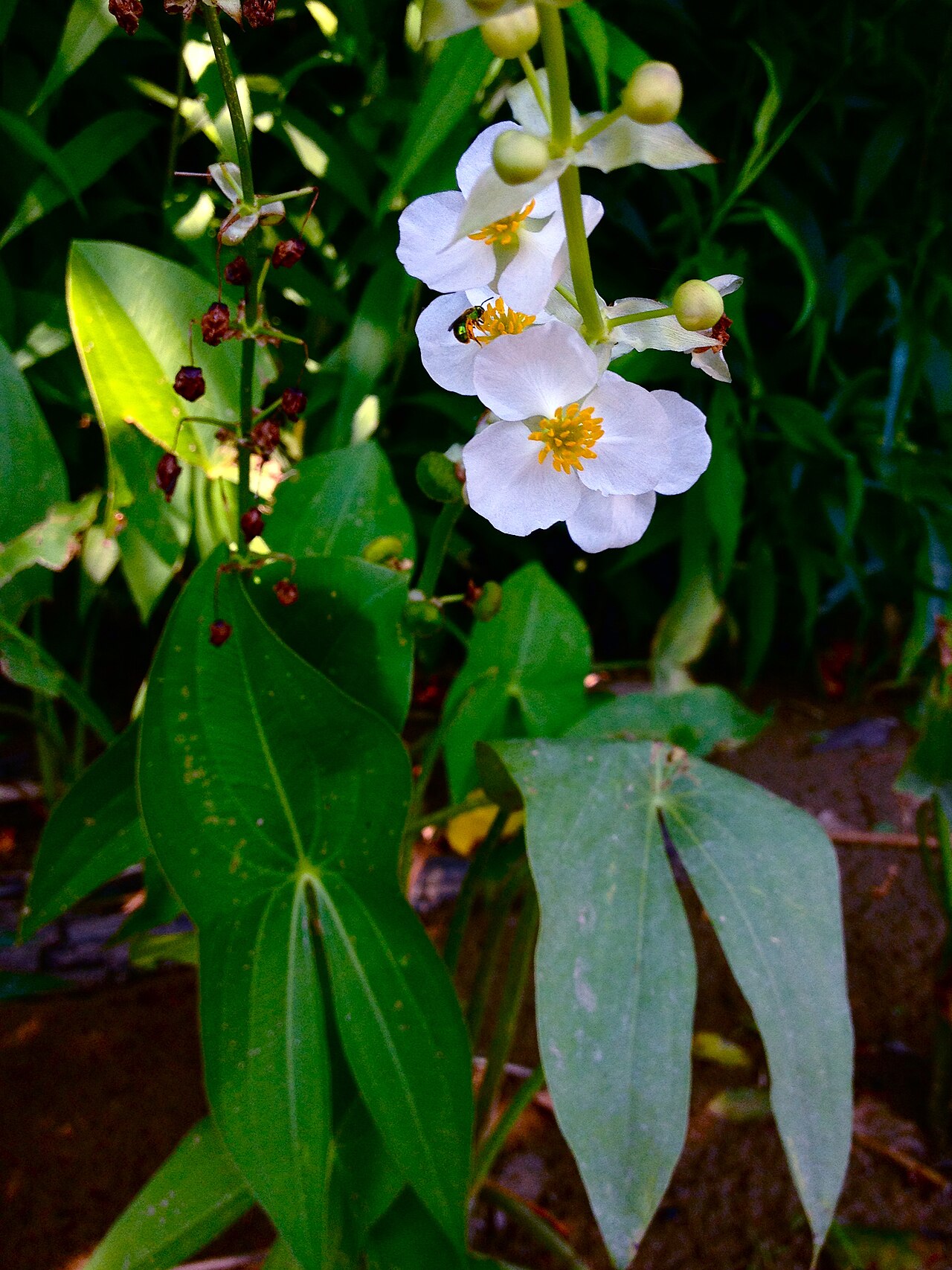
Sagittaria latifolia, known as Duck Potato, broadleaf arrowhead or wapato, is one of the most familiar emergent plants of North American wetlands. It grows in shallow water and mud along ponds, lakes, marshes, ditches and slow streams, raising bold, arrowhead-shaped leaves on long stalks and, from midsummer into fall, spikes of white three-petaled flowers arranged in neat whorls of three. It belongs to the water-plantain family (Alismataceae) and is native across southern Canada and nearly all of the lower 48 states, south through Mexico and Central America to northern South America.
The name “duck potato” comes from the plant’s starchy tubers, which form at the tips of underground runners in late summer and fall. They are about the size of a walnut or a small egg and were a major food for many Indigenous peoples. “Wapato,” the name used along the lower Columbia River, is the one Lewis and Clark recorded in 1805 and 1806, when Chinookan peoples traded the roasted tubers to the expedition. The genus name Sagittaria comes from the Latin sagitta, an arrow, after the leaf shape, and latifolia means broad-leaved.
Duck potato is also an excellent plant for water gardens, rain gardens, pond edges and wetland restoration. It is easy to grow, hardy from Canada to Florida, and valuable to wildlife: waterfowl eat its seeds, muskrats and beavers eat the whole plant, and its colonies shelter fish, frogs and invertebrates. This guide covers identification, range, growing tips, wildlife value and its long history as a food plant.
Identification
Duck potato is easy to recognize when it flowers. Out of flower, its arrowhead leaves can be confused with a few other wetland plants, especially arrow arum and pickerelweed. Its leaves are also unusually variable, changing shape with water depth and growing conditions.
Roots, Runners & Tubers
Each plant grows from a short, fleshy base with fibrous roots. In summer it sends out slender runners (stolons) through the mud, and in late summer and fall the tip of each runner swells into a firm, starchy tuber, roughly ½ to 2 inches across, with a pointed bud at one end. The tubers overwinter in the mud and produce new plants the next spring, which is how a single plant becomes a colony. All parts of the plant contain a milky sap.
Leaves
The leaves rise in a basal rosette on long, spongy stalks and usually stand well above the water. Typical leaves are broadly arrowhead-shaped, with a pointed tip and two long, backward-pointing basal lobes, and the blade may be 4 to 16 inches long or more. The leaf shape is remarkably variable: some plants have very broad blades almost as wide as long, others have narrow, lance-shaped blades with slender lobes, and plants growing in deeper or moving water may produce ribbon-like submerged leaves. The main veins radiate from the point where the stalk joins the blade and then run toward the tip and the lobe tips.
Arrow arum (Peltandra virginica) has similar arrow-shaped leaves, but its leaves have a distinct vein running along the margin and many fine, parallel side veins, and it bears a green, pod-like spathe rather than white flowers. Pickerelweed (Pontederia cordata) has heart-shaped rather than arrow-shaped leaves and spikes of blue-violet flowers.
Flowers
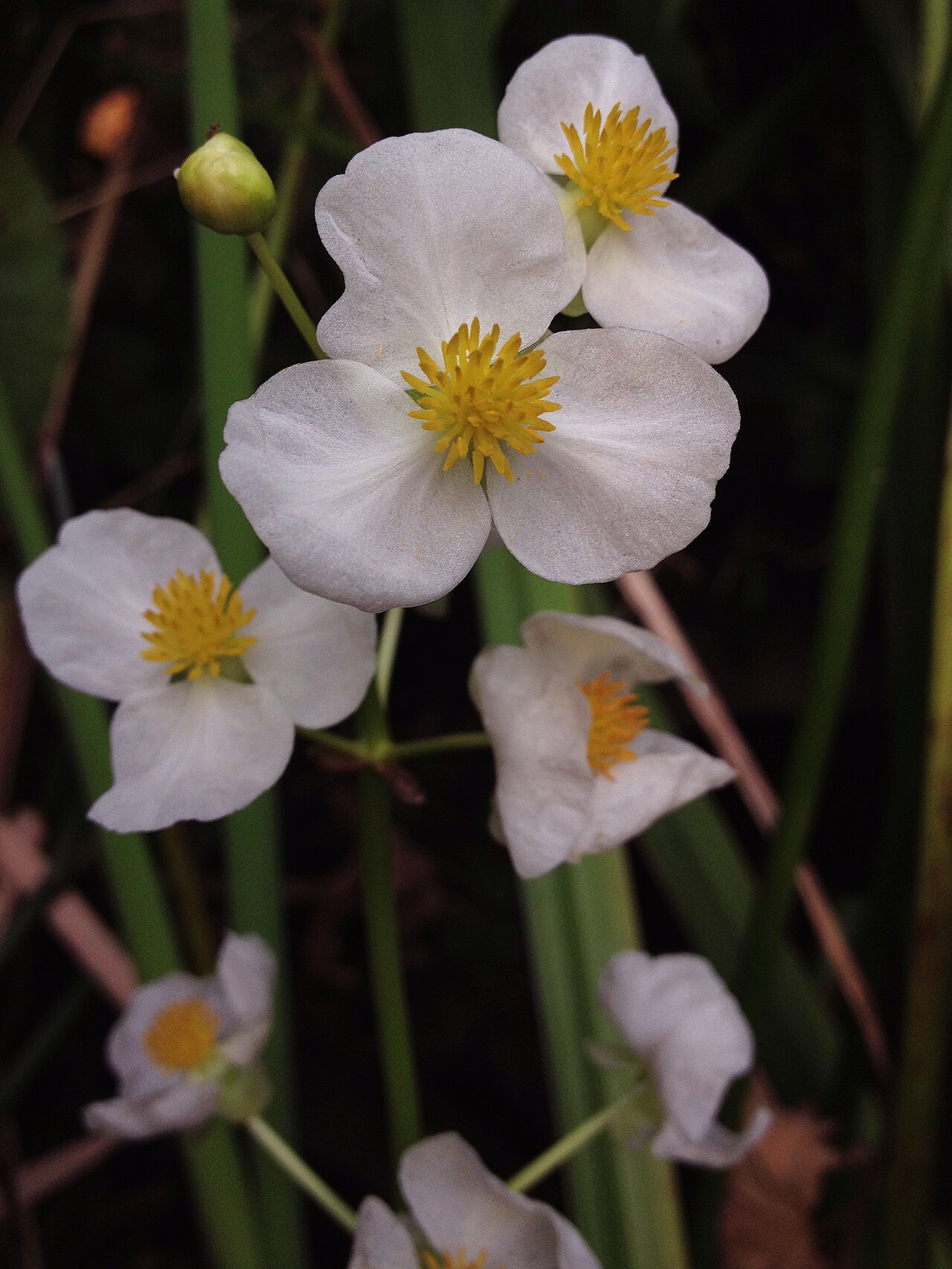
The flowering stalk is leafless and usually about as tall as the leaves, 1 to 3 feet. It carries several tiers of flowers in whorls of three. Each flower is about 1 to 1½ inches across, with three rounded, often crinkled white petals and three small green sepals. Most plants are monoecious: female flowers, with a round green head of many tiny pistils, are on the lower tiers, and male flowers, with a dense ring of 25 to 50 yellow stamens, are above. Some plants bear flowers of only one sex. Flowering runs mainly from July to September, and longer in the South.
Fruit & Seeds
After flowering, each female flower ripens into a round head, about ½ to 1½ inches across, of many flat, winged achenes. Each achene has a short beak that sticks out horizontally from its upper edge, a detail that helps separate duck potato from related arrowheads. The ripe seeds float and are scattered by water and by the waterfowl that eat them.
Quick Facts
| Scientific Name | Sagittaria latifolia (broadleaf arrowhead; also called wapato) |
| Family | Alismataceae (water-plantain family) |
| Plant Type | Emergent aquatic perennial with tubers |
| Mature Height | 1–3 ft (occasionally to 4 ft or more) |
| Mature Spread | 1–2 ft per plant; spreads by runners and tubers to form colonies |
| Growth Rate | Fast |
| Sun Exposure | Full sun to part shade |
| Water Needs | High; wet mud to standing water up to about 12–18 in deep |
| Soil Type | Mud, muck, silt or sandy loam that stays saturated or flooded |
| Soil pH | Wide range, slightly acidic to alkaline (about 6.0–8.0); tolerates hard water |
| Bloom Time | July–September (longer in the South) |
| Flower Color | White with yellow centers |
| Fall Color | Leaves yellow and collapse after frost |
| Fruit | Round heads of flat, winged achenes; starchy underground tubers |
| Deer Resistant | Moderately; deer occasionally browse it, but muskrats and beavers eat it readily |
| USDA Hardiness Zones | 3–10 |
Native Range
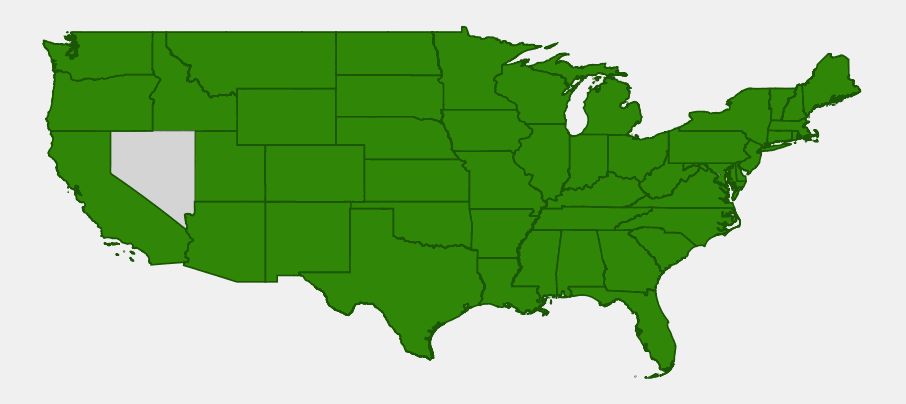
Duck potato has one of the widest ranges of any North American wetland plant. The Lady Bird Johnson Wildflower Center, drawing on USDA data, lists it from 47 of the lower 48 states and the District of Columbia, from Maine to Florida and west to Washington, Oregon and California. It is native in Puerto Rico as well. In Canada it grows across the southern part of the country, from British Columbia east through Ontario and Quebec to the Maritime provinces and Newfoundland. Beyond the United States it extends through Mexico and Central America to Cuba, Colombia, Venezuela and Ecuador.
It is most common in the East and Midwest and along the Pacific Coast, especially in the lower Columbia River and the Central Valley of California. In the arid interior West it is scattered, limited to river backwaters, reservoirs, irrigation ditches and spring-fed marshes, and Nevada is the one lower-48 state where the Wildflower Center does not list it. It grows from near sea level in coastal marshes and the Everglades to the mountain valleys of the Rockies.
In Hawaii, duck potato is an introduced plant, not a native one. It has also become naturalized in parts of Europe, Australia and Asia, where it can spread aggressively in ditches, rice fields and shallow waters. Within its native range it is a normal and valuable member of marsh and shoreline communities.
📋 Regional plant lists featuring Duck Potato: North & South Florida · Alabama, Georgia & Mississippi · North & South Carolina · Maryland, Virginia & West Virginia · Kentucky & Tennessee · Arkansas, Louisiana, Eastern Oklahoma & Eastern Texas · Illinois, Iowa & Missouri · Ohio & Indiana · Nebraska, Kansas & Eastern Colorado · North Dakota, South Dakota & Western Minnesota · Michigan, Wisconsin & Eastern Minnesota · New York, Pennsylvania & Northern New Jersey · Delaware, Southern New Jersey & Long Island · Connecticut, Massachusetts & Rhode Island · New Hampshire, Maine & Vermont · Idaho, Eastern Oregon & Eastern Washington · Western Oregon & Western Washington · California & Nevada · Arizona & New Mexico · Utah & Western Colorado · Montana & Wyoming
Growing & Care Guide
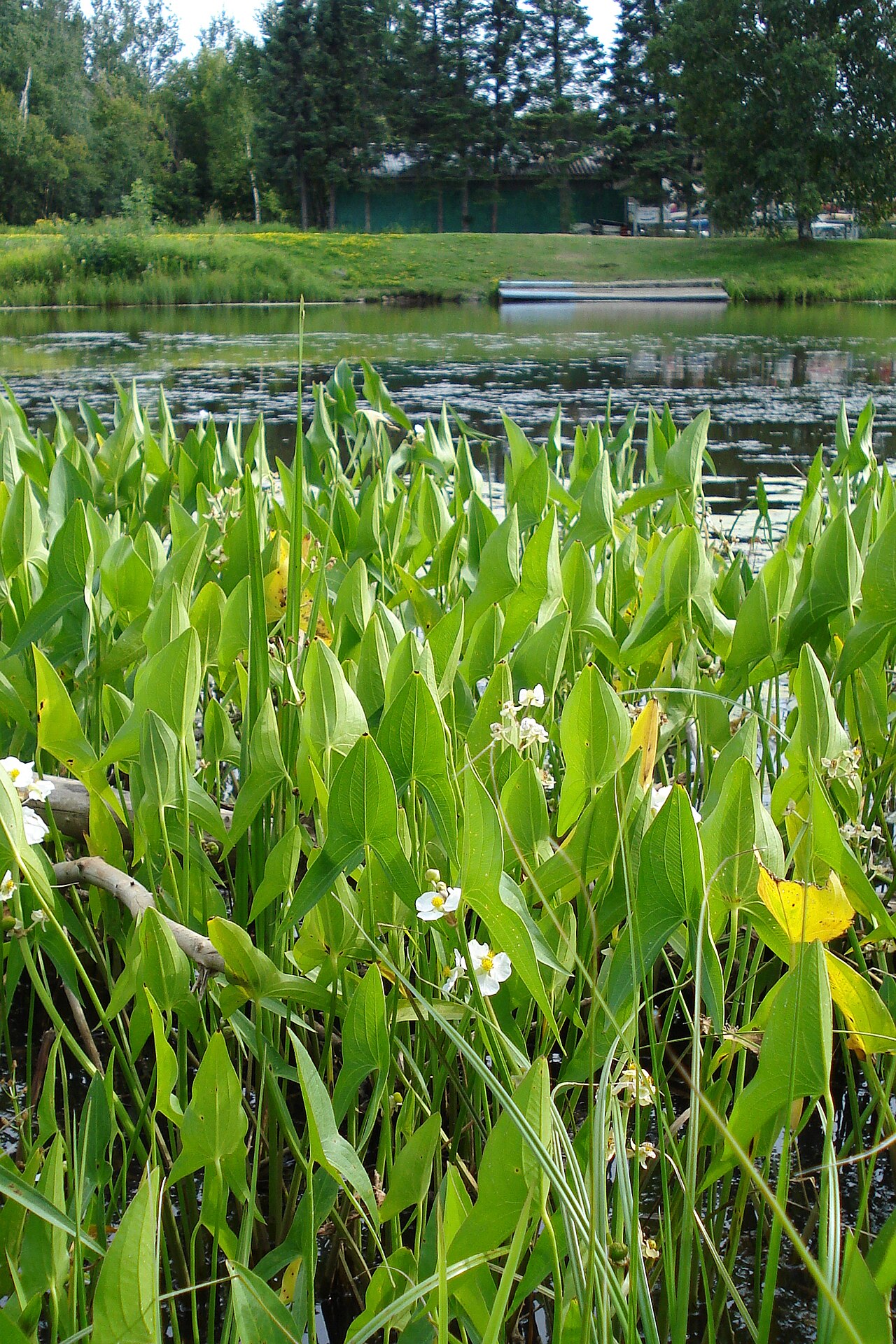
Duck potato is one of the easiest native aquatic plants to grow. It needs only sun, mud and steady moisture, and it rewards those simple needs with bold foliage and a long season of white flowers. Its one drawback is vigor: in a small pond it can spread quickly by runners and tubers, so many gardeners grow it in submerged containers.
Light
Full sun gives the most flowers and the sturdiest leaves. It also grows in part shade, such as a pond edge shaded for part of the day, but flowers less in heavy shade.
Soil & Water
Plant it in heavy, mucky or loamy soil that stays saturated, or in standing water up to about 12 to 18 inches deep. Shallow water of 2 to 6 inches over the crown suits it best. It tolerates fluctuating water levels, short dry spells in the mud and hard, mineral-rich water. It does not tolerate drying out completely for long periods during the growing season.
Planting Tips
Plant tubers or potted plants in spring, once the water has warmed. Set tubers 2 to 3 inches deep in the mud with the pointed bud upward, about 1 to 2 feet apart. In a lined garden pond, plant it in a wide, shallow pot or aquatic basket filled with heavy garden soil (not potting mix, which floats), top the soil with gravel, and set the pot so its rim is a few inches under water. Containers keep it from taking over the pond. In a natural pond or restoration site, it can be allowed to colonize the shallows freely.
Pruning & Maintenance
Remove yellowing leaves and spent flower stalks in summer if you want a tidy look. In fall the foliage collapses after frost and can be cut back or left to decompose. Divide potted plants every two or three years when they become crowded. Aphids sometimes cluster on leaves and flower stalks, and a strong spray of water usually knocks them back. Never introduce it to waters outside its native range.
Propagation
The simplest method is to plant tubers, which are dug in fall or early spring and can be stored cool and moist until planting. Established clumps can also be divided in spring or early summer. Seed can be sown on wet, sunny mud in spring, ideally after a period of cold, moist storage over winter; seedlings grow quickly in warm, shallow water.
Landscape Uses
- Water gardens and ponds: bold arrowhead leaves and white flowers for the shallow margin, best in submerged containers in small ponds
- Wetland restoration and shoreline stabilization: spreading roots and runners help bind soft mud along pond and lake edges
- Stormwater ponds and rain gardens: tolerates fluctuating water and absorbs nutrients from runoff
- Wildlife ponds: seeds and tubers feed waterfowl, muskrats and beavers
- Edible landscaping: the tubers are a traditional food; harvest only from clean water and your own plantings
Wildlife & Ecological Value
Few shoreline plants feed and shelter as much wildlife as duck potato. Its seeds, leaves and tubers are eaten by birds and mammals, and its dense stands give cover to fish, amphibians and aquatic insects.
For Pollinators
The white flowers produce pollen and some nectar and are visited by many small insects, including sweat bees, other native bees and flower flies (hover flies). Because male and female flowers are usually on different tiers of the stalk and open at slightly different times, insects moving between plants carry pollen from one colony to another.
For Birds
Ducks, geese and other waterfowl eat the seeds, and where the water is shallow enough, some dabble or dig for the tubers. In spite of the name, most tubers are buried too deep in the mud for ducks to reach, so the seeds are the more important duck food. Marsh birds such as rails and herons hunt among the stands, and red-winged blackbirds and other songbirds perch on the flower stalks to pick off insects.
For Mammals
Muskrats and beavers eat the leaves, stalks and tubers and sometimes store tubers in their lodges. North American porcupines eat the plant as well, and deer may browse leaves at the water’s edge.
Ecosystem Role
Duck potato colonies stabilize soft sediments, slow wave action along shorelines and take up nutrients from the water. Their submerged stalks support algae and invertebrates that fish and young amphibians feed on, and the dense stands offer cover for fish, frogs and turtles. Snapping turtles are among the animals reported to eat the tubers. In freshwater tidal marshes and river floodplains it is often one of the dominant broad-leaved emergent plants.
Cultural & Historical Uses
Duck potato tubers were one of the most important wild plant foods of North America. Along the lower Columbia River, Chinookan peoples harvested huge quantities of wapato each fall, often by wading into cold water and loosening the tubers from the mud with their feet so they floated to the surface, then gathering them into canoes. Members of the Lewis and Clark expedition traded for wapato during the winter of 1805–06, and the large island at the mouth of the Willamette River, now Sauvie Island, was once known as Wapato Island.
The tubers were also eaten by many other Indigenous peoples, including the Omaha and the Cherokee, and there are accounts of people opening muskrat lodges to collect the animals’ stored tubers. They were roasted, boiled or baked, or sliced and dried for winter, and their taste is often compared to potatoes or chestnuts. Wapato harvesting remains culturally significant, and several tribes and First Nations in the Pacific Northwest have worked to restore wapato beds in recent decades.
Foragers still gather duck potato tubers today. If you try it, harvest only from your own plantings or clean, unpolluted water where collecting is permitted, since aquatic plants can absorb contaminants from polluted water and sediment, and always cook the tubers. In the garden, duck potato is valued simply as one of the showiest and easiest native water plants.
Frequently Asked Questions
Is duck potato edible?
Yes. The starchy tubers that form at the ends of underground runners in late summer and fall are edible when cooked and were a staple food for many Indigenous peoples. Harvest only from clean water where collecting is allowed, and cook them thoroughly before eating.
Do ducks really eat duck potatoes?
Waterfowl readily eat the seeds, and some dabble for tubers in shallow, soft mud. Most tubers, though, are buried too deep for ducks to reach. Muskrats and beavers are the main tuber eaters.
Will duck potato take over my pond?
It can. Duck potato spreads by runners and tubers and can fill the shallow edge of a small pond in a few years. Grow it in a submerged pot or basket to keep it contained, and thin it every few years.
What is the difference between duck potato and arrow arum?
Both have arrow-shaped leaves and grow in the same places. Duck potato has white three-petaled flowers in whorls and leaf veins that radiate from the top of the leafstalk. Arrow arum has a green, pod-like spathe instead of showy flowers and many fine parallel side veins running to a vein along the leaf edge.
How deep should duck potato be planted in a pond?
Set the crown or tubers 2 to 3 inches into the mud, with about 2 to 6 inches of water above. Established plants tolerate water up to about 12 to 18 inches deep, as well as wet mud along the shoreline.

Looking for a nursery that carries Duck Potato?
Browse our native plant nursery directory: Alabama, Arizona & Arkansas · California · Colorado, Connecticut, Delaware, Florida & Georgia · Idaho, Illinois, Indiana, Iowa & Kansas · Kentucky, Louisiana, Maine, Maryland, Massachusetts, Michigan, Minnesota, Mississippi, Missouri & Montana · Nebraska, New Hampshire, New Jersey, New Mexico, New York, North Carolina, North Dakota, Ohio & Oklahoma · Oregon · Pennsylvania, Rhode Island, South Carolina, South Dakota, Tennessee, Texas, Utah, Vermont & Virginia · Washington · West Virginia, Wisconsin & Wyoming