Spatterdock (Nuphar advena)
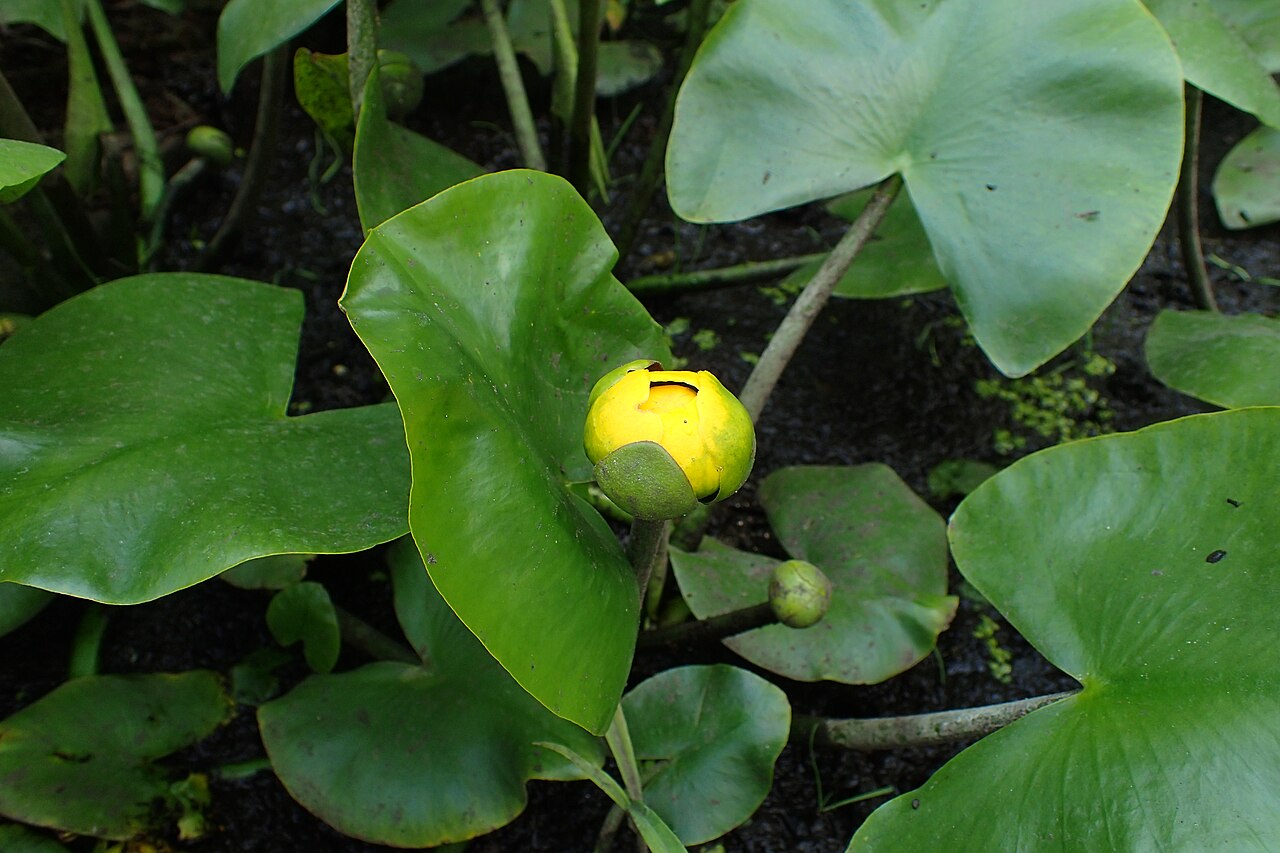
Nuphar advena, commonly called Spatterdock, Cow Lily, or Yellow Pond-lily, is a tough, reliable native aquatic perennial found in ponds, slow rivers, and backwaters across much of the eastern United States. Unlike the flat, open blooms of a water lily, Spatterdock’s flower stays mostly closed into a thick, waxy, cup-shaped ball that barely opens at the tip — a distinctive, almost sculptural bloom that gives the plant real year-round character, even when not in flower.
Taxonomists have long debated whether Spatterdock deserves full species status or is better treated as a subspecies of the wide-ranging Nuphar lutea complex; USDA PLANTS currently lists it as Nuphar lutea subsp. advena, while many state floras and most gardening references continue to use Nuphar advena as a full species. Either way, the plant itself is unmistakable once you know its large, heart-shaped leaves and waxy yellow flowers.
Spatterdock thrives in exactly the conditions many other native plants avoid: shallow, still or slow-moving water with a soft, mucky bottom, including spots too deep or too silty for most emergent wetland plants. That makes it an excellent, low-maintenance choice for naturalizing the edges of a farm pond, restoring a degraded backwater, or anchoring the deep-water zone of a larger native water garden.
Identification
Spatterdock is a rhizomatous aquatic perennial, dying back to its thick, fleshy underwater rootstock each winter and resprouting leaves and flower stalks from the same rhizome each spring.
Leaves
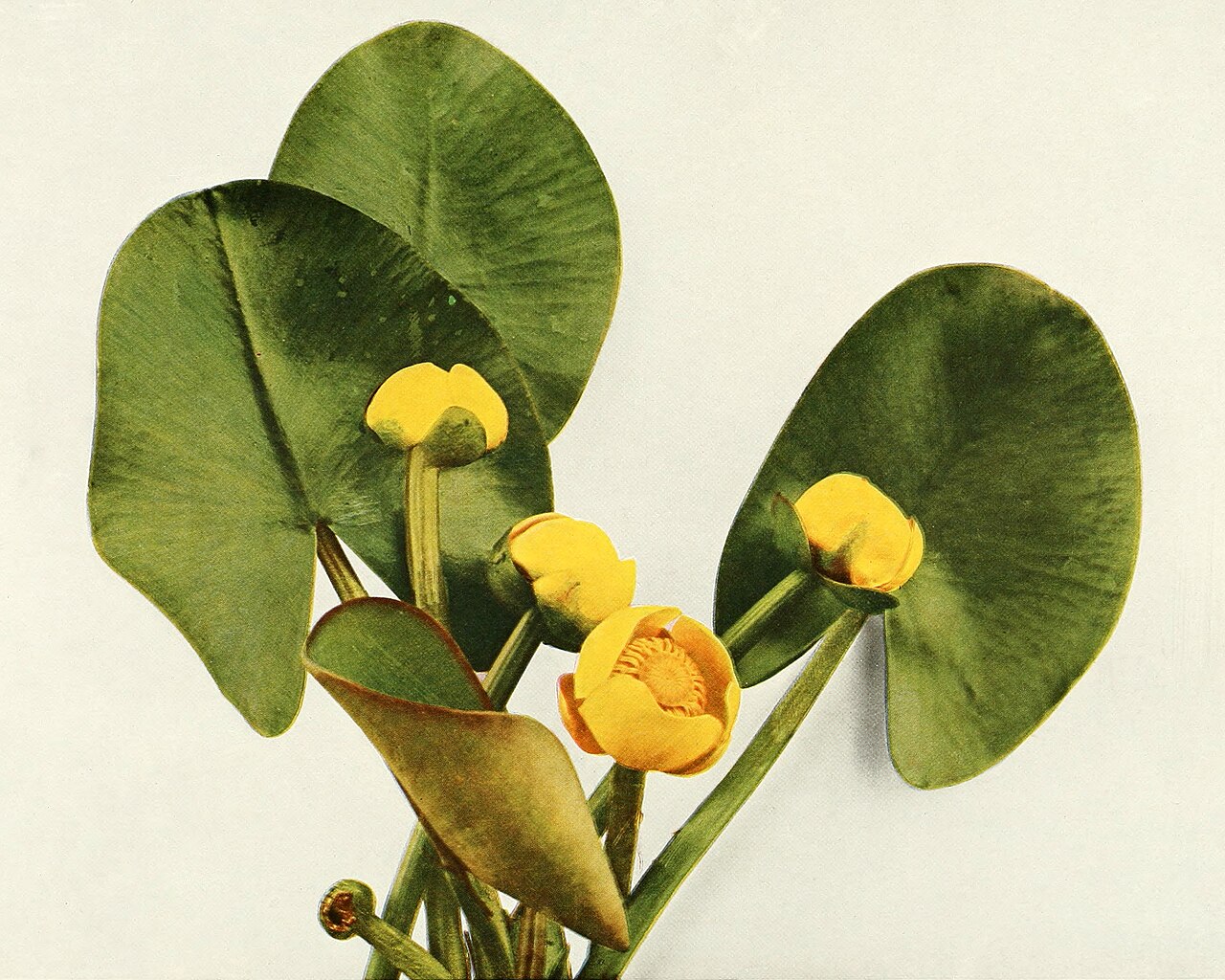
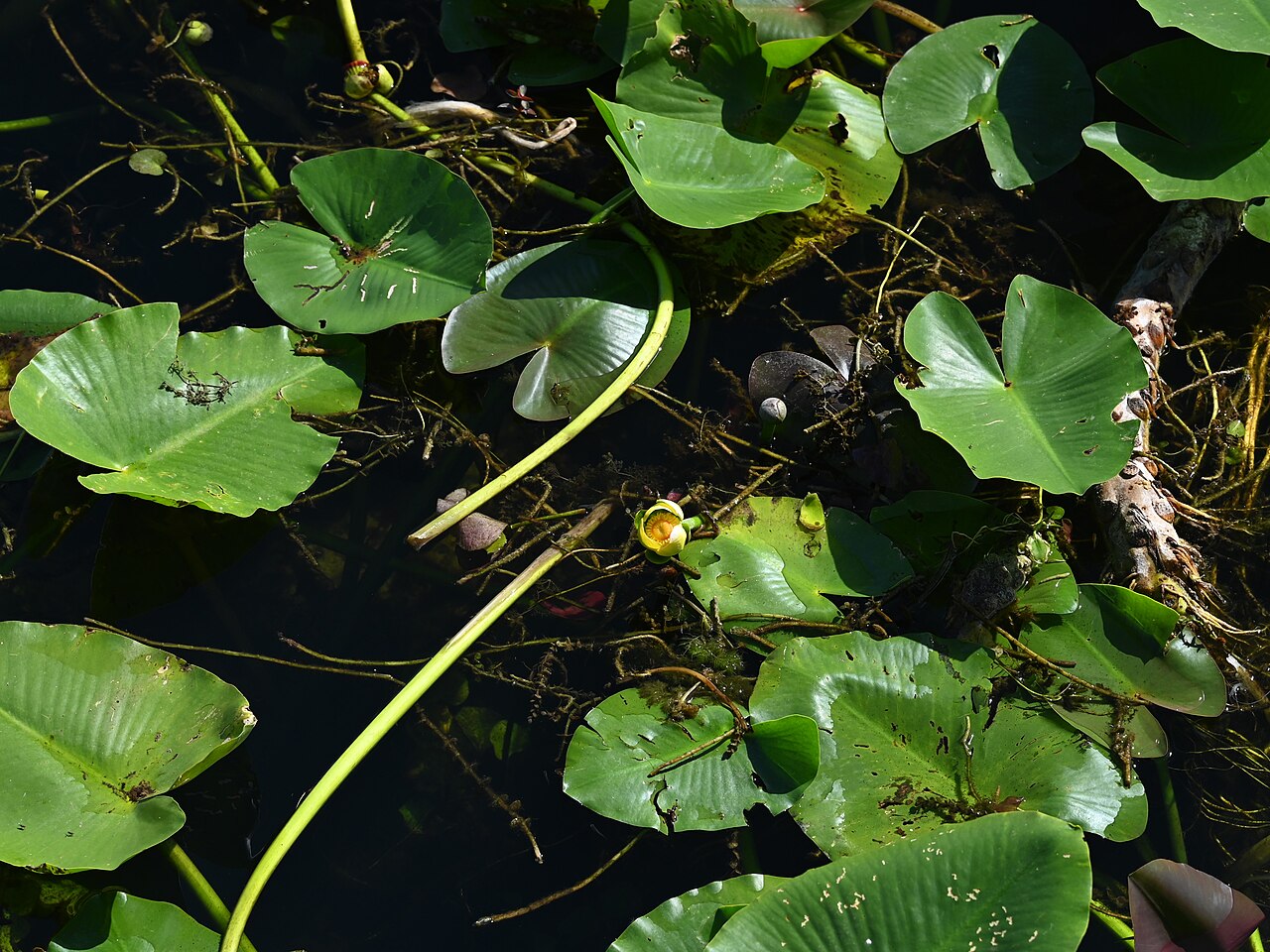
Leaves are large, 4 to 16 inches long, broadly heart- or arrowhead-shaped, with a deep basal notch where the long, round leafstalk attaches at the leaf margin (not centrally, as in American Lotus). Most leaves stand erect just above the water surface on stout stalks, though some leaves — especially on young plants or in deeper water — may float flat on the surface. The leaf surface is smooth, leathery, and deep green.
Flowers
Flowers are solitary, borne on thick stalks that hold the bloom just at or slightly above the water surface, 1.5 to 2.5 inches across. What looks like a cup of yellow “petals” is actually made of 5 to 9 large, rounded, waxy sepals; the true petals are small, numerous, and hidden inside, resembling stamens. The flower never opens fully flat the way a water lily does, instead staying cupped with only a small central opening exposing the disk-shaped stigma. Bloom runs from late spring through summer.
Fruit & Seeds
After pollination, the flower matures into a somewhat flask-shaped, leathery green seed capsule that ripens above or just at the water surface, eventually splitting open to release numerous small seeds into the water.
Quick Facts
| Scientific Name | Nuphar advena (Aiton) W.T.Aiton (USDA: Nuphar lutea subsp. advena) |
| Family | Nymphaeaceae (Water Lily) |
| Plant Type | Aquatic Perennial (emergent/floating-leaved) |
| Mature Height | Leaves & flowers held 0–12 in above the water |
| Growth Rate | Moderate to fast |
| Sun Exposure | Full Sun to Partial Shade |
| Water Needs | Aquatic — standing or slow water 6 in–6 ft deep |
| Soil Type | Soft mud or silt pond/stream bottom |
| Soil pH | 5.5–7.5 |
| Bloom Time | May – September |
| Flower Color | Yellow, often green-tinged at the base |
| Fruit | Flask-shaped leathery seed capsule |
| Deer Resistant | Yes — grows out of browsing reach in open water |
| USDA Hardiness Zones | 4–10 |
Native Range
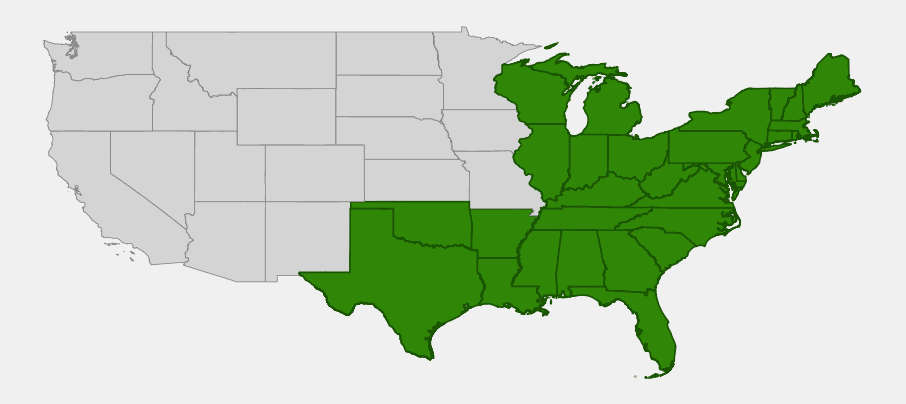
Spatterdock is native across the eastern United States, from New England and the Great Lakes south through the Appalachians and the Southeast to the Gulf Coast and Texas. It is especially common in the coastal plain states of the Southeast and Mid-Atlantic, where it forms extensive stands in cypress swamps, slow blackwater rivers, and farm ponds, while also occurring more locally northward into New England, the upper Midwest, and the Great Lakes basin.
It grows in still or slow-flowing fresh water with a soft, mucky bottom — ponds, lake margins, oxbows, canals, and the backwaters of slow rivers and streams — tolerating water depths from just a few inches up to several feet. It is notably shade-tolerant for an aquatic plant, often found thriving in the dappled light beneath streamside trees where few other flowering aquatics persist.
Spatterdock does not occur natively west of the Great Plains; western pond-lily populations are represented instead by the related Nuphar polysepala.
📋 Regional plant lists featuring Spatterdock: Northern New England · Southern New England · New York, Pennsylvania & New Jersey · Maryland, Virginia & West Virginia · North & South Carolina · Kentucky & Tennessee · Arkansas, Louisiana & Eastern Texas/Oklahoma
Growing & Care Guide
Spatterdock is one of the toughest, most forgiving native aquatics available, able to handle part shade, moving water, and mucky soil that would set back many other pond plants.
Light
Spatterdock blooms best in full sun but, unusually for a flowering aquatic, tolerates partial shade well — a useful trait for wooded pond edges or shaded stream backwaters where sun-hungry water lilies struggle.
Water & Planting Depth
Plant the rhizome in soft mud or a wide planting container with heavy clay-loam soil, in water from just a few inches to several feet deep; established plants tolerate water up to 6 feet over the crown. Spatterdock is more tolerant of gentle current than true water lilies, making it a good choice for the slow-moving edges of streams and canals as well as still ponds.
Planting Tips
Set rhizomes in spring to early summer, positioning the growing tip just at or slightly below the soil surface. Space plants 3 to 5 feet apart if naturalizing a pond edge or backwater, since Spatterdock spreads steadily to fill available shallow water over a few seasons.
Maintenance
Established Spatterdock needs very little upkeep. Remove old, yellowing leaves periodically to keep the planting tidy and limit nutrient release into the water as they decay. Divide crowded rhizome clumps every few years if flowering declines or the planting outgrows its intended area; unwanted spread can be managed by physically removing rhizome sections, since the plant does not respond to typical aquatic herbicide treatments as readily as some invasive aquatics.
Landscape Uses
- Farm pond and lake-edge naturalizing — thrives in mucky, shallow water other plants avoid
- Shaded stream and backwater restoration — more shade-tolerant than most flowering aquatics
- Wildlife ponds — strong cover and food value for fish, waterfowl, and amphibians
- Erosion control along soft, muddy pond and canal banks
- Deep-water zone planting in larger native water gardens, paired with shallower marginal species
Wildlife & Ecological Value
Spatterdock is a workhorse native for pond and wetland ecosystems, offering food and shelter across several wildlife groups.
For Waterfowl & Fish
Ducks and other waterfowl eat the seeds, while muskrats and beavers feed on the rhizomes and leaf stalks. The dense underwater stems and leaf cover provide important shelter and ambush habitat for largemouth bass, bluegill, and other sport fish, which is why Spatterdock beds are often prized by anglers and pond managers alike.
For Pollinators & Insects
The waxy, cupped flowers are pollinated chiefly by beetles that crawl inside to feed, along with flies and some native bees; the specialized flower form is thought to be adapted to beetle pollination, an older evolutionary pollination strategy shared with other primitive flowering plant lineages.
Ecosystem Role
Spatterdock’s extensive rhizome mats stabilize soft pond and stream-bottom sediment, reducing erosion along banks and shallow margins. Its leaf canopy shades the water, helping moderate temperature and limit algae growth, while the structurally complex stands support a wide range of aquatic invertebrates that form the base of the pond food web.
Cultural & Historical Uses
Indigenous peoples across Spatterdock’s range historically used the starchy rhizomes and the seeds as food sources, with the seeds sometimes parched or popped much like corn and the rhizomes boiled or roasted after preparation to reduce bitterness. These foraging traditions reflect the plant’s long-standing role as a dependable wetland food resource in regions where it grows abundantly.
The common name “Spatterdock” and the alternate “Cow Lily” both reflect the plant’s long familiarity to rural communities across the eastern United States, where dense stands have historically marked slow-moving, fertile waterways favored for fishing and waterfowl hunting. “Yellow Pond-lily” remains a widely used alternative name, especially in field guides and state wildflower references.
Today, Spatterdock is valued primarily for its ecological role in ponds and wetlands, and increasingly by native-plant gardeners and pond managers looking for a low-maintenance, wildlife-friendly aquatic that performs reliably even in partial shade and less-than-ideal water conditions.
Frequently Asked Questions
Is Spatterdock the same plant as Nuphar lutea?
USDA PLANTS currently classifies it as Nuphar lutea subsp. advena, treating it as part of the broader Nuphar lutea species complex found across the Northern Hemisphere. Many botanists and most American field guides, however, continue to recognize it as the distinct species Nuphar advena, and that name remains in common use for the eastern U.S. plant described here.
Why don’t the flowers open all the way?
The yellow “petals” you see are actually thick sepals that stay cupped around the smaller true petals and stamens inside; this nearly closed form is normal and distinguishes Spatterdock from true water lilies, whose flowers open flat.
Can Spatterdock grow in moving water?
Yes, more so than true water lilies — it tolerates gentle current and is a good choice for the slow-moving edges of streams and canals, though it still prefers mostly still water for best growth.
Does Spatterdock need full sun?
It flowers best in full sun but is unusually shade-tolerant for a flowering aquatic, making it one of the few options for ponds and backwaters with significant tree cover.
Is Spatterdock aggressive like American Lotus?
It spreads steadily by rhizome and can fill shallow pond margins over time, though generally less explosively than American Lotus; plan for gradual spread and divide or thin clumps as needed in a contained water garden.
Pair Spatterdock with other wetland-edge natives discussed in our guide to starting a rain garden, or with moisture-loving perennials covered in our piece on the benefits of planting native Joe-Pye Weed.