
Florida Rosemary (Ceratiola ericoides)
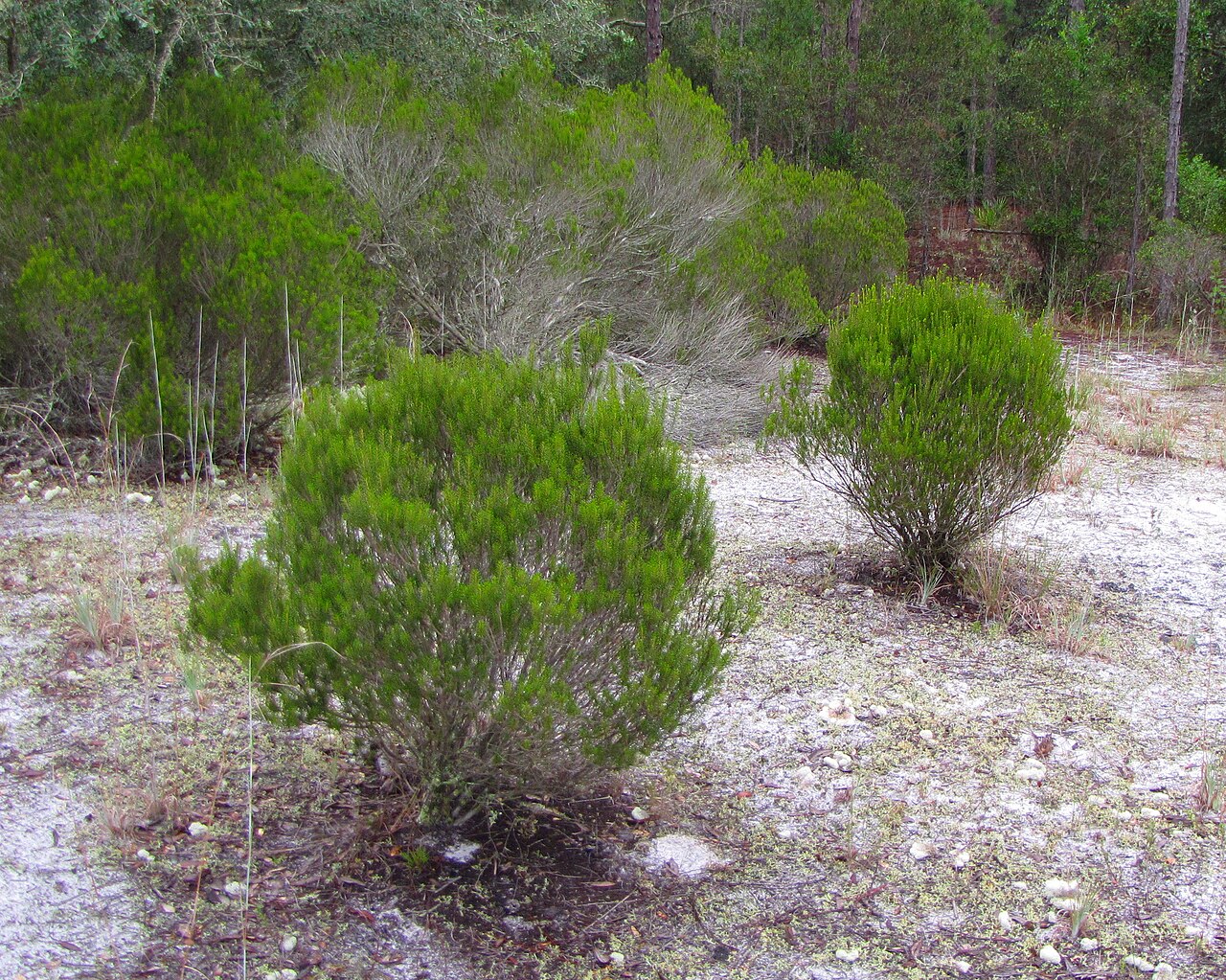
Ceratiola ericoides, known as Florida Rosemary, sand heath, scrub rosemary or sandhill rosemary, is an aromatic evergreen shrub of the deep, dry sands of the southeastern Coastal Plain. It grows into a dense, rounded mound up to about 6 feet tall and as wide, clothed in short, needle-like leaves that look whorled around the stems and smell strongly of resin when crushed. It is the only species in its genus, a true southeastern endemic with no close relatives anywhere else in the region.
The common name is a convenience, not a relationship. Florida rosemary is not the culinary herb (Salvia rosmarinus, long known as Rosmarinus officinalis), and its leaves are not a kitchen substitute. It belongs instead to the heath family, Ericaceae, alongside blueberries and azaleas, in the small tribe Empetreae with the northern crowberries. Older books place it in a family of its own, Empetraceae, which is why many field guides and herbarium labels still carry that name.
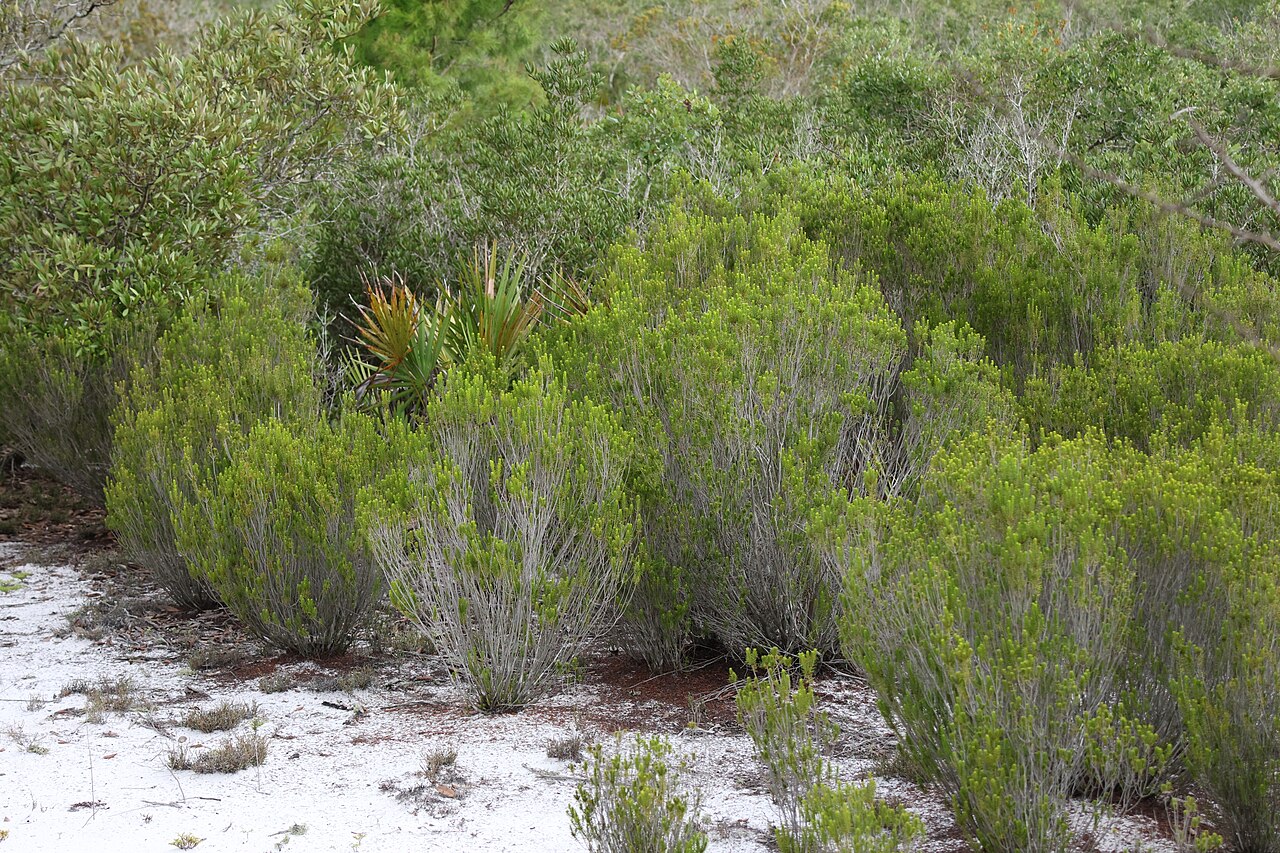
Florida rosemary is the signature plant of one of the driest, most nutrient-poor habitats in eastern North America: the white-sand scrub and sandhills of ancient dune ridges and coastal dunes. Where it dominates, the result is a “rosemary bald,” an open landscape of widely spaced shrubs separated by bare, glaring sand. Those gaps are not empty. They hold a remarkable set of rare herbs, lichens and animals found nowhere else, and the shrub itself helps create and maintain them. This guide covers how to identify Florida rosemary, where it grows, how to use it in a dry sand garden, and why fire and chemistry govern its life.
Identification
Florida rosemary is hard to confuse with anything else once you have seen it. Nothing else in southeastern scrub forms a neat, dome-shaped shrub of fine, resinous, needle-like leaves on pale sand. The surest field check is to crush a few leaves: the scent is sharp, piney and resinous, somewhere between culinary rosemary and turpentine.
Habit & Stems
Mature plants are rounded to broadly dome-shaped, usually 2 to 5 feet tall and about as wide, and occasionally reaching 6 feet. Branching is dense and repeated, and because the shrub normally produces one set of branches each year, the branching nodes along a main stem can be counted to estimate its age. Old stems are gray and woody, often with the lower branches dying back or arching to the ground. Young twigs are slender, pale green to tan, and finely hairy. There is no spread by root suckers or runners: every plant you see grew from a seed.
Leaves
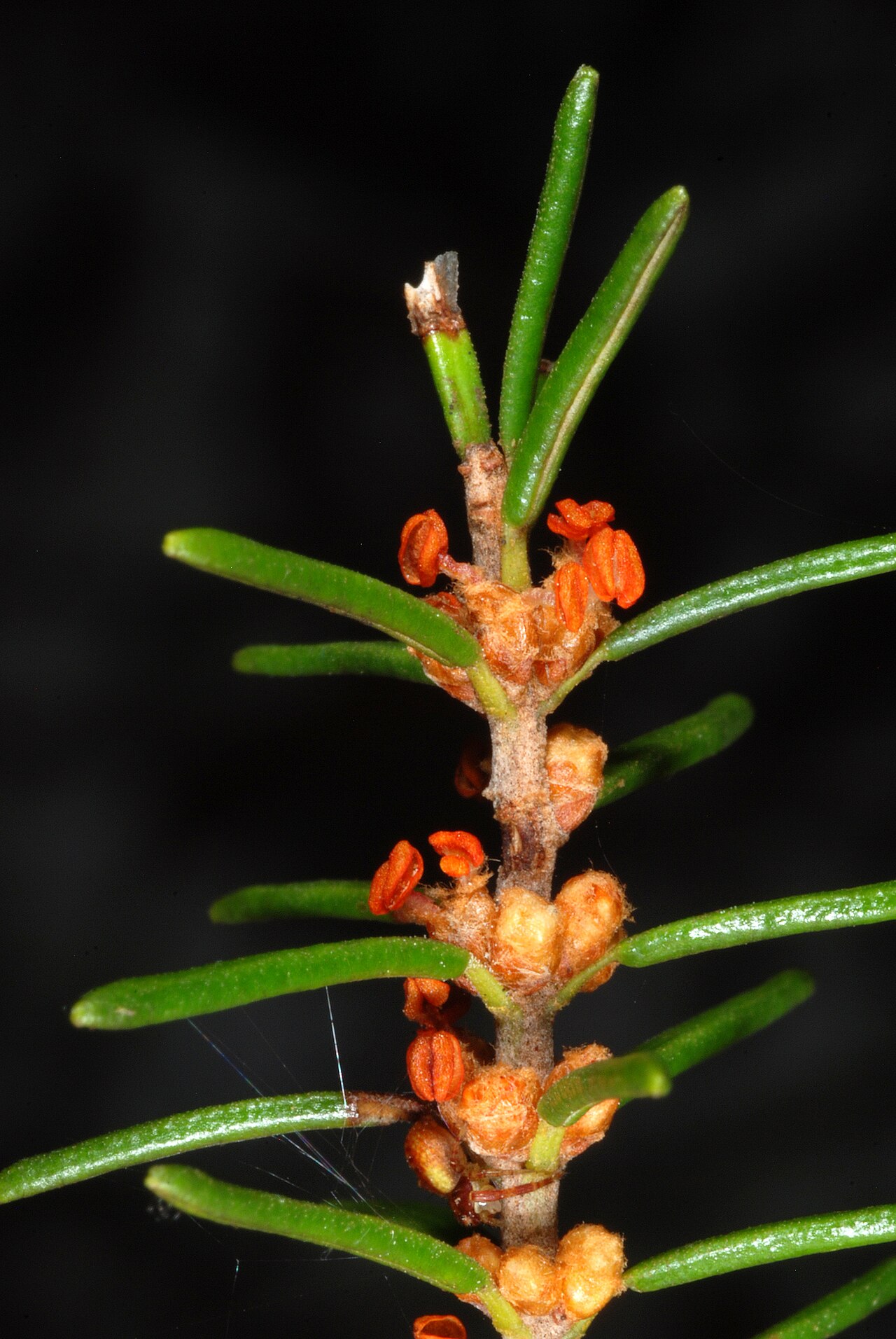
The leaves are narrow and needle-like, roughly 8 to 12 mm long (about a third to half an inch) and only about 1 mm wide, dark green and thick, with the margins rolled under so tightly that the underside is hidden in a groove. They are crowded along the stems in close ranks and appear whorled rather than alternate. The rolled edges and thick cuticle are classic drought adaptations, cutting water loss in a habitat where rain drains through the sand within hours. The foliage is fragrant year-round and the plant is evergreen.
Flowers
Florida rosemary is dioecious: individual shrubs are either male or female, so both are needed for fruit. The flowers are very small and easy to miss, borne singly in the leaf axils along the previous year’s growth. Male flowers are the more noticeable of the two, with a pair of curved anthers that are orange to reddish-brown and dust the air with pollen. Female flowers are smaller still, greenish to bronze, and reduce to little more than a stigma and ovary. There are no petals worth the name, no nectar and no scent: this is a wind-pollinated shrub, and the open, breezy structure of a rosemary bald is part of how its pollen travels.
Flowering is concentrated in fall and winter but is not strictly seasonal. Records run from early fall through spring, and in Florida flowers and ripening fruit can be found on the plant through much of the year, especially after rain.
Fruit & Seeds
The fruit is a small, round, juicy drupe about 3 mm across, green ripening to yellowish or olive, containing two hard seeds. Fruits mature mainly from winter into spring. Seedlings are rare and slow: plants generally do not set seed until they are 10 to 15 years old, seed production peaks somewhere around 20 to 30 years, and it declines in shrubs older than about 35 years. Seed stored in the sand loses viability in under a decade, which ties the whole species to a fairly narrow window of fire frequency.
Quick Facts
| Scientific Name | Ceratiola ericoides Michx. (syn. Ceratiola falcatula, Empetrum aciculare) |
| Family | Ericaceae (heath family); formerly placed in Empetraceae |
| Plant Type | Evergreen shrub; dioecious |
| Mature Height | 2–5 ft, occasionally to 6 ft |
| Mature Spread | 3–6 ft; rounded and dense |
| Growth Rate | Slow |
| Sun Exposure | Full sun |
| Water Needs | Very low; drought tolerant once established and intolerant of wet soil |
| Soil Type | Deep, sterile, excessively drained white or yellow quartz sand |
| Soil pH | About 4.5–6.5 (acid) |
| Bloom Time | Mainly fall through spring; flowers may appear sporadically year-round after rain |
| Flower Color | Inconspicuous; orange to reddish-brown anthers on male plants, greenish-bronze female flowers |
| Fall Color | None; evergreen |
| Fruit | Small juicy yellow-green drupe about 3 mm wide with two seeds |
| Deer Resistant | Yes; the resinous, aromatic foliage is rarely browsed |
| USDA Hardiness Zones | 8–10 |
Native Range
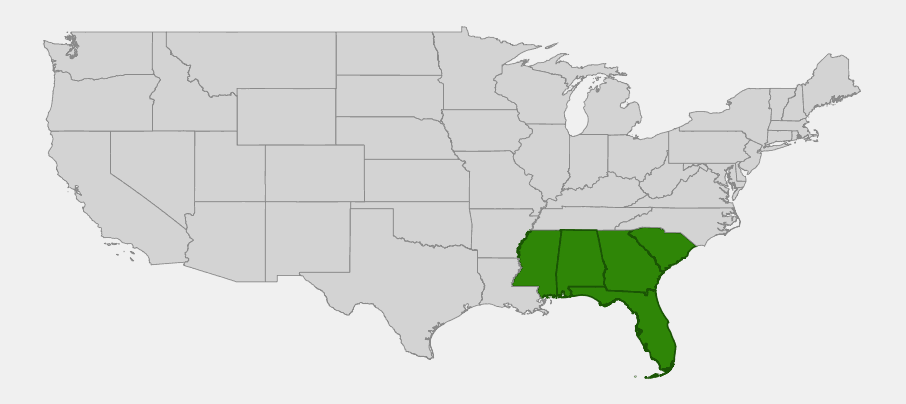
Florida rosemary is endemic to the southeastern United States. USDA PLANTS and the Lady Bird Johnson Wildflower Center record it from five states: Alabama, Florida, Georgia, Mississippi and South Carolina. It occurs throughout peninsular and northern Florida, north along the Atlantic Coastal Plain through Georgia into South Carolina, and west in the coastal counties of Alabama and Mississippi. It reaches no farther inland than the Coastal Plain, and it grows nowhere else in the world. Some older databases also list Nova Scotia for this species; that is a data error, almost certainly a confusion with the northern crowberries, and no Canadian population exists.
Within that range the plant is strictly tied to deep, sterile, sharply drained sand. It is most abundant on the ancient inland dune ridges of peninsular Florida, above all the Lake Wales Ridge, where rosemary scrub covers the highest and driest sands. It also grows on the Atlantic and Gulf coastal dunes and barrier islands, in sandhill openings, in sand pine scrub, and in sandy pine and mixed woodlands. It avoids clay, loam, muck and anywhere the water table sits near the surface.
NatureServe ranks the species globally as Apparently Secure (G4), but that global rank hides a sharp local story. The scrub and sandhill habitats it depends on are among the most heavily developed landscapes in the Southeast, converted to citrus groves, housing and roads, and much of what remains is degraded by fire suppression. Rosemary scrub on the Lake Wales Ridge in particular is a conservation priority because of the long list of rare species that live in and between the shrubs.
📋 Regional plant lists featuring Florida Rosemary: North & South Florida · Alabama, Georgia & Mississippi · North & South Carolina
Growing & Care Guide
Florida rosemary is a specialist, and that cuts both ways. In the right place it is nearly care-free, needs no irrigation and no fertilizer, and keeps a tidy shape for decades without pruning. In the wrong place it dies quickly. The single most common cause of failure is soil that holds water. If your site is not fast-draining sand, this is not your shrub.
Light
Give it full sun, all day. Florida rosemary evolved in open scrub where nothing shades it, and plants that end up under a canopy thin out, stop fruiting and eventually die. In the wild, the loss of rosemary balds to encroaching oaks and sand pine after decades without fire is exactly this process at landscape scale.
Soil & Water
Plant only in deep, infertile, sharply drained sand. Raised sand beds and natural sand ridges work; amended beds, clay, and anything with a liner or a hardpan do not. Do not add compost, peat or topsoil, and do not fertilize. Water new plants lightly to settle them and through the first dry season, then stop. Established shrubs need no supplemental irrigation and are damaged by routine lawn watering, which is the quickest way to kill one in a home landscape. Keep irrigation heads pointed away from the plant.
Planting Tips
Set container plants in the cooler months so the roots establish before summer heat. Dig a hole no deeper than the root ball and keep the crown slightly high rather than slightly low. Space plants 4 to 6 feet apart and allow for the full rounded form, because the shrub looks best unpruned and standing alone. Leave the sand around the base bare. Do not mulch with bark or wood chips: a layer that holds moisture against the stem encourages rot, and bare sand is the natural condition. If you want fruit and seedlings, plant several shrubs, since male and female flowers are on separate plants.
Pruning & Maintenance
Essentially none. The shrub makes its own neat dome and resents being sheared; cuts into old wood do not resprout well, and a hard cutback often kills the plant outright. Remove dead wood if you like the look, and otherwise leave it alone. Weeding around the base is rarely needed, since the shrub suppresses most of its own competition. Expect a long, slow life rather than fast results.
Propagation
Seed is the natural route and the difficult one. Germination is poor and slow, partly because the plant’s own chemistry suppresses it, and viable seed comes only from mature female plants in a population with males. Growers who succeed usually clean the pulp from the fruit, sow in pure sand, and wait, sometimes for a year or more. Semi-hardwood cuttings taken from new growth are the more practical method and are how most nursery stock is produced, though rooting percentages are modest. Never dig plants from the wild: the long taproot and deep root system make transplanting from scrub almost always fatal, and wild populations cannot spare them.
Landscape Uses
- Dry sand and scrub gardens: the defining shrub of a Florida scrub planting, with saw palmetto, gopher apple and prickly pear
- Coastal dune landscapes: salt-wind tolerant and well suited to stabilized back dunes on sandy sites within its range
- Low-water and no-irrigation landscapes: a true no-care shrub once established, needing neither water nor fertilizer
- Scrub and sandhill restoration: used in Coastal Plain restoration projects on deep sand, planted from nursery-grown stock
- Fragrance and evergreen structure: an aromatic, fine-textured evergreen that holds its rounded form year-round without shearing
Wildlife & Ecological Value
For a shrub with flowers almost nobody notices, Florida rosemary carries an unusual amount of ecological weight. It feeds a short list of scrub animals, shelters a longer one, and its chemistry shapes the openings that make rosemary scrub the habitat it is.
For Pollinators
Very little, and that is the point. Florida rosemary is wind-pollinated, with no nectar, no petals and no scent to attract insects, so it is not a plant to grow for bees. Its contribution to scrub insect life is as food and shelter rather than as a nectar source. The best-known example is a flightless grasshopper, Schistocerca ceratiola, named for the shrub and confined to Florida scrub, which feeds and shelters in rosemary and is active largely at night.
For Birds
The small fruits are eaten by scrub birds, including the eastern towhee and the Florida scrub-jay, and seeds pass through a bird’s gut intact and still able to germinate, which makes birds the shrub’s most effective dispersers. The structural role is at least as important: dense rosemary provides cover and nest sites in open scrub. The Florida scrub-jay, a federally threatened bird found nowhere outside Florida, depends on exactly the low, open, patchy scrub that rosemary helps define, and management for one generally benefits the other.
For Mammals
The oldfield mouse eats the fruits and seeds, though seeds chewed by mice are destroyed rather than dispersed. Gopher tortoises and other scrub animals use the shade and cover of the shrubs. Deer browse the foliage very little, which is why Florida rosemary holds up in landscapes where deer pressure is heavy.
Ecosystem Role
Florida rosemary is allelopathic. Its leaves and litter contain a compound called ceratiolin, which breaks down in the sand into hydrocinnamic acid, and that acid suppresses the germination and growth of neighboring plants, including its own seeds. The result is the bare sand gap around each shrub that gives a rosemary bald its look. Those gaps are valuable habitat in their own right, supporting rare scrub herbs and a distinctive ground-lichen community that includes the Florida perforate cladonia, a federally listed lichen of Lake Wales Ridge rosemary scrub.
Fire resets the whole system. Unlike the scrub oaks and palmettos around it, Florida rosemary does not resprout: fire kills it outright, and the stand returns only from seed. Fire and soil microbes also break down the accumulated hydrocinnamic acid, lifting the chemical brake and allowing a flush of seedlings and gap specialists. Florida scrub historically burned at intervals of roughly 15 to 100 years, and that window matters. Burn too often and there is no seed bank left, because plants need a decade or more to begin fruiting; burn too rarely and oaks and sand pine shade the rosemary out and close the gaps.
Cultural & Historical Uses
André Michaux described Ceratiola ericoides from the Carolinas around 1803, and the genus has never gained a second species. The name joins Greek keration, a little horn, for the curved anthers of the male flowers, with ericoides, heath-like, for the needle-like foliage. For most of the twentieth century botanists kept it with the crowberries in the family Empetraceae; molecular work published in 2002 folded that group into the Ericaceae as the tribe Empetreae, which is why a shrub from hot Florida sand turns out to be a close relative of the crowberries of arctic and alpine heath.
Settlers and naturalists in Florida borrowed the name rosemary for the resemblance of its foliage and scent, and the shrub is still sometimes called scrub rosemary or sandhill rosemary. USDA lists it as sand heath. It has no record as a culinary herb: the leaves are resinous and bitter, nothing like the kitchen plant, and the confusion in name is worth clearing up before anyone tries it. Branches were occasionally cut for their fragrance, and the shrub’s greatest practical value in its own country was simply as a landmark of the driest, poorest ground.
Modern interest in Florida rosemary is scientific and conservation-driven. Research at Archbold Biological Station on the Lake Wales Ridge has made rosemary scrub one of the best-studied shrub systems in North America, from its allelopathy and gap dynamics to the way fire frequency controls the entire community. For gardeners, it has become a quiet symbol of the dry-sand garden: a native shrub that asks for no water, no fertilizer and no pruning, provided it is given the harsh, sterile, sunny ground it was built for.
Frequently Asked Questions
Is Florida rosemary the same as cooking rosemary?
No. Culinary rosemary is Salvia rosmarinus (formerly Rosmarinus officinalis), a Mediterranean mint-family herb. Florida rosemary is Ceratiola ericoides, a southeastern heath-family shrub. They look and smell broadly similar because both are dry-country shrubs with narrow, resinous leaves, but they are unrelated and Florida rosemary is not used as a seasoning.
Why is the sand bare around each shrub?
Florida rosemary releases ceratiolin, which breaks down in the soil into hydrocinnamic acid and suppresses the germination of nearby plants, including its own seedlings. That chemical effect, combined with the shrub’s shallow spreading roots and the extremely poor sand, produces the open gaps that give a rosemary bald its distinctive appearance. Fire and soil microbes break the chemical down and allow new plants to establish.
Will Florida rosemary grow in my garden?
Only in full sun on deep, sharply drained, infertile sand within or near its native range. It will not tolerate clay, heavy irrigation, rich amended beds or standing water, and it is the rare shrub that is killed by kindness. If your yard is natural scrub or sandhill soil, it is an excellent and nearly care-free choice; if it is anything else, choose a different plant.
Do I need more than one plant to get fruit?
Yes. The species is dioecious, meaning male and female flowers are on separate shrubs, so fruit requires at least one of each within pollen range. Nursery plants are seldom labeled by sex, so planting a group of three or more gives the best chance of both. Plants also take 10 to 15 years to begin fruiting, so this is a long-term proposition.
Does Florida rosemary come back after a fire?
Not from the roots. Fire kills the shrubs outright, and the stand regenerates entirely from seed already in the sand. That makes fire timing critical: scrub that burns again within about a decade may have no viable seed left, while scrub that goes many decades without fire is overtaken by oaks and sand pine. Land managers use prescribed fire on long intervals to keep rosemary scrub in balance.

Looking for a nursery that carries Florida Rosemary?
Browse our native plant nursery directory: Alabama · Florida & Georgia · Mississippi · South Carolina