
Marsh Rattlesnake Master (Eryngium aquaticum)
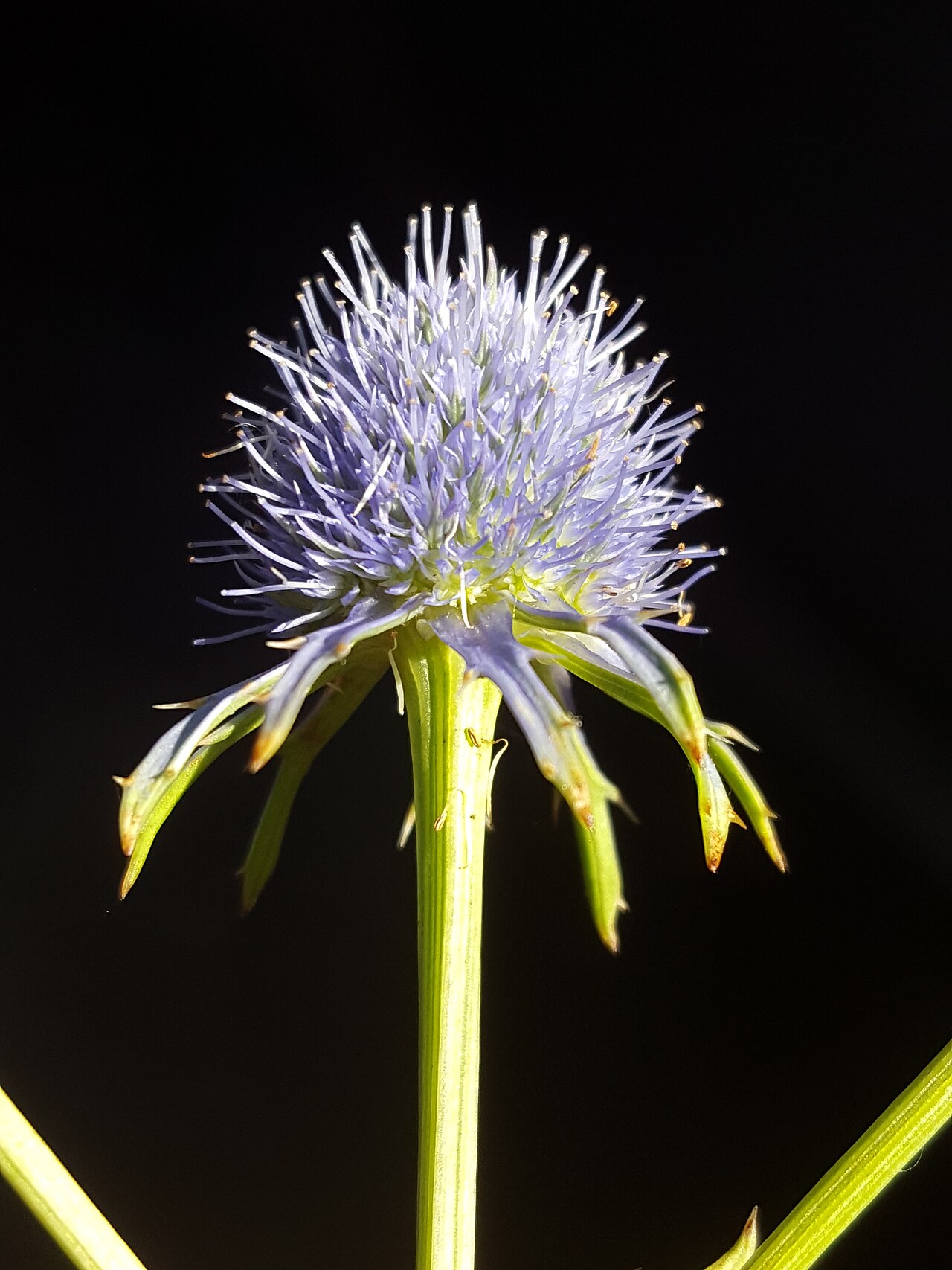
Eryngium aquaticum, known as Marsh Rattlesnake Master, marsh eryngo, or simply rattlesnakemaster (the name USDA PLANTS uses), is a tall, thistle-like wetland plant of the Atlantic and Gulf Coastal Plain. It belongs to the carrot family (Apiaceae), though it looks nothing like its lacy relatives. From a rosette of long, stiff leaves it sends up a ribbed stem 3 to 6 feet tall that forks near the top into a loose candelabra of small, bristly, globe-shaped flower heads. The heads range from whitish green to a striking steel blue and bloom from early summer into fall.
This is a plant of wet ground: fresh and brackish marshes, wet pine flatwoods and savannas, bogs, swamp edges, wet meadows and roadside ditches. The USDA classes it as an obligate wetland plant, meaning it almost always grows in wetlands. It is usually described as a biennial or short-lived perennial. A plant spends its first season as a leafy rosette, flowers in a later season, and often dies after setting seed, leaving seedlings to carry on.
Gardeners who know the prairie species Rattlesnake Master (Eryngium yuccifolium) will see the family resemblance, and the two are often confused in the nursery trade. The USDA plant guide notes that most plants sold as E. aquaticum are actually E. yuccifolium. This guide explains how to tell them apart, where marsh rattlesnake master grows, how to grow it in a rain garden or pond edge, and what it offers native bees and other wildlife.
Identification
Marsh rattlesnake master is easiest to spot in late summer, when its branched, blue-tinged flower heads stand above the surrounding grasses and sedges. Before it flowers it is just a rosette of long, narrow leaves that can pass for a young sedge or a small yucca.
Stems & Growth Habit
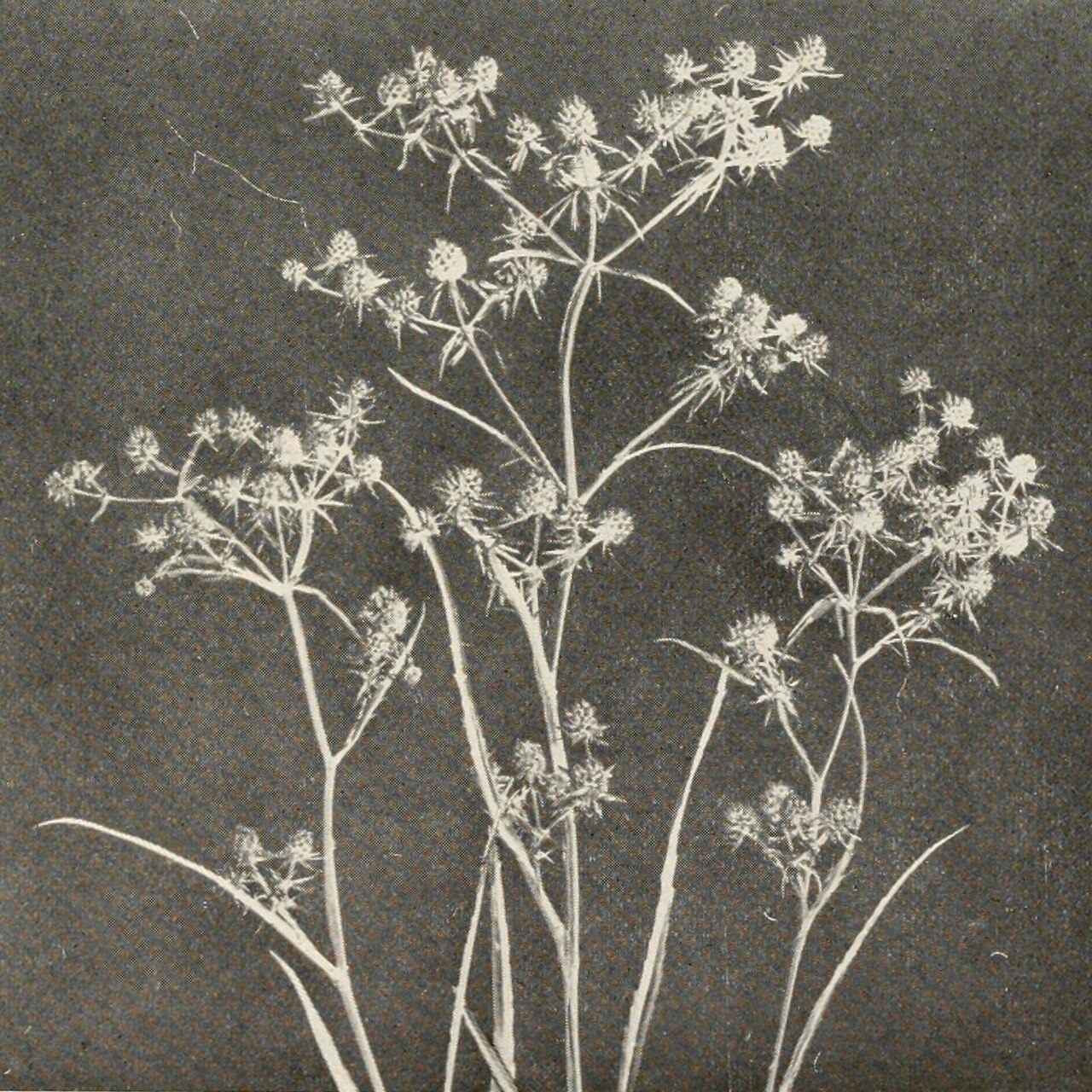
Each flowering plant usually has a single erect, stiff stem with lengthwise ribs. It grows 3 to 6 feet tall, rarely a little more, and branches repeatedly in its upper part. Each fork ends in a flower head, so a vigorous plant carries dozens of heads at once. The whole plant is smooth (hairless) and often has a bluish or grayish cast in the upper stems and bracts.
Leaves
The basal leaves are long, narrow and stiff, up to about 3 feet long and 3½ inches wide, with pinnate (feather-like) veins and edges that are toothed to sparsely spiny. They are often withered by the time the plant flowers. The stem leaves are alternate and much smaller toward the top, becoming lance-shaped and toothed. This is the most reliable way to separate it from Eryngium yuccifolium, whose yucca-like leaves have parallel veins and widely spaced bristles along the margins.
Flowers
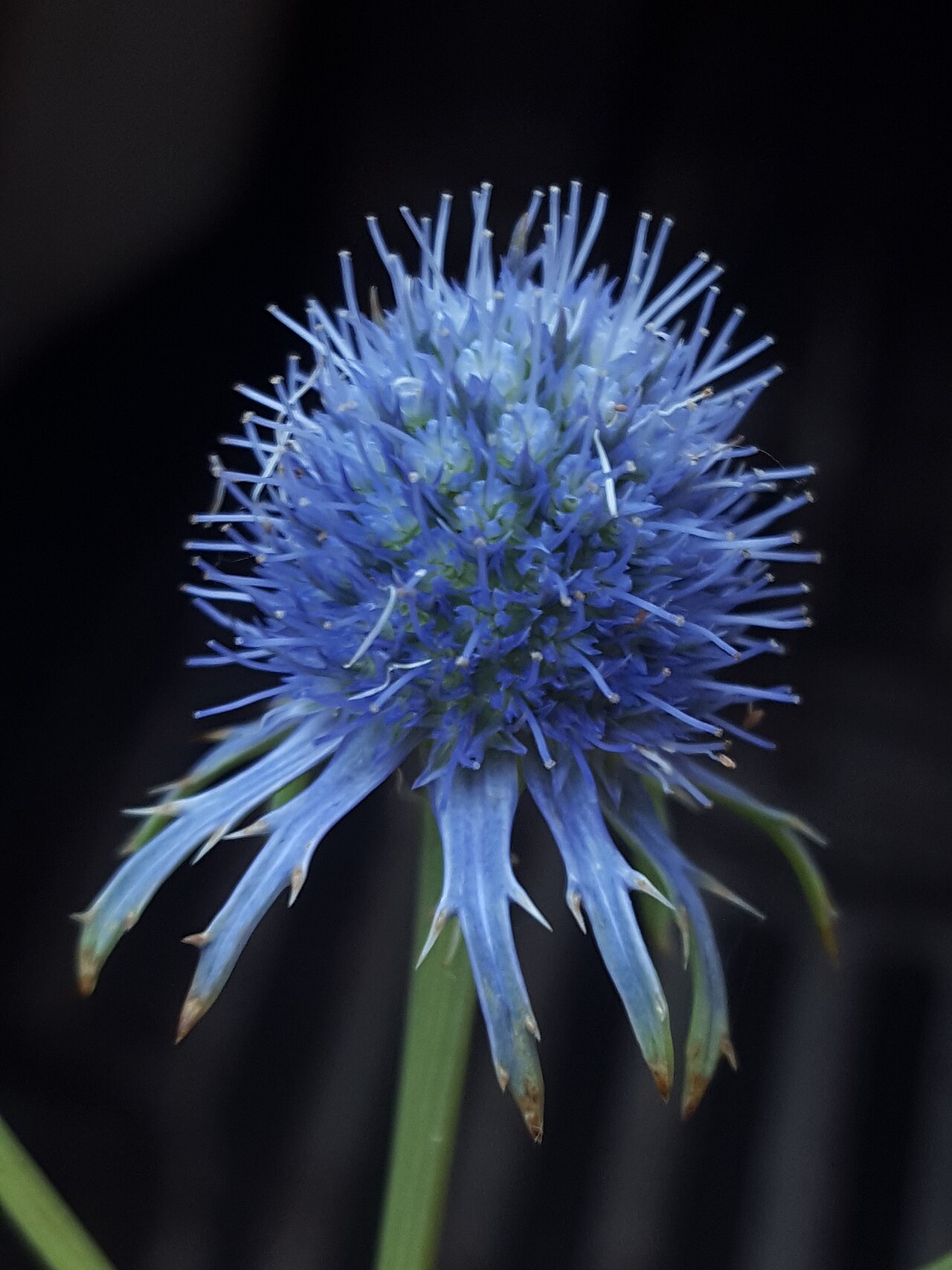
The flowers are tiny, with petals only about 2 mm long, and are packed into dense, rounded heads roughly ½ inch (1 to 1.5 cm) across. Below each head is a ring of narrow, stiff, spine-tipped bracts that spread outward and often extend beyond the head, giving it a spiky, starburst look. Heads and bracts vary from greenish white to pale lavender and deep steel blue. Flowering runs from about June into October, and in New Jersey Witmer Stone recorded it from late July into October.
Fruit & Seeds
Like other members of the carrot family, each flower produces a dry fruit (a schizocarp) that splits into two one-seeded halves. The fruits are small, about 2 to 4 mm long, and covered in scales. The heads turn brown as the seeds ripen in fall and can be collected once they are dry on the plant.
Quick Facts
| Scientific Name | Eryngium aquaticum (syn. E. virginianum, E. floridanum, E. praealtum) |
| Family | Apiaceae (carrot family) |
| Plant Type | Biennial or short-lived herbaceous perennial; wetland forb |
| Mature Height | 3–6 ft in flower |
| Mature Spread | 1–2 ft |
| Growth Rate | Moderate; rosette in the first year, flowers in a later season |
| Sun Exposure | Full sun to part shade |
| Water Needs | High; moist to saturated soil, tolerates periodic flooding |
| Soil Type | Wet sand, peaty sand, muck or loam; somewhat acidic |
| Soil pH | Acidic to near neutral (about 5.0–7.0) |
| Bloom Time | June–October |
| Flower Color | Whitish green to pale lavender or steel blue |
| Fall Color | None; flower heads and stems dry to tan or brown |
| Fruit | Small scaly schizocarp splitting into two seeds |
| Deer Resistant | Usually; the stiff, spiny leaves and bracts discourage browsing |
| USDA Hardiness Zones | 6–10 |
Native Range
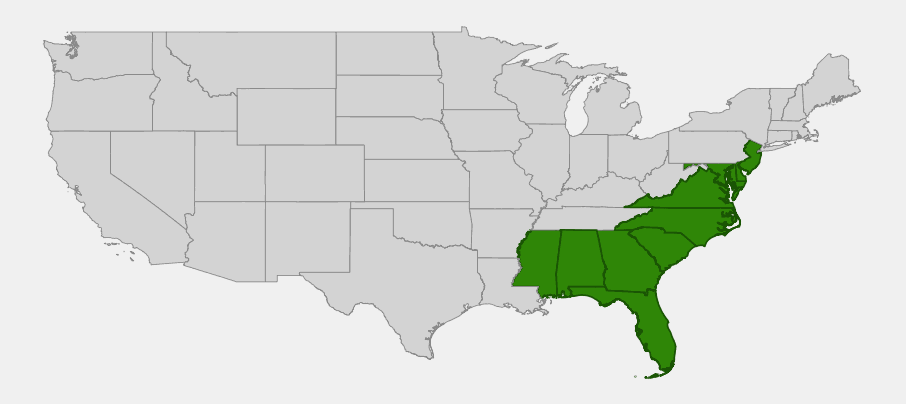
Marsh rattlesnake master is a Coastal Plain species of the eastern United States. USDA PLANTS and the Lady Bird Johnson Wildflower Center record it from New Jersey, Delaware, Maryland, the District of Columbia and Virginia south through North Carolina, South Carolina and Georgia to Florida, and west along the Gulf Coast to Alabama and Mississippi. It is not native to Canada.
It once reached farther north. Old records exist from New York, where the New York Flora Atlas now lists it as presumed extirpated, and from Pennsylvania, where it is officially classified as Pennsylvania Extirpated. Those two states are left unshaded on the map. Near the edges of its range it is uncommon: NatureServe ranks it imperiled in Delaware and critically imperiled in Mississippi, and vulnerable in New Jersey and North Carolina. Farther south, in Georgia, South Carolina, Virginia and Florida, it is a familiar plant of wet pinelands and marshes.
In southern New Jersey it grows chiefly on the coastal salt meadows and along tidal rivers, where Stone described its compound clusters of bluish, spiny heads as giving “a peculiar misty appearance at a distance.” In the Southeast it is more often found in freshwater settings: wet pine flatwoods and savannas, bogs, cypress and swamp margins, wet prairies and ditches. Florida plants have sometimes been separated as var. floridanum.
📋 Regional plant lists featuring Marsh Rattlesnake Master: North & South Florida · Alabama, Georgia & Mississippi · North & South Carolina · Maryland, Virginia & West Virginia · Delaware, Southern New Jersey & Long Island
Growing & Care Guide
Marsh rattlesnake master is an unusual, architectural plant for wet spots where few showy natives thrive. It is not hard to grow if you give it sun and steady moisture, but buy from a nursery that knows its natives, because much of what is sold under this name is actually the dry-prairie Eryngium yuccifolium. Check the leaves: the true marsh species has feather-veined, toothed leaves rather than parallel-veined, yucca-like ones.
Light
Full sun gives the strongest stems and the most flower heads. It also tolerates part shade, as at the edge of a wet woodland or among taller marsh plants, but in deep shade the stems lean and flower poorly.
Soil & Water
Grow it in soil that stays moist to wet all season: a rain garden basin, the shallow margin of a pond, a ditch, or a low spot that holds water after storms. It is adapted to soils that are regularly saturated and occasionally flooded, and it accepts wet sand, peat or heavier loam, preferably on the acidic side. Coastal populations grow in brackish marsh, so it tolerates some salt in the soil water. It does not need fertilizer, and rich soil only makes the stems floppy.
Planting Tips
Start with container plants in spring or fall, or sow seed outdoors in fall so it gets a natural cold, wet winter. The plants form a deep taproot and resent disturbance, so set them where they can stay. Space plants about 1 to 2 feet apart and place them toward the middle or back of a planting, since flowering stems reach 3 to 6 feet. They look best in a loose group among grasses, sedges and other wetland wildflowers, which help hold up the tall stems.
Pruning & Maintenance
Because individual plants are biennial or short-lived, leave some seed heads standing into winter so the plant can reseed and keep the colony going. The dry heads also add winter structure. Cut back the old stems in late winter or early spring. Wear gloves when handling the plant, because the bracts and leaf edges are prickly.
Propagation
Seed is the usual method. Collect the heads once they are brown and dry, and sow the seed in fall outdoors, or give it a few weeks of cold, moist stratification before sowing indoors in spring. Seedlings form a rosette the first year and flower in a later season. Plants can also be carefully divided in spring, and root cuttings can be taken in winter, but the taproot makes both methods less reliable than seed.
Landscape Uses
- Rain gardens and bioswales: a tall, structural accent for the wettest part of the basin
- Pond and stream margins: in the saturated zone just above the waterline
- Coastal and brackish marsh plantings: within its native Coastal Plain range, including tidal marsh edges
- Wet meadow and savanna restoration: alongside native grasses, sedges and wildflowers of wet pinelands
- Cut and dried flowers: the spiny blue heads hold their shape in fresh and dried arrangements
Wildlife & Ecological Value
Marsh rattlesnake master is not a big plant for wildlife in sheer volume, but its long, late flowering season fills an important gap in wet habitats where few other plants bloom in late summer.
For Pollinators
The Xerces Society lists it as having special value to native bees. Each head holds many tiny flowers with exposed nectar, so short-tongued bees, wasps, flies and small butterflies can all feed on it. Like other eryngos, the heads attract a wide variety of insects at once, which makes a stand of blooming plants a good place to watch pollinators in late summer.
For Birds
The plant has no special value as bird food, but the insects it draws feed wrens, warblers and other insect-eating birds in coastal marshes and wet savannas. The tall, stiff stems also provide perches in otherwise low marsh vegetation.
For Mammals
The stiff, spiny leaves and bracts make it unappealing to deer and rabbits, and mammals rarely browse it.
Ecosystem Role
Marsh rattlesnake master is part of the diverse herb layer of fire-maintained wet pine savannas and flatwoods, where frequent fire keeps shrubs from shading out sun-loving wildflowers. In coastal marshes it grows with grasses, rushes and mallows on the slightly higher, less frequently flooded ground. The USDA notes that it can carry tobacco mild green mosaic virus, but it has few serious pests.
Cultural & Historical Uses
Linnaeus named Eryngium aquaticum in 1753, describing it from Virginia. For more than a century afterward the name was used loosely, and some authors applied it to the prairie rattlesnake master, which André Michaux had named E. yuccifolium. Old books therefore list both plants as “button snakeroot,” and the nursery trade has never fully sorted them out. The marsh plant has also gone by E. virginianum and, in Florida, E. floridanum.
Several southeastern Native American peoples used the plant medicinally, according to ethnobotanical records summarized by the USDA. The Cherokee used it for nausea and the Choctaw as a remedy for snakebite, and a tea of the plant was widely used for stomach complaints. The Delaware (Lenape) used it against intestinal worms. The Alabama and Koasati used it in ceremonies as well as in medicine, and the Koasati believed it held magical power. The name “rattlesnake master” reflects the old belief that eryngo roots could cure snakebite. Do not use it this way. Rattlesnake bites need emergency medical care.
Today marsh rattlesnake master is valued mainly as an ornamental for wet gardens and as a component of wetland restoration on the Coastal Plain. Its unusual blue heads are also used in fresh and dried flower arrangements. Cut them before the flowers are fully open for the best color.
Frequently Asked Questions
How is marsh rattlesnake master different from regular rattlesnake master?
Eryngium aquaticum grows in wet Coastal Plain marshes and pinelands, has feather-veined, toothed leaves, and usually bears smaller, bluish heads with spreading spiny bracts. Eryngium yuccifolium grows in dry to moist prairies and open woods across much of the central and eastern U.S., has parallel-veined, yucca-like leaves with scattered bristles, and has larger greenish-white heads.
Is marsh rattlesnake master a perennial?
It is usually a biennial or short-lived perennial. Plants grow as a leafy rosette, flower in a later season and often die after setting seed. Leave some seed heads so it can reseed and keep the planting going.
Will it grow in standing water?
It grows best in saturated soil at the water’s edge and tolerates periodic flooding, but it should not be kept under deep standing water all season. Plant it in the shallow margin of a pond or in a rain garden basin that drains between storms.
Is marsh rattlesnake master good for pollinators?
Yes. The Xerces Society lists it as having special value to native bees, and its many small, nectar-rich flowers attract a wide range of bees, wasps, flies and small butterflies from early summer into fall.
Why can’t I find the true marsh species at nurseries?
It is less often grown than E. yuccifolium, and the two have long been mixed up. Look for wetland or aquatic plant nurseries in the Southeast or Mid-Atlantic, and check that the leaves are feather-veined and toothed rather than parallel-veined.

Looking for a nursery that carries Marsh Rattlesnake Master?
Browse our native plant nursery directory: Alabama · Delaware, Florida & Georgia · Maryland & Mississippi · New Jersey & North Carolina · South Carolina & Virginia