Smooth Cordgrass (Spartina alterniflora)
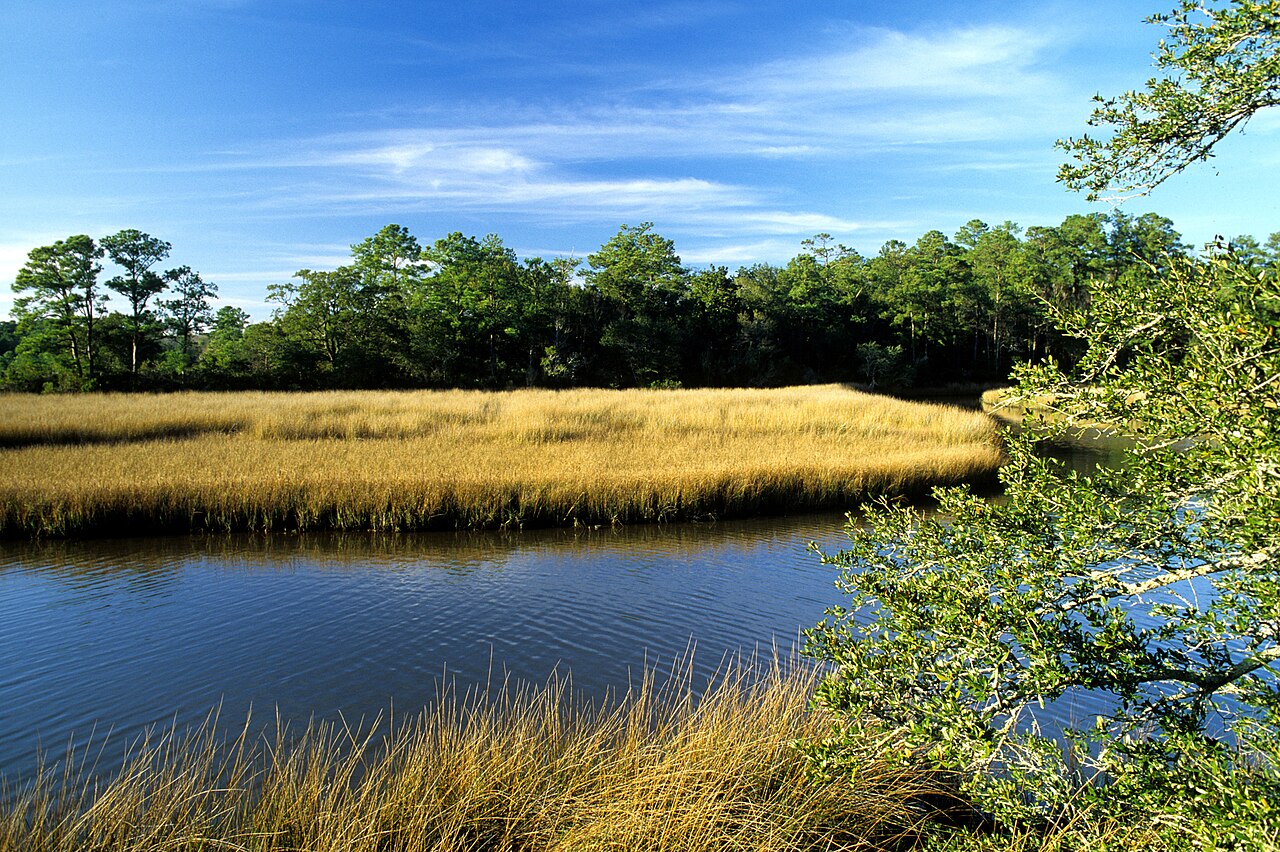
Spartina alterniflora, commonly known as Smooth Cordgrass or Saltmarsh Cordgrass, is the single most important plant in the Atlantic and Gulf Coast salt marsh — the tall, coarse grass that forms the dense, waving bands of green and gold visible at the water’s edge from Maine to Texas. It is one of the very few vascular plants able to grow rooted directly in daily tidal saltwater, and in doing so it builds and holds the marshland that protects coastlines, nurses fisheries, and filters pollutants before they reach open water.
Taxonomists have recently folded the genus Spartina into Sporobolus, so you may also see this plant listed as Sporobolus alterniflorus in newer floras and the USDA PLANTS database; both names refer to the identical native species, and older and newer sources are both correct.
A critical regional note: while Smooth Cordgrass is a foundational native species and an essential part of healthy marsh ecology along its native Atlantic and Gulf Coast range, it is not native to the U.S. Pacific Coast and has become a seriously destructive invasive species in Washington, Oregon, and California, where it was introduced accidentally and through restoration misjudgments starting in the 20th century. There, it converts open mudflats and eelgrass beds — critical habitat for shorebirds, juvenile fish, and native shellfish — into dense monoculture stands, and it is the target of active, well-funded eradication efforts. Gardeners, restoration planners, and anyone considering this plant on the West Coast should not plant it under any circumstances; this profile and its range description apply only to its native Atlantic and Gulf Coast range.
Identification
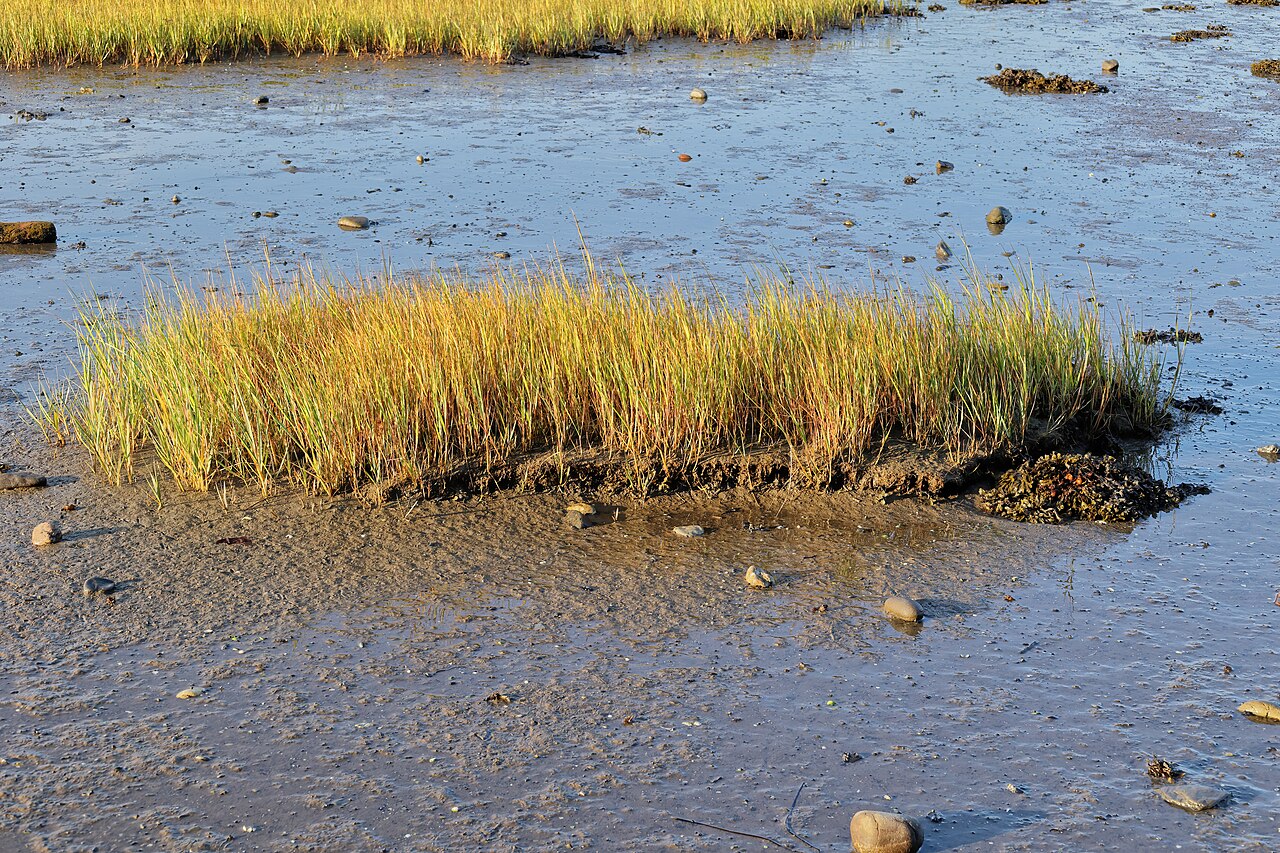
Smooth Cordgrass is identified by its tall, coarse, erect form, its distinctly two-ranked (alternating) leaf arrangement, and its habitat rooted directly in regularly flooded tidal mud.
Stems
Stems are stout, hollow, and erect, typically 3 to 7 feet tall in the tall-form marsh along creek banks, but often only 1 to 2 feet tall in a short form that grows across the higher, less-flooded marsh platform — the same species produces strikingly different statures depending on tidal flooding frequency and soil aeration.
Leaves
Leaves are long, narrow, and flat to inrolled, up to ½ inch wide and 1 to 2 feet long, arranged alternately in two ranks up the stem — giving rise to the “alterniflora” in the scientific name, which refers to the alternating arrangement of the flower spikes rather than the leaves, though the leaves show the same alternating pattern. Leaf blades are smooth (hence “smooth” cordgrass, in contrast to the hairier Saltmeadow Cordgrass, Spartina patens) and taper to a fine point, often curling inward in dry conditions to reduce water loss — an adaptation to the osmotic stress of growing in saltwater.
Flowers
The flower spikes are narrow and appressed close to a central stalk, arranged in 2 to 10 spike-like branches along the upper stem, blooming inconspicuously in mid- to late summer. The flowers are wind-pollinated and unshowy, typical of grasses, and easily overlooked against the dense green stands.
Fruit & Seeds
Seeds are small grain-like caryopses that can float and disperse on tidal currents, allowing the species to colonize new mudflat and marsh edges. Smooth Cordgrass also spreads extensively and often primarily by rhizome, forming dense, interlocking root mats that are central to its role in marsh building and shoreline stabilization.
Quick Facts
| Scientific Name | Spartina alterniflora (syn. Sporobolus alterniflorus) |
| Family | Poaceae (Grass) |
| Plant Type | Perennial Grass |
| Mature Height | 1–7 ft (tall creek-bank form to short high-marsh form) |
| Mature Spread | Spreads indefinitely by rhizome, forming dense marsh stands |
| Growth Rate | Fast, aggressive colonizer within its native tidal habitat |
| Sun Exposure | Full Sun |
| Water Needs | Wet; requires regular tidal flooding with brackish to saline water |
| Soil Type | Saturated tidal mud or silt |
| Soil pH | 6.5–8.5 (tolerant of saline, alkaline conditions) |
| Bloom Time | July – September |
| Flower Color | Green to straw-colored (inconspicuous) |
| Fall Color | Golden tan |
| Fruit | Small floating grass seed (caryopsis) |
| Deer Resistant | Yes (not a deer-browsed habitat) |
| USDA Hardiness Zones | 5–10 |
Native Range
Smooth Cordgrass is native along the Atlantic and Gulf Coasts of North America, from the Canadian Maritimes and Maine south through the mid-Atlantic and Southeast to Florida, and west along the Gulf Coast to Texas. Within this range it occupies the low to mid intertidal zone of salt and brackish marshes, typically the first vegetated zone encountered moving inland from open water.
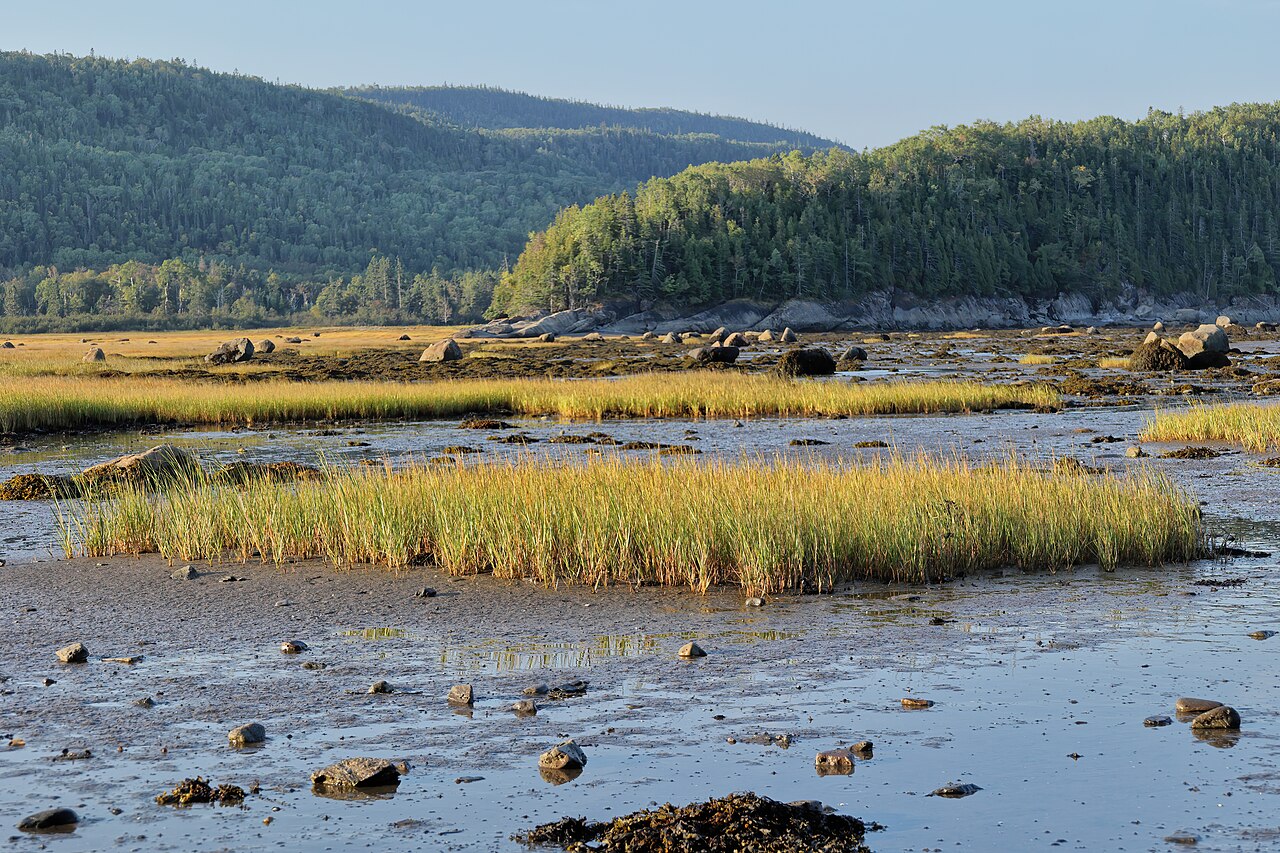
It grows rooted directly in saturated, regularly tide-flooded mud, often forming the dominant or sole vegetation in the low marsh zone closest to open water, where few other plants can tolerate the combination of daily flooding and high salinity. Farther inland, on the higher marsh platform that floods less often, it is typically replaced by Saltmeadow Cordgrass (Spartina patens) and other brackish-marsh species.
This species is not native to the Pacific Coast. In Washington, Oregon, and California, Smooth Cordgrass is a highly invasive introduced plant that aggressively converts open mudflats and eelgrass beds into dense monoculture, displacing native shorebirds, fish nurseries, and shellfish habitat. West Coast states have invested heavily in eradication programs, and this species should never be planted or intentionally spread anywhere on the Pacific Coast.
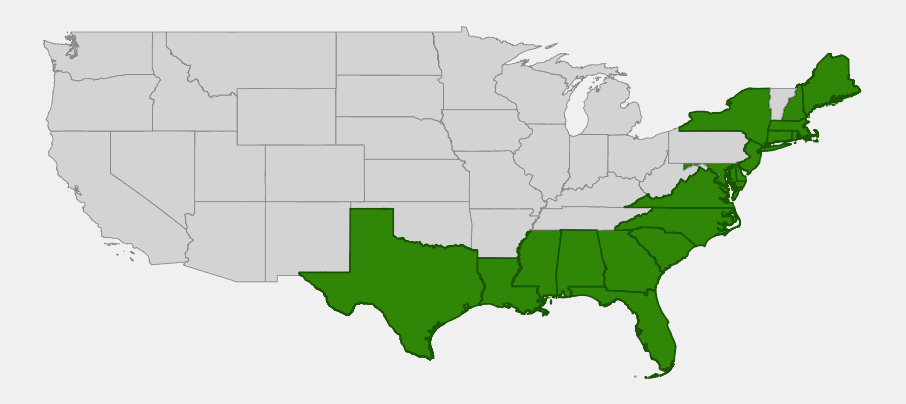
📋 Regional plant lists featuring Smooth Cordgrass: Maine, New Hampshire & Vermont · Connecticut, Massachusetts & Rhode Island · Delaware, Southern New Jersey & Long Island · Maryland, Virginia & West Virginia · North Carolina & South Carolina · Georgia, Alabama & Mississippi · Arkansas, Louisiana, Eastern Oklahoma & Eastern Texas
Growing & Care Guide
Smooth Cordgrass is not a typical garden plant — it is used almost exclusively in coastal wetland restoration, shoreline stabilization, and living-shoreline projects within its native Atlantic and Gulf Coast range, where its needs are very specific.
Light
Full sun is required; it is a plant of open tidal marsh with no tree canopy, and it does not tolerate shade.
Soil & Water
It needs saturated, regularly tide-flooded mud with brackish to full-strength seawater salinity — conditions that cannot be replicated in an ordinary garden bed. This is strictly a tidal-zone plant; it has no place in a typical rain garden or pond planting even where those are brackish, unless the project is a genuine, professionally designed tidal wetland restoration.
Planting Tips
Within its native range, Smooth Cordgrass is planted from plugs or rhizome divisions by restoration practitioners along eroding shorelines and in constructed or restored salt marshes, typically in spring, set at the correct tidal elevation for the tall or short form as appropriate to the site. This is specialist restoration work, not a home-garden project, and plantings should follow state coastal-management and permitting requirements.
Pruning & Maintenance
Established marsh stands require no maintenance; they are self-sustaining as long as tidal hydrology remains intact. Restoration plantings may need temporary erosion protection (such as coir logs) while plugs establish root systems strong enough to resist wave action.
Landscape Uses
Limited to coastal and wetland applications within its native Atlantic and Gulf range:
- Living shoreline and marsh restoration projects stabilizing eroding tidal banks
- Wetland mitigation plantings required by coastal development permits
- Estuarine water-quality buffers that filter runoff before it reaches open water
- Erosion control along tidal creek banks in professionally managed restoration sites
Wildlife & Ecological Value
Within its native Atlantic and Gulf Coast range, Smooth Cordgrass is arguably the single most ecologically productive plant on the coastline, forming the structural and nutritional foundation of the entire salt marsh food web.
For Birds
Clapper rails, seaside sparrows, saltmarsh sparrows, and willets nest and forage directly in cordgrass stands, while herons, egrets, and shorebirds hunt the fish and invertebrates that shelter among its stems and roots. The dense growth provides critical nesting cover found nowhere else in the open marsh landscape.
For Fish & Shellfish
The flooded root mat and stem base provide nursery habitat for juvenile fish, including commercially important species such as spot, flounder, and striped bass, as well as blue crabs and the fiddler crabs that burrow throughout cordgrass marshes. Ribbed mussels commonly grow attached to cordgrass stems at the base, in a relationship that helps stabilize the sediment for both species.
For Pollinators & Other Insects
As a wind-pollinated grass, it offers little floral resource for pollinators, but its stands support dense populations of planthoppers, grasshoppers, and other marsh insects that in turn feed marsh birds — an essential link in the detrital and grazing food chains of the marsh ecosystem.
Ecosystem Role
Smooth Cordgrass is a true ecosystem engineer: its dense rhizome mats trap sediment, build marsh elevation, and stabilize shorelines against erosion and storm surge, while its enormous annual production of decaying leaf litter (detritus) fuels the estuarine food web far beyond the marsh itself, exported by tides to feed organisms in adjacent bays and nearshore waters. Marshes built by this species are also significant carbon sinks, storing carbon in waterlogged peat far more effectively than most terrestrial habitats.
Cultural & Historical Uses
Coastal Indigenous peoples throughout the Atlantic seaboard, including Algonquian-speaking nations of the Northeast and Siouan and Muskogean nations of the Southeast, lived alongside extensive cordgrass marshes for millennia, relying on the fish, shellfish, and waterfowl the marshes sustained far more than on the cordgrass plant itself, which has little direct food or fiber use for humans.
Early European colonists along the Atlantic coast sometimes cut salt marsh hay — a mix of cordgrasses including this species and the finer Saltmeadow Cordgrass — for livestock bedding and rough fodder, and used dried marsh grass as insulation and thatching material in some coastal communities, a practice that persisted in scattered form into the 19th century.
Today, the plant’s primary significance is scientific and ecological rather than economic: it has become one of the most studied plants in American ecology, serving as a model system for research on salt marsh productivity, carbon sequestration, and coastal resilience, and as the signature species of large-scale marsh restoration efforts along the Atlantic and Gulf Coasts.
Frequently Asked Questions
Is Smooth Cordgrass invasive?
It depends entirely on location. Along its native Atlantic and Gulf Coast range, it is a foundational, ecologically essential native species. On the Pacific Coast (Washington, Oregon, California), it is a highly destructive invasive species that should never be planted, and active eradication programs target it there.
Can I plant Smooth Cordgrass in my home garden?
Almost certainly not. It requires regularly tide-flooded, saline mud that cannot be replicated in an ordinary yard. It is used in professional coastal restoration and living-shoreline projects, not residential landscaping.
Why is it sometimes called Sporobolus alterniflorus instead of Spartina alterniflora?
Recent genetic research led taxonomists to merge the genus Spartina into the older genus Sporobolus. Both names refer to the same native plant; USDA PLANTS and some newer references now use Sporobolus alterniflorus, while many older sources and most common usage still say Spartina alterniflora.
Why does cordgrass grow in different heights in the same marsh?
The same species produces a tall form (up to 7 feet) along better-drained, more frequently flushed creek banks, and a much shorter form (1–2 feet) on the less-flooded high marsh platform, a difference driven by soil aeration and nutrient availability rather than genetics alone.
Does Smooth Cordgrass help protect against storms and erosion?
Yes, substantially. Its dense root and rhizome mat stabilizes marsh sediment, absorbs wave energy, and helps marshes keep pace with sea-level rise by trapping sediment, which is why it is central to coastal living-shoreline and marsh restoration projects within its native range.

Looking for a nursery that carries Smooth Cordgrass?
Browse our native plant nursery directory: Mid-Atlantic & Northeast · Southeast & Gulf Coast