Zigzag Goldenrod (Solidago flexicaulis)
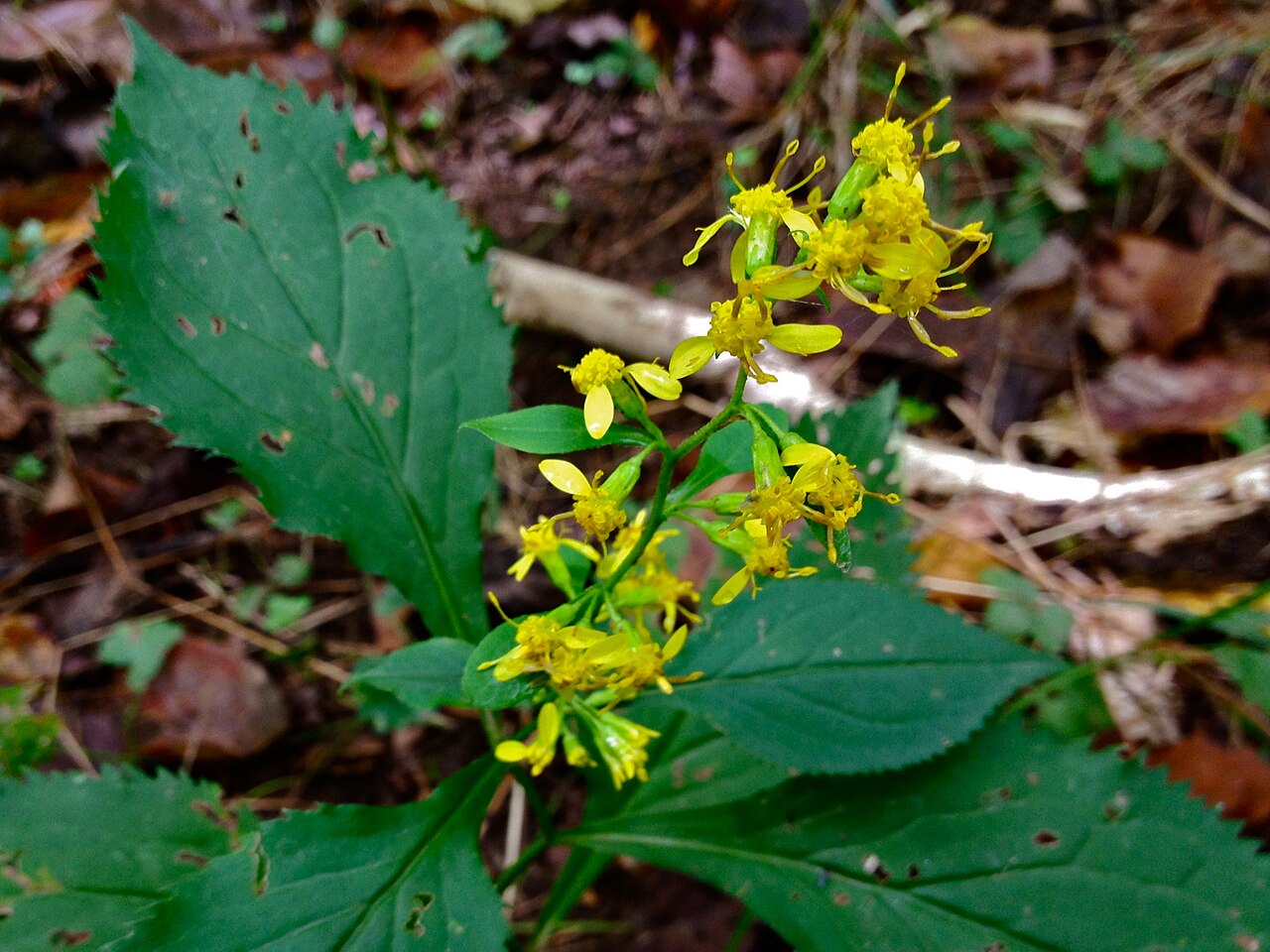
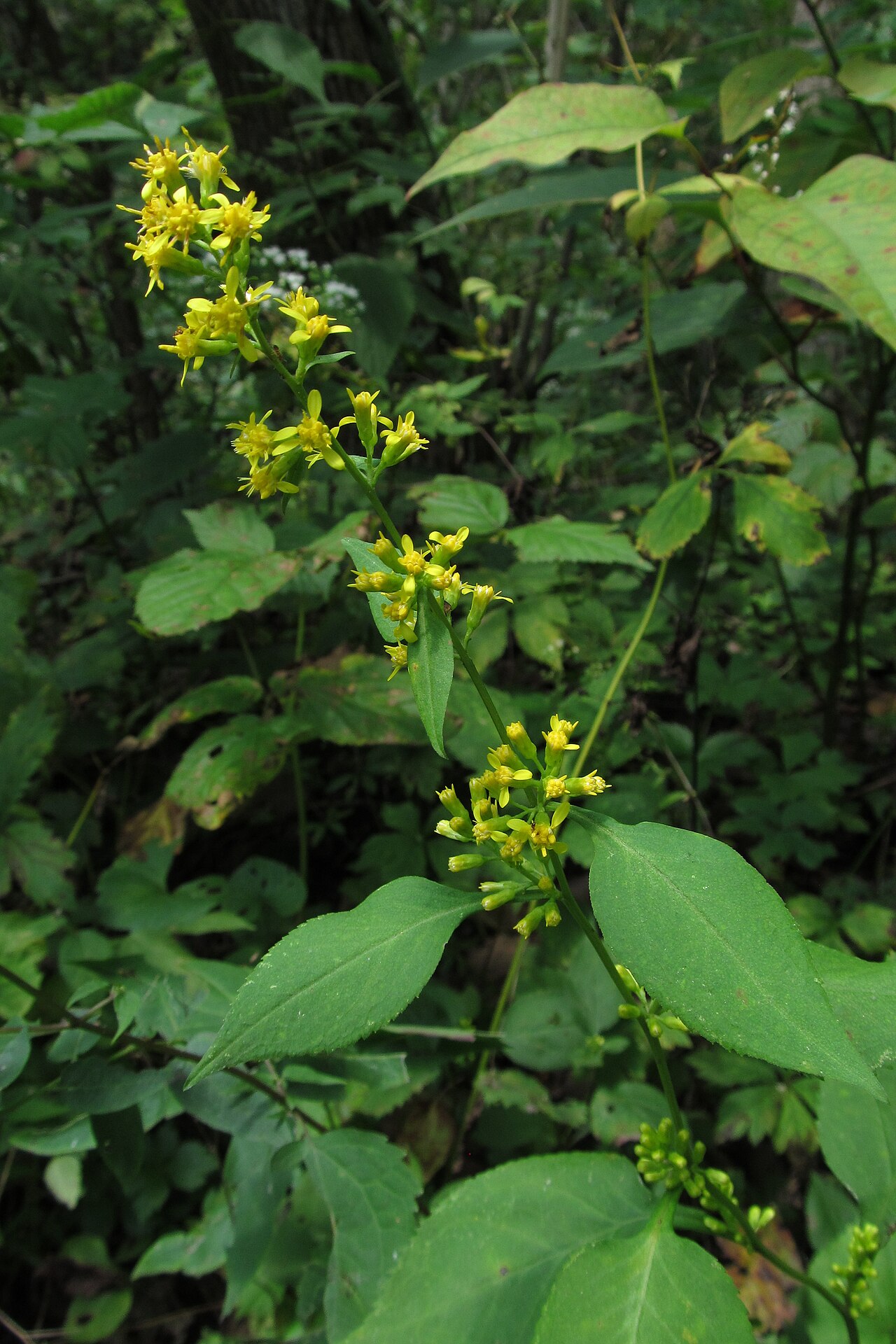
Solidago flexicaulis, commonly called Zigzag Goldenrod or Broadleaf Goldenrod, is one of the few goldenrods built for shade rather than sun. Where most of its relatives crowd meadows and roadsides, this one spreads quietly through the understory of rich deciduous forests across the eastern and upper midwestern United States and adjacent Canada. Its common name comes directly from its stem, which bends sharply at each leaf node in a visible zigzag rather than growing straight, an identification feature you can spot from several feet away once you know to look for it.
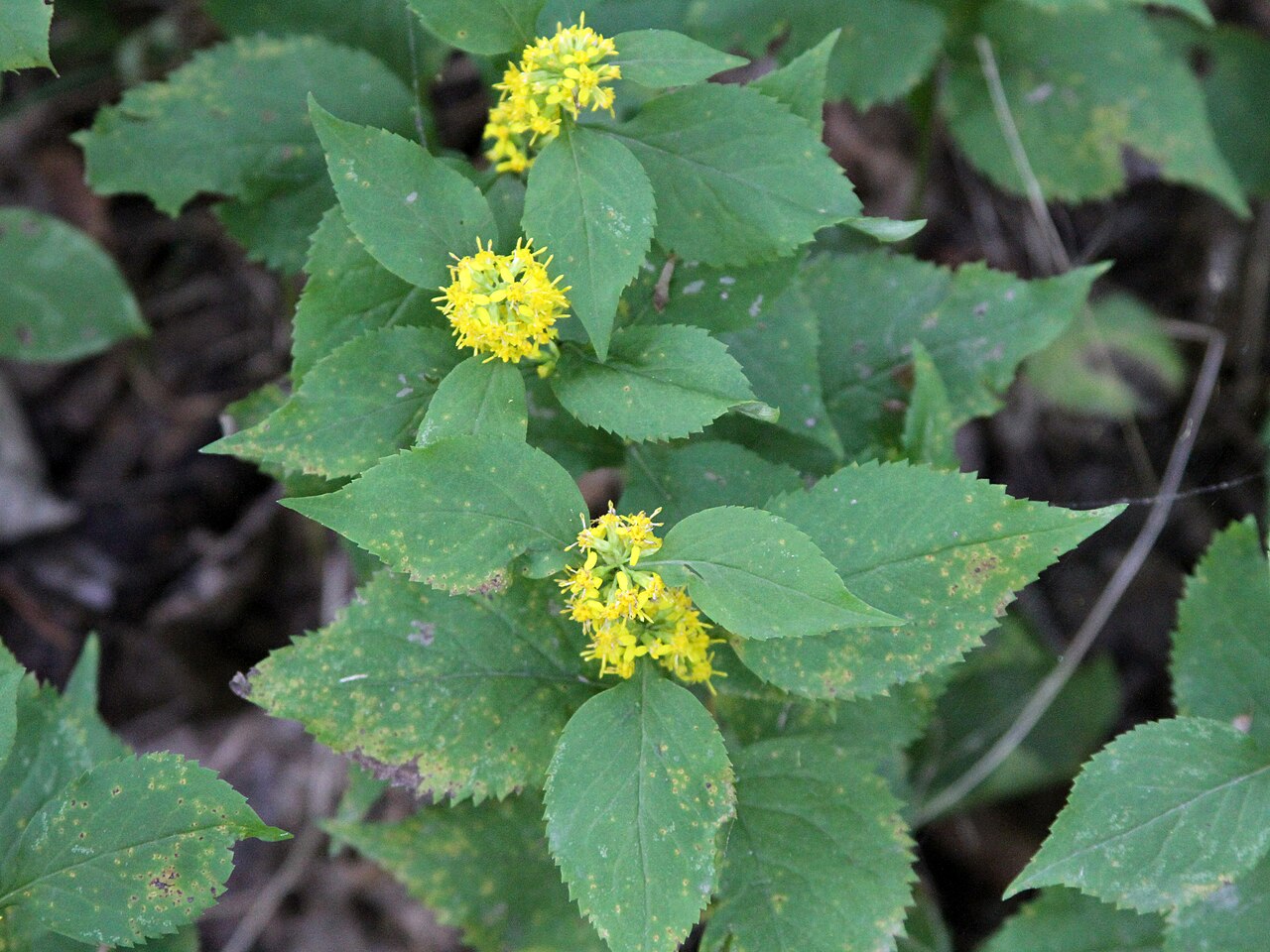
The plant forms loose colonies 1 to 3 feet tall from short rhizomes, with broad, coarsely toothed, pointed-oval leaves that look more like a nettle or wood aster than the narrow leaves of most goldenrods. In late summer and early fall, small rounded clusters of bright yellow flower heads appear in the upper leaf axils and at the stem tip, a growth habit called axillary flowering that again sets it apart from the showy terminal plumes of field goldenrods like Solidago canadensis. Because it tolerates the low light and leaf litter of a mature forest floor, Zigzag Goldenrod is a good choice for gardeners trying to add fall color to a shade garden without resorting to non-native hostas and astilbes.
Despite the word “goldenrod” in its name, this species does not deserve the hay-fever reputation that dogs the genus. Its pollen is heavy and insect-carried rather than windborne, so it is not a meaningful source of airborne allergens; that misplaced blame almost always belongs to wind-pollinated ragweed (Ambrosia), which blooms at the same time of year. In the woodland garden, Zigzag Goldenrod is instead a reliable late-season nectar source at a time when little else is flowering beneath the canopy.
Identification
Zigzag Goldenrod is most easily recognized by its stem and leaf shape before it ever flowers, which makes it a useful plant to learn for anyone doing woodland plant surveys in late spring.
Stems
The stem is the single best field mark: it angles noticeably left and right at each node, producing a visibly zigzag or crooked line from base to tip rather than growing in a straight cane like most goldenrods. Stems are slender, usually unbranched below the flower clusters, smooth to very finely hairy, and typically 1 to 3 feet tall, occasionally taller in rich, moist sites.
Leaves
Leaves are broadly oval to elliptic with a sharply pointed tip, 3 to 6 inches long, thin in texture, and coarsely and sharply toothed along the margins — a shape closer to a wood aster or nettle than to the narrow, willow-like leaves typical of sun-loving goldenrods. They are arranged alternately, taper to a short winged petiole, and have a rough, somewhat sandpapery upper surface. This broad-leaved look is also the source of the alternate common name “Broadleaf Goldenrod.”
Flowers
Small clusters of 3 to 8 bright yellow flower heads, each about ¼ inch across, bloom in tight, short-stalked clusters from the upper leaf axils, with a small terminal cluster at the stem tip. This axillary flowering pattern — clusters tucked into the leaf angles along most of the stem’s length, rather than one large showy plume at the top — is the second major identification clue. Bloom runs from late July through September depending on latitude and shade.
Fruit & Seeds
Like other goldenrods, the flowers mature into small dry seeds (achenes) tipped with a tuft of fine bristles (a pappus) that carries them on the wind, typically through October. Seed set is usually light in deep shade and heavier where the plant gets a few hours of dappled sun.
Quick Facts
| Scientific Name | Solidago flexicaulis |
| Family | Asteraceae (Aster/Sunflower) |
| Plant Type | Herbaceous Perennial Wildflower |
| Mature Height | 1–3 ft |
| Mature Spread | 1–2 ft, spreading slowly by rhizome into loose colonies |
| Growth Rate | Moderate |
| Sun Exposure | Part Shade to Full Shade |
| Water Needs | Average to Moist |
| Soil Type | Rich, humusy, well-drained forest soil |
| Soil pH | 6.0–7.5 (slightly acidic to neutral) |
| Bloom Time | Late July – September |
| Flower Color | Bright yellow |
| Fall Color | Leaves fade yellow-green before dropping |
| Fruit | Tiny bristle-tipped achenes, wind-dispersed |
| Deer Resistant | Yes, generally avoided |
| USDA Hardiness Zones | 3–8 |
Native Range
Zigzag Goldenrod is native to the eastern and upper midwestern United States and adjacent southeastern Canada, from New England and the Great Lakes states south through the Appalachians to Alabama and Georgia, and west to Iowa and Missouri. It is a true forest-interior species rather than a field plant, which separates it ecologically from most of its genus.
Within that range it grows in the understory of rich, mesic deciduous and mixed hardwood forests — the kind of mature, nutrient-rich woodland dominated by sugar maple, basswood, beech, and oaks where spring ephemerals also thrive. It favors ravines, lower slopes, and streamside terraces where leaf litter builds a deep, fertile soil, and it is often found growing alongside white snakeroot, wood asters, and ferns.
Because it depends on intact forest understory rather than disturbed ground, Zigzag Goldenrod has declined in areas of heavy deer browse and forest fragmentation, though it remains common across much of its core range. It is not considered rare or protected at the federal level, but a few states at the edge of its range track it as uncommon.
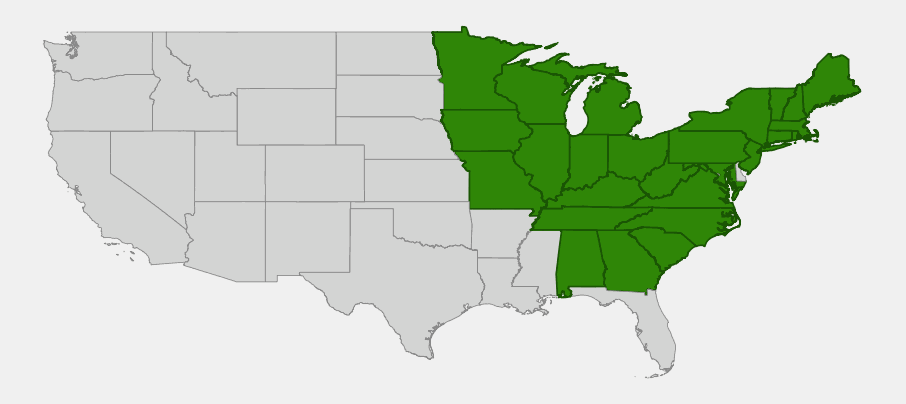
📋 Regional plant lists featuring Zigzag Goldenrod: Maine, New Hampshire & Vermont · Connecticut, Massachusetts & Rhode Island · New York, Pennsylvania & Northern New Jersey · Maryland, Virginia & West Virginia · North Carolina & South Carolina · Georgia, Alabama & Mississippi · Kentucky & Tennessee · Ohio & Indiana · Illinois, Iowa & Missouri · Michigan, Wisconsin & Eastern Minnesota
Growing & Care Guide
Zigzag Goldenrod is one of the easiest native wildflowers to grow in a shaded garden once it has the right soil, and it asks for almost nothing once settled.
Light
Give it part shade to full shade — it is a forest-floor plant, not a sun-lover, and the broad leaves can scorch in strong afternoon sun. A spot under deciduous trees that gets filtered morning light or dappled shade all day is ideal. It flowers reliably even in fairly deep shade, though bloom is fuller with a little more light.
Soil & Water
Plant it in rich, humusy soil with good drainage but consistent moisture — think of the leaf-litter-enriched soil of a mature forest floor. It does not tolerate prolonged drought or waterlogged ground equally well, so a woodland bed amended with compost or leaf mold suits it best. A 2-inch layer of shredded leaf mulch, which also mimics its natural habitat, helps retain moisture and keeps weeds down.
Planting Tips
Set out container plants or divisions in spring or fall, spacing them 12 to 18 inches apart to allow for slow rhizome spread. It pairs naturally with other shade perennials such as wood asters, foamflower, and ferns in a woodland border. Avoid planting in heavy clay without amendment, and keep it away from aggressive ground covers that can outcompete its slender stems.
Pruning & Maintenance
Little maintenance is needed. Cut spent stems back in late fall or leave them standing over winter for seed-eating birds and overwintering insects, then clear them in early spring. Divide clumps every 3 to 4 years if they become crowded or if you want to share plants, lifting and separating the shallow rhizomes in early spring.
Landscape Uses
Zigzag Goldenrod fills a niche few other native wildflowers occupy — fall color in deep shade.
- Woodland gardens as a late-season companion to spring ephemerals that have gone dormant
- Shaded borders beneath deciduous trees where sun-loving goldenrods will not bloom
- Naturalized plantings along wooded property edges and ravines
- Pollinator gardens that need a shade-tolerant nectar source for fall
- Restoration plantings in disturbed mesic forest understory
Wildlife & Ecological Value
As one of the only goldenrods adapted to deep shade, this species fills a late-season ecological gap most forest understories otherwise lack.
For Pollinators
The late-summer and fall flowers provide nectar and pollen for a range of native bees, small wasps, hoverflies, and late-season butterflies at a time when few other forest-floor plants are blooming. Because the pollen is heavy and insect-carried rather than windborne, it is a genuine resource for pollinators rather than an airborne allergen.
For Birds
Small songbirds, including native sparrows and finches, feed on the ripened seeds in fall and winter, and the foliage shelters ground-feeding insects that in turn feed woodland birds. Standing dead stems left over winter provide additional cover and foraging opportunities.
For Mammals
White-tailed deer generally avoid the foliage, which is part of why the species persists in woodlots under heavy browse pressure that has eliminated more palatable understory plants. Small mammals occasionally feed on the seeds.
Ecosystem Role
Zigzag Goldenrod’s shallow rhizomes help stabilize loose forest-floor soil on slopes and ravine edges, and its leaf litter breaks down readily, contributing to the nutrient cycling that sustains rich mesic forest soils. As a reliable indicator of relatively undisturbed, high-quality forest understory, its presence (or absence, under heavy deer pressure) is sometimes used informally by naturalists to gauge forest health.
Cultural & Historical Uses
Zigzag Goldenrod does not carry the extensive documented medicinal history of some other goldenrod species, but like many members of the genus it was known to some Indigenous communities within its eastern woodland range as a minor component of traditional plant knowledge, generally in the same broad category of uses attributed to goldenrods as a group — infusions associated with minor ailments. Specific, well-documented ethnobotanical records for this particular species are sparse compared to the widespread Canada Goldenrod, and this history should be understood as background rather than a guide to any present-day use.
The plant’s main historical significance has been botanical and horticultural: its distinctive zigzag stem and shade tolerance made it a notable curiosity among 19th- and early 20th-century American botanists cataloguing the eastern forest flora, and its broad, nettle-like leaves have occasionally led to confusion with wood nettle (Laportea canadensis) in field identification, despite the two being unrelated and the goldenrod having no sting.
In modern gardening, the species has gained attention mainly through the native-plant and ecological-landscaping movement of the past few decades, as gardeners look for shade-tolerant perennials that support local wildlife rather than relying on sterile, non-native groundcovers.
Frequently Asked Questions
Does Zigzag Goldenrod cause hay fever?
No. Its pollen is heavy and spread by insects, not wind, so it is not a meaningful allergen source. Seasonal hay fever that coincides with goldenrod bloom is almost always caused by wind-pollinated ragweed flowering at the same time.
Will Zigzag Goldenrod grow in full sun?
It can survive in a few hours of morning sun but performs best, and looks best, in part to full shade. Full, hot afternoon sun tends to scorch its broad leaves and stress the plant, unlike sun-adapted goldenrod species.
How is it different from other goldenrods?
Two features set it apart: a visibly zigzagging stem (most goldenrods grow straight), and small flower clusters tucked into the upper leaf axils rather than one large showy plume at the stem tip. Its broad, nettle-like leaves are also distinctive compared to the narrow leaves of sun-loving goldenrods.
Is Zigzag Goldenrod aggressive in the garden?
It spreads slowly by rhizome to form a loose colony over several years, but it is not considered aggressive or weedy the way some sun-loving goldenrods can be. In a shaded woodland bed it is easy to keep in bounds.
Is Zigzag Goldenrod deer resistant?
Generally yes. Deer tend to leave it alone, which is one reason it persists in woodlots where heavy browsing has removed many other native understory plants.

Looking for a nursery that carries Zigzag Goldenrod?
Browse our native plant nursery directory: Northeast & Upper Midwest · Mid-Atlantic & Plains · Southeast & Appalachians